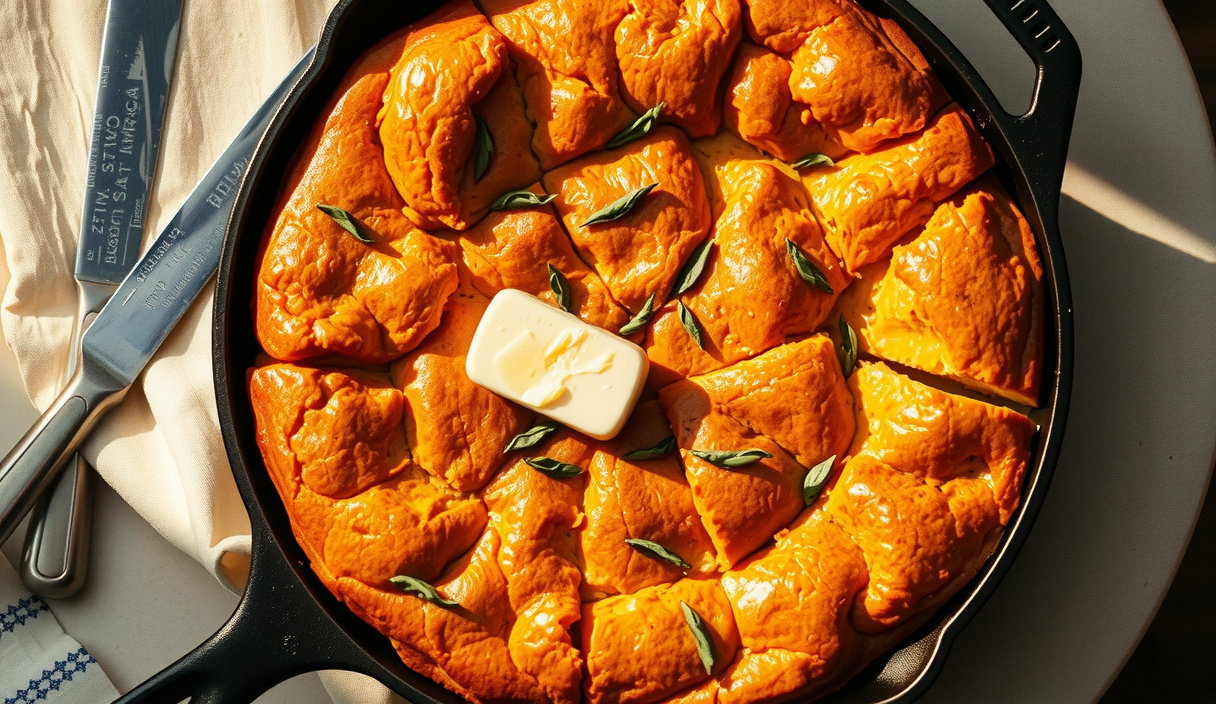
Vegan Cornbread — Aquafaba Leaven

A plant-based cornbread leavened by whipped aquafaba foam and a buttermilk analog made from oat milk acidified with apple cider vinegar. The foam replicates egg-white aeration; the acid activates baking soda for a double-leavening effect that delivers genuine lift, a custardy crumb, and a crackling cast-iron crust — no eggs, no dairy.
Equipment
- 1 10-inch cast-iron skillet Preheat inside the oven for the full 10-minute skillet preheat period for a crackling bottom crust.
- 1 Stand mixer or hand mixer with whisk attachment Must be completely free of fat residue. Wipe bowl and whisk with vinegar-dampened paper towel before use.
- 2 Two large mixing bowls
- 1 Instant-read thermometer Target 195°F internal for complete starch gelatinization.
- 1 Silicone spatula Wide, flexible head needed for efficient fold technique.
Ingredients
Oat-Milk Buttermilk Analog
- 1 cup full-fat barista-style oat milk Room temperature. Soy or cashew milk may substitute.
- 1 tbsp apple cider vinegar Raw, unfiltered preferred. Stir into oat milk and let sit 5 minutes until slightly curdled.
Dry Mix
- 1 cup medium-grind yellow cornmeal Stone-ground adds flavor; allow 10-minute hydration before folding foam if using coarse grind.
- ¾ cup all-purpose flour Spoon and level; do not pack.
- 1 tsp baking powder Verify freshness — drop a pinch in hot water; it should fizz vigorously.
- ½ tsp baking soda Reacts with the acid in the buttermilk analog.
- ¾ tsp fine sea salt
Wet Mix
- 3 tbsp refined coconut oil Melted and cooled to room temperature. Must not be warm — hot fat collapses the foam.
- 2 tbsp pure maple syrup Grade A dark for stronger flavor. Adjust to taste.
Aquafaba Foam
- ½ cup aquafaba Drained liquid from a can of unsalted chickpeas. Refrigerate at least 30 minutes before whipping. If thin, reduce to two-thirds volume and cool completely.
- ⅛ tsp cream of tartar Strongly recommended. Lowers pH, tightens protein film, dramatically stabilizes foam peaks.
Skillet
- 1 tbsp refined coconut oil or neutral vegetable oil Added to the hot skillet just before pouring batter.

Instructions
Setup
- Position a rack in the center of the oven and place the 10-inch cast-iron skillet on it. Preheat oven to 400°F with the skillet inside for at least 10 minutes. A properly preheated skillet produces an audible sizzle when the batter hits and drives immediate bottom-crust formation.
- Wipe your stand mixer bowl and whisk attachment with a paper towel dampened with white vinegar. Any trace of fat will prevent aquafaba foam from forming. Set aside.1/8 tsp cream of tartar
Make the Oat-Milk Buttermilk Analog
- Combine the oat milk and apple cider vinegar in a small bowl or liquid measuring cup. Stir briefly and let stand for 5 minutes at room temperature. The mixture will thicken slightly and may appear lightly curdled — this is the target state, indicating the pH has dropped to approximately 4.0–4.5 and the oat proteins have partially aggregated.1 tbsp apple cider vinegar
Mix Dry and Wet Ingredients
- In a large mixing bowl, whisk together the cornmeal, all-purpose flour, baking powder, baking soda, and salt until evenly combined.1 cup medium-grind yellow cornmeal, 3/4 cup all-purpose flour, 1 tsp baking powder, 1/2 tsp baking soda, 3/4 tsp fine sea salt
- Add the cooled melted coconut oil and maple syrup to the buttermilk analog and whisk to combine. Pour the wet mixture into the dry ingredients and stir with a spatula until just combined — a few streaks of dry flour are fine. Do not overmix. The batter will be thick. Set aside.3 tbsp refined coconut oil, 2 tbsp pure maple syrup, 1 tbsp apple cider vinegar
Whip the Aquafaba Foam
- Add the cold aquafaba and cream of tartar to the clean, fat-free mixer bowl. Whip on high speed for 3–5 minutes until stiff, glossy peaks form — the foam should hold its shape when the whisk is lifted and the bowl can be inverted without it sliding. Do not walk away; overwhipped aquafaba turns dry and grainy, losing its elastic film structure.1/8 tsp cream of tartar, 1 tbsp refined coconut oil or neutral vegetable oil
Fold and Bake
- Work quickly from here. Add one-third of the whipped aquafaba foam to the cornmeal batter and fold gently with a wide silicone spatula — arc from the bottom of the bowl up and over — just until incorporated. This first addition lightens the batter, making the second fold easier.1/8 tsp cream of tartar
- Add the remaining two-thirds of the foam in a single addition. Fold with 10–12 gentle arc strokes until no large white streaks remain. Some very faint streaking is acceptable — do not overfold. The batter should look aerated and slightly domed.1/8 tsp cream of tartar
- Remove the hot skillet from the oven using heavy oven mitts. Add the tablespoon of coconut oil to the skillet and swirl to coat the bottom and lower sides — it will smoke lightly. Immediately pour the batter into the skillet; it should sizzle audibly on contact. Use the spatula to spread it to the edges in one or two strokes — do not fuss with it.
- Return the skillet to the center rack and bake at 400°F for 18–22 minutes. The cornbread is done when the top is deep golden brown, the edges have pulled slightly from the sides, and an instant-read thermometer inserted into the center reads 195°F. Do not rely on the toothpick test alone — the internal temperature confirms starch gelatinization is complete and rules out a gummy crumb.
- Allow the cornbread to cool in the skillet for 5 minutes before slicing into wedges. Serve warm. Leftovers keep wrapped at room temperature for up to 2 days; reheat in a dry skillet over medium-low heat for 2 minutes per side to revive the crust.
Notes
Why aquafaba foams (and why it sometimes fails): Aquafaba contains roughly 3–5% protein by weight, predominantly legumin-type globulins and albumins in the 10–100 kDa range, along with saponins — glycosidic surfactants that reduce interfacial surface tension from ~72 mN/m (water) to approximately 40–50 mN/m. This reduction allows air bubbles to form and persist. Unlike egg albumen, aquafaba proteins do not undergo thermo-irreversible denaturation; the foam is kinetically stabilized, not thermodynamically locked. This is why fat contamination (which disrupts the saponin interfacial film), heat, and time all cause collapse. Keep everything cold and fat-free, and bake immediately.
The double-leavening mechanism: Baking soda (NaHCO₃) reacts with acetic acid from the apple cider vinegar in the buttermilk analog — generating CO₂ at room temperature on mixing. Baking powder provides a second, heat-triggered acid (sodium aluminum sulfate or monocalcium phosphate depending on the brand) that releases additional CO₂ as the oven temperature rises above 130°F. The aquafaba foam adds a third source of gas: the air mechanically incorporated during whipping. All three leavening events happen in sequence, which is why the crumb is lighter than a standard vegan batter using only baking powder.
Cornmeal Maillard kinetics: Cornmeal contains free reducing sugars (glucose, fructose, and maltose from enzymatic starch hydrolysis during milling) and free amino acids that react via the Maillard cascade beginning around 280°F surface temperature — noticeably lower than a pure wheat batter. Watch the top surface after 18 minutes. If the edges are browning faster than the center sets, tent loosely with foil for the final 5 minutes.
Internal temperature target — 195°F: Cornmeal starch granules complete gelatinization between 185°F and 195°F. Below this threshold, amylose chains remain incompletely hydrated and the crumb will be gummy regardless of how set the surface looks. An instant-read thermometer is the single most reliable doneness indicator for this recipe.
Nutrition
Calories: 185kcalCarbohydrates: 28gProtein: 3.5gFat: 7gSaturated Fat: 5.5gSodium: 310mgFiber: 1.5gSugar: 4.5g
Tried this recipe?Let us know how it was!