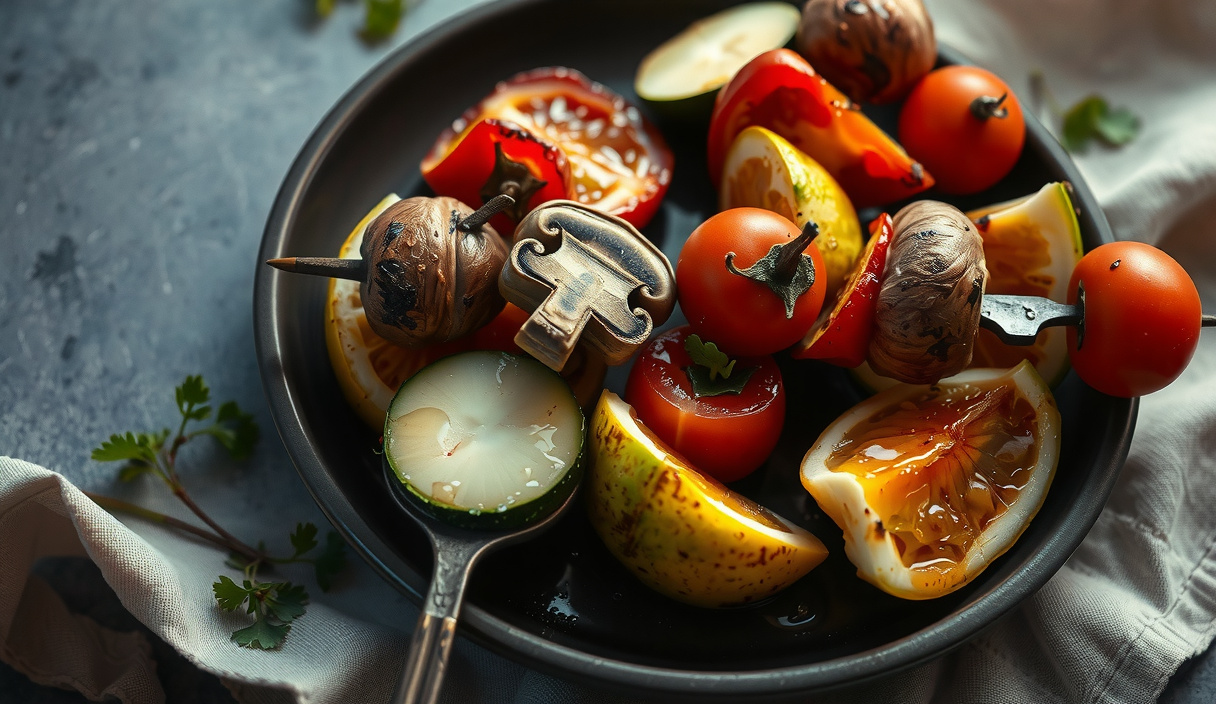
Whole-Food Smoked Veggie Skewers with Lemon-Herb Marinade

Zucchini, bell pepper, red onion, cremini mushrooms, and cherry tomatoes run a two-stage cook — 20 minutes of indirect cherry-wood smoke at 350°F to build flavor and internal tenderness, then a direct sear to develop a Maillard crust. The marinade is nothing but extra-virgin olive oil, crushed garlic, fresh lemon, thyme, rosemary, and black pepper. Zero refined ingredients. Pure whole-food BBQ.
Equipment
- 1 Charcoal or pellet grill with lid Set up for two-zone cooking — one indirect side for the smoke phase, one direct-heat side for the sear
- 2 to 3 Cherry or apple wood chunks or chips Chunks for charcoal; chips in a foil pouch for gas. Fruitwood keeps phenolic smoke deposit mild enough not to overwhelm the herbs
- 8 Flat-blade metal skewers Flat blade prevents vegetable rotation during flipping; 12-inch length accommodates a full load
- 1 Instant-read thermometer Optional but useful — target 195 to 205°F internal for onion and zucchini, 185°F for tomatoes
- 1 Large mixing bowl
- 1 Wire rack over rimmed sheet pan For resting skewers post-cook without steaming the crust
Ingredients
Vegetables
- 2 medium zucchini Cut into 3/4-inch rounds — uniform thickness ensures even cooking
- 2 large bell peppers, any color Cut into 1.5-inch squares, ribs and seeds removed
- 1 large red onion Cut through the root into 1-inch wedges, keeping the root intact to hold petals together on the skewer
- 10 oz cremini mushrooms Stems trimmed flush; leave whole — cremini density holds better than button mushrooms on a skewer
- 1 pint cherry tomatoes Thread through the equator to preserve structural integrity and delay skin rupture
Lemon-Herb Marinade
- ¼ cup extra-virgin olive oil
- 3 cloves garlic Crushed with the flat of a knife — not minced; crushing maximizes allicin and organosulfur compound generation
- 2 tablespoons fresh lemon juice From 1 large lemon; reserve the spent lemon for the finishing squeeze
- 1 teaspoon fresh lemon zest
- 1 tablespoon fresh thyme leaves Stripped from stems
- 1 teaspoon fresh rosemary Finely chopped — rosemary is assertive; do not exceed 1 teaspoon or it dominates
- 1 teaspoon kosher salt
- ½ teaspoon freshly cracked black pepper
- ¼ teaspoon red pepper flakes Optional; adds trigeminal heat without sugar or sauces
Finishing
- 1 large lemon Cut into wedges for squeezing at service — use fresh lemon here, not the marinade
- 2 tablespoons fresh flat-leaf parsley Roughly chopped; added at the last moment so the volatile terpenes survive

Instructions
Make the Marinade
- In a large bowl, combine the extra-virgin olive oil, crushed garlic cloves, lemon juice, lemon zest, thyme, rosemary, salt, black pepper, and red pepper flakes if using. Whisk briefly to homogenize the oil and juice into a loose emulsion — it will not hold permanently, but that is fine. The oil phase carries the fat-soluble herb aromatics; the aqueous acid phase carries the citric acid that will begin working on the vegetable cell walls immediately.1/4 cup extra-virgin olive oil, 3 cloves garlic, 2 tablespoons fresh lemon juice, 1 teaspoon fresh lemon zest, 1 tablespoon fresh thyme leaves, 1 teaspoon fresh rosemary, 1 teaspoon kosher salt, 1/2 teaspoon freshly cracked black pepper, 1/4 teaspoon red pepper flakes
Prep and Marinate the Vegetables
- Cut all vegetables as specified: zucchini into 3/4-inch rounds, bell pepper into 1.5-inch squares, red onion into 1-inch wedges through the root end, cremini mushrooms left whole with stems trimmed, cherry tomatoes left whole. Add all vegetables to the marinade bowl and toss thoroughly with your hands so every cut face is coated. Let sit at room temperature for 30 minutes — do not refrigerate during this window.2 large bell peppers, any color, 1 large red onion, 10 oz cremini mushrooms, 1 pint cherry tomatoes
- Thread the vegetables onto flat metal skewers in alternating order: zucchini, bell pepper, mushroom, onion wedge, cherry tomato, repeat. Leave a 1/4-inch gap between each piece — this is not aesthetic preference, it is airflow management. Reserve the leftover marinade in the bowl.2 large bell peppers, any color, 1 large red onion, 10 oz cremini mushrooms, 1 pint cherry tomatoes
Set Up the Grill for Two-Zone Cooking
- Prepare your grill for two-zone indirect cooking. For charcoal: bank coals to one side and place 2 to 3 cherry or apple wood chunks directly on the lit coals. For gas: light one or two burners on one side only and place wood chips in a foil pouch with a few holes punched in it, set over the lit burner. Close the lid and stabilize the grill temperature at 350°F — use the dome thermometer or a probe clipped to the grate level on the indirect side. Allow the wood to begin generating smoke before loading the skewers.
Smoke Phase — Indirect, 350°F, 20 Minutes
- Place loaded skewers on the indirect side of the grill — away from direct flame or coals. Close the lid. Cook undisturbed for 20 minutes. During this phase, convective heat and smoke compounds are penetrating the vegetable tissue simultaneously. The internal temperature of the zucchini and onion will climb to around 160 to 175°F, the pectin structure will soften via thermal beta-elimination, and guaiacol and syringol from the wood smoke will deposit on the moist vegetable surface. Do not open the lid repeatedly — every lid-lift drops grate temperature and disrupts the smoke envelope.
Sear Phase — Direct High Heat, 2 to 3 Minutes Per Side
- Transfer skewers to the direct-heat side of the grill. If using charcoal, the coals should still be at high heat — 450 to 500°F surface temperature. If using gas, crank the lit burners to high and allow 2 minutes to recover temperature. Sear skewers with the lid open for 2 to 3 minutes per side, turning once. You are looking for visible dark grill marks and slight char on the edges of the zucchini and onion. The cherry tomatoes will blister and their skins will tighten — this is correct. If they begin to split aggressively before the other vegetables are seared, slide them off the skewer with tongs and hold them on the indirect side.
- Total active grill time across both sides of the sear should be 4 to 6 minutes. The finished zucchini should feel tender when pressed with a finger through the skewer hole and show a dark crust on the grate-contact face. The onion wedges should be translucent at the core with charred edges. Internal temperature targets: zucchini and onion 195 to 205°F; cherry tomatoes 185°F.
Rest and Finish
- Transfer finished skewers to a wire rack over a sheet pan — not directly onto a flat plate, which would trap steam under the vegetables and soften the crust you just built. Rest for 3 minutes. Scatter freshly chopped flat-leaf parsley over the skewers. Squeeze fresh lemon wedges generously over everything immediately before serving — use fresh lemon here, not anything from the marinade bowl. The fresh squeeze delivers volatile limonene that survived no heat treatment and provides significantly brighter citrus aromatics than any pre-cooked acid.1 large lemon, 2 tablespoons fresh flat-leaf parsley
Notes
Why two-zone rather than direct grill only? Direct-heat grilling applies radiant and conductive energy simultaneously to the vegetable surface. The high surface-moisture content of vegetables (90–94% water) means that evaporative cooling will anchor the surface temperature at or near 212°F — the boiling point of water — until enough moisture has driven off. By spending 20 minutes at 350°F indirect first, you allow the vegetable interior to reach 160–175°F and the surface to lose much of its free water via gentle convective drying. When the skewer moves to the direct-heat sear, the drier surface can immediately access the 300–350°F threshold required for the Maillard amino-carbonyl browning cascade. This is the identical physics principle that explains why patting a steak dry before searing produces a dramatically superior crust.
What the smoke is actually doing: At 350°F, wood lignin undergoes pyrolysis, generating guaiacol, 4-methylguaiacol, and syringol — the three dominant phenolic volatile compounds responsible for the perception of "smokiness." These compounds are hydrophilic enough to deposit on the cool, moist vegetable surface but lipophilic enough to be retained and re-released into the headspace during the sear. A 20-minute exposure at 350°F in a closed-lid environment delivers meaningful smoke-compound deposition without the acrid, over-smoked phenolic overload you risk at high temperatures with dense woods like hickory or mesquite.
The garlic-crush chemistry: Crushing a garlic clove ruptures the cell walls and brings the enzyme alliinase into contact with its substrate alliin. Within 30 to 60 seconds, allicin is formed — the primary organosulfur compound responsible for garlic's complex aromatic signature. Mincing generates allicin too, but minced garlic cooked in hot oil at high heat loses much of its allicin quickly as it converts to more volatile thiosulfinates that evaporate. Crushed cloves left in the oil during marinating create a slower, more sustained release of sulfur compounds that penetrate the vegetable tissue and survive into the finished dish.
Pectin and the acid marinade: Lemon juice drops the local pH at the vegetable surface to approximately 4.0 to 4.5 during the marinating window. At temperatures below roughly 140°F (during the room-temperature marinate phase), this activates pectin methylesterase — a native enzyme in plant cell walls that de-esterifies pectin chains and, in the presence of ambient calcium ions in the vegetable tissue, creates calcium cross-links that temporarily firm the cell wall structure. This is why acid-marinated vegetables hold their shape better on a hot grill than unmarinated ones, and it is the same principle that makes a tomato firmer when stored in cooler, more acidic conditions.
Nutrition
Calories: 148kcalCarbohydrates: 14gProtein: 4gFat: 9gSaturated Fat: 1.3gSodium: 310mgFiber: 4gSugar: 8g
Tried this recipe?Let us know how it was!