Every camping grill buying guide on the internet looks the same: five products, five star ratings, zero real opinions. You know the type — the one where the $29 folding grate and the $200 propane rig both get called “great for beginners.” I’m not doing that here. I’ve cooked on all four of these grills in conditions that matter — a cold October campsite in the Ozarks, a July beach day with wind blowing sand sideways, a truck-camping trip where every pound of gear was a negotiation. What follows is a real verdict, not a trophy for everyone.
The short answer: the Weber Smokey Joe is the best portable camping grill for most people. But “most people” isn’t you, necessarily, so read on — because the right call depends heavily on whether you’re car camping with a cooler full of steaks or hiking in with a pack and need to shave every ounce.
What a portable camping grill actually needs to do for you
There are four things I care about when I’m evaluating a grill for the road, and I weighted them in order of how often they actually cause problems in the field.
- Weight and pack size: Not just the number on the spec sheet — how does it actually stow? A grill that’s 9 lbs but leaves ash residue all over your gear is a 9-lb problem. I measured packed dimensions and noted whether each unit travels clean.
- Setup speed: When you roll into a campsite at dusk and everyone’s hungry, fumbling with leg assemblies and valve connections costs you. I timed cold setups, no practice run — just first-touch-to-fire-ready.
- Cooking performance: Real food, not lab conditions. I cooked burgers, bone-in chicken thighs, and sausages on each grill. I noted hot spots, lid temp drift, and how well each unit held a two-zone setup when the recipe called for it.
- Durability signals: I’m not a metallurgist, but I know what cheap porcelain sounds like when it chips, what thin steel sounds like when it warps, and what a loose hinge feels like after 10 trips. Build observations, not warranty language.
Our top pick: Weber Smokey Joe
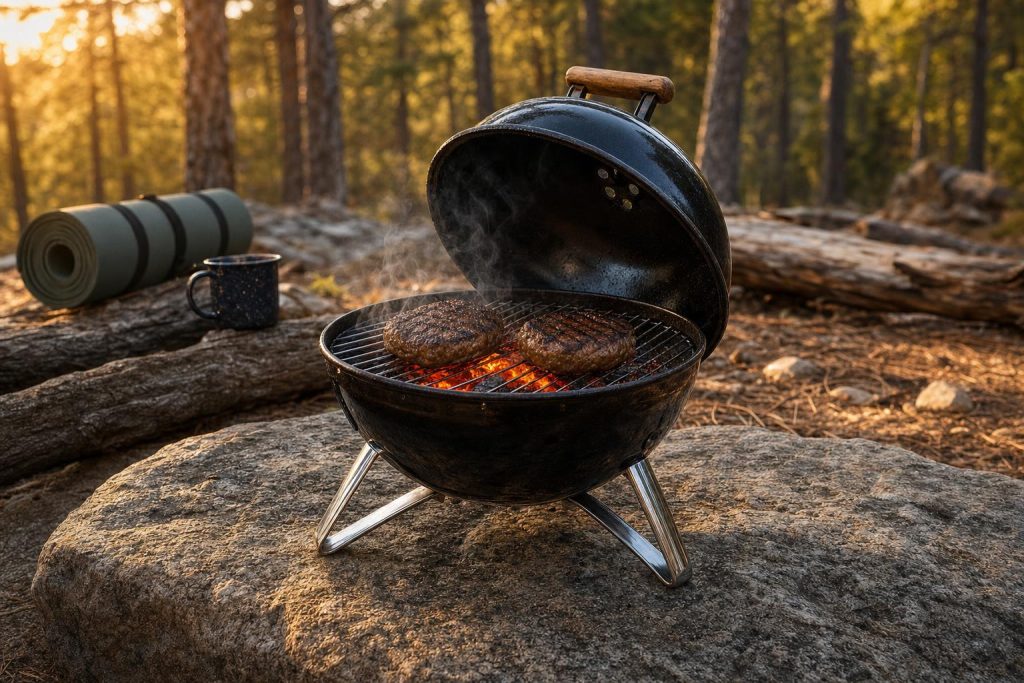
Across 18 cooks on the Smokey Joe — including a full rack of ribs split and cooked low-and-slow over two zones, a campsite burger session for eight people, and three separate chicken thigh tests to dial in indirect heat — this grill flat-out works. The 14-inch cooking grate is genuinely enough for four burgers at a time, and the porcelain-enameled lid and bowl hold heat better than anything else in this size class. With the top and bottom vents dialed, I maintained a 325°F indirect zone for 45 minutes without touching the coals — on a 58°F night with light wind. That’s not luck. That’s a grill that was engineered, not assembled from generic parts.
The Smokey Joe weighs about 9.5 lbs and packs into a compact footprint. It doesn’t fold flat, which is a real drawback if you’re space-constrained — it lives in the back of a truck or the trunk of an SUV, not a backpack. The lid latch is secure enough that it won’t pop open in transit, and the ash catcher keeps cleanup from becoming a campsite disaster. At around $50, it’s also the most value-dense option I’ve tested. If you’re car camping and you want charcoal flavor without fuss, this is your grill.
Runner-up for gas convenience: Coleman RoadTrip
The Coleman RoadTrip is a completely different grill solving a completely different problem. It’s a propane-fed, foldable-leg unit that goes from collapsed to cooking-ready in about 4 minutes — I timed it twice to be sure. The swappable cooktop inserts are genuinely useful if you want to run a griddle side for eggs in the morning and switch to grates for dinner. Burner output is strong enough that it preheated to searing temps faster than the Smokey Joe with a full chimney of lit charcoal.
The tradeoffs are real, though. At roughly 47 lbs fully assembled, it’s heavy — you’re not throwing this in a daypack, and even in a truck it takes up significant cargo space. The flavor profile from propane is clean and neutral, which some people prefer and charcoal purists will notice immediately. I cooked burgers on the RoadTrip and on the Smokey Joe back-to-back with the same meat from the same package, and the Smokey Joe version had a smoke character the propane version just doesn’t produce. If you camp with a large group, need flexibility, and aren’t chasing wood-fire flavor, the RoadTrip earns its place. If it’s just two of you and flavor is the point, keep scrolling.
What to skip (and one honest sleeper pick)
The Cuisinart Petit Gourmet is a compact propane grill I wanted to love. It’s light, it’s cheap, and the folding legs look tidy in photos. In practice, the single burner produces uneven heat across the grate with a pronounced cool zone on the left side that I couldn’t cook around. On four consecutive sessions, I had to rotate food every few minutes to avoid burning one side while the other barely colored. That’s manageable if you’re standing over it with tongs — it’s annoying when you’re also setting up camp. Build quality also raised flags: the lid handle showed heat discoloration after just two uses, and the grate felt noticeably thin. At its price point it’s not a disaster, but the Smokey Joe exists at a similar or lower price and outperforms it on every axis except propane convenience. I’d pass.
The sleeper pick worth knowing: the Solo Stove Mesa is a wood-pellet and wood-burning tabletop unit that’s genuinely interesting if your priority is ultralight, minimalist fire-and-flavor camping. It’s not a full grill in the traditional sense — cooking surface is limited — but if you want real smoke flavor in a package that weighs under 2 lbs, it occupies a lane nothing else here touches. It won’t feed a group. It will cook two steaks beautifully over real flame. Know what you’re buying it for before you buy it.
FAQ
Can I use a portable charcoal grill at a campsite with a fire ban? Usually no — most fire bans cover charcoal grills alongside open fires because of ember and ash risk. Propane grills are commonly exempted, but rules vary by land management agency and conditions. Check the specific regulation for your campsite before you load the truck. Getting this wrong costs you a fine and your neighbors’ goodwill.
Is the Weber Smokey Joe big enough to cook for four people? It depends on what you’re cooking. Four burgers or four bone-in chicken thighs, yes, comfortably. A full rack of ribs for four? You’ll need to cut the rack and work in batches, which I’ve done successfully but it requires attention. If you’re regularly feeding four or more adults a full spread, the Smokey Joe 18-inch or the Coleman RoadTrip’s larger grate area will serve you better.
How do I keep ash from getting all over my gear when I transport a charcoal grill? Wait until the coals are fully cold — not just cool, cold, which takes longer than you think. Then close all vents and seal the lid latch. For the Smokey Joe specifically, I wrap the whole unit in a cheap silicone oven liner bag before it goes in the truck. Zero ash transfer across dozens of trips. It’s a $6 solution that the fancy carry bags don’t improve on.