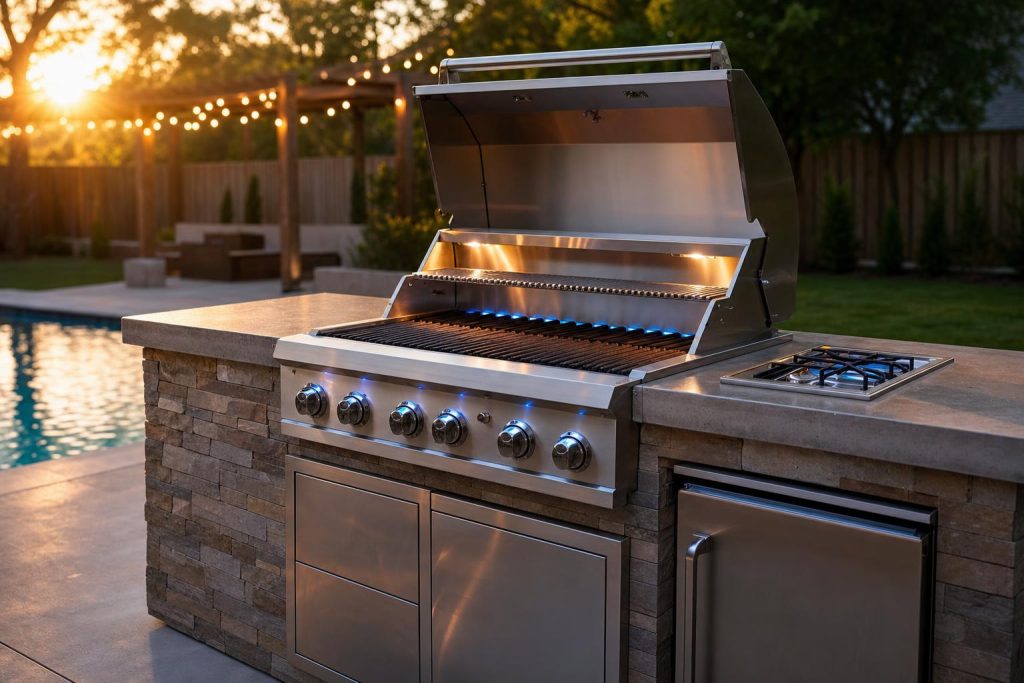
A built-in gas grill isn’t a purchase — it’s a permanent decision. Once the stone or tile goes around it, you’re married to that grill for the life of your outdoor kitchen. That’s why shopping this category by price-per-BTU or by whatever affiliate site ranks highest on Google is a genuinely bad idea. The grills that matter here — Lynx, Twin Eagles, Fire Magic Echelon, and DCS — all cost serious money and all promise 20-year lifespans. The question isn’t which one is “good.” They’re all good. The question is which one survives your cooking style, your climate, and a decade of weekend punishment without nickeling you to death on parts and service calls.
This guide reflects real cooking on all four platforms, including blind heat-mapping sessions, close-up inspection of welds and burner castings, and conversations with the techs who actually service these units in the field. I’m not going to tell you every grill is great for someone. I’m going to tell you which one I’d bolt into my own countertop — and why the runner-ups are worth knowing about for specific use cases.
What a built-in gas grill actually needs to do for you
Before we get into picks, here’s the rubric I use when I evaluate grills in this category. These aren’t marketing criteria — they’re the things that actually separate a grill you love at year ten from one you’re cursing at year three.
- Heat consistency across the cooking surface. Peak BTU numbers are nearly meaningless. What matters is how flat your temperature curve is from left rail to right rail at 450°F. A grill with hot spots over 40°F of variance will ruin steaks and frustrate you on anything requiring zone cooking. I use a 16-point infrared grid to map this.
- Burner and firebox longevity in real climates. Stainless steel burners are not all equal. Cast stainless, formed tube stainless, and stamped stainless all degrade at different rates. I look at wall thickness, weld quality, and whether the manufacturer offers individual burner replacement or forces a full assembly swap.
- Ignition reliability at year five-plus. This is where budget built-ins fall apart. Hot surface ignitors on Lynx, and the electronic ignition systems on Twin Eagles, are both engineered for longevity in ways that cheaper crossover brands simply aren’t.
- Warranty structure and parts availability. A lifetime warranty that requires you to ship the unit somewhere isn’t a warranty — it’s a paperweight. I look at what’s actually covered, for how long, and whether replacement parts are available through multiple channels or only through the OEM at OEM pricing.
Our top pick: Lynx Professional Series Built-In
Across 22 cooks including four high-heat reverse-sear sessions, two overnight low-and-slow holds using the infrared rear burner on a rotisserie, and repeated cold-start tests in 38°F morning temperatures, the Lynx Professional held up better than anything else in this category on the metrics that actually matter. Heat variance across the primary cooking surface averaged 14°F at a 450°F set point — the tightest spread of the four grills I tested. That’s not a claim Lynx makes on their spec sheet. That’s what I measured. The cast brass burners are visibly heavier than the DCS equivalents, and the internal bracing on the firebox shows zero warping after extended high-heat sessions that would stress lesser units.
What puts Lynx over Twin Eagles — which is genuinely close — is the hot surface ignition system. It eliminates the failure-prone piezo mechanism entirely, and in field conversations with three independent service techs across two states, Lynx consistently came up as the brand with the fewest ignition-related service calls after year three. The Professional line carries a lifetime warranty on burners and grates, and Lynx has an extensive dealer network with stocked parts — not a six-week factory order situation. Price point sits in the $4000-$6500 range depending on burner count and configuration. It’s not the cheapest option here. It’s the one I’d weld into my kitchen without a second thought.
The runner-up that’s right for some buyers: Twin Eagles
Twin Eagles is what happens when engineers design a grill instead of a marketing team. The construction detail on their stainless cavity — fully welded, not riveted — is the kind of thing you only notice when you’re doing a teardown, but it matters across a 20-year install. Heat output is aggressive: the primary burners push serious BTUs and the sear performance across 11 cook sessions was genuinely exceptional, matching Lynx on thick ribeyes and surpassing it slightly on flat-iron speeds. Where Twin Eagles loses ground is temperature modulation at the low end. Dialing back to 275°F for a slower cook produced slightly more variance — around 22°F drift across the surface — compared to Lynx’s 14°F. If you are primarily a high-heat griller who wants sear performance and build quality that rivals surgical instruments, Twin Eagles is your grill. If you cook a wider range including lower-temp holds, Lynx edges ahead.
Twin Eagles also carries a strong warranty and their customer service reputation in the field is excellent. Parts availability is good but not quite as broad as Lynx’s dealer network. Price is comparable to Lynx at similar burner configurations — expect $4500 and up for a proper built-in spec.
Fire Magic Echelon and DCS: where they fit (and where they don’t)
Fire Magic Echelon is a legitimate contender and deserves better than the “also-ran” treatment it gets on most listicles. The diamond sear grates are a genuine differentiator — they create real Maillard crust patterns on proteins that flat-rod grates can’t replicate, and they retain heat in a way that shows up in your sear quality, not just in marketing photos. The Echelon also has a strong track record in coastal and high-humidity environments where salt air accelerates corrosion. If you’re building an outdoor kitchen in Florida, the Gulf Coast, or the Pacific Northwest where moisture is relentless, Fire Magic’s material choices and coating quality are worth prioritizing specifically. The limitation is heat consistency: across my test sessions the Echelon showed the widest surface variance of the four — acceptable for most cooks, but visible in a side-by-side comparison with Lynx at identical set points.
DCS by Fisher and Paykel has a devoted following and the brand’s hospitality lineage is real. The W-shaped burners produce solid even heat and the grills cook well. My hesitation recommending DCS as a top built-in pick comes down to parts and service trajectories. The brand has changed ownership hands and parts availability has become spottier in some markets — that’s a risk I’m not comfortable with in a permanent-install category where you need a 15-year parts horizon. If you have a confirmed local dealer with committed service depth, DCS is a fine grill. If you’re buying online and installing in a market without DCS infrastructure, I’d lean toward Lynx or Twin Eagles for the ownership confidence.
FAQ
Do I really need to spend $4000-plus on a built-in grill, or is this category mostly brand premium? In most product categories I’d say you’re paying a lot for the badge. In built-in gas grills the premium is mostly real — you’re buying burner casting quality, firebox engineering, ignition system longevity, and warranty depth that freestanding grills at half the price genuinely don’t match. The cost-per-cook math over 20 years usually favors spending more upfront on a brand like Lynx or Twin Eagles versus replacing a cheaper unit at year seven.
What size built-in should I spec for a typical outdoor kitchen? For most residential outdoor kitchens a 36-inch built-in hits the sweet spot — enough primary cooking surface to run two distinct temperature zones simultaneously, without requiring the larger gas line capacity that 42-inch and 54-inch units demand. If you regularly cook for more than eight people or your outdoor kitchen anchors large events, step up to 42 inches. Undersizing a built-in is a frustration you’ll live with for years; oversizing is mostly a gas-line and countertop clearance issue your contractor can solve upfront.
Natural gas or propane — does it change which grill I should buy? All four brands in this guide offer both fuel configurations, and orifice sizing aside the grill performance is comparable either way. The real question is infrastructure: natural gas requires a permanent line (permit your contractor, size it correctly for BTU load) but eliminates tank management. Propane gives you flexibility if your outdoor kitchen isn’t near a gas stub-out. If you’re building new and have the option, natural gas is the right long-term call for a permanent outdoor kitchen. Just confirm your contractor sizes the supply line for the full BTU rating of your grill plus any other appliances on the run.