Pellet-Smoked King Salmon (Dry-Cured, Albumin-Free Method)

Equipment
- 1 Pellet grill Capable of a stable 180°F setting; Super Smoke or low-smoke mode preferred. Alder, cherry, or apple pellets loaded.
- 1 Leave-in probe thermometer Wireless preferred; insert into the thickest point of the loin before the fillet goes on the grill.
- 1 Wire cooling rack For pellicle development; allows airflow under the fillet during the uncovered refrigerator rest.
- 1 Rimmed baking sheet Lined with plastic wrap for the cure stage; holds the fillet flat and contains moisture drawn out by the salt-sugar mixture.
- 1 Needle-nose pliers For pin bone removal prior to curing. Pull in the direction of each bone’s natural angle.
- 1 Small desk fan (optional) Directed at the fillet during refrigerator air-dry; reduces pellicle development time from 90 minutes to approximately 45 minutes.
Ingredients
Salmon
- 2.5 lbs King salmon fillet, skin-on, pin bones removed Center-cut preferred; wild Alaskan Chinook or farm-raised New Zealand King both work. Avoid thin tail sections for this method.
Dry Cure
- 3 tablespoons Diamond Crystal kosher salt If using Morton’s kosher salt, reduce to 2.5 tablespoons — Morton’s has a higher bulk density and the ionic load will be greater by volume.
- 1 tablespoon granulated white sugar White sugar is used rather than brown to prevent hygroscopic molasses compounds from slowing pellicle formation.
- 1 teaspoon freshly cracked black pepper Optional; contributes piperine-forward aromatic complexity to the pellicle layer.
For Smoking
- 1 tablespoon neutral oil (avocado or refined sunflower) For oiling the grill grates to prevent sticking. Do not apply oil to the fillet — it will impede smoke adhesion to the pellicle.
- 2 cups alder, cherry, or apple wood pellets Loaded into the pellet hopper. Do not use hickory or mesquite at this temperature — they generate harsh phenolic compounds that overwhelm salmon fat.

Instructions
Cure the Salmon
- Remove any remaining pin bones from the salmon fillet using needle-nose pliers. Run your fingertip along the lateral line of the flesh side to locate them; pull each bone in the direction of its natural angle to avoid tearing the myotome structure.
- Combine the kosher salt, granulated white sugar, and cracked black pepper in a small bowl and mix thoroughly.1 tablespoon granulated white sugar, 1 teaspoon freshly cracked black pepper
- Line a rimmed baking sheet with plastic wrap. Lay the salmon fillet skin-side down. Apply the cure mixture evenly across the entire flesh side, pressing gently so it adheres. Do not apply cure to the skin. The cure layer should be even and approximately 1/8-inch thick — not packed on, not sparse.1 tablespoon granulated white sugar, 1 teaspoon freshly cracked black pepper
- Loosely cover the fillet with plastic wrap and refrigerate for exactly 4 hours. Do not exceed 5 hours for a 2.5-pound fillet — extended cure times increase ionic penetration depth, producing an uncomfortably salty interior and a firmer, more compressed texture than intended. Set a timer.
Rinse and Develop the Pellicle
- After 4 hours, remove the fillet from the refrigerator. Rinse thoroughly under cold running water, removing all visible cure residue from both the flesh and skin sides. Pat dry with paper towels — both sides, firmly.
- Place the fillet skin-side down on a wire rack set over a clean baking sheet. Refrigerate uncovered for a minimum of 45 minutes, ideally 90 minutes. If using a small desk fan, direct it at the flesh side of the fillet to accelerate surface drying. The fillet is ready when the surface feels distinctly tacky and slightly leathery to the touch — not wet, not shiny. A wet fillet cannot develop proper smoke adhesion and will weep albumin during the cook.
Smoke the Salmon
- Preheat your pellet grill loaded with alder, cherry, or apple pellets to 180°F. If your grill has a Super Smoke or low-smoke mode, activate it — these modes oscillate the auger to maximize smoke output at low temperatures. Allow the grill to reach and stabilize at 180°F for at least 15 minutes before the fillet goes on. Verify temperature with an independent grill thermometer if possible, as pellet grills frequently read 10–15°F warmer than actual grate-level temperature.2 cups alder, cherry, or apple wood pellets
- Oil the grill grates lightly with neutral oil using a folded paper towel held with tongs. Do not oil the fillet itself — surface oil impedes smoke compound adsorption to the pellicle.1 tablespoon neutral oil (avocado or refined sunflower)
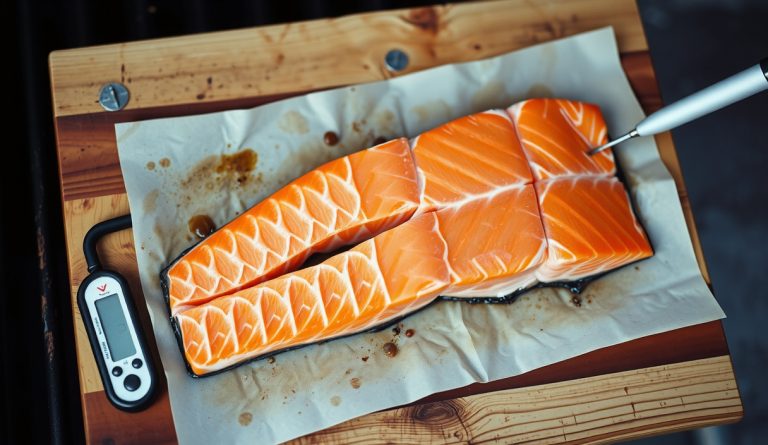
- Place the fillet on the grill skin-side down. Insert the leave-in probe into the thickest point of the loin at a shallow angle, with the tip positioned at the geometric center of the muscle mass. Close the lid. Do not open the lid during the first 60 minutes of the cook.
- Smoke the fillet at 180°F until the internal temperature reaches 130°F at the thickest point of the loin. For a 2.5-pound center-cut King salmon fillet, this typically takes 90 to 120 minutes at 180°F ambient. Begin checking the probe reading at 75 minutes. Watch for the flesh-side color transition from translucent deep coral to opaque lighter pink progressing inward from the edges — when the center retains a slightly translucent, jewel-like quality and the probe reads 125–128°F, begin monitoring closely for carryover.
- Remove the fillet from the grill when the probe reads 128–130°F. Transfer to a cutting board or serving platter and rest uncovered for 5 to 10 minutes. Do not tent with foil — trapped steam will soften the pellicle and reintroduce surface moisture. The fillet is structurally stable and will not fall apart during the rest period.
- Serve directly from the skin — use a wide spatula to separate portions from the skin, which will adhere to the grate or platter. Alternatively, leave the skin on and serve in full for guests to peel away. The belly section will be more fully cooked and richly fatty; the loin section will be the textural centerpiece.
Notes
Nutrition
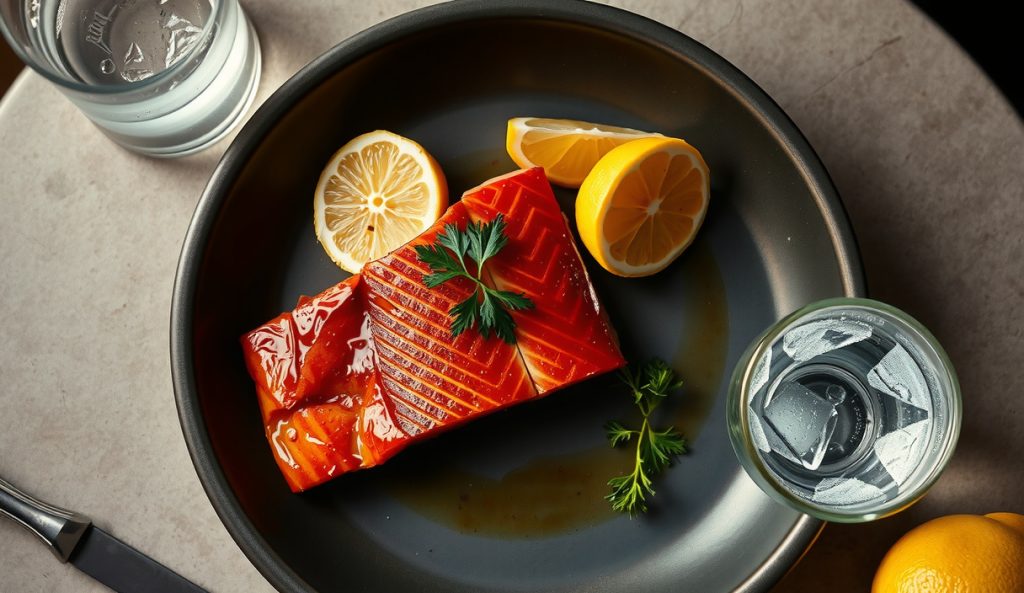
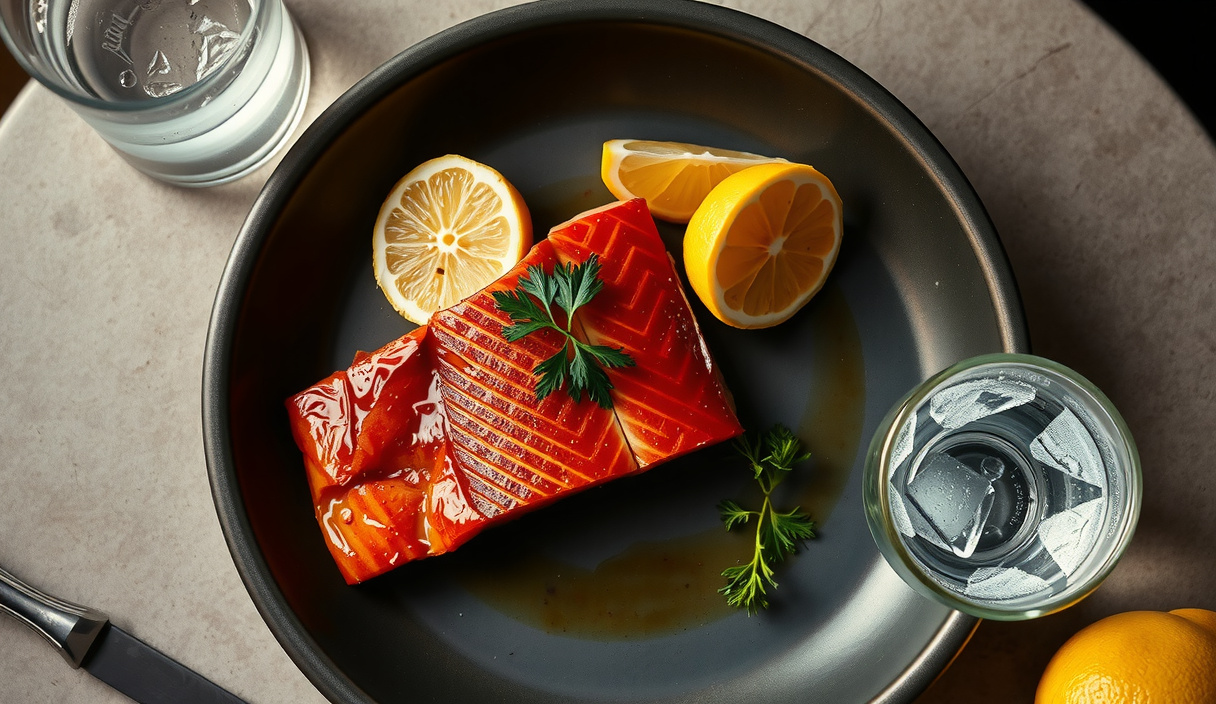
The first time I pulled a fillet of King salmon off my pellet grill and sliced into it, I understood immediately why commercial smokehouse operators guard their brine ratios like state secrets. The flesh was the color of a summer sunset — deep coral fading to amber at the edges — and it yielded to the knife with zero resistance, no stringiness, no white curd weeping from the surface. That white curd is albumin, and it is the single most reliable indicator that you have either cooked your fish too fast, too hot, or started with a wet surface. Fixing it is not a matter of technique so much as it is a matter of physics, and once you understand the physics, the fix is permanent.
This recipe is built around King salmon specifically — Chinook — because its intramuscular fat content (frequently exceeding 15% by weight in late-run fish) provides the thermodynamic buffer that lets you push smoke penetration deep into the fillet without drying the protein network. Sockeye and coho will work, but they are leaner, they cook faster, and they forgive less. Start with King, nail the method, then adapt downward.
The science
Salmon muscle is composed of myofibrillar proteins — primarily myosin and actin — organized in short, parallel fascicles called myotomes, separated by thin sheets of connective tissue (myosepta). Myosin in teleost fish begins to denature at a remarkably low threshold: around 104°F to 113°F (40–45°C), compared to 140°F (60°C) in mammals. This means that by the time your fillet reads 115°F on the probe, a significant fraction of the myosin network has already begun to aggregate and contract. The water-holding capacity of the muscle matrix drops sharply between 113°F and 140°F as the actomyosin complex tightens. Albumin — a sarcoplasmic protein that is highly water-soluble and present in meaningful concentrations in the extracellular fluid of fish muscle — is forced out of the myotome gaps under this pressure and coagulates on the surface the moment it contacts the dry heat of the smoker. It is not a sign of overcooking per se; it is a sign of too-rapid pressure differential across the myosepta.
The dry cure at a 3:1 salt-to-sugar ratio by weight addresses this at two levels simultaneously. First, sodium chloride begins to denature the outer myofibrillar layer within the first hour, causing the protein network to contract and push free moisture — including dissolved albumin — to the surface where it can be rinsed and dried away before the fillet ever enters the smoker. By the time the cure is complete at four hours, a thin, tacky pellicle of dried proteins has formed on the surface. This pellicle is the key physical structure: it creates a semi-permeable membrane that volatile smoke compounds (guaiacol, syringol, creosol, and their derivatives) adsorb to during the cook, while simultaneously acting as a diffusion barrier that prevents interior moisture from escaping too rapidly. Without the pellicle — which requires a dry surface and adequate airflow post-rinse — smoke flavor is superficial, albumin weeping returns under heat, and the fillet surface becomes tacky-wet rather than lacquered. Second, the sucrose fraction participates directly in Maillard browning above approximately 250°F surface temperature, but at our target smoke temp of 180°F, its primary role is osmotic: it draws residual moisture outward and contributes to the water activity depression that slows microbial activity during the cure window. The Maillard onset on the exterior will still occur at the elevated surface temperatures created by radiant and convective heat from the grill, particularly on the skin side.
The target internal temperature of 130°F (54°C) is a deliberate intercept point. At this temperature, myosin denaturation is essentially complete and the fillet is structurally stable, but actin — which collapses violently between 147°F and 158°F (64–70°C), destroying water-holding capacity catastrophically — remains largely intact. This is the window where the fish is fully food-safe under hot-smoke USDA guidelines (145°F is the regulatory target, but because we are holding the cook at a sustained 180°F ambient for well over the minimum time-at-temperature required for a 6-log pathogen reduction, we achieve pasteurization well before the probe reads 130°F at center), and simultaneously at the apex of texture and moisture retention. The high intramuscular fat in King salmon provides additional thermal buffering: lipid phase transitions absorb energy as the core heats, effectively slowing the temperature rise and extending the window during which smoke compounds continue to adsorb to the surface without the interior overcooking.
Equipment & ingredient notes
Pellet grill and wood selection: Alder is the canonical Pacific Northwest choice for salmon and for good reason — it burns cleanly at low temperatures, generates a delicate, slightly sweet smoke with low creosote potential, and does not overpower the fat of the fish. Cherry and apple are excellent alternatives. Hickory and mesquite at 180°F will produce an acrid, phenol-forward smoke that overwhelms salmon fat within 30 minutes; avoid them here. Set your grill to its lowest stable temperature setting. Many pellet grills have a “Smoke” or “Super Smoke” mode that oscillates between 160°F and 200°F to maximize smoke production — use it.
The cure ratio: 3:1 kosher salt to granulated white sugar by weight is not arbitrary. Kosher salt (Diamond Crystal preferred; if using Morton’s, reduce by 20% due to higher bulk density) provides the ionic strength necessary to rapidly denature the surface myofibrillar layer. Granulated white sugar is used rather than brown sugar here because brown sugar’s molasses content introduces additional hygroscopic compounds that can slow pellicle formation. If you want caramel notes, finish with a glaze after the smoke, not in the cure.
King salmon sourcing: Wild-caught Alaskan King salmon (Chinook) is the gold standard. Farm-raised King (such as New Zealand King) will work and has reliable fat content year-round, but lacks the mineral complexity of wild fish. A skin-on fillet of 2 to 3 pounds is the ideal working size — large enough to probe accurately, small enough to cure evenly in four hours. Pin bones should be removed before curing; use needle-nose pliers and pull in the direction of the bone’s angle.
The pellicle step: This is non-negotiable. After rinsing the cure, the fillet must air-dry — on a wire rack, uncovered, in the refrigerator — for a minimum of 45 minutes and ideally 90 minutes. The surface should feel tacky and slightly leathery to the touch, not wet. A small desk fan directed at the fillet accelerates this dramatically. Skipping the pellicle step and placing a wet fillet directly on the smoker is the single most common cause of albumin weeping and is irreversible once the cook begins.
Pellet-Smoked King Salmon (Dry-Cured, Albumin-Free Method)
Equipment
- 1 Pellet grill Capable of a stable 180°F setting; Super Smoke or low-smoke mode preferred. Alder, cherry, or apple pellets loaded.
- 1 Leave-in probe thermometer Wireless preferred; insert into the thickest point of the loin before the fillet goes on the grill.
- 1 Wire cooling rack For pellicle development; allows airflow under the fillet during the uncovered refrigerator rest.
- 1 Rimmed baking sheet Lined with plastic wrap for the cure stage; holds the fillet flat and contains moisture drawn out by the salt-sugar mixture.
- 1 Needle-nose pliers For pin bone removal prior to curing. Pull in the direction of each bone’s natural angle.
- 1 Small desk fan (optional) Directed at the fillet during refrigerator air-dry; reduces pellicle development time from 90 minutes to approximately 45 minutes.
Ingredients
Salmon
- 2.5 lbs King salmon fillet, skin-on, pin bones removed Center-cut preferred; wild Alaskan Chinook or farm-raised New Zealand King both work. Avoid thin tail sections for this method.
Dry Cure
- 3 tablespoons Diamond Crystal kosher salt If using Morton’s kosher salt, reduce to 2.5 tablespoons — Morton’s has a higher bulk density and the ionic load will be greater by volume.
- 1 tablespoon granulated white sugar White sugar is used rather than brown to prevent hygroscopic molasses compounds from slowing pellicle formation.
- 1 teaspoon freshly cracked black pepper Optional; contributes piperine-forward aromatic complexity to the pellicle layer.
For Smoking
- 1 tablespoon neutral oil (avocado or refined sunflower) For oiling the grill grates to prevent sticking. Do not apply oil to the fillet — it will impede smoke adhesion to the pellicle.
- 2 cups alder, cherry, or apple wood pellets Loaded into the pellet hopper. Do not use hickory or mesquite at this temperature — they generate harsh phenolic compounds that overwhelm salmon fat.
Instructions
Cure the Salmon
- Remove any remaining pin bones from the salmon fillet using needle-nose pliers. Run your fingertip along the lateral line of the flesh side to locate them; pull each bone in the direction of its natural angle to avoid tearing the myotome structure.
- Combine the kosher salt, granulated white sugar, and cracked black pepper in a small bowl and mix thoroughly.1 tablespoon granulated white sugar, 1 teaspoon freshly cracked black pepper
- Line a rimmed baking sheet with plastic wrap. Lay the salmon fillet skin-side down. Apply the cure mixture evenly across the entire flesh side, pressing gently so it adheres. Do not apply cure to the skin. The cure layer should be even and approximately 1/8-inch thick — not packed on, not sparse.1 tablespoon granulated white sugar, 1 teaspoon freshly cracked black pepper
- Loosely cover the fillet with plastic wrap and refrigerate for exactly 4 hours. Do not exceed 5 hours for a 2.5-pound fillet — extended cure times increase ionic penetration depth, producing an uncomfortably salty interior and a firmer, more compressed texture than intended. Set a timer.
Rinse and Develop the Pellicle
- After 4 hours, remove the fillet from the refrigerator. Rinse thoroughly under cold running water, removing all visible cure residue from both the flesh and skin sides. Pat dry with paper towels — both sides, firmly.
- Place the fillet skin-side down on a wire rack set over a clean baking sheet. Refrigerate uncovered for a minimum of 45 minutes, ideally 90 minutes. If using a small desk fan, direct it at the flesh side of the fillet to accelerate surface drying. The fillet is ready when the surface feels distinctly tacky and slightly leathery to the touch — not wet, not shiny. A wet fillet cannot develop proper smoke adhesion and will weep albumin during the cook.
Smoke the Salmon
- Preheat your pellet grill loaded with alder, cherry, or apple pellets to 180°F. If your grill has a Super Smoke or low-smoke mode, activate it — these modes oscillate the auger to maximize smoke output at low temperatures. Allow the grill to reach and stabilize at 180°F for at least 15 minutes before the fillet goes on. Verify temperature with an independent grill thermometer if possible, as pellet grills frequently read 10–15°F warmer than actual grate-level temperature.2 cups alder, cherry, or apple wood pellets
- Oil the grill grates lightly with neutral oil using a folded paper towel held with tongs. Do not oil the fillet itself — surface oil impedes smoke compound adsorption to the pellicle.1 tablespoon neutral oil (avocado or refined sunflower)
- Place the fillet on the grill skin-side down. Insert the leave-in probe into the thickest point of the loin at a shallow angle, with the tip positioned at the geometric center of the muscle mass. Close the lid. Do not open the lid during the first 60 minutes of the cook.
- Smoke the fillet at 180°F until the internal temperature reaches 130°F at the thickest point of the loin. For a 2.5-pound center-cut King salmon fillet, this typically takes 90 to 120 minutes at 180°F ambient. Begin checking the probe reading at 75 minutes. Watch for the flesh-side color transition from translucent deep coral to opaque lighter pink progressing inward from the edges — when the center retains a slightly translucent, jewel-like quality and the probe reads 125–128°F, begin monitoring closely for carryover.
- Remove the fillet from the grill when the probe reads 128–130°F. Transfer to a cutting board or serving platter and rest uncovered for 5 to 10 minutes. Do not tent with foil — trapped steam will soften the pellicle and reintroduce surface moisture. The fillet is structurally stable and will not fall apart during the rest period.
- Serve directly from the skin — use a wide spatula to separate portions from the skin, which will adhere to the grate or platter. Alternatively, leave the skin on and serve in full for guests to peel away. The belly section will be more fully cooked and richly fatty; the loin section will be the textural centerpiece.
Notes
Nutrition
Tips for nailing it
- Probe placement is everything. Insert a leave-in probe thermometer into the thickest part of the fillet — the loin, not the tail — at a shallow angle so the tip sits at the geometric center of the muscle mass. The tail section will reach 130°F significantly faster than the loin. If you are cooking a whole side, the tail will be done 20 to 30 minutes before the loin. Either fold the tail under the fillet to insulate it, or accept that you will serve a gradient of doneness and slice accordingly.
- Do not rush the pellicle. If you pull the fillet from the refrigerator and the surface is shiny or wet, put it back. A dry, tacky surface is the mechanical prerequisite for clean smoke adhesion and albumin retention. No amount of skill on the grill compensates for a wet surface pre-smoke.
- Skin-side down, always. The skin acts as a natural thermal insulator and a structural cradle that prevents the delicate myotome structure from disintegrating as the fat renders and the myosepta soften. Flipping salmon on a hot grill is a structural catastrophe. Cook it skin-side down from start to finish on a well-oiled grate or a cedar plank.
- Watch for the color change, not the clock. The fillet will transition from translucent deep red to an opaque, lighter coral color starting at the edges and moving inward as internal temperature rises. When the center retains a slightly translucent, jewel-like core and the probe reads 125–128°F, pull it. Carryover will bring it to 130°F. The cook time listed assumes a 2.5-pound center-cut fillet at 180°F ambient; thinner belly sections or thicker collar pieces will deviate significantly.
- Rest uncovered. Tenting smoked salmon with foil traps steam, softens the pellicle you worked hard to develop, and reintroduces surface moisture. Rest it uncovered on the cutting board for 5 to 10 minutes before serving or slicing.
- Fat render is your friend and your warning sign. A small amount of white fat rendering from between the flakes at the lateral line is normal and a sign the cook is progressing correctly. Aggressive weeping of white liquid from the cut surface is albumin — it means the surface dried unevenly or the temperature spiked. Salvageable in flavor, not in texture.
Variations
Citrus-dill cure: Add 1 tablespoon of finely grated lemon zest and 2 tablespoons of finely chopped fresh dill to the cure mixture before applying. The citrus oils (primarily limonene and linalool) are lipophilic and will partition into the fat layer of the fish during the cure window, contributing floral and citrus top notes that persist through the smoke. The dill’s terpene compounds (carvone, phellandrene) are more volatile and will largely off-gas during the air-dry and early smoke stages, but contribute meaningfully to the aroma profile of the finished fillet.
Sockeye or coho adaptation: Leaner species require a shorter cure window — 2 to 2.5 hours maximum — because lower intramuscular fat means the osmotic gradient of the cure acts more aggressively on the muscle water. Reduce the cure time, and target a slightly lower finish temp of 125°F internal to preserve moisture, as the actin denaturation threshold is the same but there is less lipid buffering to carry the fish through a longer hold.
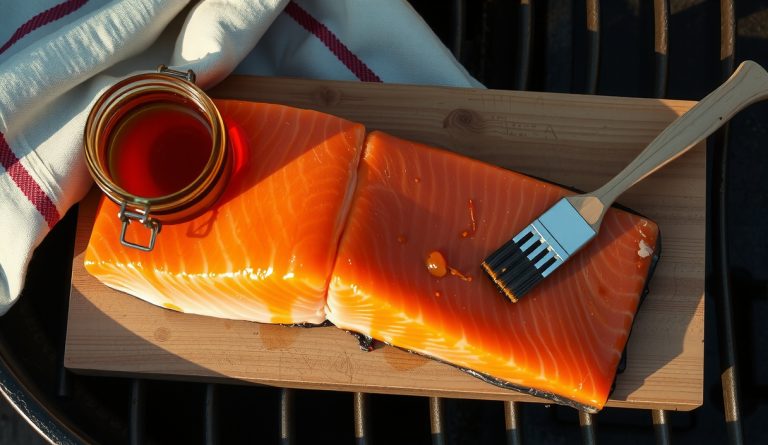
Honey-glaze finish: At the 90-minute mark of the smoke, when the surface pellicle is fully set and the internal temp is around 110–115°F, brush the flesh side with a thin layer of raw honey mixed 2:1 with a neutral, high-smoke-point oil (avocado or refined sunflower). The honey’s fructose fraction will begin caramelizing at the surface temperatures generated during the final 30 to 45 minutes of the cook, adding complexity via caramel and furfural compounds without pushing the interior past target temp. Apply in one thin pass only — multiple coats trap steam under the glaze and compromise the pellicle.
Scaling for a whole side: A full King salmon side (4 to 6 pounds) requires proportional cure scaling (same 3:1 ratio by weight of fish) and a longer pellicle development time — 2 hours minimum. The cook time will extend to 2.5 to 3.5 hours at 180°F depending on fillet thickness at the thickest point. Use two probes: one in the loin, one in a mid-section location. Pull when the loin probe reads 130°F; the tail section will be slightly more cooked and is ideal for flaking into salads or pasta rather than slicing.
FAQ
Why is white stuff coming out of my salmon? That is albumin — a sarcoplasmic protein that exists in the extracellular fluid of fish muscle and coagulates when expelled under thermal pressure. It appears when the surface was not adequately dried before smoking (no pellicle), when the cooker temperature spiked, or when the cure did not have enough time to pre-denature and compress the surface myofibrillar layer. It is safe to eat but indicates the texture will be drier and the surface less refined than intended. The fix is procedural: next cook, extend your pellicle time and verify your grill is holding a stable 180°F before the fillet goes on.
Can I cold-smoke this instead? True cold-smoking — smoke at sub-90°F (32°C) ambient with no heat — produces a fundamentally different product: cured but raw at the center, with dense smoke penetration and a translucent, silky texture. It requires specialized equipment (a separate smoke generator, an insulated chamber) and a validated cure protocol to ensure food safety, as the fish never reaches a pasteurizing temperature. What this recipe approximates is the flavor and texture profile of a “warm smoke” or low hot-smoke method — fully cooked to a safe internal temperature with meaningful smoke penetration — using the accessible platform of a pellet grill. If you want true cold-smoked salmon, the cure must be significantly heavier and longer (gravlax-style, 24+ hours) and the food safety math must be done carefully.
How long does smoked salmon keep? Properly smoked to 130°F internal and refrigerated within 2 hours of cooking, it will hold for 4 to 5 days tightly wrapped in the refrigerator. The water activity depression from the cure contributes to shelf life, but this is not a preserved product in the commercial sense — it has not undergone the extended, calibrated cure protocols required for extended shelf stability. For longer storage, vacuum-seal and freeze for up to 3 months. Thaw overnight in the refrigerator; do not thaw at room temperature, as the fat in King salmon oxidizes rapidly once the thermal barrier of ice is removed.