Smoked Beef Jerky — Lean Round

Equipment
- 1 Pellet grill or digital electric smoker Must hold 165°F with active convective airflow for 6+ hours
- 2 Wire smoking racks or grates Strips must lie flat with no overlap
- 1 Sharp boning or slicing knife Or a deli slicer for consistent 1/4-inch cuts
- 1 Large zip-lock bags or non-reactive container For marinating
- 1 Instant-read thermometer To verify smoker ambient and strip internal temperature
- several Paper towels For patting strips dry before smoking
Ingredients
Beef
- 2 lb top round or eye of round, trimmed of all fat and silverskin Partially freeze 45-60 minutes for easier uniform slicing
Marinade
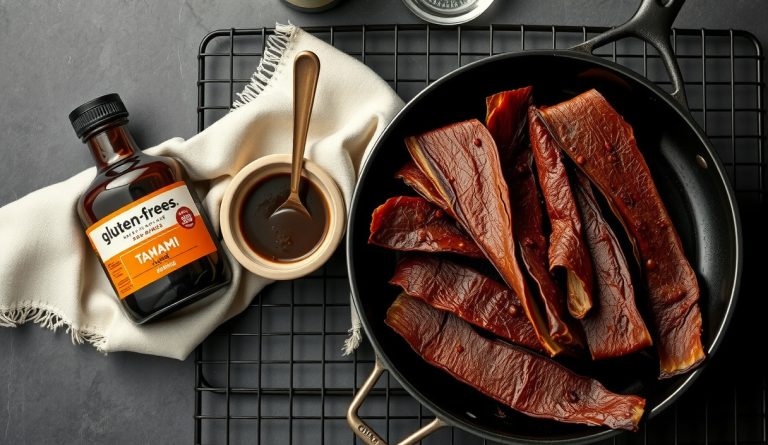
- 60 ml soy sauce Regular-sodium; tamari for gluten-free
- 30 ml Worcestershire sauce
- 30 ml water
- 2 tablespoons dark brown sugar, packed Light brown sugar works; dark gives deeper caramel notes
- 1 teaspoon coarse black pepper, freshly ground
- 1 teaspoon garlic powder
- 1 teaspoon onion powder
- ½ teaspoon smoked paprika Adds a phenolic depth note
- ¼ teaspoon red pepper flakes Optional; omit for mild
- ¼ teaspoon Prague Powder No. 1 (curing salt) Optional but recommended for long-smoke safety margin and color; 1/4 tsp per 5 lb meat

Instructions
Slice the Beef
- Wrap the trimmed top round tightly in plastic wrap and place in the freezer for 45 to 60 minutes — you want the exterior firm but the core not yet frozen solid. This firms the muscle fibers and makes consistent 1/4-inch slices significantly easier.
- Remove from the freezer and slice against the grain at a consistent 1/4 inch (6 mm). Hold the knife at a slight 10-degree bias angle to widen each strip without going thicker. Aim for strips 4 to 6 inches long. Discard any remaining silverskin or connective tissue pockets — they will not tenderize during drying.
Make the Marinade and Marinate
- In a mixing bowl, whisk together the soy sauce, Worcestershire sauce, water, brown sugar, black pepper, garlic powder, onion powder, smoked paprika, red pepper flakes (if using), and Prague Powder No. 1 (if using) until the sugar is fully dissolved. Taste — it should be aggressively salty-savory with a distinct sweet undertone.30 ml Worcestershire sauce, 30 ml water, 2 tablespoons dark brown sugar, packed, 1 teaspoon coarse black pepper, freshly ground, 1 teaspoon garlic powder, 1 teaspoon onion powder, 1/2 teaspoon smoked paprika, 1/4 teaspoon red pepper flakes, 1/4 teaspoon Prague Powder No. 1 (curing salt)
- Add the beef slices to a large zip-lock bag or non-reactive container. Pour the marinade over the meat, massage to coat every surface, press out excess air, and seal. Refrigerate for a minimum of 8 hours and up to 24 hours. Longer marination intensifies flavor and deepens the osmotic pre-treatment — the ionic load of the soy sauce will visibly firm and slightly darken the exterior of the strips by the 12-hour mark.30 ml Worcestershire sauce, 30 ml water, 2 tablespoons dark brown sugar, packed, 1 teaspoon coarse black pepper, freshly ground, 1 teaspoon garlic powder, 1 teaspoon onion powder, 1/2 teaspoon smoked paprika, 1/4 teaspoon red pepper flakes, 1/4 teaspoon Prague Powder No. 1 (curing salt)
Set Up the Smoker
- Preheat your smoker to 165°F with the vents fully open to maximize convective airflow. Load hickory or cherry wood — enough for a moderate, consistent smoke for the first 2 hours. Do not use a water pan: you need the environment dry to drive surface desiccation and allow Maillard browning to initiate.
Dry and Load the Strips
- Remove the strips from the marinade and lay them flat on paper towels. Press a second layer of paper towels firmly on top and blot dry — remove as much surface moisture as possible. This step is critical: surface moisture creates an evaporative cooling layer that delays browning and adds 30 to 60 minutes of unnecessary drying time.
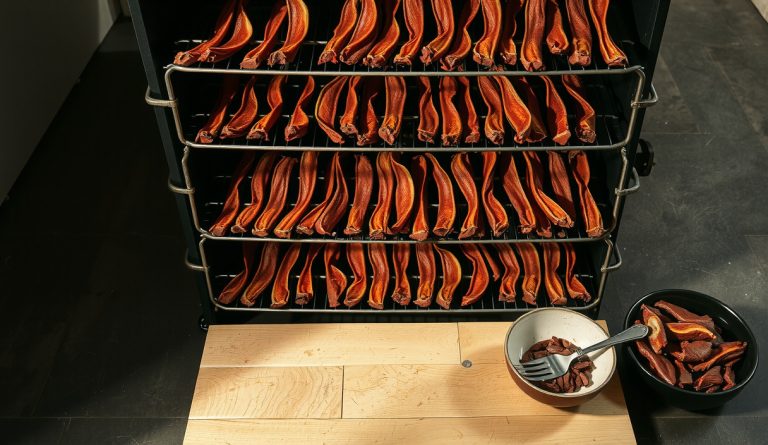
- Arrange the strips directly on the smoker grates in a single layer with at least 1/2 inch of clearance between every strip. No overlapping. Every surface must have exposure to moving air and smoke. If you are using two racks, rotate them top-to-bottom at the 2-hour mark.
Smoke and Monitor
- Smoke at 165°F for 4 to 6 hours without opening the lid unnecessarily. The first 30 to 45 minutes accomplish two things simultaneously: the strips reach internal temperature equilibrium with the smoker environment (achieving USDA-compliant pathogen lethality for whole-muscle beef), and the surface desiccates enough for Maillard browning to begin. You will see the exterior transition from a wet, crimson color to a dark mahogany within the first hour.
- At the 4-hour mark, begin performing the bend test every 30 minutes. Pull a representative strip, let it cool on the counter for exactly 2 minutes (it will feel softer hot than at equilibrium), then bend it 90 degrees at its midpoint. Target result: the strip flexes and cracks open at the apex but does not fully snap in two — a fibrous hinge of a few threads remains. A strip that folds without cracking needs more time. A strip that snaps cleanly in two with no hinge has been over-dried but is still edible — adjust time down on your next batch.
Cool and Store
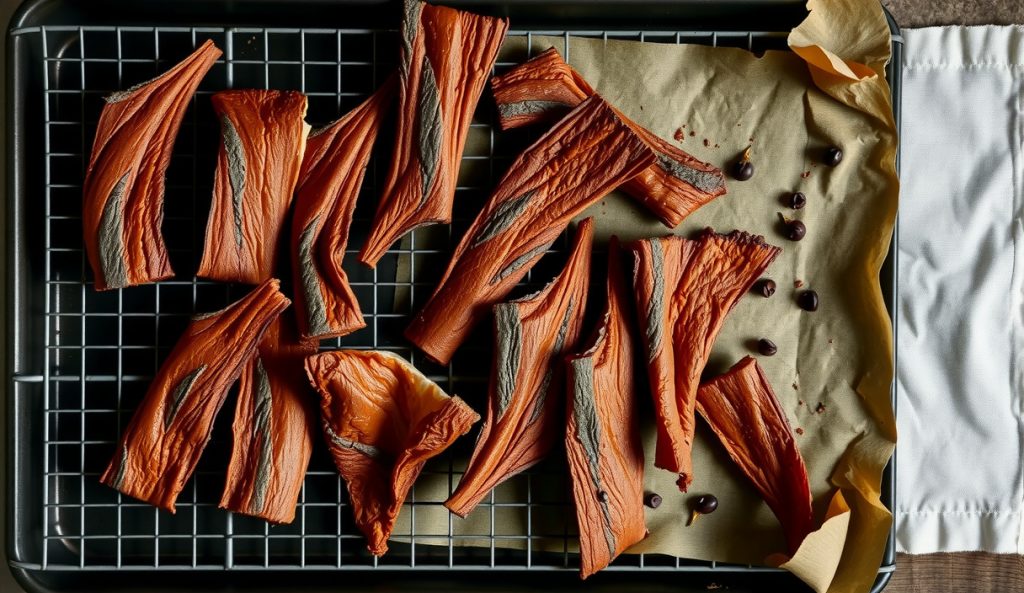
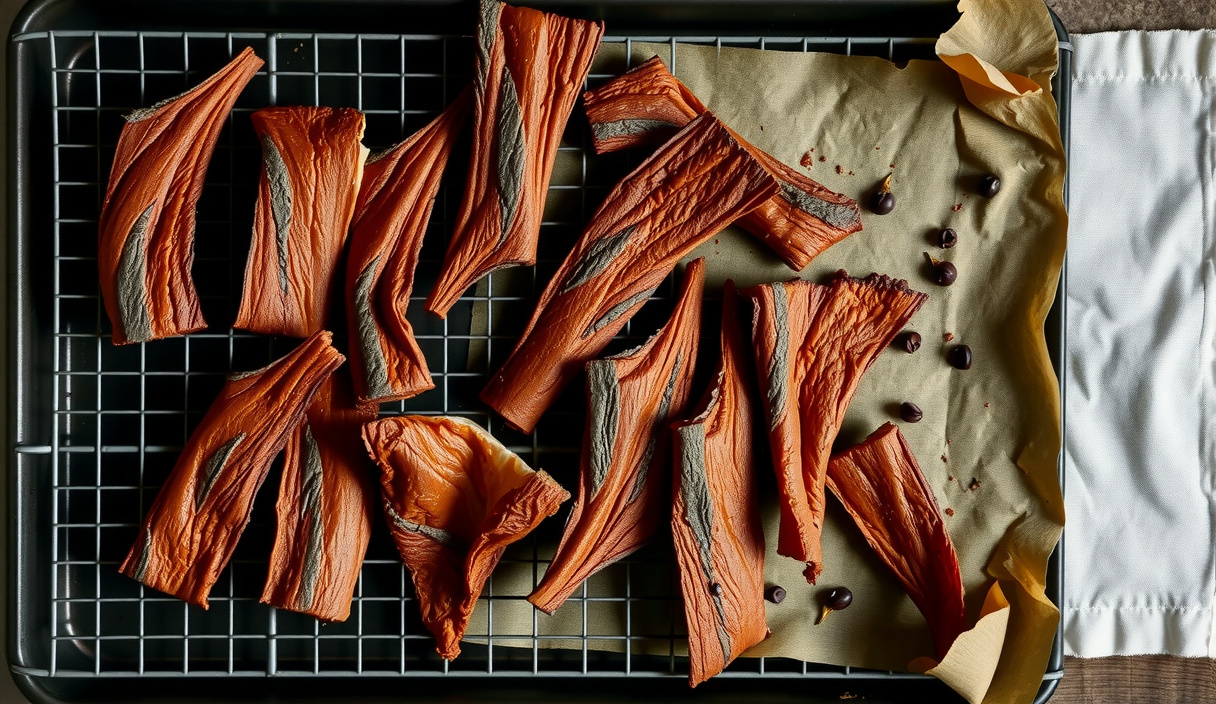
- When the bend test confirms doneness, remove all strips and spread them in a single layer on a wire cooling rack at room temperature. Do not pile or stack. Allow to cool completely — a minimum of 1 hour. Strips continue to lose a small amount of surface moisture as they cool, which firms the texture slightly.
- Once fully cooled and at room temperature, transfer to vacuum-seal bags or zip-lock bags with excess air pressed out. At aw 0.85, the jerky is shelf-stable at room temperature for up to 2 weeks if sealed properly. Vacuum-sealed and refrigerated, quality holds for 3 months. Vacuum-sealed and frozen, 12 months with no meaningful quality loss.
Notes
Nutrition
The first time I watched a batch of jerky shrivel into shoe leather inside a cheap dehydrator, I knew I was missing something. Not patience — physics. Every strip I slid into that machine was carrying the same battle: free water racing for the surface, evaporative cooling anchoring the boundary layer near 100°F, and myofibrillar proteins quietly tightening like a fist around the moisture I was trying to extract. The result was tough, pale, and chewy in all the wrong ways. Then I moved the process to a smoker and started treating the drying curve as a tunable heat-transfer problem. That changed everything.
What you are about to make is not a recipe so much as a controlled dehydration protocol with a smoke co-processor running in parallel. The target is a water activity (aw) of 0.85 or below — the threshold at which pathogen growth becomes thermodynamically untenable and the jerky qualifies as shelf-stable. We get there through a combination of osmotic pre-treatment (the marinade), protein denaturation kinetics (the initial 165°F heat lock), and convective moisture removal sustained over four to six hours of smoke. The payoff is a strip that snaps at the bend, carries a bark of Maillard-developed crust, and releases a continuous retronasal smoke signal long after the last bite.
Why does smoked beef jerky work? The science
Lean top round is the correct starting material because it is principally myofibrillar protein with minimal intramuscular lipid. Fat does not dehydrate — it oxidizes. Rancidity accelerates exponentially in low-moisture environments where the lipid phase is concentrated and exposed to oxygen and heat, so high-fat cuts produce jerky with a dramatically shortened shelf life. By selecting top round, we eliminate that failure mode before the first slice is cut. Slicing against the grain severs the long actin and myosin filament bundles, which shortens the chew path and prevents the stringy, dental-floss texture that plagues with-grain cuts. At a 1/4-inch thickness, the geometry creates a diffusion distance short enough that moisture can migrate to the surface before the exterior case-hardens and traps it inside — a classic drying defect called case hardening.
The marinade is doing two distinct jobs simultaneously. Soy sauce delivers a sodium chloride ionic load that swells the myofibrillar lattice via the Hofmeister series, increasing water uptake during the soak but simultaneously lowering the equilibrium water activity of the meat’s aqueous phase. Brown sugar introduces reducing monosaccharides after sucrose undergoes partial hydrolysis in the acidic Worcestershire environment. These reducing sugars are the Maillard fuel: during the first 30 to 45 minutes in the smoker, when the surface temperature climbs past 140°F into the 150–170°F band, the amino-carbonyl condensation cascade fires, generating melanoidin pigments and hundreds of volatile organic compounds — the pyrazines, furans, and thiophenes responsible for the jerky’s dark crust and roasted depth. Water activity must sit between 0.5 and 0.7 at the surface for this browning reaction to proceed efficiently; too much free water and evaporative cooling holds the surface below the activation threshold. Keeping the smoker dry (no water pan) and starting at 165°F rather than a lower set-point ensures the surface desiccates fast enough to allow Maillard onset.
The collagen content in top round is low relative to chuck or brisket, so there is no meaningful gelatin conversion happening during this process. What is happening is a progressive, irreversible protein aggregation: myosin denatures and begins coagulating around 55–58°C, sarcoplasmic proteins follow through 67°C, and actin collapses between 74 and 78°C. At a 165°F smoker floor temperature, all of these thresholds are crossed rapidly in the first 30 minutes, which achieves the USDA-recommended pathogen lethality for whole muscle beef and eliminates the need for a post-dehydration oven flash step. From that point on, the process is purely kinetic drying: convective air movement in the smoker removes water vapor at the boundary layer, the concentration gradient drives free water from the interior to the surface, and the strips lose roughly 50 to 60 percent of their starting mass. The end-point indicator is the bend test — a properly dried strip flexes 90 degrees and cracks at the apex without snapping completely in two. That mechanical signature corresponds reliably to a water activity in the 0.80–0.87 range.
What equipment and ingredients do you need?
Smoker or pellet grill: You need a unit capable of holding 165°F with convective airflow for at least six hours. A closed offset with a very small fire works, but a pellet grill or digital electric smoker gives you the temperature stability the process demands. Airflow is non-negotiable — stagnant air stalls moisture removal and extends drying time into the danger zone.
Wood choice: Hickory delivers the classic American jerky profile — assertive, slightly phenolic, with a ring of reddish smoke penetration. Cherry wood softens the smoke and adds a fruit-forward top note that pairs well with the brown sugar. Avoid mesquite at low temps: its high combustion volatility generates acrid, bitter-band VOCs that overwhelm delicate beef flavor when the smoke exposure runs for hours rather than minutes.
Top round vs. eye of round: Both work. Eye of round has a tighter, more uniform grain that produces very consistent slices but can be slightly tougher. Top round has a minor fat seam on one edge that should be trimmed. Either way, partial freezing the roast for 45 to 60 minutes before slicing firms the tissue and makes 1/4-inch uniform cuts dramatically easier without a deli slicer.
Soy sauce: Use regular-sodium soy sauce as written. Low-sodium reduces the osmotic pre-treatment effect and slows the aw depression in the marinade. If you need a gluten-free version, tamari performs identically in this application.
Brown sugar: Dark brown sugar contains more molasses, which means more hygroscopic compounds and a slightly more pronounced caramel-bitter note in the finished crust. Light brown sugar is milder. Either works; the total sugar mass is identical.
Smoked Beef Jerky — Lean Round
Equipment
- 1 Pellet grill or digital electric smoker Must hold 165°F with active convective airflow for 6+ hours
- 2 Wire smoking racks or grates Strips must lie flat with no overlap
- 1 Sharp boning or slicing knife Or a deli slicer for consistent 1/4-inch cuts
- 1 Large zip-lock bags or non-reactive container For marinating
- 1 Instant-read thermometer To verify smoker ambient and strip internal temperature
- several Paper towels For patting strips dry before smoking
Ingredients
Beef
- 2 lb top round or eye of round, trimmed of all fat and silverskin Partially freeze 45-60 minutes for easier uniform slicing
Marinade
- 60 ml soy sauce Regular-sodium; tamari for gluten-free
- 30 ml Worcestershire sauce
- 30 ml water
- 2 tablespoons dark brown sugar, packed Light brown sugar works; dark gives deeper caramel notes
- 1 teaspoon coarse black pepper, freshly ground
- 1 teaspoon garlic powder
- 1 teaspoon onion powder
- ½ teaspoon smoked paprika Adds a phenolic depth note
- ¼ teaspoon red pepper flakes Optional; omit for mild
- ¼ teaspoon Prague Powder No. 1 (curing salt) Optional but recommended for long-smoke safety margin and color; 1/4 tsp per 5 lb meat
Instructions
Slice the Beef
- Wrap the trimmed top round tightly in plastic wrap and place in the freezer for 45 to 60 minutes — you want the exterior firm but the core not yet frozen solid. This firms the muscle fibers and makes consistent 1/4-inch slices significantly easier.
- Remove from the freezer and slice against the grain at a consistent 1/4 inch (6 mm). Hold the knife at a slight 10-degree bias angle to widen each strip without going thicker. Aim for strips 4 to 6 inches long. Discard any remaining silverskin or connective tissue pockets — they will not tenderize during drying.
Make the Marinade and Marinate
- In a mixing bowl, whisk together the soy sauce, Worcestershire sauce, water, brown sugar, black pepper, garlic powder, onion powder, smoked paprika, red pepper flakes (if using), and Prague Powder No. 1 (if using) until the sugar is fully dissolved. Taste — it should be aggressively salty-savory with a distinct sweet undertone.30 ml Worcestershire sauce, 30 ml water, 2 tablespoons dark brown sugar, packed, 1 teaspoon coarse black pepper, freshly ground, 1 teaspoon garlic powder, 1 teaspoon onion powder, 1/2 teaspoon smoked paprika, 1/4 teaspoon red pepper flakes, 1/4 teaspoon Prague Powder No. 1 (curing salt)
- Add the beef slices to a large zip-lock bag or non-reactive container. Pour the marinade over the meat, massage to coat every surface, press out excess air, and seal. Refrigerate for a minimum of 8 hours and up to 24 hours. Longer marination intensifies flavor and deepens the osmotic pre-treatment — the ionic load of the soy sauce will visibly firm and slightly darken the exterior of the strips by the 12-hour mark.30 ml Worcestershire sauce, 30 ml water, 2 tablespoons dark brown sugar, packed, 1 teaspoon coarse black pepper, freshly ground, 1 teaspoon garlic powder, 1 teaspoon onion powder, 1/2 teaspoon smoked paprika, 1/4 teaspoon red pepper flakes, 1/4 teaspoon Prague Powder No. 1 (curing salt)
Set Up the Smoker
- Preheat your smoker to 165°F with the vents fully open to maximize convective airflow. Load hickory or cherry wood — enough for a moderate, consistent smoke for the first 2 hours. Do not use a water pan: you need the environment dry to drive surface desiccation and allow Maillard browning to initiate.
Dry and Load the Strips
- Remove the strips from the marinade and lay them flat on paper towels. Press a second layer of paper towels firmly on top and blot dry — remove as much surface moisture as possible. This step is critical: surface moisture creates an evaporative cooling layer that delays browning and adds 30 to 60 minutes of unnecessary drying time.
- Arrange the strips directly on the smoker grates in a single layer with at least 1/2 inch of clearance between every strip. No overlapping. Every surface must have exposure to moving air and smoke. If you are using two racks, rotate them top-to-bottom at the 2-hour mark.
Smoke and Monitor
- Smoke at 165°F for 4 to 6 hours without opening the lid unnecessarily. The first 30 to 45 minutes accomplish two things simultaneously: the strips reach internal temperature equilibrium with the smoker environment (achieving USDA-compliant pathogen lethality for whole-muscle beef), and the surface desiccates enough for Maillard browning to begin. You will see the exterior transition from a wet, crimson color to a dark mahogany within the first hour.
- At the 4-hour mark, begin performing the bend test every 30 minutes. Pull a representative strip, let it cool on the counter for exactly 2 minutes (it will feel softer hot than at equilibrium), then bend it 90 degrees at its midpoint. Target result: the strip flexes and cracks open at the apex but does not fully snap in two — a fibrous hinge of a few threads remains. A strip that folds without cracking needs more time. A strip that snaps cleanly in two with no hinge has been over-dried but is still edible — adjust time down on your next batch.
Cool and Store
- When the bend test confirms doneness, remove all strips and spread them in a single layer on a wire cooling rack at room temperature. Do not pile or stack. Allow to cool completely — a minimum of 1 hour. Strips continue to lose a small amount of surface moisture as they cool, which firms the texture slightly.
- Once fully cooled and at room temperature, transfer to vacuum-seal bags or zip-lock bags with excess air pressed out. At aw 0.85, the jerky is shelf-stable at room temperature for up to 2 weeks if sealed properly. Vacuum-sealed and refrigerated, quality holds for 3 months. Vacuum-sealed and frozen, 12 months with no meaningful quality loss.
Notes
Nutrition
How do you nail smoked beef jerky every time?
- Slice thickness is the most critical variable. Thicker than 3/8 inch and the exterior will case-harden before interior moisture migrates out, trapping water and producing a jerky that feels soft in the center days later. Thinner than 3/16 inch and the strips become brittle and crumble. A consistent 1/4 inch is the sweet spot — use a ruler on your first batch until your eye is calibrated.
- Pat dry before the smoker, not just before the marinade. Surface moisture on the strip when it enters the smoker creates an evaporative cooling layer that delays Maillard onset and adds 30 to 60 minutes to the drying time. Use a paper towel on both faces immediately before loading.
- Do not overlap strips on the grates. Overlapping creates dead-air zones where moisture cannot escape. Every square centimeter of strip surface needs exposure to moving smoke-air. Leave at least 1/2 inch between strips.
- The bend test is your aw proxy. Pull a strip at the four-hour mark, let it cool to room temperature for two minutes (strips always feel softer hot), then bend it 90 degrees. If it folds without cracking, give it another 30 to 45 minutes. If it snaps cleanly in two with no fibrous hinge, you have over-dried. The target is a crack that opens at the apex but does not fully sever.
- Cool completely before sealing. Sealing warm jerky traps residual steam. That condensation raises the local aw inside the bag above your hard-earned 0.85 threshold, enabling mold growth within days. Spread strips on a wire rack at room temperature for at least one hour before vacuum sealing or bagging.
- Refrigerate or vacuum-seal for storage beyond two weeks. At aw 0.85, the product is shelf-stable against most bacterial growth, but lipid oxidation and mold from rehydration events (opening the bag in a humid kitchen) can degrade quality. Vacuum-sealed and refrigerated, this jerky holds three months with essentially no quality loss.
What variations can you make on this smoked beef jerky?
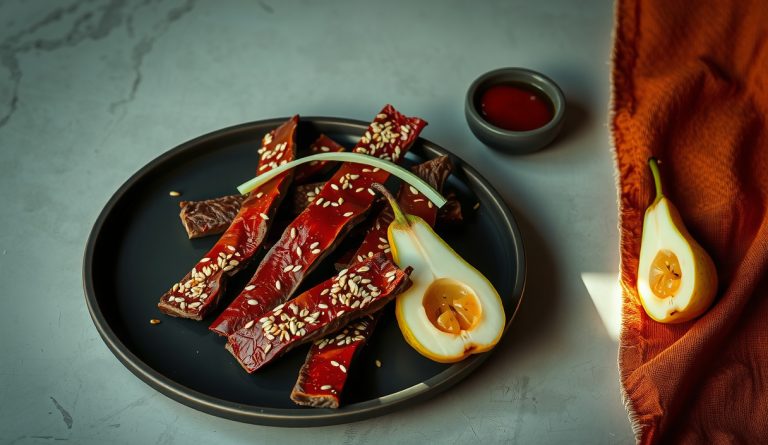
Spicy Korean-style: Replace 2 tablespoons of the soy sauce with gochujang and add 1 teaspoon toasted sesame oil and 1 tablespoon grated Asian pear to the marinade. The pear introduces calpain-activating enzymes that lightly tenderize the myofibrillar network, and the natural sugars in the fruit add a floral sweetness that balances the fermented chile heat. Reduce total marinade sugar by half since gochujang carries its own sweetness.
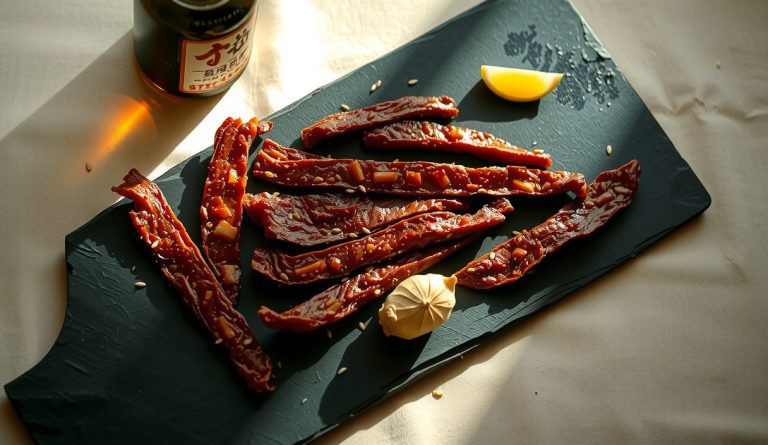
Teriyaki-style: Swap Worcestershire for mirin (30 ml) and rice vinegar (15 ml), reduce brown sugar to 1 tablespoon, and add 1 teaspoon fresh grated ginger. The mirin introduces volatile esters that volatilize during drying, leaving a clean, sweet-savory finish. Note that the higher total sugar load will accelerate surface browning — drop the smoker temperature to 155°F to avoid over-darkening the exterior before the interior is dry.
Gluten-free adaptation: Substitute tamari 1:1 for soy sauce. Verify that your Worcestershire sauce is gluten-free (most US brands are, but some British formulations use malt vinegar). No other changes are required — the functional chemistry of the marinade is identical.
Scaling for large batches: The marinade formula scales linearly — double the meat, double the marinade. The only variable that does not scale is time: a batch of 4 pounds uses the same smoker surface area (spread across two racks) and the same 4-to-6-hour drying window, assuming your smoker has sufficient airflow. Do not crowd extra racks into a smoker not designed for them; stacked racks create convection dead zones on the middle grates and produce inconsistent drying.
Frequently asked questions
Do I need to hit 165°F internal temperature if I am using a smoker set to 165°F? At a smoker ambient temperature of 165°F with active convective airflow, thin jerky strips reach internal equilibrium with the environment within 30 to 45 minutes. USDA guidelines for whole-muscle jerky specify either heating the meat to 160°F internal before dehydrating, or dehydrating and then finishing in a 275°F oven for 10 minutes. Setting your smoker to 165°F from the start satisfies the pre-dehydration heat treatment approach for whole-muscle beef, which is why this recipe starts at 165°F rather than a lower dehydrator temperature. If you are making ground-meat jerky from a gun, the oven finish step is mandatory.
Why does my jerky feel soft when it comes out of the smoker but hard the next day? The strips are still at elevated temperature when you pull them, which means the protein matrix is more pliable and any residual surface moisture has not fully redistributed through the strip. As the jerky cools, the proteins contract and residual free water continues to migrate toward the surface and evaporate into the ambient air. The mechanical properties at room temperature after complete cooling are the true end-state. Always evaluate doneness with the bend test after a two-minute cool, not immediately off the grate.
Can I use a standard kitchen oven instead of a smoker? Yes, with modifications. Set the oven to 165°F (or its lowest setting, propped open slightly with a wooden spoon to allow moisture to escape). Lay strips on wire racks over baking sheets. Drying time will be similar — four to six hours — but you will lose the smoke-derived VOC complexity. You can approximate smoke character by adding 1/2 teaspoon of smoked paprika and 1/4 teaspoon of liquid smoke to the marinade. The Maillard browning will be less pronounced without the convective airflow of a smoker, so do not expect the same dark mahogany crust.