Keto Brisket Rub — No-Sugar Bark
Equipment
- 1 Offset smoker or ceramic kamado Target 250–265°F at grate level. Verify with a calibrated probe — not the dome thermometer.
- 1 Digital kitchen scale Gram-precision required for the allulose 5% w/w calculation. Volume measures are insufficiently accurate.
- 1 Instant-read probe thermometer For tracking internal brisket temperature through the stall and into the 200–205°F probe-tender window.
- 1 Mixing bowl Medium, for combining the dry rub components.
- 2 sheets Unwaxed butcher paper For wrapping at 165°F internal if needed. Do not use foil — it traps steam and softens the bark.
Ingredients
Rub Base
- 36 g kosher salt (Diamond Crystal) Coarse. If using Morton kosher salt, reduce to 29 g — Morton crystals are denser. This is approximately 3 tablespoons Diamond Crystal.
- 30 g coarse-ground black pepper 16–18 mesh coarseness. Pre-ground coarse, not fine. The large fragments are structurally important for bark texture.
- 18 g sweet smoked paprika (pimentón de la Vera dulce) Specifically sweet smoked, not hot. Contributes guaiacol and syringol volatiles plus color precursors.
- 14 g ancho chile powder Pure ancho only — not a chili powder blend. Adds fruity, low-heat depth without front-loading capsaicin.
- 10 g garlic powder Standard granulated garlic powder. Contributes alliin-derived sulfur volatiles and free amine groups.
- 8 g onion powder Adds propanethial S-oxide volatiles and fructan-derived browning precursors.
- 4 g ground cayenne pepper Optional heat layer. Omit or halve for a mild profile.
- 4 g dry mustard powder Provides isothiocyanate volatiles and emulsification support for rub adhesion.
Browning Agent
- 17 g granular D-allulose Fine granular form, not syrup. This constitutes 5% w/w of the total rub batch. Measure by weight. Supplies reducing monosaccharide for Maillard bark at pit temperatures without glycemic impact.
The Brisket
- 1 whole packer brisket, 12–14 lb, USDA Choice or Prime Fat cap trimmed to 1/4 inch. Point and flat intact. Dry the surface with paper towels before applying the rub.

Instructions
Make the Rub
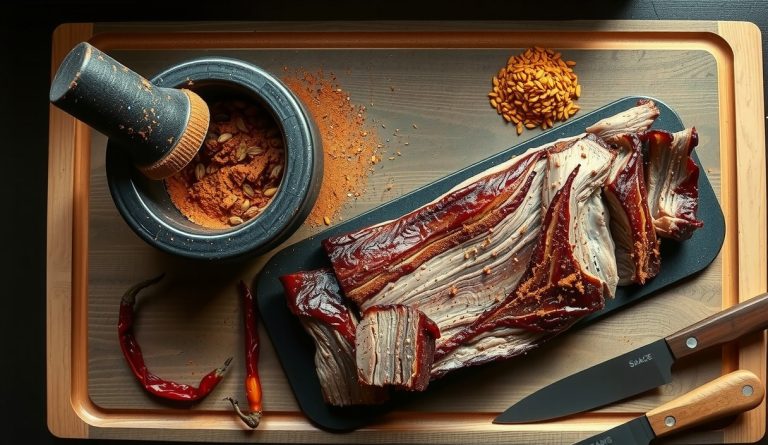
- Weigh each ingredient separately using a digital kitchen scale. Combine the kosher salt, black pepper, smoked paprika, ancho chile powder, garlic powder, onion powder, cayenne, and dry mustard in a mixing bowl.30 g coarse-ground black pepper, 18 g sweet smoked paprika (pimentón de la Vera dulce), 14 g ancho chile powder, 10 g garlic powder, 8 g onion powder, 4 g ground cayenne pepper, 4 g dry mustard powder
- Add the granular allulose. Whisk thoroughly until the rub is homogeneous — allulose is slightly more hygroscopic than the other components and will clump if not fully dispersed. The final rub should be visually uniform in color and texture.17 g granular D-allulose
- Transfer to an airtight jar. The rub keeps for up to 6 months at room temperature in a dark, dry location. Shake before each use as the allulose may settle.
Dry Brine the Brisket
- Pat the trimmed brisket completely dry on all surfaces with paper towels. Any surface moisture will dilute the rub and slow the osmotic draw.1 whole packer brisket, 12–14 lb, USDA Choice or Prime
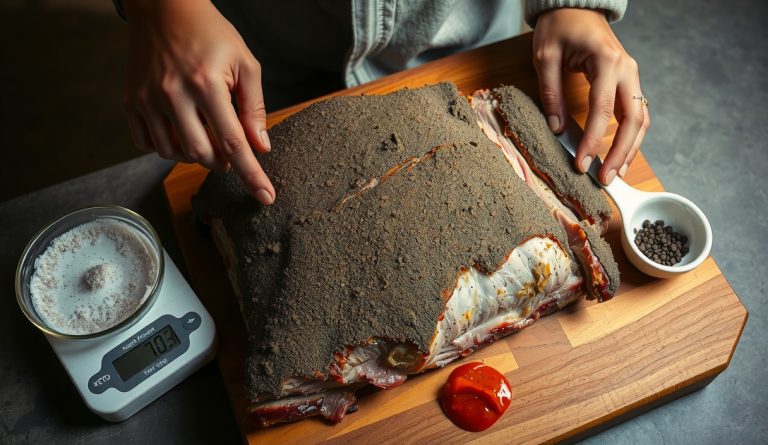
- Apply the rub generously and evenly across all surfaces of the brisket — fat cap, flat, point, and all edges. Target 2–2.5 grams of rub per 100 grams of estimated brisket surface area. For a 13 lb brisket, you will use approximately 100–110 grams of the total rub batch. Press the rub firmly into the meat surface to ensure adhesion.30 g coarse-ground black pepper, 18 g sweet smoked paprika (pimentón de la Vera dulce), 14 g ancho chile powder, 10 g garlic powder, 8 g onion powder, 4 g ground cayenne pepper, 4 g dry mustard powder, 17 g granular D-allulose, 1 whole packer brisket, 12–14 lb, USDA Choice or Prime
- Place the rubbed brisket on a wire rack set over a sheet pan. Refrigerate uncovered for 12–24 hours. Do not cover — you want air circulation over the surface to facilitate the initial moisture draw and evaporation cycle that drops surface water activity into the Maillard-active range before the cook begins.
Smoke the Brisket
- Remove the brisket from the refrigerator 45–60 minutes before cooking. Do not rinse off the rub. The surface should look slightly tacky and moist where the salt has drawn and reabsorbed moisture — this is correct.
- Fire the smoker and stabilize at 250–265°F at grate level. Verify temperature with a calibrated probe thermometer placed at the cooking grate, not by the dome gauge. Add your chosen wood — post oak for Central Texas authenticity, hickory or pecan for a heavier smoke profile. Allow the smoker to reach steady temperature before loading the brisket.
- Place the brisket fat cap up on the grate. Insert a leave-in probe thermometer into the thickest part of the flat, away from the fat seam. Close the smoker and do not open it for the first 6 hours minimum.
- Monitor the internal temperature through the stall — the long plateau between 155°F and 170°F is normal and driven by evaporative cooling. Do not panic and crank the heat. The surface Maillard chemistry is active during the stall even though the internal temperature is static. Allow the stall to resolve naturally, or wrap in butcher paper at 165°F internal to push through it while preserving bark integrity. Do not spritz with any liquid during this phase.
- Continue cooking until the internal temperature reaches 200–205°F and a probe slides into the thickest part of the flat with zero resistance — it should feel like probing warm butter. Color, feel, and probe-tenderness together define doneness, not temperature alone.
Rest and Slice
- Remove the brisket from the smoker. Rest uncovered on a wire rack for 15 minutes — this allows the bark to firm before wrapping. Then wrap tightly in butcher paper (not foil) and place in a dry cooler or warming oven at 150–160°F for a minimum of 1 hour, ideally 2–3 hours. The rest is non-negotiable for moisture redistribution and collagen gelation in the flat.
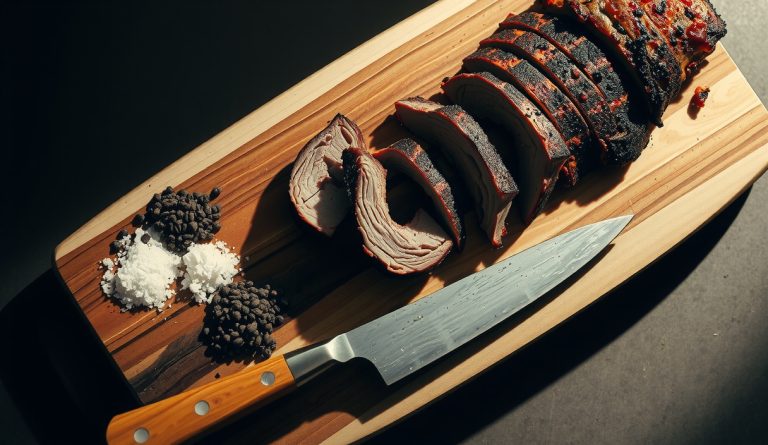
- Unwrap and slice against the grain. Slice the flat at approximately 1/4 inch thickness. Separate the point from the flat at the fat seam and slice the point against its own grain direction, which runs perpendicular to the flat. Serve immediately.
Notes
Nutrition
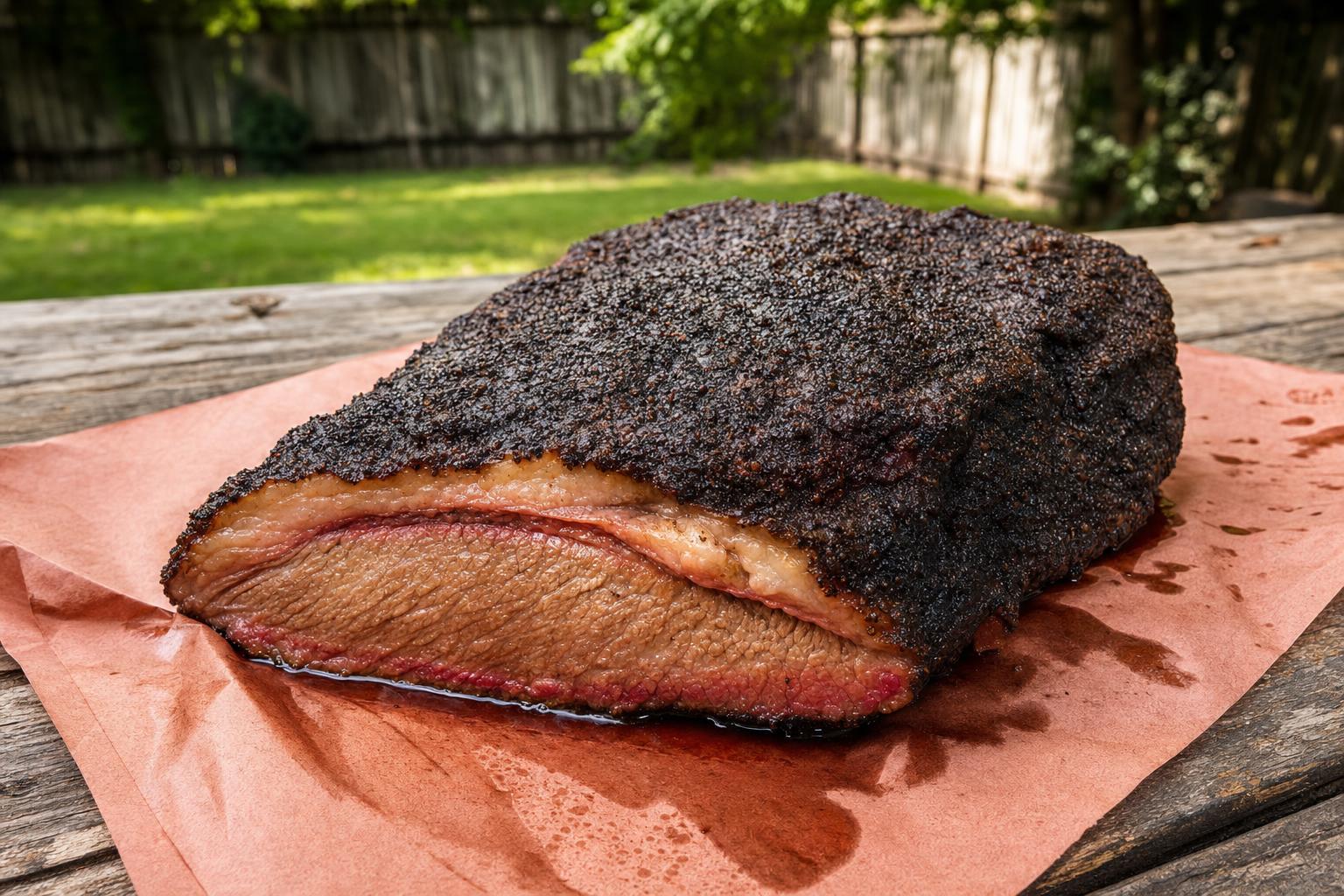
Every keto pitmaster has stood over a brisket at hour fourteen, scraping at a pale, dusty exterior that never developed the mahogany bark they wanted. The usual culprit they name is “no sugar.” That diagnosis is wrong — or at least deeply incomplete. The correct diagnosis is: not enough Maillard reactants at the surface layer. Fix the reactants, and the bark forms. Sucrose is just one way to deliver them. Allulose, it turns out, is a better one.
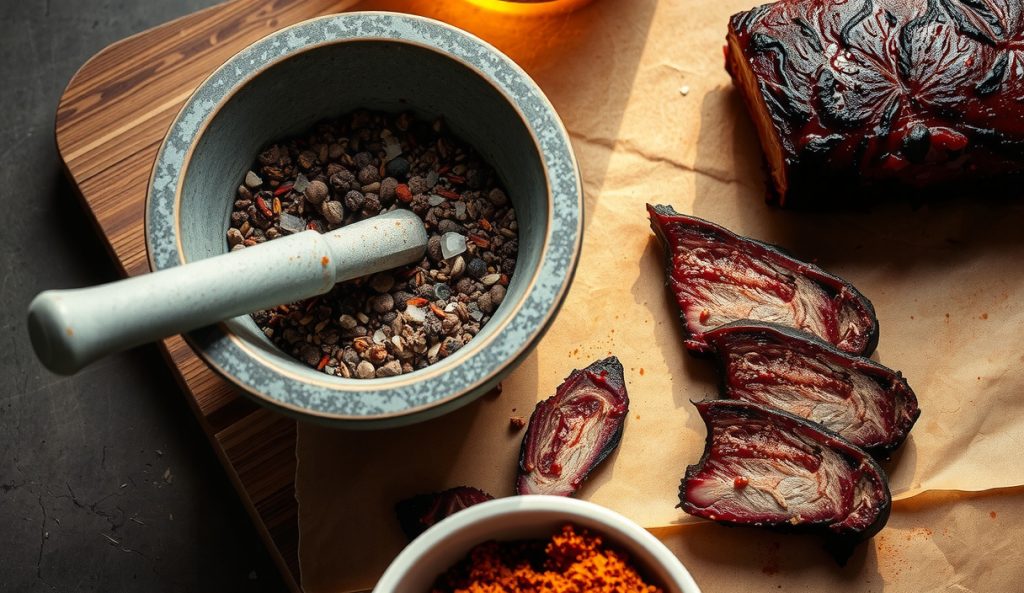
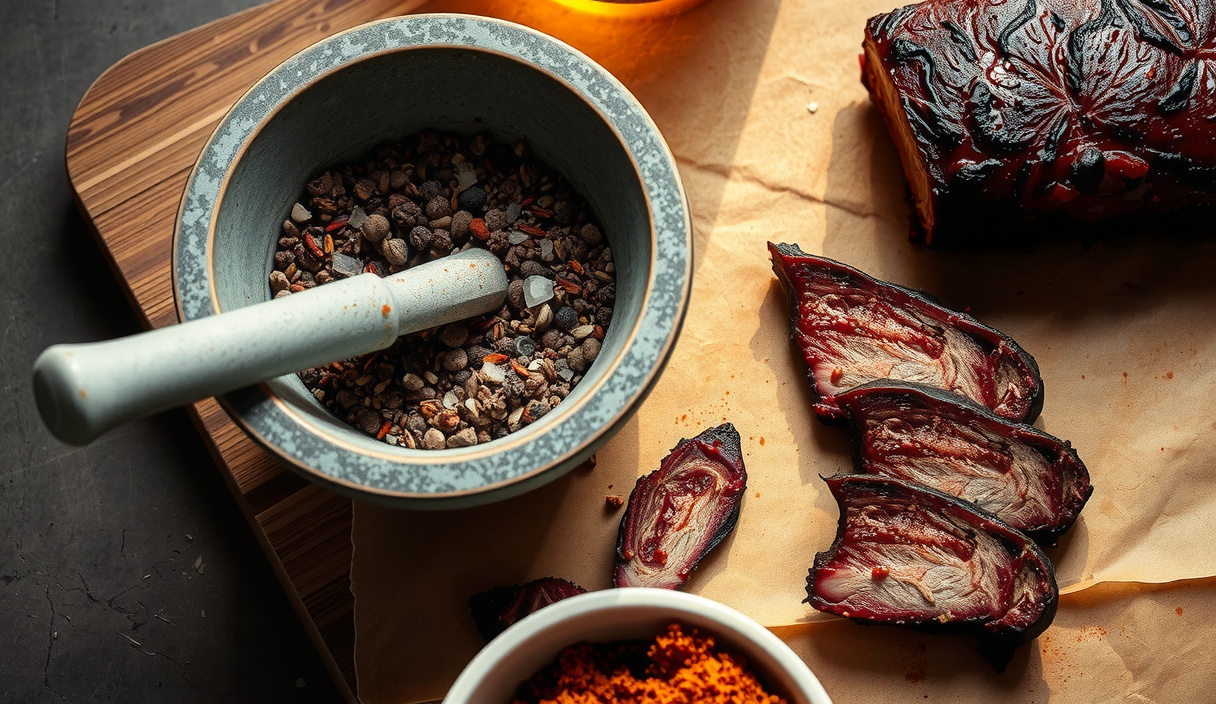
This rub takes the classic Central Texas salt-and-pepper foundation and builds a complete keto architecture around it — smoked paprika for color depth and a second-wave volatile organic compound hit, ancho for slow-building heat that does not front-load capsaicin on a 250°F cook, and a calibrated 5% allulose load by weight. That allulose percentage is not arbitrary. At 5% w/w, allulose supplies enough free reducing monosaccharide to sustain Maillard condensation across a 10-to-18-hour cook window without driving the bark into the acrid territory that high-fructose overloads produce. The net carb contribution per serving is negligible — allulose clears renally rather than metabolically.
Why does keto brisket bark form? The science
Bark formation on a smoked brisket is a surface-chemistry event, not a sugar event. The Maillard cascade — the amino-carbonyl condensation chain that runs from Schiff base formation through Amadori rearrangement and Strecker degradation — requires three things: a nucleophilic free amine group, an electrophilic reducing carbonyl, and a water activity (aw) between roughly 0.50 and 0.70 at the surface. Sucrose, being a non-reducing disaccharide, actually contributes nothing to this reaction until it hydrolyzes into glucose and fructose at high heat. What competition BBQ cooks call “sugar bark” is mostly free-monosaccharide bark — the sucrose just gets there first because high-heat hydrolysis is fast. At 250°F smoking temperatures, hydrolysis is slow and inefficient, meaning a large fraction of the sucrose never participates at all and instead sits as a hygroscopic layer that retards the surface drying required for crust formation.
Allulose is a C-3 epimer of fructose and a reducing monosaccharide — it carries a free aldehyde group ready for immediate Amadori condensation with the lysine and arginine residues in myofibrillar proteins, and it does not require hydrolysis. Allulose’s Maillard activation energy threshold is approximately 110°C (230°F), meaningfully lower than the 160°C threshold of sucrose. At pit temperatures of 225–275°F, allulose participates in browning chemistry continuously across the full cook, building a layered melanoidin crust rather than a sudden, late-stage caramelization event. The 5% w/w load used in this rub sits well below the threshold where allulose would push into advanced melanoidin accumulation and bitterness.
The stall — the notorious plateau between 160°F and 170°F internal — is a pure evaporative-cooling event. As surface water vaporizes, the evaporation absorbs latent heat energy as fast as the smoker delivers it, anchoring the surface temperature near 212°F and simultaneously maintaining a surface aw high enough to suppress browning. The coarse salt in this rub pulls additional surface moisture via osmotic draw in the first two hours; as that purged moisture evaporates, surface aw drops into the Maillard-optimal band. This mechanism is why applying the rub 12–24 hours before cooking — effectively a dry brine — produces visibly deeper bark than a same-day application.
What equipment and ingredients do I need?
- Allulose (granular, D-allulose): Use the fine-granular form, not the liquid syrup — dry w/w control requires a dry ingredient. Brands like Wholesome and NOW Foods are widely available. Measure allulose by weight, not volume; its particle density differs from sucrose.
- Smoked paprika vs. hot paprika: This recipe calls for sweet smoked paprika (pimentón de la Vera dulce). The smoking process during paprika production contributes an independent layer of guaiacol and syringol volatiles that persist through the cook. Hot smoked paprika skews the heat profile unpredictably alongside the ancho.
- Ancho chile powder: True ancho (dried poblano) runs 1,000–1,500 SHU and contributes fruity, raisin-adjacent volatile organic compounds alongside its mild heat. Generic “chili powder” blends include cumin, oregano, and salt — avoid them here; precise control over each variable is the goal.
- Black pepper — coarse grind: The coarse grind is structural, not decorative. Large pepper fragments create micro-pockets that trap moisture locally, supporting differential Maillard intensity across the bark surface — exactly what produces the visually complex, cratered bark texture.
- Salt — kosher, coarse: Diamond Crystal and Morton kosher differ in salinity by crystal density. This recipe was developed with Diamond Crystal. If using Morton, reduce the salt volume by approximately 20% or weigh to 18 grams.
- Offset smoker or ceramic kamado: This rub performs best in a convection-dominant smoke environment. Pellet grills work but tend to produce a thinner bark due to lower particulate smoke density. If using a pellet grill, add a smoke tube for supplemental smoke.
Keto Brisket Rub — No-Sugar Bark
Equipment
- 1 Offset smoker or ceramic kamado Target 250–265°F at grate level. Verify with a calibrated probe — not the dome thermometer.
- 1 Digital kitchen scale Gram-precision required for the allulose 5% w/w calculation. Volume measures are insufficiently accurate.
- 1 Instant-read probe thermometer For tracking internal brisket temperature through the stall and into the 200–205°F probe-tender window.
- 1 Mixing bowl Medium, for combining the dry rub components.
- 2 sheets Unwaxed butcher paper For wrapping at 165°F internal if needed. Do not use foil — it traps steam and softens the bark.
Ingredients
Rub Base
- 36 g kosher salt (Diamond Crystal) Coarse. If using Morton kosher salt, reduce to 29 g — Morton crystals are denser. This is approximately 3 tablespoons Diamond Crystal.
- 30 g coarse-ground black pepper 16–18 mesh coarseness. Pre-ground coarse, not fine. The large fragments are structurally important for bark texture.
- 18 g sweet smoked paprika (pimentón de la Vera dulce) Specifically sweet smoked, not hot. Contributes guaiacol and syringol volatiles plus color precursors.
- 14 g ancho chile powder Pure ancho only — not a chili powder blend. Adds fruity, low-heat depth without front-loading capsaicin.
- 10 g garlic powder Standard granulated garlic powder. Contributes alliin-derived sulfur volatiles and free amine groups.
- 8 g onion powder Adds propanethial S-oxide volatiles and fructan-derived browning precursors.
- 4 g ground cayenne pepper Optional heat layer. Omit or halve for a mild profile.
- 4 g dry mustard powder Provides isothiocyanate volatiles and emulsification support for rub adhesion.
Browning Agent
- 17 g granular D-allulose Fine granular form, not syrup. This constitutes 5% w/w of the total rub batch. Measure by weight. Supplies reducing monosaccharide for Maillard bark at pit temperatures without glycemic impact.
The Brisket
- 1 whole packer brisket, 12–14 lb, USDA Choice or Prime Fat cap trimmed to 1/4 inch. Point and flat intact. Dry the surface with paper towels before applying the rub.
Instructions
Make the Rub
- Weigh each ingredient separately using a digital kitchen scale. Combine the kosher salt, black pepper, smoked paprika, ancho chile powder, garlic powder, onion powder, cayenne, and dry mustard in a mixing bowl.30 g coarse-ground black pepper, 18 g sweet smoked paprika (pimentón de la Vera dulce), 14 g ancho chile powder, 10 g garlic powder, 8 g onion powder, 4 g ground cayenne pepper, 4 g dry mustard powder
- Add the granular allulose. Whisk thoroughly until the rub is homogeneous — allulose is slightly more hygroscopic than the other components and will clump if not fully dispersed. The final rub should be visually uniform in color and texture.17 g granular D-allulose
- Transfer to an airtight jar. The rub keeps for up to 6 months at room temperature in a dark, dry location. Shake before each use as the allulose may settle.
Dry Brine the Brisket
- Pat the trimmed brisket completely dry on all surfaces with paper towels. Any surface moisture will dilute the rub and slow the osmotic draw.1 whole packer brisket, 12–14 lb, USDA Choice or Prime
- Apply the rub generously and evenly across all surfaces of the brisket — fat cap, flat, point, and all edges. Target 2–2.5 grams of rub per 100 grams of estimated brisket surface area. For a 13 lb brisket, you will use approximately 100–110 grams of the total rub batch. Press the rub firmly into the meat surface to ensure adhesion.30 g coarse-ground black pepper, 18 g sweet smoked paprika (pimentón de la Vera dulce), 14 g ancho chile powder, 10 g garlic powder, 8 g onion powder, 4 g ground cayenne pepper, 4 g dry mustard powder, 17 g granular D-allulose, 1 whole packer brisket, 12–14 lb, USDA Choice or Prime
- Place the rubbed brisket on a wire rack set over a sheet pan. Refrigerate uncovered for 12–24 hours. Do not cover — you want air circulation over the surface to facilitate the initial moisture draw and evaporation cycle that drops surface water activity into the Maillard-active range before the cook begins.
Smoke the Brisket
- Remove the brisket from the refrigerator 45–60 minutes before cooking. Do not rinse off the rub. The surface should look slightly tacky and moist where the salt has drawn and reabsorbed moisture — this is correct.
- Fire the smoker and stabilize at 250–265°F at grate level. Verify temperature with a calibrated probe thermometer placed at the cooking grate, not by the dome gauge. Add your chosen wood — post oak for Central Texas authenticity, hickory or pecan for a heavier smoke profile. Allow the smoker to reach steady temperature before loading the brisket.
- Place the brisket fat cap up on the grate. Insert a leave-in probe thermometer into the thickest part of the flat, away from the fat seam. Close the smoker and do not open it for the first 6 hours minimum.
- Monitor the internal temperature through the stall — the long plateau between 155°F and 170°F is normal and driven by evaporative cooling. Do not panic and crank the heat. The surface Maillard chemistry is active during the stall even though the internal temperature is static. Allow the stall to resolve naturally, or wrap in butcher paper at 165°F internal to push through it while preserving bark integrity. Do not spritz with any liquid during this phase.
- Continue cooking until the internal temperature reaches 200–205°F and a probe slides into the thickest part of the flat with zero resistance — it should feel like probing warm butter. Color, feel, and probe-tenderness together define doneness, not temperature alone.
Rest and Slice
- Remove the brisket from the smoker. Rest uncovered on a wire rack for 15 minutes — this allows the bark to firm before wrapping. Then wrap tightly in butcher paper (not foil) and place in a dry cooler or warming oven at 150–160°F for a minimum of 1 hour, ideally 2–3 hours. The rest is non-negotiable for moisture redistribution and collagen gelation in the flat.
- Unwrap and slice against the grain. Slice the flat at approximately 1/4 inch thickness. Separate the point from the flat at the fat seam and slice the point against its own grain direction, which runs perpendicular to the flat. Serve immediately.
Notes
Nutrition
How do I nail this keto brisket rub every time?
- Apply the rub 12–24 hours ahead. The dry-brine window allows salt to draw surface moisture and then reabsorb into the meat, seasoning the outer protein layer and dropping surface aw into the Maillard-optimal band before the cook even starts. Same-day application produces noticeably lighter bark, full stop.
- Do not spritz with anything sweet during the stall. Apple juice, apple cider, honey-water — all common spritz bases — introduce fructose and glucose to the surface mid-cook, temporarily spiking local aw back above 0.70 and suppressing the browning that was building. If moisture management is needed during the stall, use plain water or beef tallow. Better yet, wrap in butcher paper at 165°F internal and let the brisket push through.
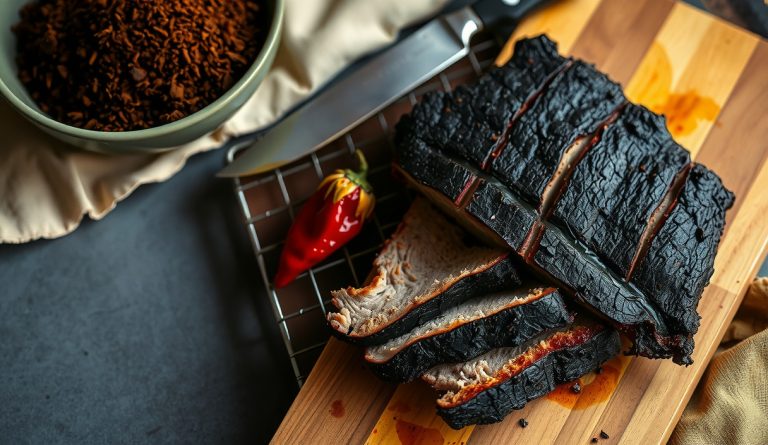
- Monitor surface color, not time. The Maillard cascade does not run on a clock. Bark is ready to set when the exterior reads a deep mahogany-to-black and is dry to the touch — no tackiness. A tacky surface at hour ten signals that pit temperature or airflow is too low to push surface aw down into the crust-forming range.
- Rest on a rack, uncovered, for 15 minutes before wrapping. Immediately wrapping a hot brisket in foil or butcher paper traps steam and softens the bark. A short open rest allows the surface to firm before the long hold. Then wrap and hold in a dry cooler at 140°F–160°F internal for at least 1 hour, ideally 2–3 hours.
- Do not disturb the fat cap during the cook. Fat renders continuously and bastes the surface in a self-lubricating system that carries fat-soluble volatile organic compounds from the rub into the surface layer. Trimming or disturbing the fat cap mid-cook interrupts this mechanism and produces uneven bark.
- If bark is too dark at hour 12: Tent very loosely with a single layer of unwaxed butcher paper — not foil — to reduce radiant heat input without trapping steam. This approach buys another 2–4 hours without scorching the crust further.
What variations can I make on this keto brisket rub?
Texas Minimalist (Salt-Pepper Only): To honor the Central Texas tradition of beef-forward simplicity, reduce the rub to just kosher salt and coarse black pepper at a 1:1 ratio by weight, and drop the allulose to 3% w/w. Bark will still form — the paprika and ancho color and volatile organic compound complexity are the only losses. This variation is the purest test of smoke and beef, and it carries a clean keto profile with essentially zero carbohydrate load.
Coffee-Ancho Variation: Add 10 grams of finely ground espresso roast (medium-fine grind, not coarse) to the base recipe. Coffee contributes a dense array of Maillard precursor compounds — primarily furans and pyrazines from its own roasting process — that layer onto the brisket’s surface chemistry. The result is a darker, more complex bark with pronounced roasted bitterness that pairs exceptionally well with fatty point-cut brisket. Keep the allulose at 5%; the coffee’s own reducing sugars are present in small quantities and contribute negligibly to the keto load.
Chipotle-Cumin Variation (Tex-Mex Profile): Swap the ancho chile powder for chipotle morita powder and add 8 grams of ground cumin. Chipotle runs approximately 2,500–8,000 SHU and carries smoke-cured pepper volatile organic compounds that stack onto the smoked paprika base. The cumin introduces terpenoid volatiles — cuminaldehyde, para-cymene — that shift the aroma profile firmly into Tex-Mex territory. This variation works particularly well when finishing the brisket for tacos or enchiladas.
Scaling for a Whole Packer (14–18 lb): This recipe is formulated for a 12–14 lb packer brisket. For a full 18-pounder, scale the rub by 1.4x. The target application rate is 2–2.5 grams of rub per 100 grams of surface area — roughly 1 tablespoon per side of the flat, heavier on the point. Do not eyeball the application; consistent bark requires consistent rub thickness, and variation in application rate is one of the most common sources of patchy bark.
Frequently asked questions
Can I substitute erythritol for allulose in the rub? No — and this is a hard no. Erythritol is a 4-carbon sugar alcohol that does not participate meaningfully in the Maillard cascade and will not contribute to browning at smoking temperatures. Using erythritol in place of allulose makes the rub perform as though no reducing sugar is present at all — the functional equivalent of a plain salt-pepper rub. Allulose is the specific molecular choice here because it is a reducing monosaccharide with a low Maillard activation energy threshold of approximately 110°C. No other sweetener in the keto space replicates this function.
Will the 5% allulose kick me out of ketosis? Allulose is metabolized and excreted renally rather than glycolytically — the FDA recognizes allulose as contributing approximately 0.2–0.4 kcal/g rather than the 4 kcal/g of glucose. Allulose does not meaningfully raise blood glucose or insulin and is not counted in net carbohydrates in the United States. The total allulose in this rub formulation is approximately 17 grams across the entire brisket. Distributed across 12–16 servings at 2–2.5 grams of rub per serving, the per-serving allulose exposure is under 1.5 grams — negligible in any practical keto context.
My bark is still pale after 14 hours. What went wrong? Three likely culprits, in order of probability: (1) The pit temperature is running low — verify with a calibrated probe at grate level, not the dome thermometer, which often reads 15–25°F high. A true 225°F at the grate may not supply enough thermal energy to push surface aw below the Maillard-active threshold efficiently; increase to 250–265°F. (2) The brisket was spritzed or mopped during the cook, repeatedly resetting surface moisture to aw levels above 0.70 and suppressing browning each time. (3) The rub was applied same-day without a dry-brine rest, so surface moisture had not been managed before the cook began. For the next cook: apply the rub 18 hours ahead, cook at 260°F, and do not open the smoker before hour 6.