Plant-Based ‘Pulled Pork’ — Jackfruit + Soy Curls

Equipment
- 1 Smoker or kettle grill with indirect heat setup Target 225°F at grate level. A two-zone charcoal setup with apple or cherry wood chunks works equivalently to a pellet smoker.
- 2-3 Wood chunks (apple or cherry) For smoke flavor. Avoid mesquite — it over-dominates the delicate jackfruit matrix.
- 1 Large cast iron skillet or Dutch oven For the braise phase. Must be oven-safe to 300°F if finishing in the oven.
- 1 Wire rack set inside a rimmed baking sheet For drying jackfruit before seasoning and smoking.
- 2 Two forks For shredding. Pull apart at 130–140°F internal — not scalding hot.
- 1 Instant-read thermometer For monitoring both smoker grate temperature and braise temperature.
Ingredients
Jackfruit
- 2 cans (20 oz each) young green jackfruit in brine Drained, rinsed thoroughly, and patted completely dry. Do not use ripe jackfruit in syrup.
- 2 tbsp smoked paprika (pimentón de la Vera) Sweet or bittersweet variety. Check label for authentic oak-smoke processing.
- 1 tbsp ground cumin
- 1 tsp garlic powder
- 1 tsp onion powder
- 1 tsp fine sea salt
- ½ tsp black pepper, freshly ground
- ½ tsp cayenne pepper Adjust to heat preference.
- 1 tbsp neutral oil (avocado or sunflower) Helps dry rub adhere to jackfruit surface and promotes smoke adhesion.
Soy Curls
- 2 oz dry soy curls (Butler Foods or equivalent whole-soybean TVP) Approximately 2 loosely packed cups dry.
- 1 cup low-sodium vegetable broth Warm, 140–160°F. Used for rehydration.
- 1 tbsp apple cider vinegar Added to the rehydration liquid to suppress LOX-driven off-notes in soy matrix.
- ½ tsp smoked paprika Added to the rehydration liquid to pre-season soy curls.
Braising Sauce
- 1 cup crushed tomatoes Provides free glutamic acid (umami baseline) and pectin for natural sauce body.
- ½ cup low-sodium vegetable broth
- 3 tbsp apple cider vinegar Organic, unfiltered preferred. Primary acid for LOX suppression and flavor balance.
- 2 tbsp tomato paste Concentrated free glutamates and Maillard products. Stir into the sauce off the direct heat to avoid scorching.
- 2 tbsp molasses (unsulfured) Adds body, dark color, and a low-Maillard browning note. Omit for Carolina-style variation.
- 1 tbsp smoked paprika Reinforces the smoke signal with pyrazines and furanones from its own Maillard cascade.
- 1 tbsp soy sauce or tamari (gluten-free if needed) Delivers free glutamate and 5′-nucleotide synergy. Use coconut aminos for soy-free variation.
- 1 tsp ground cumin
- 1 tsp garlic powder
- ½ tsp onion powder
- ½ tsp black pepper
- ¼ tsp cayenne pepper
For Serving
- 6 hamburger buns or slider buns (use GF buns as needed)
- 1 cup coleslaw (store-bought or homemade) Optional but recommended — the acid and crunch contrast the rich, smoky braise.
- ¼ cup pickled red onion Optional. Adds bright acidity and color contrast.

Instructions
Prep: Jackfruit
- Drain and rinse the canned jackfruit thoroughly under cold running water. Using your hands, squeeze each piece firmly over the sink to expel as much brine and excess water as possible. Spread the pieces on a wire rack set inside a rimmed baking sheet. Pat dry with paper towels, then allow to air-dry at room temperature for 15 minutes. A completely dry surface is non-negotiable for smoke adhesion. Any residual moisture film will cause the phenolic smoke compounds to dissolve and evaporate rather than deposit on the matrix.
- While the jackfruit dries, combine the smoked paprika, cumin, garlic powder, onion powder, salt, black pepper, and cayenne in a small bowl to make the dry rub. Drizzle the oil over the dried jackfruit pieces and toss to coat evenly. Sprinkle the dry rub over the oiled jackfruit and toss again, pressing the spices into the surface so they adhere. Set aside.2 tbsp smoked paprika (pimentón de la Vera), 1 tbsp ground cumin, 1 tsp garlic powder, 1 tsp onion powder, 1 tsp fine sea salt, 1/2 tsp black pepper, freshly ground, 1/2 tsp cayenne pepper, 1 tbsp neutral oil (avocado or sunflower)
Rehydrate: Soy Curls
- In a medium bowl, combine the warm vegetable broth (140–160°F / 60–71°C — not boiling), apple cider vinegar, and smoked paprika for the soy curl rehydration liquid. Add the dry soy curls and stir to submerge. Allow to rehydrate for 15 minutes, stirring once halfway through. Do not use boiling liquid — temperatures above 170°F collapse the cellular matrix of the soy curls into a dense, rubbery mass. The acidic rehydration environment (target pH 4.5–5.0) actively denatures residual lipoxygenase in the soy matrix, suppressing hexanal and related aldehyde off-notes before any heat is applied.1 cup low-sodium vegetable broth, 1 tbsp apple cider vinegar, 1/2 tsp smoked paprika, 1 cup crushed tomatoes
- After 15 minutes, drain the rehydrated soy curls, reserving the rehydration liquid. Squeeze the soy curls firmly to remove excess liquid. Tear any large pieces into smaller, pulled-pork-scale shreds. Set aside. Reserve the rehydration liquid — it carries seasoning and will be incorporated into the braise.1 cup low-sodium vegetable broth
Smoke: Jackfruit
- Set up your smoker or grill for indirect cooking at 225°F (107°C) measured at the grate. Add 2–3 chunks of apple or cherry wood. Allow the smoke to establish and run clean (thin blue smoke, not thick white billowing smoke) before loading the jackfruit. Thick white smoke indicates incomplete combustion and will deposit acrid creosote rather than clean phenolic flavor compounds.
- Place the seasoned jackfruit pieces directly on the grate over the indirect zone in a single layer. Close the lid and smoke at 225°F (107°C) for 90 minutes, adding wood as needed to maintain visible smoke for at least the first 60 minutes. Do not open the lid during the first 45 minutes — every lid-lift drops the grate temperature by 30–50°F and disrupts the evaporative stall that concentrates the flavor-forming surface reactions. After 90 minutes, the jackfruit should be slightly dried on the exterior, deeply colored, and carry a pronounced smoky aroma. Remove from the smoker and set aside.
Build: Braising Sauce
- While the jackfruit smokes, combine all braising sauce ingredients — crushed tomatoes, vegetable broth, apple cider vinegar, tomato paste, molasses, smoked paprika, soy sauce, cumin, garlic powder, onion powder, black pepper, and cayenne — in a large Dutch oven or cast iron skillet. Whisk until the tomato paste and molasses are fully dissolved and homogeneous. The sauce should read pH 4.0–4.5 (test with a strip if you have one) — this acidic environment completes LOX denaturation and activates the pectin-release mechanism in the jackfruit during the braise.1/2 cup low-sodium vegetable broth, 3 tbsp apple cider vinegar, 2 tbsp tomato paste, 2 tbsp molasses (unsulfured), 1 tbsp smoked paprika, 1 tbsp soy sauce or tamari (gluten-free if needed), 1 tsp ground cumin, 1 tsp garlic powder, 1/2 tsp onion powder, 1/2 tsp black pepper, 1/4 tsp cayenne pepper, 6 hamburger buns or slider buns (use GF buns as needed)
Braise: Jackfruit + Soy Curls
- Add the smoked jackfruit pieces and the drained, shredded soy curls to the braising sauce. Add 1/4 cup of the reserved soy curl rehydration liquid to the pot. Stir gently to coat everything with the sauce. Bring to a gentle simmer over medium heat on the stovetop, then reduce heat to low. Cover and braise at a bare simmer — target 185–195°F (85–90°C) internal pot temperature — for 45–55 minutes, stirring every 15 minutes to prevent the bottom from scorching and to distribute the sauce evenly.1 cup low-sodium vegetable broth, 1/2 cup low-sodium vegetable broth, 3 tbsp apple cider vinegar
- After 45 minutes, check the jackfruit texture: it should pull apart easily under fork pressure into long, fibrous strands without resistance. If it still feels dense, continue braising in 10-minute increments. Do not allow the braise to exceed 205°F (96°C) — above this threshold, the cellulose walls of the jackfruit cells fully collapse and the strands disintegrate into paste rather than remaining shred-able. Remove the lid for the final 10 minutes of braising to allow the sauce to reduce and concentrate. The finished sauce should cling to the jackfruit strands rather than pool at the bottom of the pot.1 cup low-sodium vegetable broth
Shred and Serve
- Remove the pot from heat and allow to cool slightly until the mixture reaches 130–140°F (54–60°C) — warm to the touch but no longer scalding. Using two forks, shred the jackfruit pieces in the pot by pulling the strands apart against each other. The soy curls will integrate naturally with the jackfruit strands. Shredding at this temperature produces long, clean strands; shredding at scalding temperatures causes the strands to clump and steam-fuse before you can separate them.1 cup low-sodium vegetable broth
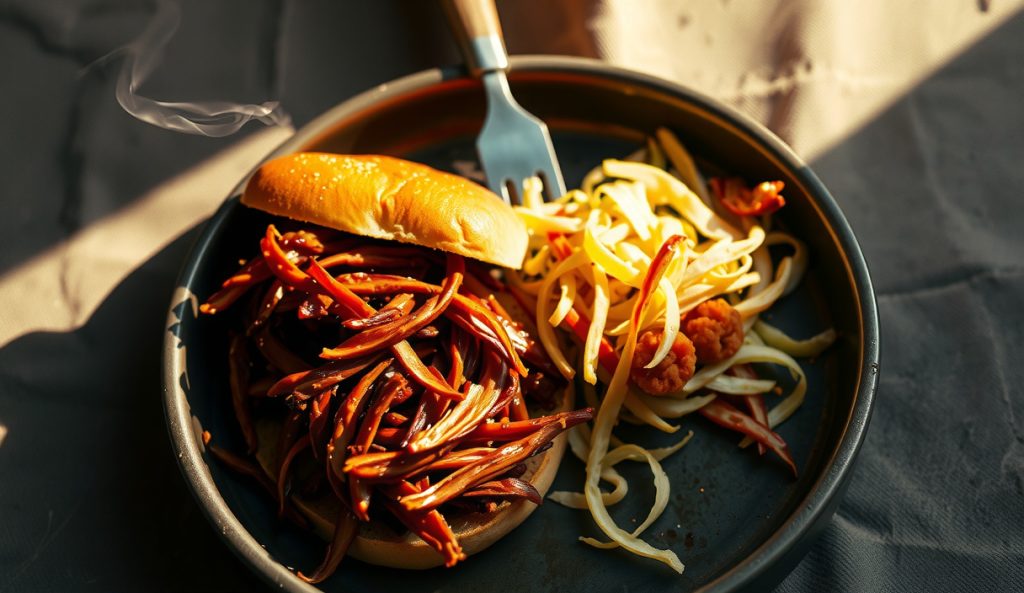
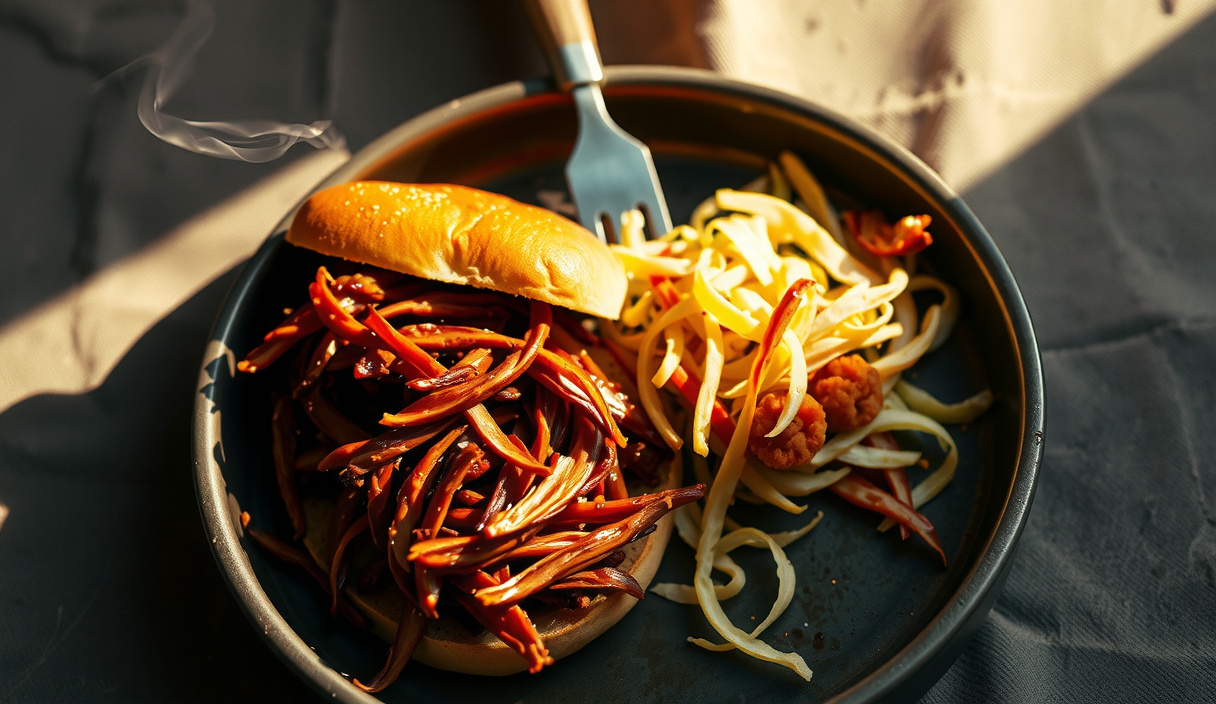
- Taste the finished pulled jackfruit. If you detect any residual grassy or green off-note (residual aldehyde), stir in 1 additional tablespoon of apple cider vinegar and toss over low heat for 3 minutes. Adjust salt if needed. Serve piled high on buns with coleslaw and pickled red onion.2 tbsp tomato paste, 1 cup coleslaw (store-bought or homemade), 1/4 cup pickled red onion
Notes
Nutrition
The first time I pulled apart a smoked head of young green jackfruit, I had to stop and look twice. The fibrous architecture of the unripe fruit — long, directional strands running parallel to the core — is so structurally close to myofibrillar muscle tissue that it genuinely fools the eye. But visual fidelity is the easy part. The hard part is making plant-based pulled pork taste like something that spent eight hours over white oak, carry enough protein to function as a main course, and not smell like a bag of cut grass.
That last problem — the raw, green, beany off-note that haunts so many plant-based dishes — is a lipoxygenase problem, not a seasoning problem. The enzyme LOX oxidizes linoleic acid into volatile hexanal and related aldehydes, and no amount of cumin will mask it if the underlying chemistry is still running. This recipe intercepts that reaction at two points: the acid environment of the braising liquid denatures residual LOX, and the smoked paprika’s Maillard-derived pyrazines layer over any remaining green volatiles with roasted depth. The result is a plate of plant-based pulled pork that passes the smell test before it ever passes the taste test.
Why does plant-based pulled pork work? The science
Young green jackfruit (Artocarpus heterophyllus) produces convincing pulled-pork texture because its mesocarp is built from elongated parenchyma cells reinforced by cellulose and pectin — a fibrous architecture that mirrors skeletal muscle at the macro scale. The jackfruit is harvested before the fruit accumulates sugars or softens, so at this stage the flesh is dense and shreds under fork pressure rather than collapsing into sweetness.
During the smoke phase at 225°F (107°C), surface evaporation anchors the boundary-layer temperature near 212°F (100°C) — the same evaporative stall that pitmaster lore calls ‘the stall’ on brisket. Energy is consumed by the latent heat of vaporization rather than raising internal temperature, which is precisely why the smoke phase must run long: the phenolic compounds in wood smoke (guaiacol, syringol, 4-methylguaiacol) need time to deposit on the jackfruit surface and penetrate the outer cellular layers via vapor-phase diffusion. Cut the smoke phase short and you get surface color without aromatic depth.
Soy curls — a full-fat, minimally processed TVP made from the whole soybean — are rehydrated separately before entering the cook. Rehydrating the soy curls in warm, mildly acidic liquid (apple cider vinegar diluted in vegetable broth) serves two functions. First, the pH-driven environment begins denaturation of any residual lipoxygenase in the soy matrix, suppressing hexanal generation before the soy curls ever meet heat. Second, the acidic brine pre-seasons the soy protein matrix at the molecular level: salt and organic acids penetrate faster into a hydrated, open protein network than into a dry, compact one. The soy curl’s protein — predominantly glycinin and beta-conglycinin globulins — sits well above its isoelectric point at the working pH of 4–5, keeping the chains in solution and maximally hydrated rather than precipitated and chalky.
The braise is where both components converge. The braising liquid — built on crushed tomatoes, smoked paprika, apple cider vinegar, and low-sodium vegetable broth — creates an acidic, Maillard-active environment. The tomato’s free glutamic acid provides baseline umami. The smoked paprika contributes a dense library of pyrazines and furanones from its own prior Maillard cascade, effectively doubling the roasted-savory signal without adding any animal-derived nucleotides. Pectin released from the jackfruit’s softening cell walls thickens the sauce naturally as the braise reduces, providing cling and body without starch. Total cook time keeps the jackfruit below the threshold where cellulose fully disintegrates — the goal is firm-tender strands that shred under fork pressure, not a homogeneous paste.
What equipment and ingredients do I need?
- Young green jackfruit in brine (canned): Not ripe jackfruit in syrup. The brine-packed variety has zero residual sweetness and a neutral pH that accepts smoke and acid seasoning without fighting back. Drain and rinse thoroughly — residual brine is high-sodium and dilutes your seasoning control.
- Soy curls (Butler Foods brand): Whole-soybean TVP with a naturally open, sponge-like cellular matrix ideal for rehydration. Do not substitute with isolated soy protein TVP crumbles — the texture and fat content differ materially. If soy curls are unavailable, use 2 cups of rehydrated pea protein curls, noting you may need to add 1 tsp of sunflower lecithin to the rehydration liquid to compensate for lower native fat content.
- Smoker or kettle grill with indirect heat: Target 225°F (107°C) grate temperature measured at the grate level, not the dome thermometer. A two-zone charcoal setup with a full chimney of hardwood lump coal plus 2–3 chunks of apple or cherry wood works precisely as well as a pellet smoker. No smoker? A 250°F oven with 1 tsp liquid smoke stirred into the braise is the fallback — smoke penetration will be surface-only but the flavor profile is acceptable.
- Smoked paprika: Use a Spanish-style pimentón de la Vera (sweet or bittersweet) rather than a generic smoked paprika. The former is cold-smoked over oak, carrying a richer pyrazine spectrum. Check the label — if ‘artificial smoke flavor’ appears, the Maillard chemistry is absent.
- Apple cider vinegar: Organic, unfiltered. The acetic acid drives LOX suppression in the soy rehydration step and provides the bright, high-note acid contrast to the heavy smoke and tomato base.
Plant-Based ‘Pulled Pork’ — Jackfruit + Soy Curls
Equipment
- 1 Smoker or kettle grill with indirect heat setup Target 225°F at grate level. A two-zone charcoal setup with apple or cherry wood chunks works equivalently to a pellet smoker.
- 2-3 Wood chunks (apple or cherry) For smoke flavor. Avoid mesquite — it over-dominates the delicate jackfruit matrix.
- 1 Large cast iron skillet or Dutch oven For the braise phase. Must be oven-safe to 300°F if finishing in the oven.
- 1 Wire rack set inside a rimmed baking sheet For drying jackfruit before seasoning and smoking.
- 2 Two forks For shredding. Pull apart at 130–140°F internal — not scalding hot.
- 1 Instant-read thermometer For monitoring both smoker grate temperature and braise temperature.
Ingredients
Jackfruit
- 2 cans (20 oz each) young green jackfruit in brine Drained, rinsed thoroughly, and patted completely dry. Do not use ripe jackfruit in syrup.
- 2 tbsp smoked paprika (pimentón de la Vera) Sweet or bittersweet variety. Check label for authentic oak-smoke processing.
- 1 tbsp ground cumin
- 1 tsp garlic powder
- 1 tsp onion powder
- 1 tsp fine sea salt
- ½ tsp black pepper, freshly ground
- ½ tsp cayenne pepper Adjust to heat preference.
- 1 tbsp neutral oil (avocado or sunflower) Helps dry rub adhere to jackfruit surface and promotes smoke adhesion.
Soy Curls
- 2 oz dry soy curls (Butler Foods or equivalent whole-soybean TVP) Approximately 2 loosely packed cups dry.
- 1 cup low-sodium vegetable broth Warm, 140–160°F. Used for rehydration.
- 1 tbsp apple cider vinegar Added to the rehydration liquid to suppress LOX-driven off-notes in soy matrix.
- ½ tsp smoked paprika Added to the rehydration liquid to pre-season soy curls.
Braising Sauce
- 1 cup crushed tomatoes Provides free glutamic acid (umami baseline) and pectin for natural sauce body.
- ½ cup low-sodium vegetable broth
- 3 tbsp apple cider vinegar Organic, unfiltered preferred. Primary acid for LOX suppression and flavor balance.
- 2 tbsp tomato paste Concentrated free glutamates and Maillard products. Stir into the sauce off the direct heat to avoid scorching.
- 2 tbsp molasses (unsulfured) Adds body, dark color, and a low-Maillard browning note. Omit for Carolina-style variation.
- 1 tbsp smoked paprika Reinforces the smoke signal with pyrazines and furanones from its own Maillard cascade.
- 1 tbsp soy sauce or tamari (gluten-free if needed) Delivers free glutamate and 5′-nucleotide synergy. Use coconut aminos for soy-free variation.
- 1 tsp ground cumin
- 1 tsp garlic powder
- ½ tsp onion powder
- ½ tsp black pepper
- ¼ tsp cayenne pepper
For Serving
- 6 hamburger buns or slider buns (use GF buns as needed)
- 1 cup coleslaw (store-bought or homemade) Optional but recommended — the acid and crunch contrast the rich, smoky braise.
- ¼ cup pickled red onion Optional. Adds bright acidity and color contrast.
Instructions
Prep: Jackfruit
- Drain and rinse the canned jackfruit thoroughly under cold running water. Using your hands, squeeze each piece firmly over the sink to expel as much brine and excess water as possible. Spread the pieces on a wire rack set inside a rimmed baking sheet. Pat dry with paper towels, then allow to air-dry at room temperature for 15 minutes. A completely dry surface is non-negotiable for smoke adhesion. Any residual moisture film will cause the phenolic smoke compounds to dissolve and evaporate rather than deposit on the matrix.
- While the jackfruit dries, combine the smoked paprika, cumin, garlic powder, onion powder, salt, black pepper, and cayenne in a small bowl to make the dry rub. Drizzle the oil over the dried jackfruit pieces and toss to coat evenly. Sprinkle the dry rub over the oiled jackfruit and toss again, pressing the spices into the surface so they adhere. Set aside.2 tbsp smoked paprika (pimentón de la Vera), 1 tbsp ground cumin, 1 tsp garlic powder, 1 tsp onion powder, 1 tsp fine sea salt, 1/2 tsp black pepper, freshly ground, 1/2 tsp cayenne pepper, 1 tbsp neutral oil (avocado or sunflower)
Rehydrate: Soy Curls
- In a medium bowl, combine the warm vegetable broth (140–160°F / 60–71°C — not boiling), apple cider vinegar, and smoked paprika for the soy curl rehydration liquid. Add the dry soy curls and stir to submerge. Allow to rehydrate for 15 minutes, stirring once halfway through. Do not use boiling liquid — temperatures above 170°F collapse the cellular matrix of the soy curls into a dense, rubbery mass. The acidic rehydration environment (target pH 4.5–5.0) actively denatures residual lipoxygenase in the soy matrix, suppressing hexanal and related aldehyde off-notes before any heat is applied.1 cup low-sodium vegetable broth, 1 tbsp apple cider vinegar, 1/2 tsp smoked paprika, 1 cup crushed tomatoes
- After 15 minutes, drain the rehydrated soy curls, reserving the rehydration liquid. Squeeze the soy curls firmly to remove excess liquid. Tear any large pieces into smaller, pulled-pork-scale shreds. Set aside. Reserve the rehydration liquid — it carries seasoning and will be incorporated into the braise.1 cup low-sodium vegetable broth
Smoke: Jackfruit
- Set up your smoker or grill for indirect cooking at 225°F (107°C) measured at the grate. Add 2–3 chunks of apple or cherry wood. Allow the smoke to establish and run clean (thin blue smoke, not thick white billowing smoke) before loading the jackfruit. Thick white smoke indicates incomplete combustion and will deposit acrid creosote rather than clean phenolic flavor compounds.
- Place the seasoned jackfruit pieces directly on the grate over the indirect zone in a single layer. Close the lid and smoke at 225°F (107°C) for 90 minutes, adding wood as needed to maintain visible smoke for at least the first 60 minutes. Do not open the lid during the first 45 minutes — every lid-lift drops the grate temperature by 30–50°F and disrupts the evaporative stall that concentrates the flavor-forming surface reactions. After 90 minutes, the jackfruit should be slightly dried on the exterior, deeply colored, and carry a pronounced smoky aroma. Remove from the smoker and set aside.
Build: Braising Sauce
- While the jackfruit smokes, combine all braising sauce ingredients — crushed tomatoes, vegetable broth, apple cider vinegar, tomato paste, molasses, smoked paprika, soy sauce, cumin, garlic powder, onion powder, black pepper, and cayenne — in a large Dutch oven or cast iron skillet. Whisk until the tomato paste and molasses are fully dissolved and homogeneous. The sauce should read pH 4.0–4.5 (test with a strip if you have one) — this acidic environment completes LOX denaturation and activates the pectin-release mechanism in the jackfruit during the braise.1/2 cup low-sodium vegetable broth, 3 tbsp apple cider vinegar, 2 tbsp tomato paste, 2 tbsp molasses (unsulfured), 1 tbsp smoked paprika, 1 tbsp soy sauce or tamari (gluten-free if needed), 1 tsp ground cumin, 1 tsp garlic powder, 1/2 tsp onion powder, 1/2 tsp black pepper, 1/4 tsp cayenne pepper, 6 hamburger buns or slider buns (use GF buns as needed)
Braise: Jackfruit + Soy Curls
- Add the smoked jackfruit pieces and the drained, shredded soy curls to the braising sauce. Add 1/4 cup of the reserved soy curl rehydration liquid to the pot. Stir gently to coat everything with the sauce. Bring to a gentle simmer over medium heat on the stovetop, then reduce heat to low. Cover and braise at a bare simmer — target 185–195°F (85–90°C) internal pot temperature — for 45–55 minutes, stirring every 15 minutes to prevent the bottom from scorching and to distribute the sauce evenly.1 cup low-sodium vegetable broth, 1/2 cup low-sodium vegetable broth, 3 tbsp apple cider vinegar
- After 45 minutes, check the jackfruit texture: it should pull apart easily under fork pressure into long, fibrous strands without resistance. If it still feels dense, continue braising in 10-minute increments. Do not allow the braise to exceed 205°F (96°C) — above this threshold, the cellulose walls of the jackfruit cells fully collapse and the strands disintegrate into paste rather than remaining shred-able. Remove the lid for the final 10 minutes of braising to allow the sauce to reduce and concentrate. The finished sauce should cling to the jackfruit strands rather than pool at the bottom of the pot.1 cup low-sodium vegetable broth
Shred and Serve
- Remove the pot from heat and allow to cool slightly until the mixture reaches 130–140°F (54–60°C) — warm to the touch but no longer scalding. Using two forks, shred the jackfruit pieces in the pot by pulling the strands apart against each other. The soy curls will integrate naturally with the jackfruit strands. Shredding at this temperature produces long, clean strands; shredding at scalding temperatures causes the strands to clump and steam-fuse before you can separate them.1 cup low-sodium vegetable broth
- Taste the finished pulled jackfruit. If you detect any residual grassy or green off-note (residual aldehyde), stir in 1 additional tablespoon of apple cider vinegar and toss over low heat for 3 minutes. Adjust salt if needed. Serve piled high on buns with coleslaw and pickled red onion.2 tbsp tomato paste, 1 cup coleslaw (store-bought or homemade), 1/4 cup pickled red onion
Notes
Nutrition
How do I nail it every time? Tips for success
- Dry the jackfruit thoroughly before the smoker. Surface moisture kills smoke adhesion. Pat the drained, rinsed pieces with a clean towel and let them air-dry on a wire rack for 15 minutes before seasoning. A dry surface means the phenolic smoke compounds in the vapor phase have direct contact with the fruit matrix rather than dissolving into and evaporating off a water film first.
- Season in layers, not all at once. Apply the dry rub to the jackfruit before the smoke phase and hold the wet braising sauce for after. Adding acid-heavy sauce to a smoker load drops the surface pH below the Maillard optimal window (pH 6–8) and accelerates pectin degradation, producing mushy strands before they have had time to take on smoke character.
- Rehydrate soy curls in warm, not boiling, liquid. Boiling collapses the cellular matrix of the soy curl into a dense, rubbery mass. Warm liquid at 140–160°F (60–71°C) allows the protein network to open gradually, maximizing water uptake without triggering irreversible thermal aggregation of the globulin fraction.
- Watch the braise temperature — keep it at a bare simmer. The target braising temperature for the combined mass is 185–195°F (85–90°C). At this range, the jackfruit’s pectin-rich middle lamella softens enough for clean strand separation without the cellulose walls fully collapsing. Above 205°F (96°C), the strands disintegrate into a paste.
- Shred with forks while still warm, not scalding hot. Shredding jackfruit at serving temperature — 130–140°F (54–60°C) — produces clean, long strands. Shredding while scalding hot, above 160°F (71°C), creates too much steam and the strands clump before you can separate them.
- Taste for LOX off-notes before serving. If you detect a faint grassy or cut-cucumber note in the final dish, stir in an additional tablespoon of apple cider vinegar and let the braise tighten for 3–5 minutes. The acetic acid will neutralize the remaining aldehyde load.
What variations can I make to this recipe?
Carolina-style vinegar finish: Replace 1/2 cup of the crushed tomatoes with an equal volume of apple cider vinegar and add 1 tsp red pepper flakes. Omit the molasses. The resulting braise is thin, sharp, and bright — a classic Eastern North Carolina flavor profile that lets the smoke character of the jackfruit read without the interference of a thick tomato sauce. Finish with an additional splash of raw vinegar off-heat.
Higher-protein build: Double the soy curl quantity to 4 oz dry and reduce the jackfruit to one 20 oz can. This shifts the macronutrient profile significantly — roughly 22g protein per serving — while preserving the fibrous texture. An additional 1/4 cup of braising liquid is needed to account for the added protein absorbing more moisture. Suitable for high-protein operating mode or post-workout recovery applications.
Gluten-free adaptation: This recipe is already naturally gluten-free provided your soy curls and Worcestershire (if used) are certified GF. Confirm your smoked paprika is processed in a dedicated gluten-free facility — some bulk-bin paprikas carry wheat cross-contact risk from shared grinding equipment.
Oven-only (no smoker): Roast the seasoned jackfruit on a wire rack at 400°F (204°C) for 20–25 minutes to develop surface browning and some dehydration. Then proceed with the braise as written, adding 1 tsp liquid smoke to the sauce. The Maillard crust from the high-heat roast compensates meaningfully for the missing smoke-deposit layer. This method works well for a weeknight preparation with roughly 45 minutes active time.
Frequently asked questions
Can I use fresh jackfruit instead of canned? Yes, with significantly more prep work. Fresh young green jackfruit must be handled with oiled hands because the latex sap is extremely sticky and stains permanently. Quarter the fruit, remove the core and any tough fibrous pods, and parboil the pieces in salted water for 20–25 minutes before proceeding with the smoke phase. The flavor of fresh jackfruit is marginally cleaner, but canned brine-packed jackfruit is within acceptable range for this application and saves approximately 45 minutes of prep.
Why does my jackfruit taste like nothing even after smoking? Three probable causes account for the vast majority of bland results: surface moisture blocked smoke adhesion (see Tips above); the smoker ran too hot and the evaporative stall never formed, so the jackfruit surface charred before phenolic compounds could deposit; or overripe jackfruit was used, which has high sugar content that burns rather than absorbs smoke character. Confirm you started with brine-packed young green jackfruit, dried the surface completely, and held 225°F (107°C) grate temperature for the full 90-minute smoke phase.
Is the soy curl step strictly necessary? No, but it is strongly recommended. Without soy curls, the dish delivers excellent texture and smoke character but falls short on protein — roughly 4–5g per serving versus 14g with curls included. The soy curls also add a denser, meatier chew that contrasts the delicate jackfruit strands, creating a more complex textural experience. If soy is a concern due to allergy or dietary restriction, substitute with rehydrated chickpea-based protein curls, adjusting the rehydration liquid to compensate for the different isoelectric point and solubility curve of chickpea globulins.