Vegan BBQ Beans — Smoked Pinto
Equipment
- 1 Smoker or covered kettle grill Target 250–275°F ambient with apple, hickory, or oak wood chunks
- 1 Enameled cast iron Dutch oven 5–6 quart capacity; enameled interior protects against ACV reactivity with bare iron
- 1 Colander
- 1 Large mixing bowl For overnight bean soak
- 1 Instant-read thermometer Optional but useful for monitoring smoker ambient temp
Ingredients
Beans
- 1 lb dried pinto beans Picked over and rinsed; soaked overnight in salted water (1 tbsp kosher salt per quart)
- 1 tbsp kosher salt For the soak brine — not added to the final dish
Aromatic Base
- 2 tbsp extra-virgin olive oil
- 1 medium yellow onion Diced fine, approximately 1 1/2 cups
- 6 cloves garlic Minced
Sauce
- ½ cup blackstrap molasses Blackstrap preferred for its lower sugar content and deeper bitter-iron edge; regular unsulfured molasses produces a sweeter, milder result
- ¼ cup ketchup Check label for vegan compliance — most are
- 3 tbsp apple cider vinegar Raw or filtered; adds acetic acid backbone that brightens molasses sweetness and preserves pectin gelling
- 2 tbsp yellow mustard Standard prepared mustard; its mucilage proteins contribute secondary emulsification
- 2 tbsp nutritional yeast Deactivated Saccharomyces cerevisiae; contributes free glutamates and 5′-nucleotide precursors for umami synergy
- 2 tbsp smoked paprika Spanish pimentón de la vera preferred; provides carotenoid color and phenolic smoke character
- 1 tsp chipotle powder Optional; increases heat and deepens smoke dimension
- 1 tbsp soy sauce Or tamari for gluten-free; adds sodium and additional glutamate load
- 1 tbsp brown sugar Packed; provides additional reducing sugars for Maillard surface development during smoker exposure
- 1 tsp black pepper Freshly ground
- 1 tsp kosher salt Plus more to taste at finish
- 3 cups vegetable broth Low-sodium preferred; or water
- 1 tsp liquid smoke Added strictly off-heat at the end; hickory or mesquite; do not cook with it

Instructions
Soak the Beans
- Place the dried pinto beans in a large bowl. Add enough cold water to cover by at least 3 inches and stir in 1 tbsp kosher salt. The salt brine — approximately 1% ionic strength — keeps the pectin chains in the seed coat more intact during cooking, resulting in beans that hold their shape through the long braise without blowing out. Soak at room temperature for 8–12 hours or overnight. Drain and rinse thoroughly before using.1 tbsp kosher salt
Build the Aromatic Base
- Set your Dutch oven over medium heat on the stovetop. Add the olive oil and heat until it shimmers — approximately 180–200°F surface temperature, well below the smoke point. Add the diced onion and cook, stirring occasionally, for 8–10 minutes until deeply softened and beginning to show golden edges. The caramelization here contributes reducing sugars and Strecker degradation products that build baseline sweetness and aromatic complexity.2 tbsp extra-virgin olive oil, 1 medium yellow onion
- Add the minced garlic and cook for 90 seconds, stirring constantly. Garlic burns rapidly above 250°F due to its high reducing-sugar content; pull it from heat the moment it turns pale gold and fragrant. Remove from heat.6 cloves garlic
Assemble the Pot
- Add the drained, soaked beans directly to the Dutch oven with the softened aromatics. Pour in the molasses, ketchup, apple cider vinegar, yellow mustard, nutritional yeast, smoked paprika, chipotle powder (if using), soy sauce, brown sugar, black pepper, and 1 tsp kosher salt. Stir to combine, making sure the molasses is fully incorporated — it tends to sink and pool at the bottom.1/2 cup blackstrap molasses, 1/4 cup ketchup, 3 tbsp apple cider vinegar, 2 tbsp yellow mustard, 2 tbsp nutritional yeast, 2 tbsp smoked paprika, 1 tsp chipotle powder, 1 tbsp soy sauce, 1 tbsp brown sugar, 1 tsp black pepper, 1 tsp kosher salt
- Pour in the vegetable broth. The liquid level should come to approximately 1/2 inch above the top of the beans — the beans will absorb a significant volume during the first 90 minutes of cooking. Stir once more to integrate. Taste the raw braising liquid; it should be aggressively seasoned and slightly sharp — it will mellow and deepen dramatically during the cook.3 cups vegetable broth
Fire Up the Smoker
- Prepare your smoker for indirect cooking at 250–275°F. Add apple, hickory, or oak wood chunks to generate active smoke — approximately one fist-sized chunk at the start, with a second added at the 60-minute mark. These wood species produce phenolic compounds (guaiacol, syringol) in the 250–350 ppm range that adsorb onto the fat phase of your sauce, creating genuine smoke complexity. Avoid mesquite for this application — its higher combustion temperature produces excess creosote that turns bitter on long cooks.
- Place the uncovered Dutch oven in the smoker. Let it ride uncovered for the first 30 minutes so the exposed sauce surface picks up direct smoke contact. Then lid the Dutch oven and continue cooking for 90 minutes, maintaining smoker temp at 250–275°F. At the 90-minute mark, check the liquid level — if it has dropped below the top of the beans, add hot water in 1/4 cup increments to bring it back just even with the bean surface.
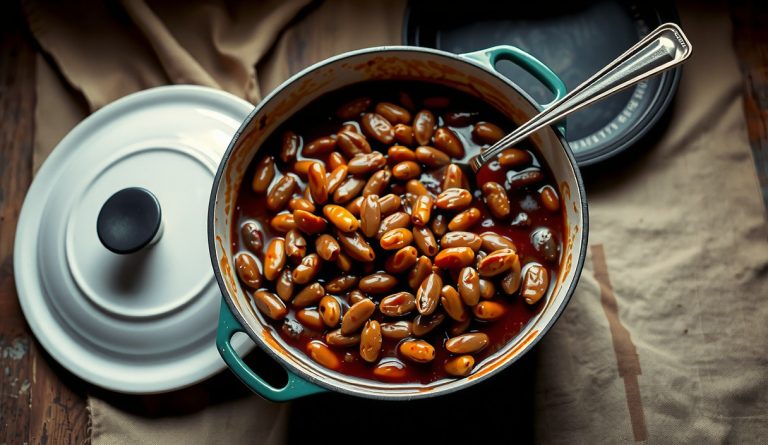
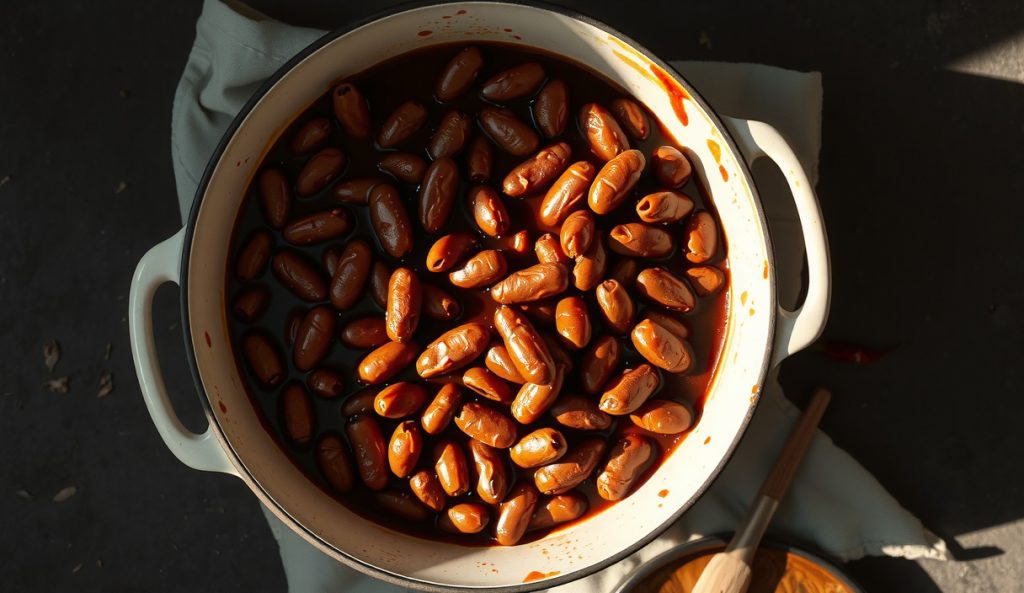
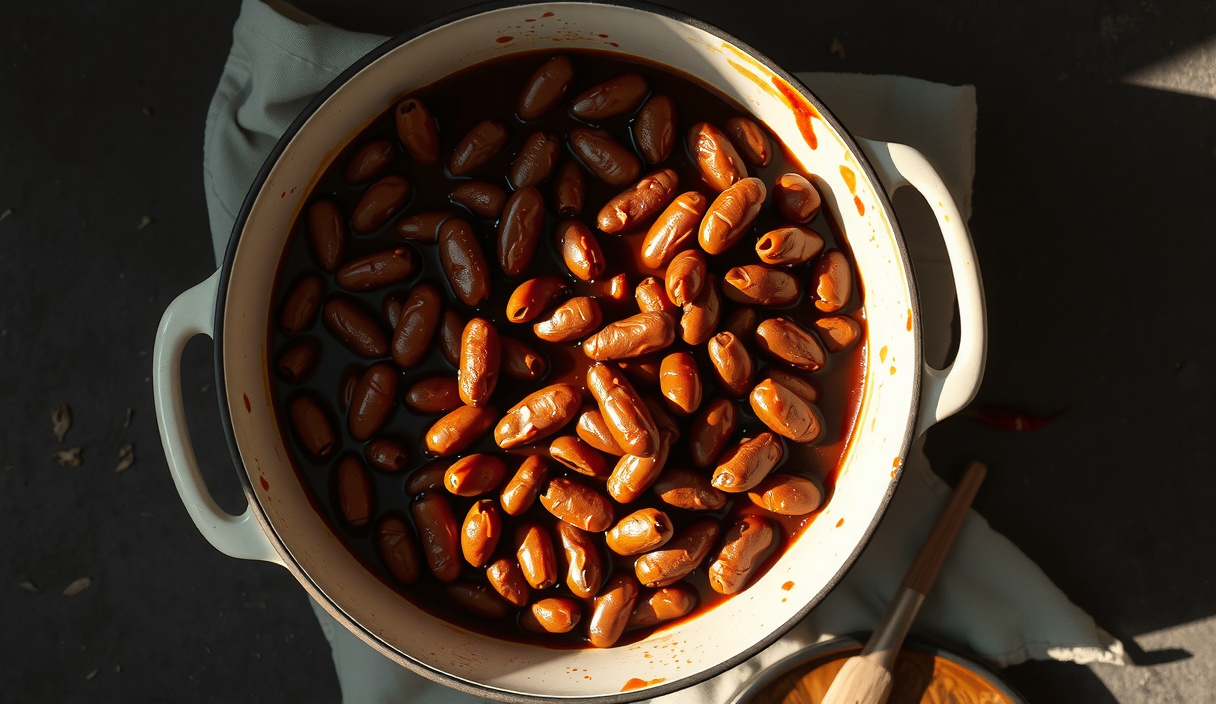
- Remove the lid and continue smoking for a final 45–60 minutes until the sauce has reduced to a thick, lacquer-like consistency that coats a spoon heavily and the beans are completely tender — no chalky bite at the center. The uncovered final stage drives evaporative concentration of the pectin-molasses matrix, building body and intensifying flavor through Maillard-driven melanoidin formation at the exposed sauce surface. Total smoker time: approximately 2.5–3 hours.
Finish and Rest
- Remove the Dutch oven from the smoker and set on a heat-safe surface. Stir in the liquid smoke off-heat — this is critical. The top-note phenolics in liquid smoke (responsible for the campfire, fresh-smoke aroma) volatilize rapidly above 150°F, so adding off-heat preserves them. Start with 3/4 tsp, stir, and taste. Add the remaining 1/4 tsp if you want a more pronounced smoke signal.1 tsp liquid smoke
- Taste for balance: the sauce should read smoky, sweet, tangy, and savory in that order. If it tastes flat or one-dimensionally sweet, add 1 tsp ACV. If the acid is sharp and dominant, add 1 tsp molasses. Adjust salt. Let the pot rest uncovered for 15 minutes before serving — the sauce will continue to tighten as the temperature drops from approximately 200°F to 160°F, improving the coating and presentation of each bean.
Notes
Nutrition
The first time I pulled a Dutch oven of these beans off the smoker and cracked the lid, the steam hit me with something I did not expect from an all-plant pot: that deep, iron-backed, almost meaty darkness you get from a long braise. No bacon. No ham hock. Just pintos, molasses, and fire — plus a few strategic molecular levers that make the flavor sing at a register most people assume requires animal fat.
This recipe is the product of working backward from the physics. What does bacon actually do? It contributes rendered saturated fat for mouthfeel, a protein-and-sugar Maillard crust, and smoked phenolic compounds. Every one of those functions has a plant-based analog. Smoked paprika and a calibrated dose of liquid smoke carry the phenolic axis. Nutritional yeast loads the savory-glutamate layer. And the pinto beans themselves — high in natural pectic polysaccharides — build the sauce body as they cook, creating a self-thickening braising liquid that no cornstarch rescue is needed for.
Why do smoked pinto beans taste meaty without any meat? The science
Smoked pinto beans develop their meaty depth because three converging molecular mechanisms — pectin-driven viscosity, Maillard browning, and phenolic smoke absorption — replicate the exact sensory functions that animal fat and protein perform in a traditional BBQ bean pot.
Pinto beans carry a meaningful endogenous pectin load concentrated in their seed coat. As the beans hydrate and cook past 180°F, the middle lamella — the pectin-rich cellular glue holding the cotyledon cells together — undergoes partial beta-elimination degradation. This releases soluble pectin polymers into the braising liquid, where they physically restrict free-water mobility and build viscosity without any added starch. The longer the braise, and the lower the pH, the greater the pectin contribution to sauce body. Apple cider vinegar, pulled back to a final pH of roughly 3.8–4.2 in the sauce, both preserves that pectin structure and activates the acid-forward brightness that balances molasses sweetness.
The Maillard cascade on these beans is driven by three converging inputs: molasses (a dense reducing-sugar and amino-acid matrix), smoked paprika (which contributes Amadori rearrangement precursors alongside its carotenoid pigments), and real smoker time. Smoker combustion produces guaiacol, syringol, and eugenol — the phenolic VOCs that define wood-smoke aroma. These lipophilic molecules partition preferentially into the fat phase of the sauce (here, olive oil) per thermodynamic partitioning logic, slowing their volatilization and extending the perceived smokiness on the palate. Liquid smoke, a condensate of these same phenolics, is added off-heat at the end to restore any volatile loss from the long cook without adding the char-acrid notes of over-smoking.
Nutritional yeast contributes free glutamic acid alongside 5′-ribonucleotides (IMP/GMP precursors), activating T1R1/T1R3 umami receptors synergistically. That synergy is what creates the perception of savory depth — the same receptor-level mechanism that bacon’s amino acid load exploits, now delivered through a fermentation byproduct of Saccharomyces cerevisiae. The smoked paprika’s carotenoids (capsanthin, capsorubin) provide the visual mahogany of the sauce — the same deep-red color signal that unconsciously reads as “rich” and “smoky” before a single bite is taken.
What equipment and ingredients do I need? Key notes before you start
- Smoker or covered kettle grill: You need actual combustion for the phenolic layer. A ceramic kamado, offset smoker, or even a kettle grill with a two-zone setup and a handful of wood chips all work. Target 250–275°F ambient. If you have no smoker access, compensate with an extra 1/2 tsp liquid smoke and finish in a 325°F oven — the beans will still be excellent, just without the layered phenolic depth.
- Dutch oven (enameled cast iron preferred): You need a vessel that transitions from stovetop sauté to smoker to table. Bare cast iron will react with the ACV and strip seasoning; enameled is the right call here.
- Pinto beans — dried, not canned: Dried beans hydrate to roughly 2.2–2.5x their dry weight and contribute dramatically more pectin to the braising liquid than pre-cooked canned beans, whose pectin has already been degraded by the canning retort. If you must use canned, reduce braising liquid by 30% and expect a thinner sauce.
- Smoked paprika: Spanish pimentón de la vera (wood-smoked, not oven-dried) contains the genuine phenolic fraction. Generic smoked paprika is fine but the depth is lighter. Use the full amount.
- Nutritional yeast: The glutamate and B-vitamin matrix here is doing heavy lifting on the savory axis. Reduce only if you have a strong aversion to its flavor in concentrated form — but don’t skip it.
- Apple cider vinegar: The acetic acid backbone drops the sauce pH into the range where pectin gelling is most favorable and where the perception of sweetness from molasses is refreshed and brightened. Raw (with mother) vs. filtered makes no flavor difference at these concentrations.
- Liquid smoke: Add strictly off-heat at the end. Phenolic compounds degrade under extended thermal stress, and adding liquid smoke during cooking burns off the top notes that make it smell like a campfire rather than an ashtray.
Vegan BBQ Beans — Smoked Pinto
Equipment
- 1 Smoker or covered kettle grill Target 250–275°F ambient with apple, hickory, or oak wood chunks
- 1 Enameled cast iron Dutch oven 5–6 quart capacity; enameled interior protects against ACV reactivity with bare iron
- 1 Colander
- 1 Large mixing bowl For overnight bean soak
- 1 Instant-read thermometer Optional but useful for monitoring smoker ambient temp
Ingredients
Beans
- 1 lb dried pinto beans Picked over and rinsed; soaked overnight in salted water (1 tbsp kosher salt per quart)
- 1 tbsp kosher salt For the soak brine — not added to the final dish
Aromatic Base
- 2 tbsp extra-virgin olive oil
- 1 medium yellow onion Diced fine, approximately 1 1/2 cups
- 6 cloves garlic Minced
Sauce
- ½ cup blackstrap molasses Blackstrap preferred for its lower sugar content and deeper bitter-iron edge; regular unsulfured molasses produces a sweeter, milder result
- ¼ cup ketchup Check label for vegan compliance — most are
- 3 tbsp apple cider vinegar Raw or filtered; adds acetic acid backbone that brightens molasses sweetness and preserves pectin gelling
- 2 tbsp yellow mustard Standard prepared mustard; its mucilage proteins contribute secondary emulsification
- 2 tbsp nutritional yeast Deactivated Saccharomyces cerevisiae; contributes free glutamates and 5′-nucleotide precursors for umami synergy
- 2 tbsp smoked paprika Spanish pimentón de la vera preferred; provides carotenoid color and phenolic smoke character
- 1 tsp chipotle powder Optional; increases heat and deepens smoke dimension
- 1 tbsp soy sauce Or tamari for gluten-free; adds sodium and additional glutamate load
- 1 tbsp brown sugar Packed; provides additional reducing sugars for Maillard surface development during smoker exposure
- 1 tsp black pepper Freshly ground
- 1 tsp kosher salt Plus more to taste at finish
- 3 cups vegetable broth Low-sodium preferred; or water
- 1 tsp liquid smoke Added strictly off-heat at the end; hickory or mesquite; do not cook with it
Instructions
Soak the Beans
- Place the dried pinto beans in a large bowl. Add enough cold water to cover by at least 3 inches and stir in 1 tbsp kosher salt. The salt brine — approximately 1% ionic strength — keeps the pectin chains in the seed coat more intact during cooking, resulting in beans that hold their shape through the long braise without blowing out. Soak at room temperature for 8–12 hours or overnight. Drain and rinse thoroughly before using.1 tbsp kosher salt
Build the Aromatic Base
- Set your Dutch oven over medium heat on the stovetop. Add the olive oil and heat until it shimmers — approximately 180–200°F surface temperature, well below the smoke point. Add the diced onion and cook, stirring occasionally, for 8–10 minutes until deeply softened and beginning to show golden edges. The caramelization here contributes reducing sugars and Strecker degradation products that build baseline sweetness and aromatic complexity.2 tbsp extra-virgin olive oil, 1 medium yellow onion
- Add the minced garlic and cook for 90 seconds, stirring constantly. Garlic burns rapidly above 250°F due to its high reducing-sugar content; pull it from heat the moment it turns pale gold and fragrant. Remove from heat.6 cloves garlic
Assemble the Pot
- Add the drained, soaked beans directly to the Dutch oven with the softened aromatics. Pour in the molasses, ketchup, apple cider vinegar, yellow mustard, nutritional yeast, smoked paprika, chipotle powder (if using), soy sauce, brown sugar, black pepper, and 1 tsp kosher salt. Stir to combine, making sure the molasses is fully incorporated — it tends to sink and pool at the bottom.1/2 cup blackstrap molasses, 1/4 cup ketchup, 3 tbsp apple cider vinegar, 2 tbsp yellow mustard, 2 tbsp nutritional yeast, 2 tbsp smoked paprika, 1 tsp chipotle powder, 1 tbsp soy sauce, 1 tbsp brown sugar, 1 tsp black pepper, 1 tsp kosher salt
- Pour in the vegetable broth. The liquid level should come to approximately 1/2 inch above the top of the beans — the beans will absorb a significant volume during the first 90 minutes of cooking. Stir once more to integrate. Taste the raw braising liquid; it should be aggressively seasoned and slightly sharp — it will mellow and deepen dramatically during the cook.3 cups vegetable broth
Fire Up the Smoker
- Prepare your smoker for indirect cooking at 250–275°F. Add apple, hickory, or oak wood chunks to generate active smoke — approximately one fist-sized chunk at the start, with a second added at the 60-minute mark. These wood species produce phenolic compounds (guaiacol, syringol) in the 250–350 ppm range that adsorb onto the fat phase of your sauce, creating genuine smoke complexity. Avoid mesquite for this application — its higher combustion temperature produces excess creosote that turns bitter on long cooks.
- Place the uncovered Dutch oven in the smoker. Let it ride uncovered for the first 30 minutes so the exposed sauce surface picks up direct smoke contact. Then lid the Dutch oven and continue cooking for 90 minutes, maintaining smoker temp at 250–275°F. At the 90-minute mark, check the liquid level — if it has dropped below the top of the beans, add hot water in 1/4 cup increments to bring it back just even with the bean surface.
- Remove the lid and continue smoking for a final 45–60 minutes until the sauce has reduced to a thick, lacquer-like consistency that coats a spoon heavily and the beans are completely tender — no chalky bite at the center. The uncovered final stage drives evaporative concentration of the pectin-molasses matrix, building body and intensifying flavor through Maillard-driven melanoidin formation at the exposed sauce surface. Total smoker time: approximately 2.5–3 hours.
Finish and Rest
- Remove the Dutch oven from the smoker and set on a heat-safe surface. Stir in the liquid smoke off-heat — this is critical. The top-note phenolics in liquid smoke (responsible for the campfire, fresh-smoke aroma) volatilize rapidly above 150°F, so adding off-heat preserves them. Start with 3/4 tsp, stir, and taste. Add the remaining 1/4 tsp if you want a more pronounced smoke signal.1 tsp liquid smoke
- Taste for balance: the sauce should read smoky, sweet, tangy, and savory in that order. If it tastes flat or one-dimensionally sweet, add 1 tsp ACV. If the acid is sharp and dominant, add 1 tsp molasses. Adjust salt. Let the pot rest uncovered for 15 minutes before serving — the sauce will continue to tighten as the temperature drops from approximately 200°F to 160°F, improving the coating and presentation of each bean.
Notes
Nutrition
How do I nail these beans every time? Tips for success
- Do not skip the overnight soak — and salt it. Brining the beans (1 tbsp kosher salt per quart of water) hydrates the seed coat under ionic conditions that keep pectin chains more intact, resulting in beans that hold their shape during the long smoke-braise without turning to mush. An un-brined quick-soak produces beans with weaker cell walls and more blowout.
- Maintain smoker temperature discipline. At 250–275°F, you get the Maillard development on the exposed sauce surface and the phenolic smoke absorption without overcooking the beans. Above 300°F with the lid on, the internal braise temperature climbs above 212°F and you risk blowing out the beans’ pectin structure entirely, losing the self-thickening sauce.
- Watch the liquid level at the 90-minute mark. Beans absorb water at a rate governed by osmotic pressure differentials across their seed coat. If the liquid has dropped below the top of the beans, add hot water in 1/4 cup increments — never cold, which shocks the beans and can cause skin splitting.
- The sauce should coat a spoon before you lid it for the final rest. If it looks thin at the end, remove the lid and let it ride uncovered for 15–20 additional minutes. The evaporative surface area of the open pot drops the water activity and concentrates the pectin-molasses matrix fast.
- Taste for ACV balance after the liquid smoke goes in. The final acid pop should be perceptible but not sharp. If it bites, add 1 tsp molasses. If it reads flat and sweet, add another 1 tsp ACV. This push-pull calibration between acid and reducing sugar is where the sauce moves from good to very good.
- Rest 15 minutes uncovered before serving. The sauce continues to tighten as it cools from ~200°F to ~160°F. Serving too hot means a thinner sauce; resting means each bean arrives at the table lacquered.
How can I adapt this recipe? Variations worth trying
Bean swap: Navy beans are the classic American baked-bean choice and work beautifully in this recipe — they are smaller, cook 20–30 minutes faster, and their lower pectin content yields a slightly less viscous sauce, which some prefer. Great northern beans split the difference between navy and pinto. Black beans produce a dramatically colored (near-black) sauce with an earthier, less sweet character that pairs extremely well with cumin-heavy spice profiles. All substitutions follow the same cook time logic: check for tenderness at 90 minutes and adjust from there.
Heat level: The base recipe is mild-to-medium, appropriate for a broad crowd and excellent alongside spicy grilled proteins. For a genuine kick, add 1–2 tsp chipotle powder (which also boosts the smoke axis) or 1 tsp cayenne alongside the smoked paprika. For a Korean-inflected direction, substitute 1 tbsp gochujang for the chipotle and reduce the mustard to 1 tsp — the fermented chili paste adds umami depth that echoes the nutritional yeast layer.
No smoker, all oven: Preheat your oven to 325°F. Complete the stovetop sauté and assembly exactly as written. Bake covered for 2 hours, then uncovered for 30–45 minutes until the sauce has reduced to a lacquered consistency. Add the extra 1/2 tsp liquid smoke called for in the notes and a pinch of smoked paprika stirred in at the end. The beans will be excellent — just without the multilayer phenolic depth of actual combustion smoke.
Scaling: This recipe doubles without issue in a 7-quart Dutch oven. The bean-to-liquid ratio scales linearly. Smoker time does not decrease for a double batch — if anything, add 20 minutes to account for the higher thermal mass of the pot. Do not triple in a single vessel; the beans at the bottom will overcook before the center reaches temperature.
Frequently asked questions about vegan smoked pinto beans
Can I use canned beans to save time? Yes, with adjustments. Drain and rinse two 15-oz cans of pinto beans and reduce the added liquid to 1 cup total (the beans are already fully hydrated). The braising time drops to 45–60 minutes on the smoker. The sauce will be thinner because canned beans have already lost most of their pectin during retort processing — compensate by adding 1 tbsp tomato paste, which contributes pectin and body, and allowing the final uncovered reduction to run a full 20 minutes.
Why does my sauce look thin even after the full cook time? Two common causes: the beans were not soaked (dried beans absorb braising liquid aggressively for the first 60 minutes, and un-soaked beans pull so much water that the sauce never concentrates), or the lid was kept on for the entire cook (you need at least 30–45 minutes of uncovered time for meaningful evaporative reduction). Fix it by removing the lid and letting the pot ride at 275°F until the sauce thickens to your target — it usually takes no more than 20 additional minutes.
Is liquid smoke “natural” or is it a synthetic additive? Liquid smoke is a genuine condensate of wood combustion phenolics — the exact same guaiacol, syringol, and cresol compounds that adsorb onto food during conventional smoking. It is produced by burning wood, capturing the smoke in a chamber, and condensing it through water. The resulting product is chemically identical to smoke-deposited surface compounds, just without the particulate matter. A traditional stock and a lab digest run the same collagen-hydrolysis pathways; smoke and liquid smoke run the same phenolic chemistry. The only meaningful culinary difference is volatility control — liquid smoke allows you to add a precise dose off-heat, eliminating the over-smoking risk that plagues long cooks.