Spherified Mango-Habanero BBQ Sauce Caviar

Equipment
- 1 Immersion blender For hydrating and homogenizing the alginate bath without lumps
- 1 Digital kitchen scale Accuracy to 0.1 g is required for alginate and calcium lactate
- 1 Hemisphere silicone mold (10 mL cavities) or squeeze bottle with 3 mm tip Controls drop size and sphere diameter
- 3 Wide, shallow container (at least 20 cm diameter) One for the alginate bath, two for rinse water
- 1 Slotted spoon For transferring spheres without tearing membranes
- 1 Fine-mesh sieve For straining the alginate bath between batches
- 1 Timer Precision matters: 30 seconds per sphere in the bath
- 1 Blender or food processor For the mango-habanero sauce base
- 1 Medium saucepan For reducing and building the BBQ sauce
- 1 Instant-read thermometer Monitor sauce temperature; target 20-22°C at spherification
Ingredients
Sodium Alginate Bath
- 500 g cold filtered water Distilled or filtered preferred; hard tap water with high Ca²⁺ can pre-gel the bath
- 2.5 g food-grade sodium alginate Exactly 0.5% w/w; weigh on a 0.1 g scale — do not estimate
Mango-Habanero BBQ Sauce
- 200 g ripe mango puree Ataulfo or Kent; fresh or frozen-thawed; avoid heavily acidified canned versions
- 1 habanero pepper, stemmed and seeded One pepper for medium heat; two for serious fire
- 60 g ketchup Standard commercial ketchup provides the tomato base and pectin
- 30 g apple cider vinegar Adds brightness; keep below 35 g to avoid dropping sauce pH under 4
- 25 g dark brown sugar Molasses content contributes Maillard-active reducing sugars
- 20 g vegan Worcestershire sauce For umami depth without fish; check label if serving vegan guests
- 15 g smoked paprika Sweet or bittersweet; adds smoke VOCs in the absence of a smoker
- 10 g garlic powder
- 5 g onion powder
- 3 g fine sea salt Adjust to taste after reducing
- 2 g ground cumin
Calcium Lactate Addition
- 4 g food-grade calcium lactate Exactly 1% w/w of finished sauce weight (target ~400 g sauce); weigh precisely
Rinse Baths
- 1 liter cold water Divided between two rinse containers; refreshed between batches

Instructions
Prepare the Alginate Bath (Start Here — Needs 60 Min Rest)
- Weigh 500 g of cold filtered water into a tall container. Weigh 2.5 g of sodium alginate and sprinkle it over the surface of the water while blending with an immersion blender on medium-high. Blend continuously for 3 minutes until no visible powder remains. The bath will be slightly cloudy and thicker than water — this is correct.2.5 g food-grade sodium alginate
- Transfer the alginate bath to the refrigerator uncovered for a minimum of 60 minutes (up to overnight). This rest period allows the alginate polymer chains to fully hydrate and air bubbles introduced by blending to rise out. A fully rested bath is nearly clear and pours smoothly. Do not skip this step — undissolved alginate causes weak, uneven membranes.2.5 g food-grade sodium alginate
Build the Mango-Habanero BBQ Sauce
- Combine the mango puree, habanero pepper, ketchup, apple cider vinegar, dark brown sugar, vegan Worcestershire sauce, smoked paprika, garlic powder, onion powder, salt, and cumin in a blender. Blend on high for 60 seconds until completely smooth.200 g ripe mango puree, 1 habanero pepper, stemmed and seeded, 60 g ketchup, 30 g apple cider vinegar, 25 g dark brown sugar, 20 g vegan Worcestershire sauce, 15 g smoked paprika, 10 g garlic powder, 5 g onion powder, 3 g fine sea salt, 2 g ground cumin
- Pour the blended sauce into a medium saucepan over medium heat. Bring to a bare simmer (small bubbles at the edge, approximately 85–90°C), stirring frequently. Reduce heat to low and cook for 10–12 minutes, stirring every 2 minutes, until the sauce thickens enough to coat the back of a spoon and the volume has reduced by roughly 15%. Taste and adjust salt.200 g ripe mango puree, 1 habanero pepper, stemmed and seeded, 60 g ketchup, 30 g apple cider vinegar, 25 g dark brown sugar, 20 g vegan Worcestershire sauce, 15 g smoked paprika, 10 g garlic powder, 5 g onion powder, 3 g fine sea salt, 2 g ground cumin
- Pass the sauce through a fine-mesh sieve, pressing firmly with a spatula to extract all liquid and leave behind any fibrous habanero or mango solids. You should have approximately 380–420 g of smooth, strained sauce. Allow to cool to 20–22°C (68–72°F) before proceeding — use a thermometer. Warm sauce accelerates crosslinking unevenly; cold sauce slows it.200 g ripe mango puree, 1 habanero pepper, stemmed and seeded, 60 g ketchup, 30 g apple cider vinegar, 25 g dark brown sugar, 20 g vegan Worcestershire sauce, 15 g smoked paprika, 10 g garlic powder, 5 g onion powder, 3 g fine sea salt, 2 g ground cumin
Add Calcium Lactate to the Sauce
- Weigh your cooled sauce precisely. Weigh out calcium lactate at exactly 1% of the sauce weight (e.g., 4 g calcium lactate for 400 g sauce). Whisk the calcium lactate directly into the sauce until fully dissolved — approximately 60 seconds of vigorous whisking. The sauce should remain smooth with no visible particles. Transfer to a squeeze bottle or keep in a bowl beside the alginate bath.4 g food-grade calcium lactate
Set Up the Spherification Station
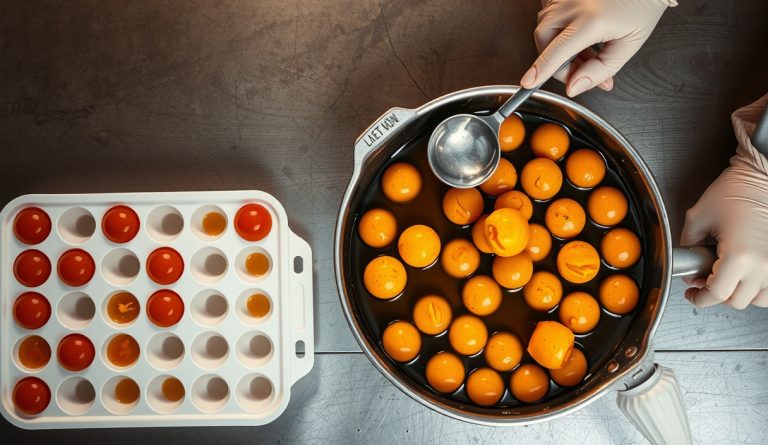
- Remove the alginate bath from the refrigerator. Set up three wide, shallow containers in a line: (1) the alginate bath, (2) cold rinse water, (3) cold rinse water. Have your slotted spoon, a timer, and the calcium-laced sauce in a squeeze bottle or mold ready. Work in a cool kitchen (under 25°C) for the most consistent results.1 liter cold water
Form the Spheres
- Hold the squeeze bottle or mold 1–2 cm above the surface of the alginate bath. Squeeze or drop a measured amount of sauce (approximately 5–8 mL for roe-sized spheres, 15 mL for larger pearls) slowly into the bath. Start your timer immediately. The sauce droplet will round into a sphere on contact as the outer surface begins to gel within 2–3 seconds.2.5 g food-grade sodium alginate, 4 g food-grade calcium lactate
- After exactly 30 seconds, gently slide a slotted spoon beneath the sphere and lift it out of the alginate bath. Do not drag it sideways — lift from directly below to avoid tearing the still-forming membrane. Transfer immediately to the first rinse water bath. Give the sphere a gentle swirl in the rinse water for 10 seconds, then move it to the second clean rinse bath for another 10 seconds. This removes residual alginate gel from the exterior.1 liter cold water
- Repeat for remaining sauce, dropping one sphere at a time, maintaining 30-second intervals. After every 20 spheres, assess the alginate bath: if membranes are forming unevenly or the bath looks cloudy and thick at the surface, strain through a fine-mesh sieve and refresh with additional prepared alginate bath if available.2.5 g food-grade sodium alginate, 4 g food-grade calcium lactate
Hold and Serve
- Transfer finished, rinsed spheres to a clean container of plain cold water. Store refrigerated at 4°C for up to 24 hours. The liquid interior will not continue to gel — the membrane is sealed and the alginate cannot penetrate inward. The spheres will remain liquid-burst and intact throughout the holding window.1 liter cold water
- To serve: allow spheres to come to room temperature for 5–10 minutes for peak flavor volatility. Gently spoon 4–6 spheres onto plated wings, burgers, or grilled proteins using a slotted spoon. Do not plate directly onto meat that is above 60°C (140°F) — thermal shock can rupture membranes prematurely. A brief rest after pulling protein from the heat is sufficient. Finish with a sprinkle of flake salt and fresh cilantro if desired.
Notes
Nutrition
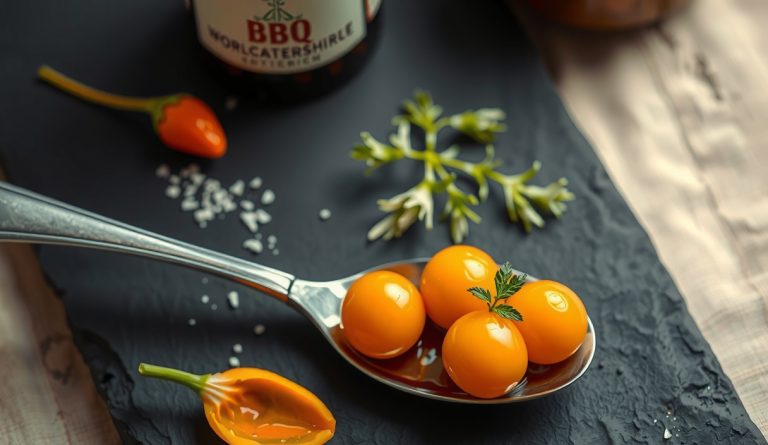
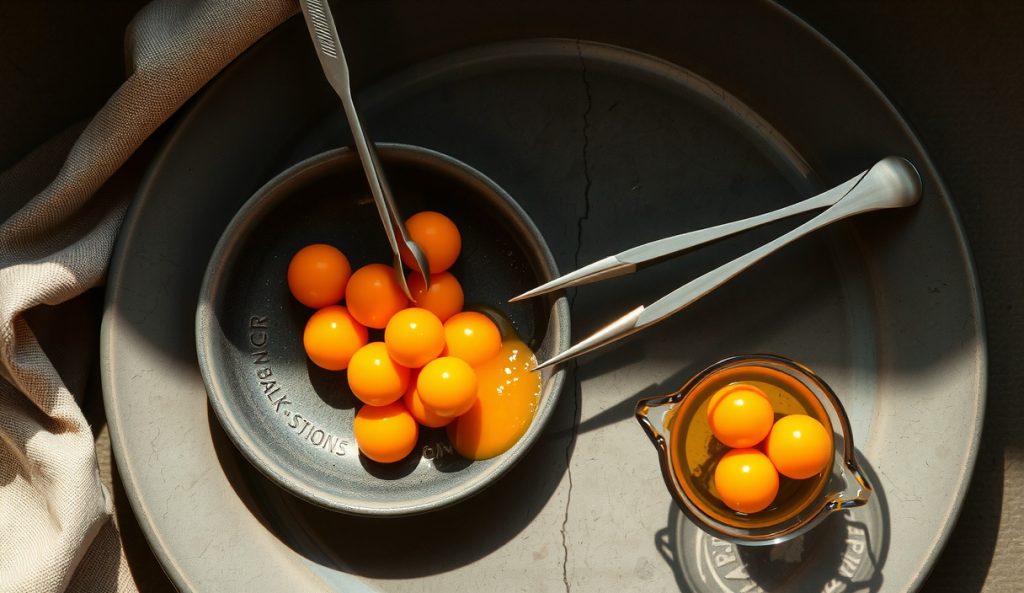
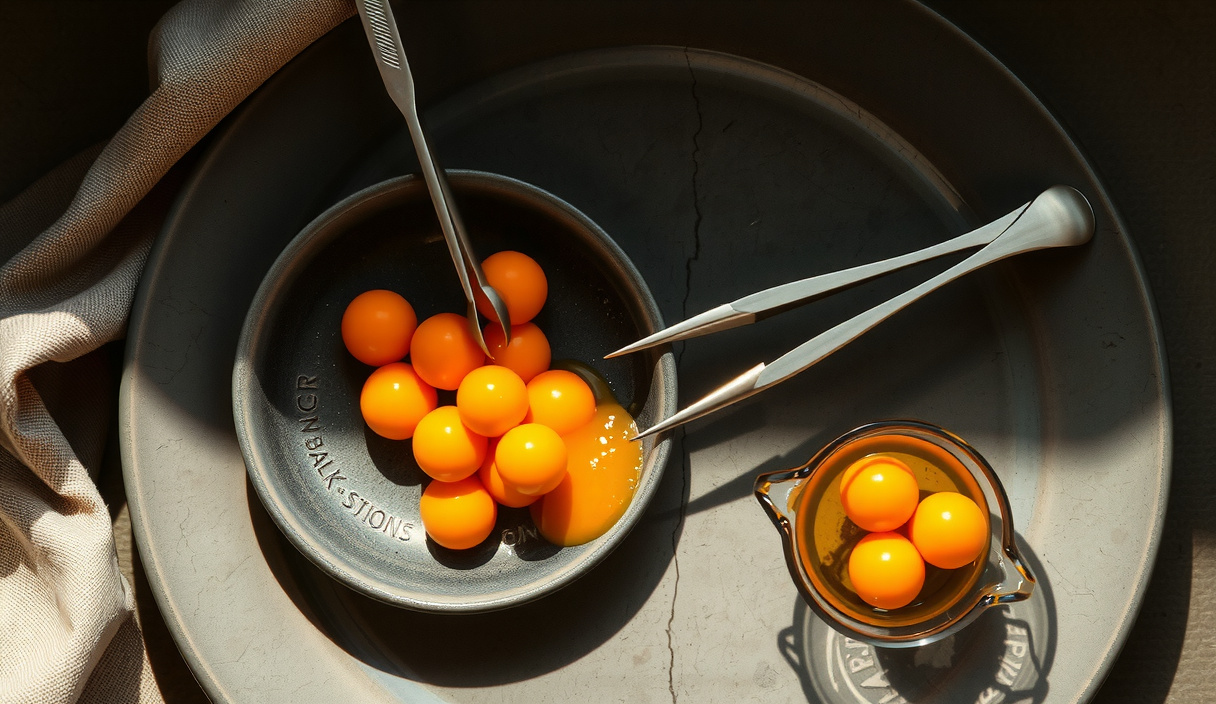
The first time I dropped a ladle of mango BBQ sauce into an alginate bath and watched it skin over in real time, it felt like sleight of hand — a trick the sauce was pulling on itself. What came out of the bath thirty seconds later was a sphere the color of a sunset: amber-orange, glossy, fragile enough to quiver on a spoon. Bite it over a just-pulled chicken wing and the membrane gives way like a soap bubble, flooding your palate with concentrated mango, habanero heat, and wood smoke before the wing itself even registers. That, right there, is the entire argument for modernist technique at the backyard grill.
This is reverse spherification — the method where calcium lives inside the sauce and alginate lives in the bath. The result is a sphere that holds indefinitely without continuing to gel through, making it far more pitmaster-practical than classical spherification for service on a busy cook day. One gram of calcium lactate per 100 g of sauce. Half a gram of sodium alginate per 100 g of water in the setting bath. Thirty seconds of contact, a cold-water rinse, and you have jewels that sit happily in a holding bath for hours without turning rubbery.
The science
Reverse spherification is an ionic crosslinking reaction operating at the food-physics scale. Sodium alginate — a linear anionic polysaccharide extracted from brown kelp — dissolves in water to form a viscous sol. When a droplet of calcium-laden liquid contacts that sol, free calcium ions (Ca²⁺) migrate outward from the droplet surface and exchange with the sodium counter-ions on adjacent alginate chains. Each divalent Ca²⁺ bridges two guluronate blocks on neighboring chains in what polymer chemists call an “egg-box” junction zone. At 0.5% w/w alginate and 1% w/w calcium lactate, this crosslinking reaction is fast — diffusion-limited, completing a structurally sound membrane in 25–35 seconds at room temperature (20–22°C). The membrane thickness grows with contact time, so pulling the spheres at 30 seconds gives you a delicate 0.3–0.5 mm skin rather than a thick, chewy wall.
Calcium lactate is the preferred calcium salt here over calcium chloride for one precise reason: lactate anions contribute no bitterness at culinary concentrations. Calcium chloride at the same ionic strength leaves a detectable mineral edge that fights the habanero and fruit esters in the sauce. The target ionically is straightforward — you need enough free Ca²⁺ to drive crosslinking at the droplet surface before the droplet sinks through the bath and the geometry degrades. One percent calcium lactate (molecular weight 218 g/mol) in 100 g of sauce delivers approximately 46 mM Ca²⁺, well above the threshold required to saturate the alginate binding sites near the interface. In reverse spherification, because the calcium source is inside and the alginate is outside, the membrane seals from the exterior inward, trapping the liquid core permanently. The sphere is shelf-stable in a plain water holding bath at 4°C for up to 24 hours without any textural penalty — the internal liquid never gels because alginate cannot diffuse inward faster than the membrane blocks it.
The mango-habanero sauce itself is engineered for two additional physical demands: it must be fluid enough to drop cleanly from a hemisphere mold or squeeze bottle (target viscosity 200–400 mPa·s at 20°C), and it must carry enough dissolved solids to suppress excessive membrane fragility. Mango puree contributes natural pectin and sugars that slightly buffer the alginate interface, giving the membrane a touch more elasticity than a pure water-based sauce would. The habanero’s capsaicin (a phenolic amide) and the smoke’s phenolic VOCs are lipophilic — they partition into any fat droplets in the sauce and are released thermodynamically as the membrane ruptures on the palate, creating that characteristic delayed heat bloom behind the initial fruit-acid hit. The Maillard-active reducing sugars from the mango and brown sugar provide the browning capacity that makes this sauce work on hot grilled protein even after the spherification step.
Equipment & ingredient notes
Sodium alginate: Buy food-grade sodium alginate (not carrageenan blends). Hydration is the critical step — alginate must fully hydrate before use or you get white specks and uneven membranes. Use an immersion blender and let the bath rest at least 60 minutes, ideally overnight in the refrigerator, to allow full polymer swelling and air-bubble release.
Calcium lactate: Available from modernist pantry suppliers and online. Weigh it — 1 g per 100 g sauce is non-negotiable for reliable spherification. Too little Ca²⁺ and the membrane forms slowly and unevenly; too much and the exterior of your spheres can pre-gel in the bottle before you even reach the bath.
Mango puree: Fresh or frozen (thawed) Ataulfo or Kent mango gives the cleanest ester profile. Avoid canned mango with added citric acid at high levels — excess free acid can partially hydrolyze alginate chains, weakening the bath over repeated use. If using canned, check the pH: target bath pH 5–8 for reliable gelation.
Hemisphere molds or squeeze bottle: For consistent 10–12 mm spheres (about the size of large roe), use a 10 mL hemisphere silicone mold or a squeeze bottle with a 3 mm tip. A medicine dropper works for small test batches. Drop from no higher than 2 cm above the bath surface to prevent deformation on impact.
Two-bath rinse setup: You need a setting bath (alginate solution) and two rinse baths of plain cold water. Carry the spheres through both rinse baths on a slotted spoon to remove residual alginate from the exterior — skip this and the shells taste seaweedy.
Spherified Mango-Habanero BBQ Sauce Caviar
Equipment
- 1 Immersion blender For hydrating and homogenizing the alginate bath without lumps
- 1 Digital kitchen scale Accuracy to 0.1 g is required for alginate and calcium lactate
- 1 Hemisphere silicone mold (10 mL cavities) or squeeze bottle with 3 mm tip Controls drop size and sphere diameter
- 3 Wide, shallow container (at least 20 cm diameter) One for the alginate bath, two for rinse water
- 1 Slotted spoon For transferring spheres without tearing membranes
- 1 Fine-mesh sieve For straining the alginate bath between batches
- 1 Timer Precision matters: 30 seconds per sphere in the bath
- 1 Blender or food processor For the mango-habanero sauce base
- 1 Medium saucepan For reducing and building the BBQ sauce
- 1 Instant-read thermometer Monitor sauce temperature; target 20-22°C at spherification
Ingredients
Sodium Alginate Bath
- 500 g cold filtered water Distilled or filtered preferred; hard tap water with high Ca²⁺ can pre-gel the bath
- 2.5 g food-grade sodium alginate Exactly 0.5% w/w; weigh on a 0.1 g scale — do not estimate
Mango-Habanero BBQ Sauce
- 200 g ripe mango puree Ataulfo or Kent; fresh or frozen-thawed; avoid heavily acidified canned versions
- 1 habanero pepper, stemmed and seeded One pepper for medium heat; two for serious fire
- 60 g ketchup Standard commercial ketchup provides the tomato base and pectin
- 30 g apple cider vinegar Adds brightness; keep below 35 g to avoid dropping sauce pH under 4
- 25 g dark brown sugar Molasses content contributes Maillard-active reducing sugars
- 20 g vegan Worcestershire sauce For umami depth without fish; check label if serving vegan guests
- 15 g smoked paprika Sweet or bittersweet; adds smoke VOCs in the absence of a smoker
- 10 g garlic powder
- 5 g onion powder
- 3 g fine sea salt Adjust to taste after reducing
- 2 g ground cumin
Calcium Lactate Addition
- 4 g food-grade calcium lactate Exactly 1% w/w of finished sauce weight (target ~400 g sauce); weigh precisely
Rinse Baths
- 1 liter cold water Divided between two rinse containers; refreshed between batches
Instructions
Prepare the Alginate Bath (Start Here — Needs 60 Min Rest)
- Weigh 500 g of cold filtered water into a tall container. Weigh 2.5 g of sodium alginate and sprinkle it over the surface of the water while blending with an immersion blender on medium-high. Blend continuously for 3 minutes until no visible powder remains. The bath will be slightly cloudy and thicker than water — this is correct.2.5 g food-grade sodium alginate
- Transfer the alginate bath to the refrigerator uncovered for a minimum of 60 minutes (up to overnight). This rest period allows the alginate polymer chains to fully hydrate and air bubbles introduced by blending to rise out. A fully rested bath is nearly clear and pours smoothly. Do not skip this step — undissolved alginate causes weak, uneven membranes.2.5 g food-grade sodium alginate
Build the Mango-Habanero BBQ Sauce
- Combine the mango puree, habanero pepper, ketchup, apple cider vinegar, dark brown sugar, vegan Worcestershire sauce, smoked paprika, garlic powder, onion powder, salt, and cumin in a blender. Blend on high for 60 seconds until completely smooth.200 g ripe mango puree, 1 habanero pepper, stemmed and seeded, 60 g ketchup, 30 g apple cider vinegar, 25 g dark brown sugar, 20 g vegan Worcestershire sauce, 15 g smoked paprika, 10 g garlic powder, 5 g onion powder, 3 g fine sea salt, 2 g ground cumin
- Pour the blended sauce into a medium saucepan over medium heat. Bring to a bare simmer (small bubbles at the edge, approximately 85–90°C), stirring frequently. Reduce heat to low and cook for 10–12 minutes, stirring every 2 minutes, until the sauce thickens enough to coat the back of a spoon and the volume has reduced by roughly 15%. Taste and adjust salt.200 g ripe mango puree, 1 habanero pepper, stemmed and seeded, 60 g ketchup, 30 g apple cider vinegar, 25 g dark brown sugar, 20 g vegan Worcestershire sauce, 15 g smoked paprika, 10 g garlic powder, 5 g onion powder, 3 g fine sea salt, 2 g ground cumin
- Pass the sauce through a fine-mesh sieve, pressing firmly with a spatula to extract all liquid and leave behind any fibrous habanero or mango solids. You should have approximately 380–420 g of smooth, strained sauce. Allow to cool to 20–22°C (68–72°F) before proceeding — use a thermometer. Warm sauce accelerates crosslinking unevenly; cold sauce slows it.200 g ripe mango puree, 1 habanero pepper, stemmed and seeded, 60 g ketchup, 30 g apple cider vinegar, 25 g dark brown sugar, 20 g vegan Worcestershire sauce, 15 g smoked paprika, 10 g garlic powder, 5 g onion powder, 3 g fine sea salt, 2 g ground cumin
Add Calcium Lactate to the Sauce
- Weigh your cooled sauce precisely. Weigh out calcium lactate at exactly 1% of the sauce weight (e.g., 4 g calcium lactate for 400 g sauce). Whisk the calcium lactate directly into the sauce until fully dissolved — approximately 60 seconds of vigorous whisking. The sauce should remain smooth with no visible particles. Transfer to a squeeze bottle or keep in a bowl beside the alginate bath.4 g food-grade calcium lactate
Set Up the Spherification Station
- Remove the alginate bath from the refrigerator. Set up three wide, shallow containers in a line: (1) the alginate bath, (2) cold rinse water, (3) cold rinse water. Have your slotted spoon, a timer, and the calcium-laced sauce in a squeeze bottle or mold ready. Work in a cool kitchen (under 25°C) for the most consistent results.1 liter cold water
Form the Spheres
- Hold the squeeze bottle or mold 1–2 cm above the surface of the alginate bath. Squeeze or drop a measured amount of sauce (approximately 5–8 mL for roe-sized spheres, 15 mL for larger pearls) slowly into the bath. Start your timer immediately. The sauce droplet will round into a sphere on contact as the outer surface begins to gel within 2–3 seconds.2.5 g food-grade sodium alginate, 4 g food-grade calcium lactate
- After exactly 30 seconds, gently slide a slotted spoon beneath the sphere and lift it out of the alginate bath. Do not drag it sideways — lift from directly below to avoid tearing the still-forming membrane. Transfer immediately to the first rinse water bath. Give the sphere a gentle swirl in the rinse water for 10 seconds, then move it to the second clean rinse bath for another 10 seconds. This removes residual alginate gel from the exterior.1 liter cold water
- Repeat for remaining sauce, dropping one sphere at a time, maintaining 30-second intervals. After every 20 spheres, assess the alginate bath: if membranes are forming unevenly or the bath looks cloudy and thick at the surface, strain through a fine-mesh sieve and refresh with additional prepared alginate bath if available.2.5 g food-grade sodium alginate, 4 g food-grade calcium lactate
Hold and Serve
- Transfer finished, rinsed spheres to a clean container of plain cold water. Store refrigerated at 4°C for up to 24 hours. The liquid interior will not continue to gel — the membrane is sealed and the alginate cannot penetrate inward. The spheres will remain liquid-burst and intact throughout the holding window.1 liter cold water
- To serve: allow spheres to come to room temperature for 5–10 minutes for peak flavor volatility. Gently spoon 4–6 spheres onto plated wings, burgers, or grilled proteins using a slotted spoon. Do not plate directly onto meat that is above 60°C (140°F) — thermal shock can rupture membranes prematurely. A brief rest after pulling protein from the heat is sufficient. Finish with a sprinkle of flake salt and fresh cilantro if desired.
Notes
Nutrition
Tips for nailing it
- Hydrate the alginate bath overnight. Undissolved alginate produces cloudy membranes with weak spots. Blend, refrigerate, and skim the foam before use. A fully hydrated 0.5% bath is nearly water-clear and pours like thin maple syrup.
- Keep sauce temperature at 20–22°C (68–72°F). Cold sauce (straight from the fridge) slows Ca²⁺ diffusion and produces thinner, more fragile membranes. Hot sauce above 30°C accelerates the reaction unevenly, producing thick, chewy skins. Room temperature is the sweet spot.
- Do not exceed 35 seconds in the alginate bath. The membrane continues to grow with contact time. At 45–60 seconds the skin becomes perceptibly chewy and the liquid-burst effect diminishes. Use a timer on every batch.
- Refresh the alginate bath after 20 spheres. Repeated drops leach Ca²⁺ into the bath, gradually raising ionic strength and causing premature gelation at the surface. Strain and refresh, or keep a fresh bath on standby.
- Hold spheres in plain cold water, not in the alginate bath. Alginate bath exposure continues the crosslinking reaction. Water stops it. Store finished spheres submerged in still water at 4°C for up to 24 hours. Do not freeze — ice crystal nucleation shreds the membrane.
- Spoon, never pour, onto food. Use a small slotted spoon or offset spatula to transfer spheres. Pouring from height causes coalescence and the membranes stick together permanently on contact.
Variations
Peach-ghost pepper version: Substitute an equal weight of ripe peach puree for the mango. Replace the habanero with 1/4 of a ghost pepper (Bhut jolokia), seeds removed. The peach’s lower sugar content means slightly thinner membranes — compensate by extending bath time to 35 seconds. The result is a sphere with a slower, creeping heat that builds rather than blooms.
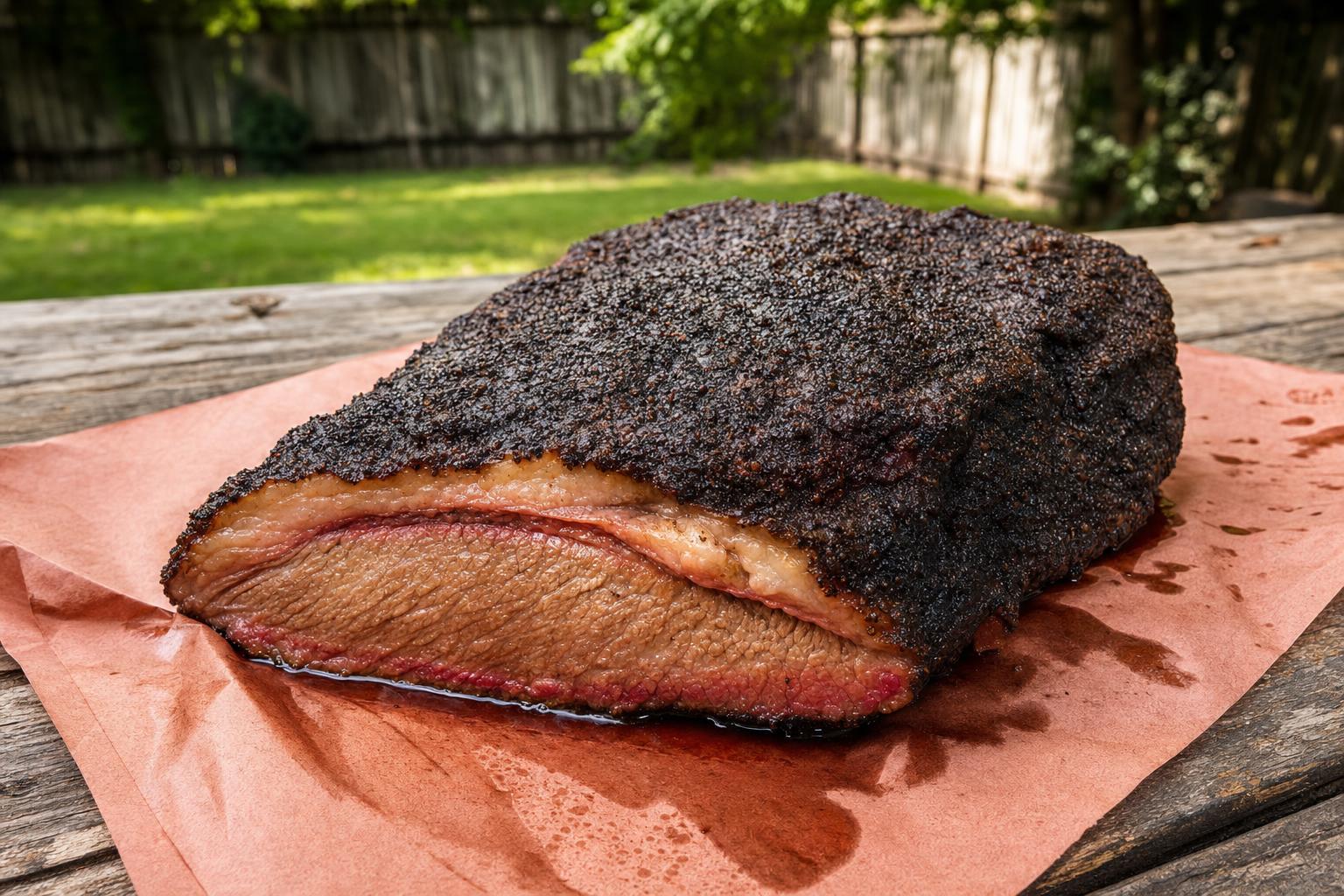
Tamarind-chipotle smoky version: Blend 30 g tamarind concentrate with the mango puree and swap the habanero for one or two chipotles in adobo, blended smooth. The high acidity of tamarind will lower your bath pH over many drops — check with a strip between batches and refresh the bath if you notice membrane inconsistencies. This version pairs exceptionally well with smoked brisket and fatty pork belly.
Scaling for service: The recipe below yields approximately 40 spheres — enough to garnish 8–10 plates of wings. For catering scale (200+ spheres), blend the alginate bath in a 4-liter hotel pan, use a multi-cavity hemisphere mold to set 12 spheres simultaneously, and run a continuous chain through two large rinse containers. Pre-made spheres hold well for 18–24 hours refrigerated; sauce flavor deepens slightly as aromatics continue to equilibrate inside the sealed membrane.
Gluten-free and vegan-compatible: The base recipe contains no gluten, dairy, or animal products as written. Verify that your Worcestershire sauce is fish-free if serving to vegans — swap for coconut aminos or a vegan Worcestershire. The spherification chemistry itself is entirely plant-derived.
FAQ
Why did my spheres stick together in the bath? Spheres that are dropped too close together will fuse at the membrane before it sets — they are sticky for the first 8–10 seconds after entry. Drop one at a time and give each sphere a gentle stir with a slotted spoon immediately after entry to ensure it is suspended and not touching its neighbor. A wider, shallower bath also helps.
Can I re-use the alginate bath? Yes, up to a point. As you drop spheres, leaching Ca²⁺ gradually weakens the bath’s gelling capacity. After roughly 20–25 spheres in 500 g of bath, membrane formation becomes unreliable. Strain the bath through a fine-mesh sieve to remove any fragments, and either discard or blend in fresh alginate to bring it back to working strength. Tracking drops-per-batch rather than testing by feel makes production consistent.
What is the maximum safe serving temperature? Agar membranes melt above 85°C; alginate membranes are thermally stable up to approximately 60°C (140°F) without rupturing, but the heat causes rapid Ca²⁺ redistribution that stiffens and eventually collapses the sphere. Serve the caviar at room temperature or cold — never plate directly onto scorching hot protein. A five-second rest after pulling wings from the fryer or grill before spooning on the caviar is sufficient to protect the membranes.