Smoked Brussels Sprouts with Bacon and Maple-Dijon Glaze
Equipment
- 1 Smoker or indirect-setup charcoal or pellet grill Capable of holding 350°F and ramping to 425°F
- 1 Probe thermometer For accurate grate temperature; factory dials are often unreliable by 25 to 50°F
- 1 Cast-iron skillet or oven-safe pan For rendering bacon fat
- 1 Large mixing bowl For fat-tossing and glazing off-heat
- 1 Sheet pan or grill basket Optional: use a grill basket for easy flipping of small sprouts
- 1 to 2 Cherry or apple wood chunks or chips One small chunk or a small handful of chips; avoid hickory or mesquite
Ingredients
Sprouts and fat
- 2 lbs Brussels sprouts Trimmed and halved through the core; target 1 to 1.5 inch diameter for uniform cooking
- 4 strips thick-cut bacon Rendered for the fat; lardons reserved for garnish
- 3 tablespoons rendered bacon fat From the strips above; substitute 1.5 tbsp unsalted butter plus 1.5 tbsp avocado oil if needed
- 0.5 teaspoon kosher salt Applied after glazing; not before smoking
- 0.25 teaspoon black pepper Freshly cracked
Maple-Dijon glaze
- 3 tablespoons pure maple syrup Grade A dark or Grade B for deeper flavor; avoid pancake syrup
- 1 tablespoon Dijon mustard Smooth Dijon; the mucilage proteins act as a natural emulsifier binding the glaze
- 1 teaspoon apple cider vinegar Adjust to taste; this is the brightness lever against the maple sweetness
- 1 pinch red pepper flakes Optional; adds slow-building heat contrast

Instructions
Prep and render bacon
- Render the bacon strips in a cast-iron skillet over medium-low heat until the fat is fully liquefied and the lardons are crispy, approximately 8 to 10 minutes. Remove the lardons to a paper-towel-lined plate and reserve. Strain the rendered fat through a fine mesh strainer into a small bowl and allow it to cool for 2 minutes. You need approximately 3 tablespoons of clarified fat.4 strips thick-cut bacon, 3 tablespoons rendered bacon fat
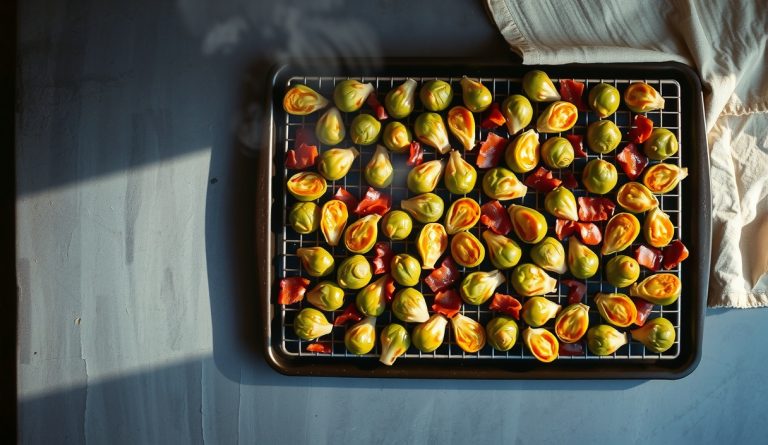
- Trim the stem end of each Brussels sprout and halve through the core. Pat the cut surfaces dry aggressively with paper towels — this is not optional. Any surface moisture delays Maillard browning onset by 4 to 6 minutes and creates steam that softens the interior before the exterior can char.
- In the large mixing bowl, toss the halved sprouts with the warm rendered bacon fat until every cut surface is evenly coated. Do not season with salt yet — salt draws cellular moisture to the surface via osmosis and counteracts the drying step you just completed.3 tablespoons rendered bacon fat
Low-smoke phase
- Prepare your smoker or grill for indirect heat at a stable 350°F (177°C). Verify the temperature with a probe thermometer at grate level — not the factory lid dial. Add one small chunk of cherry or apple wood, or a small foil packet of soaked chips, to the heat source.
- Arrange the fat-coated Brussels sprouts cut-side down on the grate in a single layer with visible space between each sprout. Crowding traps steam between sprouts and prevents the surface desiccation required for browning. Close the lid. Smoke at 350°F for 30 minutes without opening the lid. During this phase, smoke is penetrating the cut face and building the aromatic base while the surface water activity drops toward the Maillard-active zone.3 tablespoons rendered bacon fat
High-heat char phase
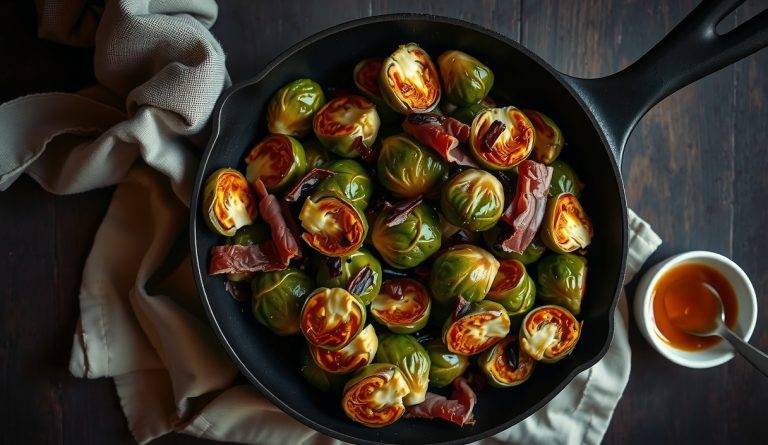
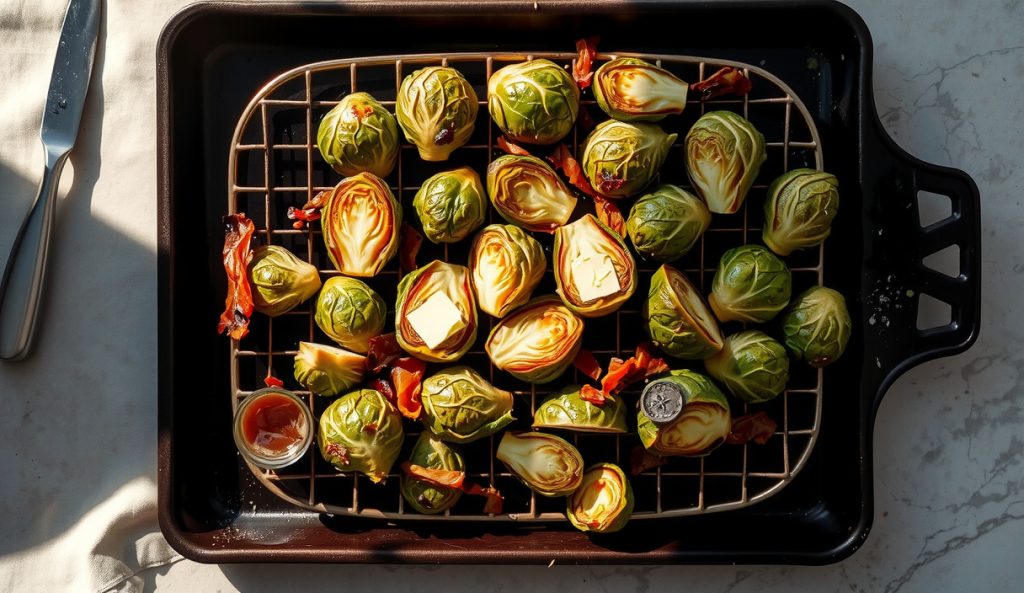
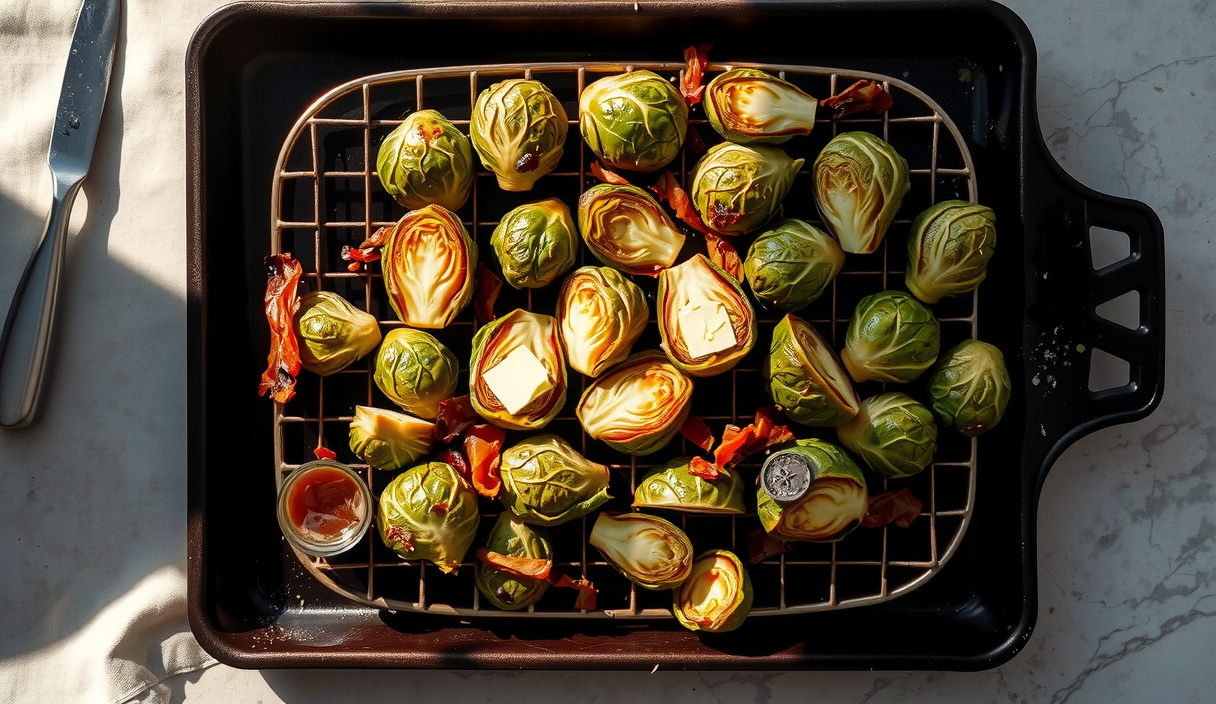
- After 30 minutes, ramp the smoker or grill to 425°F (218°C). On a pellet grill, simply increase the setpoint. On a charcoal setup, open the vents fully and, if needed, move the sprouts over the direct-heat zone. Continue cooking for 10 to 15 minutes, checking at the 10-minute mark. The cut faces should show deep, dark mahogany char with caramelized edges. The outer leaves will be crispy and slightly blackened at the tips — this is correct. Remove any sprouts under 1 inch in diameter 3 to 4 minutes earlier, as they char faster than larger ones.
Glaze and finish
- While the sprouts are in the char phase, whisk together the maple syrup, Dijon mustard, apple cider vinegar, and red pepper flakes (if using) in the large mixing bowl until fully emulsified. The Dijon’s mustard mucilage proteins will bind the fat-soluble maple compounds and vinegar into a stable, cohesive glaze.3 tablespoons pure maple syrup, 1 tablespoon Dijon mustard, 1 teaspoon apple cider vinegar, 1 pinch red pepper flakes
- Pull the sprouts from the heat and let them rest off the grate for 60 seconds — long enough to drop from active pyrolysis temperature but not long enough to cool below 150°F where caramelization stalls. Transfer to the mixing bowl with the glaze and toss vigorously. The glaze should sizzle and thicken on contact with the hot sprout surfaces. This is the caramelization event: the reducing sugars in the maple syrup reacting with the residual surface heat to build lacquered, glossy color without the bitterness of live-fire pyrolysis.3 tablespoons pure maple syrup, 1 tablespoon Dijon mustard, 1 teaspoon apple cider vinegar
- Season with kosher salt and freshly cracked black pepper immediately after glazing. Taste and adjust the vinegar level. Transfer to a serving platter and scatter the reserved crispy bacon lardons over the top. Serve immediately.0.5 teaspoon kosher salt, 0.25 teaspoon black pepper, 4 strips thick-cut bacon
Notes
Nutrition
The Brussels sprout has a reputation problem, and it is almost entirely deserved — for the boiled version. Waterlogged, sulfurous, gray. The chemistry behind that reputation is real: prolonged moist heat degrades glucosinolates into hydrogen sulfide compounds and destroys the cellular structure that makes a sprout interesting. But give that same sprout live fire, bacon fat, and a two-stage smoke-plus-char regime, and you are operating in an entirely different thermodynamic universe. This recipe is the one that converts sprout skeptics at the table every single time.
The technique here is deliberate and sequential. Low smoke first at 350°F to penetrate the cut surface and build the flavor foundation. Then a hard blast to 425°F to trigger aggressive Maillard browning on the flat faces. The Maple-Dijon glaze goes on only after the high-heat phase is done — a critical detail that separates a lacquered, jewel-like sprout from a scorched, bitter one. Where Flavor Meets the Flame.
Why do smoked Brussels sprouts taste so much better than boiled ones? The science
Smoked Brussels sprouts taste better than boiled ones because dry convective heat above 280°F (138°C) redirects sulfur chemistry from off-putting hydrogen sulfide into desirable roasted thiazole and furan structures. Brussels sprouts belong to the Brassica oleracea family and are dense with glucosinolates — sulfur-containing glycosides that hydrolyze enzymatically when cell walls are disrupted. The key control variable is water activity. In a dry, convective smoke environment at 350°F (177°C), the surface desiccates rapidly. Once the boundary layer water activity drops below approximately 0.70, evaporative cooling can no longer anchor the surface temperature at 212°F, and the Maillard cascade — the amino-carbonyl browning reaction requiring temperatures above roughly 280°F (138°C) at the surface — begins in earnest.
At the Maillard onset stage, hundreds of volatile organic compounds are generated via Schiff base formation and Strecker degradation, producing the nutty, roasted, and slightly bitter aromatic notes that make smoked brassicas so compelling. The sulfur compounds, paradoxically, become part of the flavor architecture rather than the liability — they integrate into roasted thiazole and furan structures at these temperatures instead of expressing as the detectable hydrogen sulfide associated with wet cooking.
The bacon fat is not optional — it is structural. Rendered bacon fat is a saturated lipid at approximately 40% oleic acid and 32% palmitic acid. Applied to the cut face of the sprout before smoking, bacon fat accomplishes two things simultaneously: it dramatically raises the thermal conductivity of the surface layer, accelerating both moisture loss and Maillard onset, and it acts as a thermodynamic solvent for the fat-soluble Maillard VOCs being generated, physically trapping those aromatic compounds against the vegetable surface rather than volatilizing them into the smoker exhaust. Think of the bacon fat as the aromatic reservoir.
The 425°F blast phase (218°C) is specifically designed to push the flat cut face through the pectin-degradation danger zone — the beta-elimination of polygalacturonic acid that causes cell wall softening — but because the sprout exterior is already partially desiccated from the low-smoke phase, the interior retains enough moisture and structural integrity to produce the ideal contrast: charred and crispy outside, tender and slightly sweet inside.
The Maple-Dijon glaze is applied post-heat for a specific kinetic reason. Maple syrup contains approximately 60–65% sucrose plus free reducing monosaccharides (glucose and fructose). At 425°F, those reducing sugars would cross into pyrolysis territory within 90 seconds on a hot grill surface, generating bitter, acrid melanoidins. By pulling the sprouts, lowering their surface temperature to approximately 180°F, and then tossing them in the glaze while still extremely hot, you trigger a rapid Maillard reaction between the maple amino compounds and the residual surface heat — caramelization without combustion. The Dijon provides two things: acidity (via vinegar, buffering the sweetness and brightening the palette) and mustard mucilage proteins that act as a natural emulsifier, binding the maple syrup and bacon fat into a cohesive, lacquered coating rather than a greasy, separated drizzle.
What equipment and ingredients do I need?
The smoker or grill setup. Any indirect-heat smoker works here — offset, kettle with a snake setup, pellet grill, or kamado. You need to be able to hold 350°F reliably and then ramp to 425°F without a long transition. Pellet grills are ideal for this recipe because the temperature ramp is fast and controllable. If using a kettle, set up a two-zone fire and move the sprouts from the indirect zone directly over the coals for the char phase.
Wood choice. Go mild here. Cherry or apple wood complements the sweetness of the maple without overpowering the brassica. Heavy woods like hickory or mesquite can tip the sulfur compounds into bitterness. A single chunk or a small handful of chips is all you need — this is a 30-minute smoke, not a brisket.
Bacon fat rendering. You want pure rendered fat, not the pan drippings with bits of meat. Render 4 strips of bacon low and slow in a cast-iron pan, drain the solids, and use the clarified fat. The lardons from the rendered bacon go back in as a garnish. If you do not have bacon fat on hand, substitute with a 1:1 blend of unsalted butter and neutral oil — you lose some of the smoky pork depth but the technique still works.
Brussels sprout prep. Size uniformity is essential for even cooking. Target sprouts in the 1- to 1.5-inch diameter range. Trim the stem end and halve through the core. The core holds the leaves together during the high-heat phase — do not remove it. Dry the cut surfaces with paper towels before tossing in fat; surface moisture delays the Maillard onset by several minutes.
The glaze ratio. The 3:1 maple-to-Dijon ratio by volume is calibrated for viscosity. Go below 2:1 and the Dijon sharpness dominates; above 4:1 and the glaze becomes too thin to coat. Add the apple cider vinegar to taste at the end — it is the brightness lever.
Smoked Brussels Sprouts with Bacon and Maple-Dijon Glaze
Equipment
- 1 Smoker or indirect-setup charcoal or pellet grill Capable of holding 350°F and ramping to 425°F
- 1 Probe thermometer For accurate grate temperature; factory dials are often unreliable by 25 to 50°F
- 1 Cast-iron skillet or oven-safe pan For rendering bacon fat
- 1 Large mixing bowl For fat-tossing and glazing off-heat
- 1 Sheet pan or grill basket Optional: use a grill basket for easy flipping of small sprouts
- 1 to 2 Cherry or apple wood chunks or chips One small chunk or a small handful of chips; avoid hickory or mesquite
Ingredients
Sprouts and fat
- 2 lbs Brussels sprouts Trimmed and halved through the core; target 1 to 1.5 inch diameter for uniform cooking
- 4 strips thick-cut bacon Rendered for the fat; lardons reserved for garnish
- 3 tablespoons rendered bacon fat From the strips above; substitute 1.5 tbsp unsalted butter plus 1.5 tbsp avocado oil if needed
- 0.5 teaspoon kosher salt Applied after glazing; not before smoking
- 0.25 teaspoon black pepper Freshly cracked
Maple-Dijon glaze
- 3 tablespoons pure maple syrup Grade A dark or Grade B for deeper flavor; avoid pancake syrup
- 1 tablespoon Dijon mustard Smooth Dijon; the mucilage proteins act as a natural emulsifier binding the glaze
- 1 teaspoon apple cider vinegar Adjust to taste; this is the brightness lever against the maple sweetness
- 1 pinch red pepper flakes Optional; adds slow-building heat contrast
Instructions
Prep and render bacon
- Render the bacon strips in a cast-iron skillet over medium-low heat until the fat is fully liquefied and the lardons are crispy, approximately 8 to 10 minutes. Remove the lardons to a paper-towel-lined plate and reserve. Strain the rendered fat through a fine mesh strainer into a small bowl and allow it to cool for 2 minutes. You need approximately 3 tablespoons of clarified fat.4 strips thick-cut bacon, 3 tablespoons rendered bacon fat
- Trim the stem end of each Brussels sprout and halve through the core. Pat the cut surfaces dry aggressively with paper towels — this is not optional. Any surface moisture delays Maillard browning onset by 4 to 6 minutes and creates steam that softens the interior before the exterior can char.
- In the large mixing bowl, toss the halved sprouts with the warm rendered bacon fat until every cut surface is evenly coated. Do not season with salt yet — salt draws cellular moisture to the surface via osmosis and counteracts the drying step you just completed.3 tablespoons rendered bacon fat
Low-smoke phase
- Prepare your smoker or grill for indirect heat at a stable 350°F (177°C). Verify the temperature with a probe thermometer at grate level — not the factory lid dial. Add one small chunk of cherry or apple wood, or a small foil packet of soaked chips, to the heat source.
- Arrange the fat-coated Brussels sprouts cut-side down on the grate in a single layer with visible space between each sprout. Crowding traps steam between sprouts and prevents the surface desiccation required for browning. Close the lid. Smoke at 350°F for 30 minutes without opening the lid. During this phase, smoke is penetrating the cut face and building the aromatic base while the surface water activity drops toward the Maillard-active zone.3 tablespoons rendered bacon fat
High-heat char phase
- After 30 minutes, ramp the smoker or grill to 425°F (218°C). On a pellet grill, simply increase the setpoint. On a charcoal setup, open the vents fully and, if needed, move the sprouts over the direct-heat zone. Continue cooking for 10 to 15 minutes, checking at the 10-minute mark. The cut faces should show deep, dark mahogany char with caramelized edges. The outer leaves will be crispy and slightly blackened at the tips — this is correct. Remove any sprouts under 1 inch in diameter 3 to 4 minutes earlier, as they char faster than larger ones.
Glaze and finish
- While the sprouts are in the char phase, whisk together the maple syrup, Dijon mustard, apple cider vinegar, and red pepper flakes (if using) in the large mixing bowl until fully emulsified. The Dijon’s mustard mucilage proteins will bind the fat-soluble maple compounds and vinegar into a stable, cohesive glaze.3 tablespoons pure maple syrup, 1 tablespoon Dijon mustard, 1 teaspoon apple cider vinegar, 1 pinch red pepper flakes
- Pull the sprouts from the heat and let them rest off the grate for 60 seconds — long enough to drop from active pyrolysis temperature but not long enough to cool below 150°F where caramelization stalls. Transfer to the mixing bowl with the glaze and toss vigorously. The glaze should sizzle and thicken on contact with the hot sprout surfaces. This is the caramelization event: the reducing sugars in the maple syrup reacting with the residual surface heat to build lacquered, glossy color without the bitterness of live-fire pyrolysis.3 tablespoons pure maple syrup, 1 tablespoon Dijon mustard, 1 teaspoon apple cider vinegar
- Season with kosher salt and freshly cracked black pepper immediately after glazing. Taste and adjust the vinegar level. Transfer to a serving platter and scatter the reserved crispy bacon lardons over the top. Serve immediately.0.5 teaspoon kosher salt, 0.25 teaspoon black pepper, 4 strips thick-cut bacon
Notes
Nutrition
How do I nail smoked Brussels sprouts every time?
- Dry your sprouts aggressively before you fat-toss them. Surface moisture is the enemy of Maillard browning. Any residual water on the cut face will extend the time to desiccation by 4 to 6 minutes, which cascades into undercharred, over-soft interiors by the time the surface finally browns.
- Place sprouts cut-side down on the grate for the full smoke phase. This maximizes the interface between the flat Maillard-reactive surface and the hot grate, and it keeps the rounded outer leaves from taking too much direct heat too early.
- Do not glaze over a live fire. If you apply the maple glaze while the sprouts are still on the 425°F grate, the fructose and glucose will hit pyrolysis within 60 to 90 seconds and generate acrid, bitter compounds. Pull the sprouts entirely off heat, wait 60 seconds, then toss in the glaze in a mixing bowl.
- The glaze should sizzle when it hits the sprouts. If the sprouts have cooled to below 150°F before glazing, the caramelization will not proceed and the coating will be thin and watery. Work fast after pulling from the grate.
- Watch the smaller sprouts. Any sprouts under 1 inch will char significantly faster than the larger ones during the 425°F phase. Either remove them 3 to 4 minutes early or size-sort your batch before cooking.
- Season after glazing, not before. The bacon fat carries salt, the Dijon carries salt, and adding aggressive salt pre-smoke can draw additional moisture out of the sprout cells via osmosis, creating surface puddles that delay browning further.
What variations can I make on this recipe?
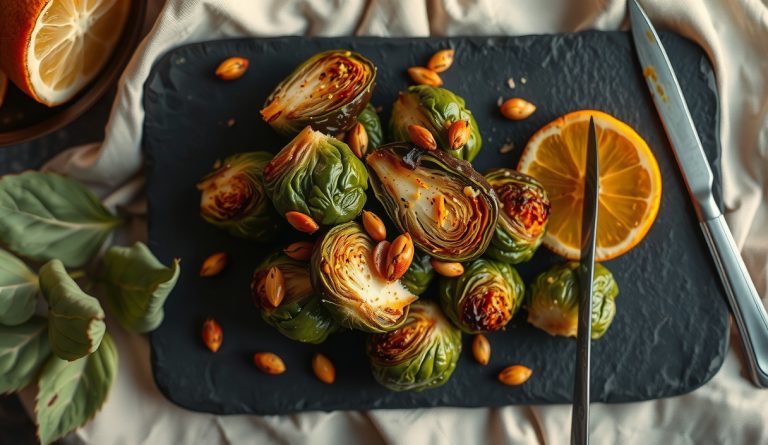
Vegan adaptation. Replace the bacon fat with refined coconut oil or a high-smoke-point avocado oil. Coconut oil carries a subtle sweetness that pairs nicely with the maple. Omit the bacon lardons and finish with toasted pepitas and a squeeze of citrus for textural contrast and brightness. The Maillard chemistry on the sprout surface is identical — the fat is a carrier, not a participant in the browning reaction itself.
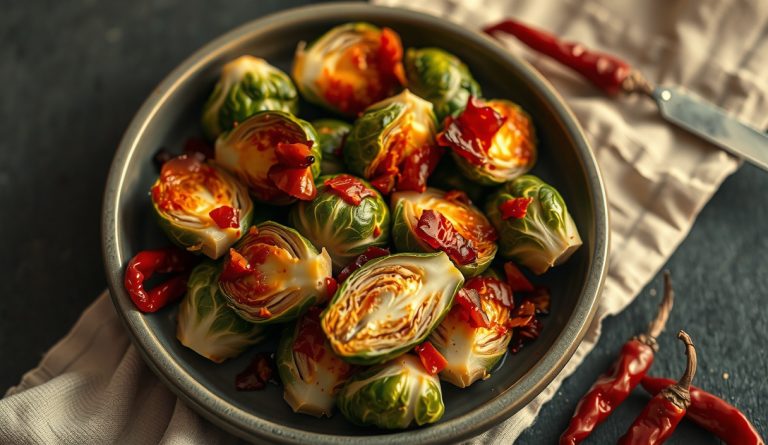
Spiced heat variant. Add 1 teaspoon of gochugaru (Korean red pepper flakes) or smoked paprika to the glaze for a smoky-sweet-hot profile. Gochugaru has a relatively low Scoville rating but provides excellent color and a slow-building heat that does not overwhelm the maple. Alternatively, a pinch of cayenne in the glaze (start at 1/8 teaspoon) creates a sharper, more immediate heat contrast against the sweetness.
Scaling for a crowd. This recipe scales linearly up to about 3 pounds of sprouts before grate overcrowding becomes a problem. Overcrowding drops the grate temperature, traps steam between sprouts, and prevents the desiccation required for browning — the classic failure mode of any high-heat vegetable dish. If you need more than 3 pounds, run two batches sequentially rather than cramming them all on at once. The glaze can be made in advance and held at room temperature for up to 4 hours before service.
Regional pairing — Southern-style. Swap the Maple-Dijon glaze for a cane syrup and whole-grain mustard combination, add a splash of bourbon to the glaze, and finish with crispy country ham bits instead of bacon. The flavor profile shifts from New England maple sweetness to deep Southern richness. The smoke wood recommendation shifts to pecan, which is traditional in much of the American South and provides a deeper, nuttier character that complements pork-forward applications.
Frequently asked questions
Can I make smoked Brussels sprouts on a gas grill without a dedicated smoker? Yes, with a workaround. Place a small foil packet of soaked wood chips directly over one burner on high heat until it begins to smoke, then set that burner to medium-low and cook the sprouts on the opposite side with the lid closed. Gas grills produce lighter smoke penetration than a dedicated smoker, but the Maillard chemistry and char phase work identically. Increase the high-heat char time by 2 to 3 minutes to compensate for the lower thermal mass of a gas grill.
Why do my smoked Brussels sprouts turn out mushy in the middle even when the outside looks right? Mushy interiors are almost always a moisture problem at the start. If the sprouts were not dried thoroughly before fat-tossing, or if they were crowded on the grate trapping steam, the interior cell walls undergo full pectin beta-elimination — the structural softening that occurs when polygalacturonic acid chains degrade — before the exterior can char. The fix is paper-towel drying, a single layer on the grate with visible space between each sprout, and confirming your smoker is actually at 350°F with a reliable probe thermometer rather than the factory dial.
How do I store and reheat leftover smoked Brussels sprouts without losing the char? Store glazed sprouts uncovered in the refrigerator for up to 2 days — covering them traps moisture and softens the char. Reheat in a cast-iron skillet over medium-high heat for 3 to 4 minutes, cut-side down, without adding any additional fat. The residual maple glaze will re-caramelize on the hot skillet surface, partially restoring the lacquered texture. Avoid microwave reheating — the rapid moisture generation from the interior will steam-soften the char within 45 seconds.