Texas-Style Beef Rub: 50/50 Salt and Pepper

Equipment
- 1 Kitchen scale Required — measuring by volume introduces unacceptable variance with different salt crystal geometries
- 1 Wide-mouth jar or shaker For mixing and applying; a large-hole shaker delivers an even, dispersed coat from 12 to 18 inches above the meat
- 1 Mixing bowl Medium size, for combining the two ingredients before transferring to shaker
Ingredients
- 56 g Diamond Crystal kosher salt 2 oz by weight; do not substitute table salt or Morton Kosher without adjusting — Morton is approximately 1.5x denser and saltier by volume
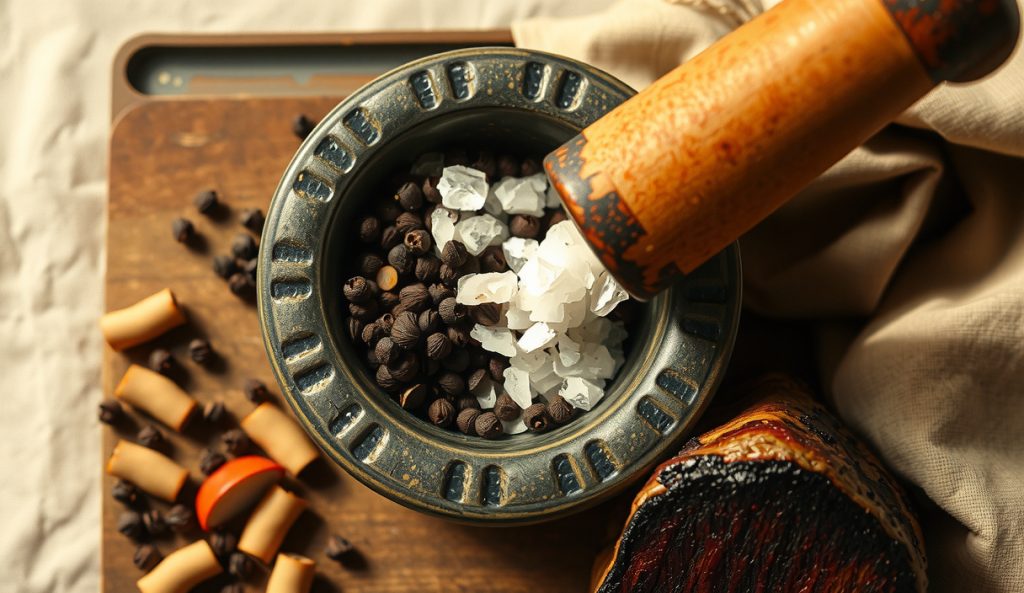
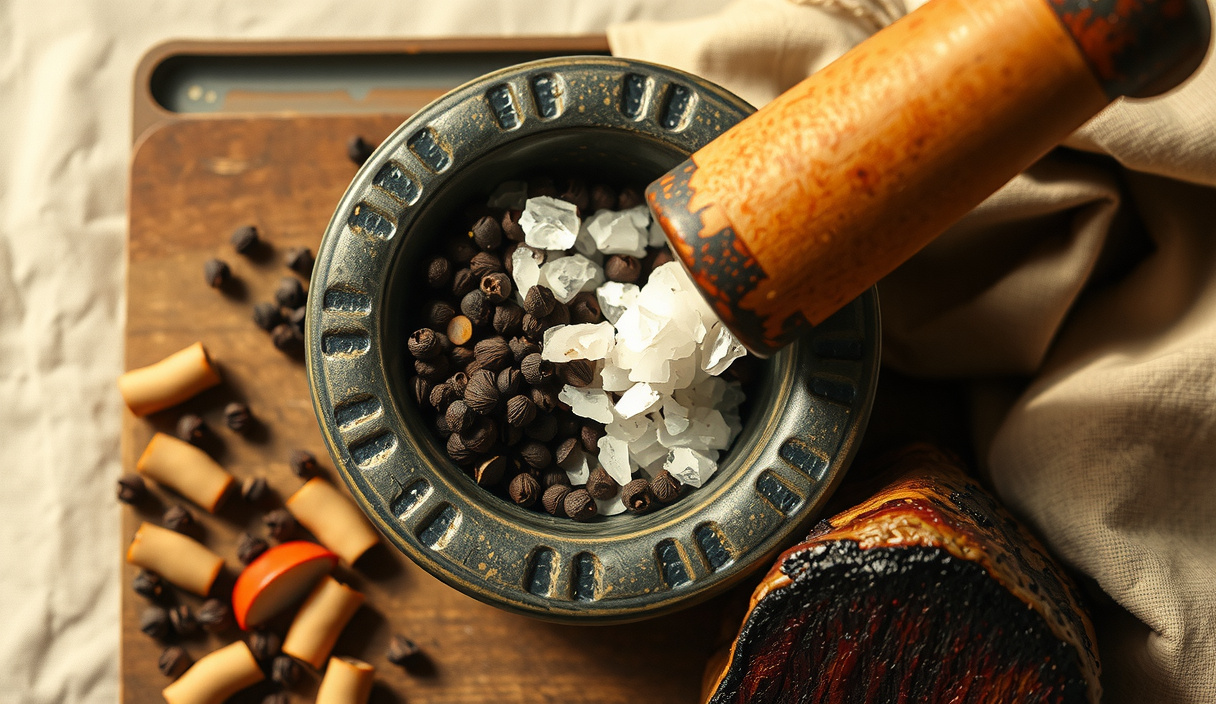
- 56 g 16-mesh coarse black pepper 2 oz by weight; source from a restaurant supply or labeled spice vendor — standard supermarket coarse grind is inconsistent and often too fine

Instructions
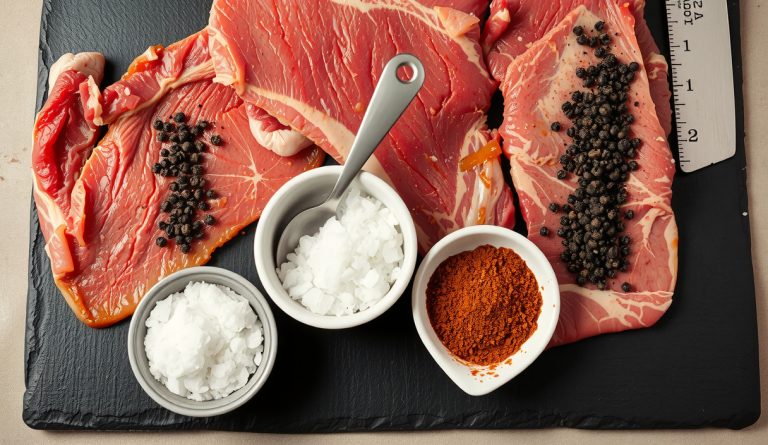
- Weigh out 56 g (2 oz) of Diamond Crystal kosher salt and 56 g (2 oz) of 16-mesh coarse black pepper on a kitchen scale. Combine in a mixing bowl and stir with a spoon until fully distributed. The blend should appear evenly speckled with no visible clustering of either component.56 g Diamond Crystal kosher salt, 56 g 16-mesh coarse black pepper
- Transfer the blended rub to a wide-mouth shaker or jar. Shake once to confirm even distribution before use.56 g Diamond Crystal kosher salt, 56 g 16-mesh coarse black pepper
- To apply: remove your brisket (or other beef cut) from refrigeration. The cold, slightly tacky surface provides natural adhesion — no binder is needed. Hold the shaker 12 to 18 inches above the surface and apply an even coat to all exposed meat surfaces at a rate of approximately 1/2 teaspoon of rub per pound of trimmed meat. Do not coat the fat cap heavily — a light dusting is sufficient as the fat cap contributes little to bark formation on the meat-side crust.56 g Diamond Crystal kosher salt, 56 g 16-mesh coarse black pepper
- After applying, press the rub lightly with an open palm — do not rub or massage — to physically seat the 16-mesh pepper particles into the wet protein surface. Heavy rubbing fractures the larger pepper fragments into fine dust that will scorch during the cook.56 g Diamond Crystal kosher salt, 56 g 16-mesh coarse black pepper
- Allow the rub to set on the meat uncovered at room temperature for 45 minutes, or refrigerate uncovered for up to 2 hours before cooking. This rest period allows the osmotic cycle to draw surface moisture out and pull brine back into the myofibrillar matrix, maximizing salt penetration and surface protein reorganization before the meat hits the smoker.56 g Diamond Crystal kosher salt, 56 g 16-mesh coarse black pepper
Notes
Nutrition
Walk into any legendary Central Texas barbecue joint — think Franklin, Snow’s, Louie Mueller — and you will find the same foundational truth behind every transcendent bark-crusted brisket: two ingredients, equal weight, no apology. Kosher salt and coarse black pepper. That is the whole recipe. The audacity of that simplicity is exactly why it works, and understanding the physics behind it will make you a better pitmaster than any twelve-spice commercial blend ever could.
Years of watching pitmasters over-complicate their rubs with garlic powder, onion powder, paprika, and brown sugar — then wonder why their bark turns soggy or their meat comes off the smoker looking like a grocery store rotisserie bird — leads to one conclusion: the 50/50 rub is not minimalism for its own sake. The 50/50 rub is a precisely engineered surface treatment that performs specific, quantifiable chemical and physical work on beef. Every additional ingredient is either redundant or counterproductive at the temperatures and timescales of low-and-slow BBQ.
Why does the Texas 50/50 rub work? The science
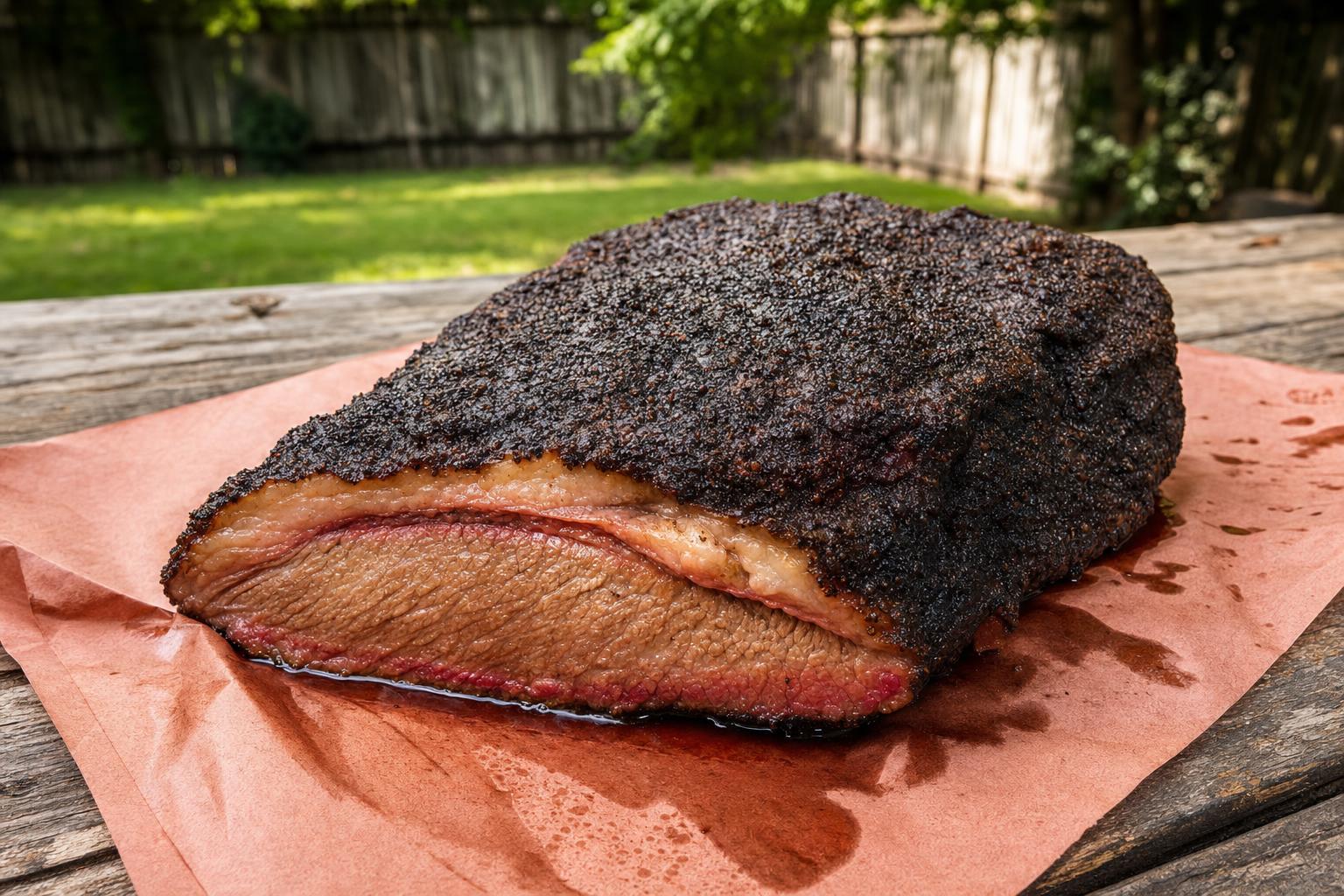
The bark on a brisket is a dehydrated, polymerized matrix of surface proteins, rendered fat, and Maillard reaction products, anchored to the meat by a crystalline salt lattice — and every component of the 50/50 rub plays a precise molecular role in building it. Sodium chloride is hygroscopic: within the first 30 to 45 minutes of application, the salt draws moisture from the myofibrillar proteins toward the surface via osmosis, temporarily creating a concentrated brine layer. That brine then diffuses back inward, driven by concentration gradient, carrying dissolved sodium and chloride ions deep into the muscle. At the ionic level, salt disrupts the electrostatic bonds holding myosin filaments in their native tertiary structure — a controlled partial denaturation that makes the surface protein matrix more porous, more adhesive, and more capable of anchoring a bark. Once moisture partially evaporates in the smoker, this salt-primed surface presents a high-surface-area, protein-rich substrate ready for the Maillard cascade, which requires local brisket surface temperatures above approximately 280°F (138°C).
Black pepper’s role in the 50/50 rub is dual and inseparable from grind geometry. The heat-active compounds in black pepper — primarily piperine, along with volatile terpenes including sabinene, pinene, and limonene — are trapped inside the pericarp of each ground particle. At a 16-mesh grind, each fragment is roughly 1 to 1.4 millimeters in diameter. That size is mechanically load-bearing: the particle is large enough to physically embed into the wet surface of the meat, creating an interlocking three-dimensional scaffold that holds the bark together across a 14-hour cook. Finer grinds — anything approaching standard table pepper or most commercial coarse grinds — will not embed; they coat the surface and burn during high-radiant-heat phases, producing acrid, bitter top notes instead of the deep, warm, resinous pepper signature that defines elite Central Texas BBQ. Coarser grinds above approximately 8-mesh will not adhere consistently and fall off during handling, leaving an uneven bark. The 16-mesh standard is not arbitrary; it is the geometric sweet spot confirmed by every serious Texas pitmaster across decades of practical repetition.
The 50/50 weight ratio works because kosher salt and 16-mesh pepper share nearly identical bulk densities — both come in around 0.9 to 1.1 grams per milliliter depending on crystal habit — so equal weight is also approximately equal volume, which simplifies application. More importantly, the ratio is calibrated to a standard application rate of 1/2 teaspoon of rub per pound of trimmed brisket. At that rate, the sodium chloride delivers roughly 450 to 500 milligrams of sodium per pound of cooked surface area — enough to drive osmotic protein reorganization without over-salting — while the pepper delivers sufficient piperine and terpene load to register as a distinct flavor compound after hours of smoke exposure without dominating the beef. This ratio survives a 14-hour cook at 250°F (121°C) on post oak.
What equipment and ingredients do you actually need?
- 16-mesh black pepper: This is the non-negotiable variable. Standard supermarket coarse ground is typically 14- to 20-mesh and inconsistent. Source a labeled 16-mesh product from a restaurant supply house or a reputable spice purveyor. Alternatively, crack whole black peppercorns in a burr grinder set to coarse and sieve through a standard kitchen sieve — the material that passes through is close to 16-mesh. Do not use pre-ground pepper from a can; the volatile terpenes that give fresh-cracked pepper its aroma have already off-gassed.
- Kosher salt: Use Diamond Crystal or Morton Kosher Salt. Do not swap for table salt — the irregular crystal geometry of kosher salt is part of what drives initial surface adhesion. Morton has a denser crystal structure than Diamond Crystal and is approximately 1.5 times saltier by volume, so adjust by weight if substituting. This recipe is written for Diamond Crystal.
- A kitchen scale: Measuring salt and pepper by volume introduces unacceptable variance. Both Diamond Crystal and 16-mesh pepper have different bulk densities than their finer counterparts. Weigh them.
- A shaker or large-mouth jar: Mix the rub, then apply through a shaker from approximately 12 to 18 inches above the meat surface. This height creates a dispersed, even coat without clumping. Do not rub it in — press lightly with an open palm to seat the pepper particles into the wet protein surface.
Texas-Style Beef Rub: 50/50 Salt and Pepper
Equipment
- 1 Kitchen scale Required — measuring by volume introduces unacceptable variance with different salt crystal geometries
- 1 Wide-mouth jar or shaker For mixing and applying; a large-hole shaker delivers an even, dispersed coat from 12 to 18 inches above the meat
- 1 Mixing bowl Medium size, for combining the two ingredients before transferring to shaker
Ingredients
- 56 g Diamond Crystal kosher salt 2 oz by weight; do not substitute table salt or Morton Kosher without adjusting — Morton is approximately 1.5x denser and saltier by volume
- 56 g 16-mesh coarse black pepper 2 oz by weight; source from a restaurant supply or labeled spice vendor — standard supermarket coarse grind is inconsistent and often too fine
Instructions
- Weigh out 56 g (2 oz) of Diamond Crystal kosher salt and 56 g (2 oz) of 16-mesh coarse black pepper on a kitchen scale. Combine in a mixing bowl and stir with a spoon until fully distributed. The blend should appear evenly speckled with no visible clustering of either component.56 g Diamond Crystal kosher salt, 56 g 16-mesh coarse black pepper
- Transfer the blended rub to a wide-mouth shaker or jar. Shake once to confirm even distribution before use.56 g Diamond Crystal kosher salt, 56 g 16-mesh coarse black pepper
- To apply: remove your brisket (or other beef cut) from refrigeration. The cold, slightly tacky surface provides natural adhesion — no binder is needed. Hold the shaker 12 to 18 inches above the surface and apply an even coat to all exposed meat surfaces at a rate of approximately 1/2 teaspoon of rub per pound of trimmed meat. Do not coat the fat cap heavily — a light dusting is sufficient as the fat cap contributes little to bark formation on the meat-side crust.56 g Diamond Crystal kosher salt, 56 g 16-mesh coarse black pepper
- After applying, press the rub lightly with an open palm — do not rub or massage — to physically seat the 16-mesh pepper particles into the wet protein surface. Heavy rubbing fractures the larger pepper fragments into fine dust that will scorch during the cook.56 g Diamond Crystal kosher salt, 56 g 16-mesh coarse black pepper
- Allow the rub to set on the meat uncovered at room temperature for 45 minutes, or refrigerate uncovered for up to 2 hours before cooking. This rest period allows the osmotic cycle to draw surface moisture out and pull brine back into the myofibrillar matrix, maximizing salt penetration and surface protein reorganization before the meat hits the smoker.56 g Diamond Crystal kosher salt, 56 g 16-mesh coarse black pepper
Notes
Nutrition
How do you nail it every time? Pitmaster tips
- Application timing is a lever, not an afterthought. Apply the rub at least 45 minutes before the cook — ideally 1 to 2 hours. This allows the osmotic draw-and-return cycle to complete before the surface hits smoker heat. Apply and immediately cook and the salt moisture extraction lags behind the evaporative phase, costing you the full protein-adhesion effect. Do not salt more than 12 hours ahead without refrigerating uncovered, or surface moisture will pool and the exterior will steam rather than dry going into the pit.
- Bark failure is almost always a moisture problem. If the bark is soft and rubbery rather than dry and crisp, the surface did not fully dehydrate before wrapping. Push the unwrapped phase longer — through the full stall if the smoker holds steady — before reaching for the butcher paper. The stall occurs when internal temperature plateaus around 155 to 165°F (68 to 74°C) as evaporative cooling matches heat input. This is collagen hydrolysis time. Do not rush it.
- Do not press the pepper in aggressively. A light open-palm press seats the particles. Heavy rubbing fractures larger pepper fragments into finer dust that will scorch. Let the wet protein surface do the adhesion work.
- This rub is calibrated for beef. The sodium-to-surface-area ratio and the pepper intensity assume the deep fat cap and dense myoglobin load of a USDA Choice or Prime packer brisket. On leaner cuts like chuck roast or beef ribs, reduce the application rate slightly — the higher surface-to-mass ratio means the rub concentration will read hotter and saltier per bite.
- Smoke wood interacts with this rub. Post oak is the canonical pairing because its low creosote output and moderate phenol load complement rather than compete with piperine. Hickory at high concentrations reads as bitter alongside heavy pepper. If using hickory, reduce pepper by 15 to 20 percent by weight or go to a lighter smoke profile.
- Store the blended rub correctly. Once mixed, volatile terpenes in the pepper begin migrating. Use blended rub within 2 weeks for optimal aromatic potency. Store in a sealed jar away from light and heat. Do not blend a year’s supply — this rub is cheap and fast to make fresh.
What variations work on the 50/50 base?
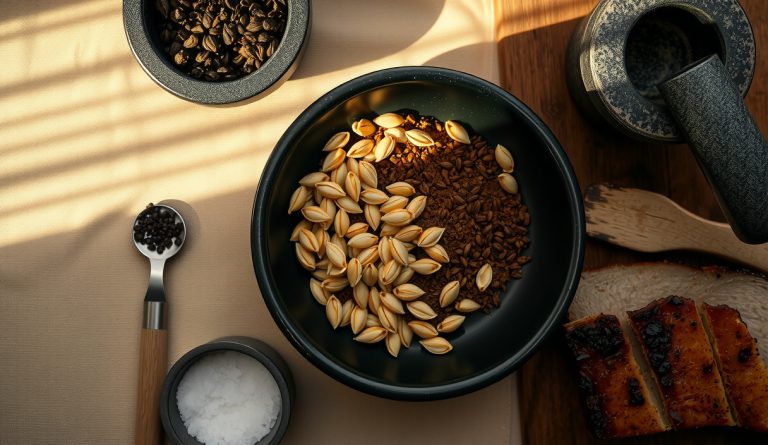
The Dalmatian with a tan: Some Central Texas pitmasters add a third element — a small percentage of coriander seed, toasted and cracked to a similar 16-mesh geometry, at 10 to 15 percent of the total weight, displacing equal parts salt and pepper. Coriander contributes citrus-terpene esters — linalool and geranyl acetate — that lift the aromatic profile without introducing sweetness or burning potential. The result is a slightly more complex bark with a citrus-herbal high note that reads as depth rather than spice. Use this variation on a whole brisket flat when a subtler profile is needed for a crowd unfamiliar with heavy pepper.
Scaling for competition cooks: Competition BBQ demands a rub that reads well cold — judges eat fast and the meat sits. For competition contexts, shift the ratio to 40 percent salt and 60 percent pepper by weight. The elevated pepper load creates a more visually dramatic bark and delivers a stronger flavor pop in the first 30 seconds post-slice, which is when judges form their impression. A small addition of MSG at 3 percent of total rub weight amplifies the glutamate signal from the beef’s own free amino acids without altering appearance or introducing any browning risk. MSG is sodium glutamate, a naturally occurring compound; its addition here is chemistry, not cheating.
Beef ribs (plate ribs and chuck ribs): Apply the same 50/50 ratio but reduce the application rate to approximately 1/3 teaspoon per pound of trimmed rib, due to the higher bone-to-meat ratio and thinner muscle sections. Beef ribs have less total collagen than brisket and a proportionally larger surface area relative to mass, so both the salt and pepper impact will read more intensely. Consider dropping to a 45/55 salt-to-pepper split and adding 5 percent white pepper at the same mesh for a slightly softer but more complex profile that works exceptionally well over mesquite.
Low-sodium adaptation: For a reduced-sodium profile without sacrificing bark mechanics, substitute half the kosher salt with potassium chloride (labeled as Nu-Salt or similar). Potassium chloride drives the same osmotic protein denaturation pathway as sodium chloride, produces equivalent surface adhesion, and is functionally indistinguishable in bark formation. The flavor is slightly more mineral and less clean-finish than pure sodium chloride — a difference the heavy pepper load masks effectively. Total sodium reduction at the standard application rate is approximately 45 to 50 percent. Do not attempt a full potassium chloride substitution: at high concentrations, potassium chloride introduces a bitter, metallic note that piperine amplifies rather than suppresses.
Frequently asked questions
Can I use freshly cracked pepper from a pepper mill instead of buying 16-mesh? A burr-type pepper mill set to its coarsest setting gets close, but consistency matters. Consumer pepper mills produce a wide particle-size distribution — a mix of dust and large shards — rather than a uniform 16-mesh grind. The dust fraction will burn; the large shards will not adhere. For occasional home cooks, a coarse burr grinder output is acceptable. For anyone cooking multiple briskets or competing, source true 16-mesh restaurant black pepper. The difference in bark texture and flavor is real and significant at the end of a 14-hour cook.
Why does bark look great going into the wrap but turn soft after the rest? Bark softening post-wrap is almost always caused by steam rehydration. When a brisket is wrapped in butcher paper or foil and rested in a dry cooler, residual steam from the meat condenses on the now-cooler bark surface and rehydrates the protein-pepper crust. The solution is to unwrap the brisket for the final 20 to 30 minutes of the cook after the internal temperature reaches the target range of 200 to 205°F (93 to 96°C), allowing the bark to re-dry and set before the cooler rest. Alternatively, rest in an oven at the lowest setting — around 170°F (77°C) — unwrapped for 30 minutes before the full cooler rest. The bark will be dramatically firmer.
Is there any reason to bind the rub with mustard, oil, or hot sauce first? Binders are not necessary with the 50/50 rub applied to a properly trimmed, cold brisket straight from the refrigerator. The cold, slightly tacky surface of refrigerator-temperature beef provides sufficient adhesion for both salt and 16-mesh pepper without any additional binder. Mustard adds acetic acid and water, which interfere with the clean osmotic draw of pure kosher salt. Oil creates a hydrophobic barrier that slows salt penetration. If the meat is room-temperature-dried or has been air-dried, a very light mist of water from a spray bottle is all that is needed to restore surface tackiness before application. Save the mustard for hot dogs.