Smoked Pineapple Daiquiri

Equipment
- 1 Smoker or kettle grill set up for indirect heat Target 225°F at grate level. Use an ambient probe thermometer, not the lid gauge.
- 1 cup Applewood or cherrywood chips Soak in water for 20 minutes before use so chips smolder rather than flare.
- 1 Juicer or blender plus fine-mesh strainer A centrifugal juicer gives the cleanest, lowest-fiber result. A blender plus straining through cheesecloth works equally well.
- 1 Cocktail shaker A two-piece tin shaker (Boston shaker) chills faster than a three-piece cobbler.
- 1 Hawthorne strainer
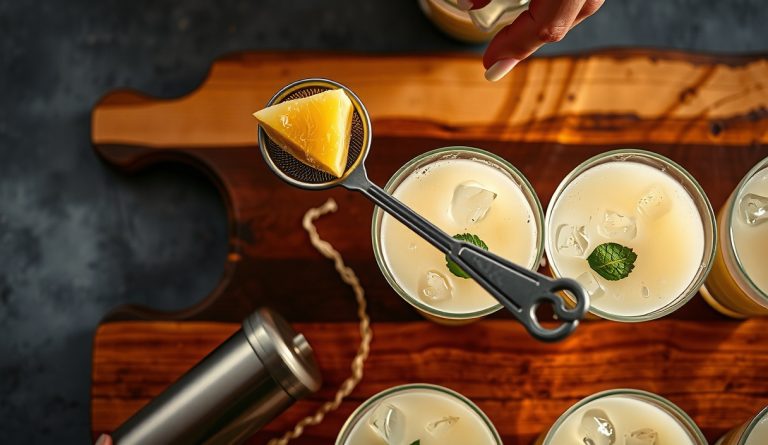
- 1 Fine-mesh conical strainer Double-straining removes ice chips and pineapple fiber for a crystal-clear pour.
- 1 Chilled coupe glass Store in the freezer for at least 20 minutes before service.
Ingredients
Smoked Pineapple Juice
- 1 small fresh pineapple About 3 lb whole. Cut into 1-inch-thick spears with skin on to protect flesh from direct radiant heat.
Cocktail
- 2 oz white rum Choose a clean, lightly filtered white rum with pronounced ethyl ester brightness. Avoid aged or spiced rum for the base build.
- 1.5 oz smoked pineapple juice Freshly pressed, fine-strained, and chilled to 34°F before use.
- 0.75 oz fresh lime juice Squeezed to order. Approximately 1 medium lime. Do not use bottled.
- 0.5 oz simple syrup 1:1 ratio, white sugar to water. Adjust up or down by 0.25 oz depending on the natural sweetness of your pineapple.
- 1 cup ice Large, hard cubes preferred. Cloudy or cracked ice melts too fast and over-dilutes before the target temperature is reached.
Garnish
- 1 small wedge smoked pineapple Reserve one smoked spear before juicing. Cut a thin wedge and nick the skin to balance on the coupe rim.

Instructions
Smoke the Pineapple
- Set up your smoker or kettle grill for indirect heat. Bring the grate temperature to a steady 225°F using an ambient probe thermometer placed at grate level. Add the soaked applewood or cherrywood chips directly over your heat source.
- Cut the pineapple into 1-inch-thick spears, leaving the skin on. The skin acts as a thermal buffer, slowing internal cooking while the flesh surface absorbs smoke compounds.
- Arrange the pineapple spears on the grate over the indirect-heat zone (not directly above the coals or burner). Close the lid. Smoke at 225°F for exactly 30 minutes. Do not lift the lid during this window — each opening drops chamber temperature by 25–40°F and disrupts the convective smoke flow that drives phenol deposition onto the fruit surface.
- Remove the pineapple from the smoker. The surface should be lightly golden with visible condensation of smoke compounds — not charred, not dried out. Allow to cool at room temperature for 10 minutes, then transfer to the refrigerator uncovered for at least 15 minutes before juicing. Cold fruit presses more efficiently and the chilled juice is ready for the shaker faster.
Press and Strain the Juice
- Remove and discard the pineapple skin. Feed the smoked flesh through a centrifugal juicer or blend with 2 tablespoons of cold water and press through a fine-mesh strainer lined with cheesecloth, pressing firmly to extract all liquid. You should yield approximately 4–6 oz of juice from a 3-pound pineapple.
- Transfer the pressed juice to a sealed container and refrigerate at 34°F for a minimum of 60 minutes before use. Chilled juice is essential for reaching the target final cocktail temperature (28–32°F in the glass) without over-diluting on ice.
Build and Shake the Cocktail
- Add the white rum, smoked pineapple juice, fresh lime juice, and simple syrup to the large tin of your cocktail shaker.1.5 oz smoked pineapple juice, 0.75 oz fresh lime juice, 0.5 oz simple syrup
- Fill the shaker two-thirds full with ice. Seal and shake hard for 12–15 seconds. You should feel the outside of the tin become painfully cold and begin to frost — this confirms the internal temperature has dropped below 32°F and sufficient dilution (approximately 20–25% by volume) has occurred.1 cup ice
- Double-strain through the Hawthorne strainer and a fine-mesh conical strainer simultaneously into your chilled coupe glass. The double-strain removes ice shards and any residual pineapple fiber, producing a clear, silky pour.
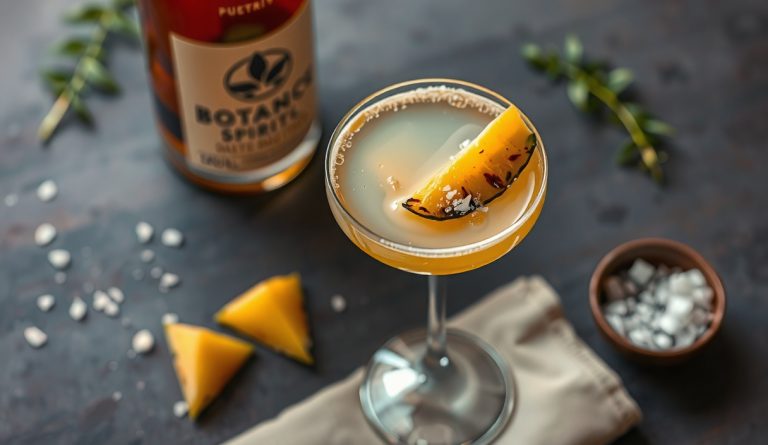
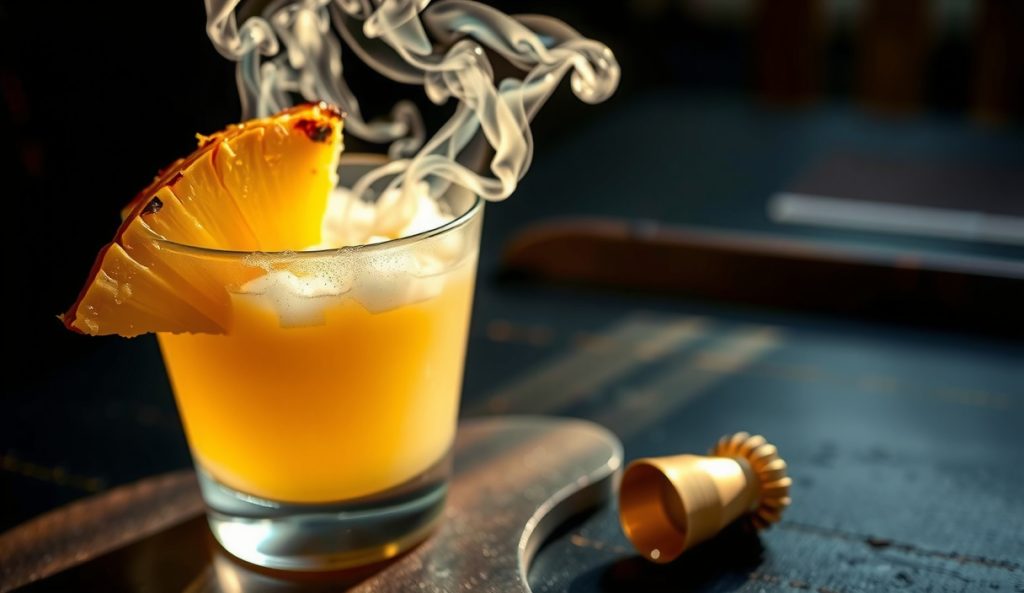
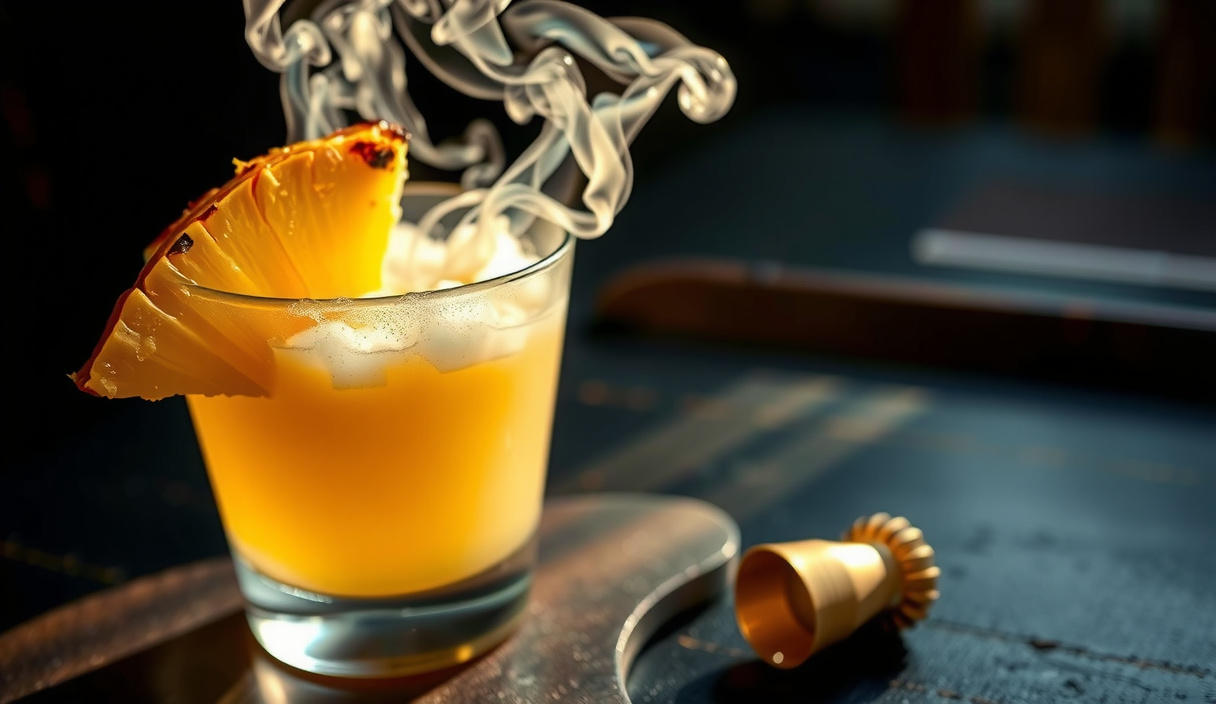
- Garnish with a thin smoked pineapple wedge balanced on the rim. Serve immediately.1 small wedge smoked pineapple
Notes
Nutrition
The classic daiquiri is three ingredients and one idea: balance. Rum, citrus, sweetener. This recipe reaches into that structure and replaces one fundamental flavor pillar with something that carries both sweetness and smoke simultaneously. Pineapple wedges go onto the grates at 225°F for 30 minutes, emerge with their surface sugars caramelized and their cell walls carrying a payload of volatile phenolic compounds from the wood smoke, and then get juiced. The result is a daiquiri that tastes like a vacation that ended at a bonfire — tropical, tart, and unmistakably alive with a lingering campfire resonance that no syrup or extract can fake.
This smoked pineapple daiquiri is not a garnish trick. It is not smoked salt on the rim or a spritz of liquid smoke added at the bar. The smoke is cooked into the fruit at the molecular level before a single drop enters the shaker. That distinction matters, and the science behind it is worth understanding before you light your first chunk of wood.
Why does a smoked pineapple daiquiri work? The science
The smoked pineapple daiquiri works because wood smoke phenols chemically bind to the sugars inside the pineapple flesh during the 30-minute smoke, locking volatile aroma compounds into the juice long after the fruit leaves the smoker. Wood smoke is a complex aerosol containing hundreds of volatile organic compounds — primarily phenols (guaiacol, syringol, 4-methylguaiacol), carbonyls (furfural, acetaldehyde), and polycyclic aromatic hydrocarbons — suspended in a water-and-oil vapor matrix. At 225°F, the pineapple surface sits at a water activity (aw) just below 1.0 and a surface temperature that fluctuates between 140°F and 180°F as evaporative cooling moderates the heat load, keeping the flesh from cooking through while maximizing smoke-compound residence time at the fruit’s surface.
The key mechanism is the lipophilic partitioning and sugar-binding behavior of phenolic smoke compounds. Pineapple flesh contains a dense matrix of sucrose, glucose, and fructose alongside cell-wall pectins. Guaiacol and syringol — the two phenols most responsible for the characteristic wood-smoke aroma — are moderately hydrophilic (log P values near 1.1 and 1.3, respectively), meaning they distribute readily into both the aqueous sugar phase and the thin lipid membranes of the pineapple’s cell walls. Crucially, the reducing sugars in pineapple form reversible hemiacetal complexes with carbonyl-bearing smoke volatiles, physically trapping those volatiles inside the juice even after mechanical pressing. Water activity in the pressed juice sits near 0.99, providing enough molecular mobility to sustain the aromatic reservoir without driving rapid evaporative loss when the juice hits the ice-cold shaker.
On the palate, smoke phenols activate two distinct receptor pathways simultaneously. Guaiacol and its methylated relatives engage olfactory receptors (OR2W1 and related) responsible for woody, spicy, and vanilla-adjacent perceptions at concentrations well below 1 ppb threshold, meaning even modest smoke absorption produces a pronounced sensory effect. Simultaneously, the high acidity of lime juice (pH 2.3–2.5) sharpens retronasal phenol volatilization by partially suppressing salivary protein binding, allowing more free guaiacol to reach the olfactory epithelium during swallowing. The Maillard browning that occurs on the pineapple surface during smoking contributes an additional layer of furanic and pyrazine compounds — the same family responsible for toasted, caramel, and nutty notes — which survive into the juice and integrate with the rum’s own ester profile (isoamyl acetate, ethyl caproate) to create cross-modal enhancement: the smoke makes the tropical fruit read as more intensely tropical, not less.
What equipment and ingredients do I need?
A real smoker or a kettle grill with an indirect-heat setup is required for the smoked pineapple daiquiri. A stovetop smoking pan or handheld smoke gun will not achieve the same result — the phenol deposition from 30 minutes of convective wood smoke inside a closed chamber is categorically different from a 60-second handheld blast, which deposits surface volatiles only and produces harsh, unintegrated smoke character. Applewood or cherrywood chips are strongly preferred: both are fruity-forward hardwoods that produce high guaiacol and low creosote, pairing well with pineapple’s ester profile. Hickory and mesquite produce aggressive syringol and phenol concentrations that can overwhelm the fruit at this short cook time.
White rum matters in this recipe. Aged or dark rum carries its own heavy wood and vanilla phenol load, and layering that on top of smoked pineapple juice creates muddy, over-complex results. A clean, lightly filtered white rum — one with pronounced ethyl ester brightness — provides the neutral-but-tropical backbone that lets the smoked pineapple carry the flavor narrative. For the lime, fresh is non-negotiable: bottled lime juice has been heat-treated, driving off linalool and terpene volatiles that provide the sharp citrus counterpoint the drink needs. Finally, use a fine-mesh strainer when pressing the smoked pineapple — any pulp fiber in the juice raises the viscosity of the shaken cocktail above the threshold where it begins to feel heavy rather than silky.
Smoked Pineapple Daiquiri
Equipment
- 1 Smoker or kettle grill set up for indirect heat Target 225°F at grate level. Use an ambient probe thermometer, not the lid gauge.
- 1 cup Applewood or cherrywood chips Soak in water for 20 minutes before use so chips smolder rather than flare.
- 1 Juicer or blender plus fine-mesh strainer A centrifugal juicer gives the cleanest, lowest-fiber result. A blender plus straining through cheesecloth works equally well.
- 1 Cocktail shaker A two-piece tin shaker (Boston shaker) chills faster than a three-piece cobbler.
- 1 Hawthorne strainer
- 1 Fine-mesh conical strainer Double-straining removes ice chips and pineapple fiber for a crystal-clear pour.
- 1 Chilled coupe glass Store in the freezer for at least 20 minutes before service.
Ingredients
Smoked Pineapple Juice
- 1 small fresh pineapple About 3 lb whole. Cut into 1-inch-thick spears with skin on to protect flesh from direct radiant heat.
Cocktail
- 2 oz white rum Choose a clean, lightly filtered white rum with pronounced ethyl ester brightness. Avoid aged or spiced rum for the base build.
- 1.5 oz smoked pineapple juice Freshly pressed, fine-strained, and chilled to 34°F before use.
- 0.75 oz fresh lime juice Squeezed to order. Approximately 1 medium lime. Do not use bottled.
- 0.5 oz simple syrup 1:1 ratio, white sugar to water. Adjust up or down by 0.25 oz depending on the natural sweetness of your pineapple.
- 1 cup ice Large, hard cubes preferred. Cloudy or cracked ice melts too fast and over-dilutes before the target temperature is reached.
Garnish
- 1 small wedge smoked pineapple Reserve one smoked spear before juicing. Cut a thin wedge and nick the skin to balance on the coupe rim.
Instructions
Smoke the Pineapple
- Set up your smoker or kettle grill for indirect heat. Bring the grate temperature to a steady 225°F using an ambient probe thermometer placed at grate level. Add the soaked applewood or cherrywood chips directly over your heat source.
- Cut the pineapple into 1-inch-thick spears, leaving the skin on. The skin acts as a thermal buffer, slowing internal cooking while the flesh surface absorbs smoke compounds.
- Arrange the pineapple spears on the grate over the indirect-heat zone (not directly above the coals or burner). Close the lid. Smoke at 225°F for exactly 30 minutes. Do not lift the lid during this window — each opening drops chamber temperature by 25–40°F and disrupts the convective smoke flow that drives phenol deposition onto the fruit surface.
- Remove the pineapple from the smoker. The surface should be lightly golden with visible condensation of smoke compounds — not charred, not dried out. Allow to cool at room temperature for 10 minutes, then transfer to the refrigerator uncovered for at least 15 minutes before juicing. Cold fruit presses more efficiently and the chilled juice is ready for the shaker faster.
Press and Strain the Juice
- Remove and discard the pineapple skin. Feed the smoked flesh through a centrifugal juicer or blend with 2 tablespoons of cold water and press through a fine-mesh strainer lined with cheesecloth, pressing firmly to extract all liquid. You should yield approximately 4–6 oz of juice from a 3-pound pineapple.
- Transfer the pressed juice to a sealed container and refrigerate at 34°F for a minimum of 60 minutes before use. Chilled juice is essential for reaching the target final cocktail temperature (28–32°F in the glass) without over-diluting on ice.
Build and Shake the Cocktail
- Add the white rum, smoked pineapple juice, fresh lime juice, and simple syrup to the large tin of your cocktail shaker.1.5 oz smoked pineapple juice, 0.75 oz fresh lime juice, 0.5 oz simple syrup
- Fill the shaker two-thirds full with ice. Seal and shake hard for 12–15 seconds. You should feel the outside of the tin become painfully cold and begin to frost — this confirms the internal temperature has dropped below 32°F and sufficient dilution (approximately 20–25% by volume) has occurred.1 cup ice
- Double-strain through the Hawthorne strainer and a fine-mesh conical strainer simultaneously into your chilled coupe glass. The double-strain removes ice shards and any residual pineapple fiber, producing a clear, silky pour.
- Garnish with a thin smoked pineapple wedge balanced on the rim. Serve immediately.1 small wedge smoked pineapple
Notes
Nutrition
How do I nail this smoked pineapple daiquiri every time?
- Do not exceed 225°F or 30 minutes on the smoker. Above 230°F, the pineapple surface begins to dehydrate aggressively, concentrating bitter chlorogenic-adjacent compounds and producing a scorched rather than smoked character. A calibrated ambient probe thermometer at grate level is worth using here — not the lid thermometer, which reads 20–30°F higher than actual grate temperature.
- Chill the juice before shaking. Smoked pineapple juice at room temperature will melt your ice during shaking before you achieve full dilution, resulting in a flat, warm, over-diluted cocktail. Press, strain, and refrigerate the juice for at least one hour before service.
- Shake hard and long — 12 to 15 seconds minimum. Pineapple juice contains bromelain, a protease that at cocktail concentrations actually helps stabilize the small foam head generated by vigorous shaking. Rapid agitation also drives phenol volatiles out of solution temporarily, then recaptures them as the cocktail cools, creating a more aromatic initial pour. Under-shaking leaves the cocktail too warm and under-aerated.
- Double-strain into a chilled coupe. A Hawthorne strainer plus a fine-mesh conical strainer removes ice chips and any residual pineapple fiber, ensuring a crystal-clear pour with the silky mouthfeel this drink demands at its final viscosity window (target ~3–5 mPa·s in the glass).
- Match your wood chip moisture level. Bone-dry chips ignite too fast and produce high-particulate, acrid smoke. Chips soaked for 20 minutes produce lower-temperature, higher-water-vapor smoke that deposits phenols more gently and evenly across the pineapple surface. Aim for chips that are damp on the outside but not dripping.
- Serve immediately after pouring. The smoked phenol-sugar complexes are in dynamic equilibrium — they volatilize from the cold liquid surface within 5–8 minutes at room temperature. A cocktail that sits in the glass loses 30–40% of its aromatic headspace before the second sip.
What variations can I make on this recipe?
Spiced rum swap: Replace the white rum with a lightly spiced rum — one whose spice profile leans toward cinnamon and allspice rather than vanilla and caramel — for a drink that reads closer to a Caribbean-smoke fusion. Reduce the simple syrup by half, as spiced rums carry residual sweetness. The cinnamon aldehydes in spiced rum are chemically similar to guaiacol in their receptor interactions, amplifying the smoke perception through cross-modal synergy without adding more actual smoke.
Mezcal blend: Replace 0.5 oz of the white rum with 0.5 oz of a highland Oaxacan mezcal (espadin or tobala). This substitution introduces agave-derived smoke phenols alongside the wood smoke in the pineapple juice, creating an agave-tropical bridge. Use orange bitters (2 dashes) in place of simple syrup to manage sweetness while adding oxidized orange terpenes that link the mezcal and pineapple aromatic families.
Virgin build: Replace the rum entirely with a non-alcoholic spirit (such as a distilled botanical spirit with citrus and juniper character) at the same 2 oz volume. The smoked pineapple juice and lime carry remarkable structural complexity without alcohol, and the botanical spirit provides the bitter, herbal counterpoint that keeps the drink from reading as juice. Add a small pinch of flake sea salt (0.5 g) to the shaker — sodium ions suppress bitter perception and amplify sweet-aromatic volatiles through ionic strength modulation, a necessary compensation when removing ethanol’s own flavor-carry function.
Scaling for batch service: Multiply all ingredients by the number of servings and combine juice, rum, lime, and syrup in a sealed container. Do not pre-dilute with water; instead, store at 34°F and shake each portion individually to order, or shake the full batch over ice in a large Cambro for exactly 90 seconds and fine-strain immediately into a pre-chilled pitcher. Batch cocktails lose aromatic headspace 2× faster than individually shaken drinks at equivalent temperatures, so the batch should be consumed within 45 minutes of preparation.
Frequently asked questions
Can I use canned or frozen pineapple instead of fresh? Frozen pineapple (unsweetened, individually quick-frozen) is an acceptable substitute; the freeze-thaw cycle ruptures cell walls, increases juice yield, and preserves an aromatic profile closer to fresh than canned. Canned pineapple has been heat-processed at temperatures above 200°F, which destroys bromelain and drives off linalool and other volatile esters that give fresh pineapple its brightness — the resulting juice is flatter and sweeter without the aromatic lift that makes the smoked contrast legible. Smoke frozen pineapple directly from frozen; the lower internal temperature extends the smoking window slightly and produces more even phenol deposition.
What wood should I avoid? Avoid pine, cedar, spruce, and any resinous softwood — these produce high concentrations of terpene-based resins and turpentine compounds (alpha-pinene, beta-pinene) that create a harsh, medicinal bitterness incompatible with fruit. Avoid walnut, which generates high concentrations of juglone, a polyphenolic compound with an intensely astringent, tannic character that overwhelms delicate fruit juice. Stick to fruit-bearing hardwoods — apple, cherry, peach — or light-density hardwoods like alder for the cleanest phenol-to-fruit integration.
How far in advance can I make the smoked pineapple juice? Smoked pineapple juice is best used within 24 hours of pressing. The volatile phenolic compounds are in dynamic equilibrium with the aqueous sugar matrix, and oxidation — particularly of guaiacol — begins converting the aromatic smoke character into flatter, stale, wood-chip-adjacent notes within 36–48 hours even under refrigeration. For make-ahead prep, press and store the juice in a vacuum-sealed container or sous-vide bag with all air removed; reduced oxygen exposure slows phenol oxidation significantly and extends the aromatic window to 48–72 hours at 34°F.