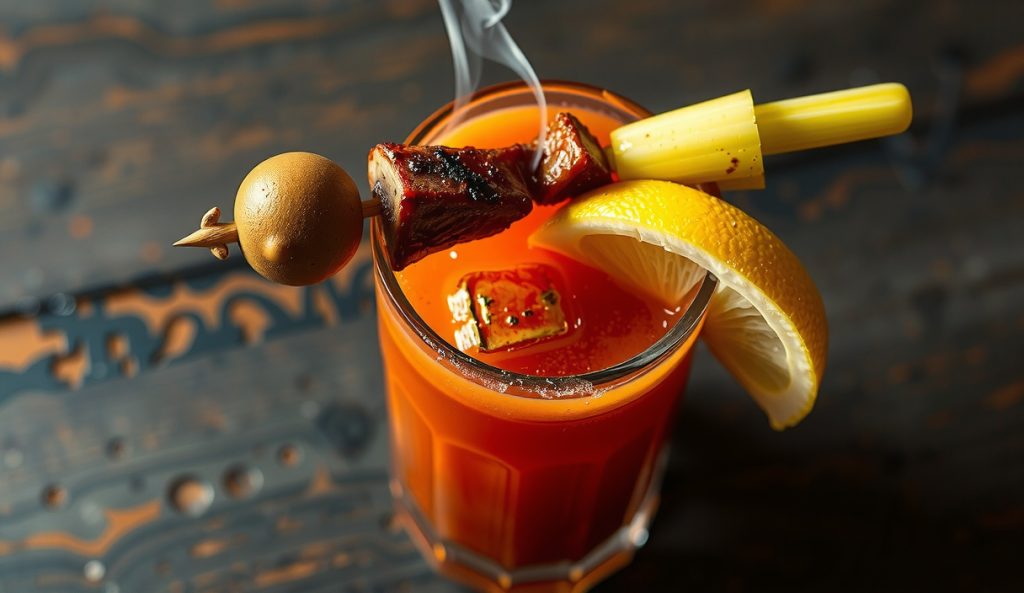
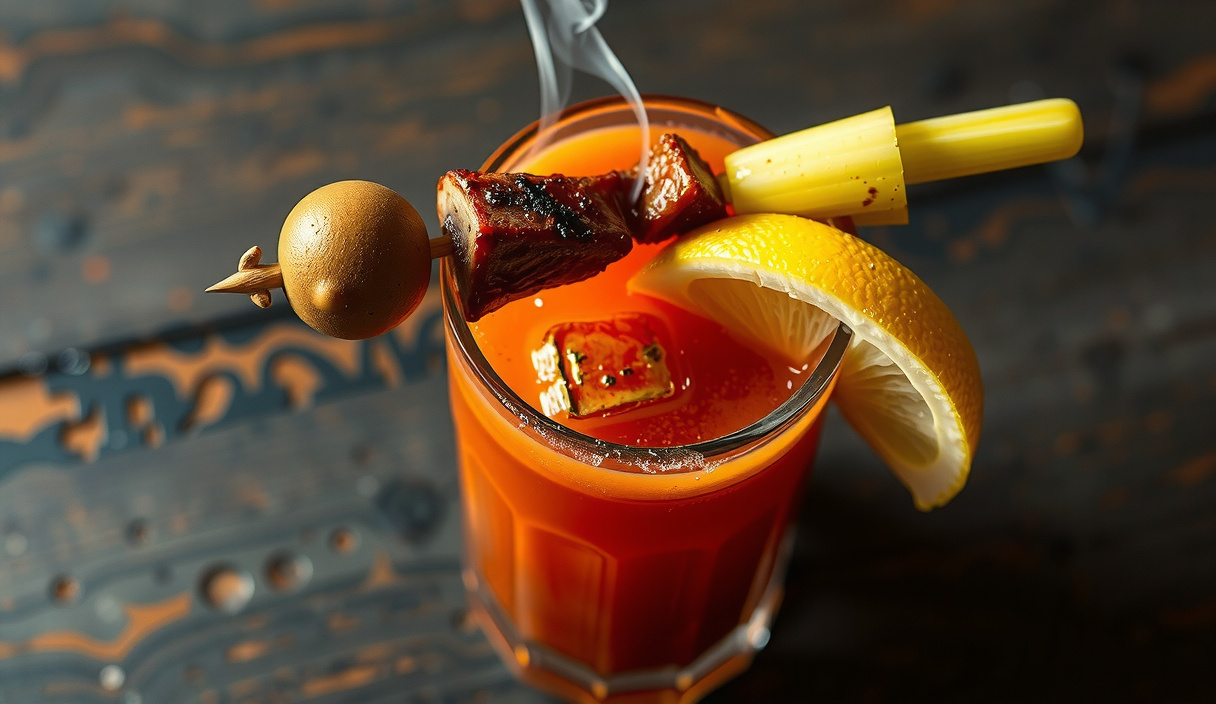
Smoked Bloody Mary with Brisket Burnt-End Skewer
Equipment
- 1 Pint glass or highball glass (16 oz) Chilled if possible
- 1 Handheld smoke infuser or cold-smoke setup For cold-smoking the tomato juice; cherry or applewood chips recommended
- 1 Bar spoon
- 1 Jigger or measuring cups
- 1 Fine-mesh sieve For straining fresh horseradish if desired
- 2 Wooden cocktail skewers (6-inch)
- 1 Shallow plate for rim mixture
Ingredients
Smoked Rim
- 1 tbsp coarse kosher salt
- 1 tsp smoked paprika
- 0.5 tsp coarsely cracked black pepper
- 0.5 wedge lemon For wetting the glass rim
Cold-Smoked Tomato Juice Base
- 4 oz tomato juice Low-sodium preferred; or fresh-juiced and strained San Marzano tomatoes
- 1 tsp cherry or applewood chips For cold-smoking; smoke below 85°F
Cocktail Build
- 1.5 oz vodka Neutral, unflavored 80-proof; chilled
- 0.5 oz fresh lemon juice Squeezed immediately before building
- 1 tsp fresh horseradish Grated immediately before use; adjust to heat preference
- 0.5 tsp Worcestershire sauce Full-sodium, original formulation
- 0.25 tsp hot sauce Tabasco or Crystal; adjust to taste
- 0.125 tsp celery salt
- 3 cracks black pepper Freshly cracked
Garnish
- 2 pieces brisket burnt ends Point-cut, caramelized, bark re-formed; firm enough to skewer
- 1 piece smoked olive Green or Castelvetrano; smoked in a smoker or with a smoke infuser
- 1 spear pickled okra Store-bought or homemade; adds vinegar brightness and crunch
- 1 wedge lemon For garnish
- 3 pieces large-format ice cubes 2-inch cubes preferred for slow melt rate

Instructions
Cold-Smoke the Tomato Juice (Do This the Night Before)
- Pour the tomato juice into a sealed container or covered pitcher with enough headspace for smoke to accumulate. Using a handheld smoke infuser loaded with cherry or applewood chips, inject cold smoke into the container. Seal immediately and let the smoke contact the juice for 10 to 15 minutes at ambient temperature — the juice surface temperature should remain below 85°F throughout. Do not heat the juice.1.5 oz vodka, 0.5 oz fresh lemon juice
- After the smoke contact period, refrigerate the smoked juice uncovered for 30 minutes to allow volatile surface compounds to dissipate, then cover and refrigerate for a minimum of 8 hours (overnight is ideal). The phenolic compounds need time to equilibrate through the full volume of juice. Juice used immediately will taste sharp and unintegrated.1.5 oz vodka
Prep the Rim and Glass
- Combine the coarse kosher salt, smoked paprika, and cracked black pepper on a shallow plate. Stir to distribute evenly. Run a lemon wedge around the outer lip of a pint or highball glass, wetting only the outermost half-inch of the rim. Roll the moistened rim lightly through the spice-salt mixture, applying even pressure to build a thin, consistent layer. Shake off any excess.1 tsp smoked paprika, 0.5 tsp coarsely cracked black pepper, 0.5 wedge lemon
- Fill the rimmed glass with large-format ice cubes. Cold glass and slow-melting ice are non-negotiable — a warm Bloody Mary degrades the aromatic profile and turns the horseradish harsh.
Build the Cocktail
- Add the chilled vodka directly over the ice, followed by the cold-smoked tomato juice, fresh lemon juice, fresh-grated horseradish, Worcestershire sauce, hot sauce, celery salt, and cracked black pepper. Do not pre-mix the spice components — add them individually so you can taste and adjust before the final stir.1 tsp fresh horseradish, 1.5 oz vodka, 0.5 tsp Worcestershire sauce, 0.25 tsp hot sauce, 0.125 tsp celery salt, 3 cracks black pepper, 2 pieces brisket burnt ends, 1 piece smoked olive
- Using a bar spoon, stir the drink five to six times with a gentle, sweeping motion from the bottom of the glass upward. The goal is to integrate the components and chill the liquid further without over-aerating the tomato juice. Taste through the straw. Adjust horseradish, hot sauce, or lemon to your preference before adding garnish.0.25 tsp hot sauce, 3 cracks black pepper, 0.5 tsp Worcestershire sauce
Assemble and Add the Garnish
- Thread two brisket burnt ends and one smoked olive onto a 6-inch cocktail skewer, alternating for visual balance. Leave enough skewer handle exposed for easy gripping above the rim of the glass.1 spear pickled okra, 1 wedge lemon
- Lay the pickled okra spear against the inside of the glass, angled outward. Place the lemon wedge on the rim. Rest the burnt-end skewer across the top of the glass so it sits partly submerged in the drink. Allow the skewer to rest in the drink for 45 to 60 seconds before serving or drinking. This is the fat-migration window — bark compounds and rendered beef fat will begin dissolving into the liquid, enriching each subsequent sip.3 pieces large-format ice cubes, 1 spear pickled okra, 1 wedge lemon
Notes
Nutrition
There is a specific kind of Saturday morning that demands more than a mimosa. The kind where the smoker ran all night, the brisket rested until midnight, and now the burnt ends are sitting in a foil pan on the counter begging for a purpose. The Smoked Bloody Mary with Brisket Burnt-End Skewer is that purpose — a precisely engineered brunch cocktail that treats every component as a functional flavor layer, from the cold-smoked tomato base to the rendered fat migrating off the meat skewer into the glass.
This build rests on a single conviction: the Bloody Mary is the only cocktail that legitimately benefits from BBQ garnish, because the savory, umami-dense profile of smoked beef does not fight the drink — it extends it. Every sip taken after a bite of caramelized burnt-end bark deepens the Maillard resonance already present in the smoked tomato juice. That is not an accident. It is chemistry.
Why does a Smoked Bloody Mary work? The science
Cold-smoking tomato juice transforms its flavor architecture at the molecular level. Raw tomato juice is dominated by cis-3-hexenal — a green, grassy aldehyde — and geranylacetone. When wood smoke passes over the juice at temperatures below 90°F, well beneath the thermal threshold that would trigger additional Maillard reactions or denature proteins, it deposits a suite of phenolic compounds: guaiacol, syringol, and 4-methylguaiacol. These molecules carry extraordinarily low odor thresholds, active at concentrations as low as 3 parts per billion, and they synergize with the free glutamic acid already present in tomatoes to generate a savory depth that registers as umami rather than simply smoky. The result is a base that tastes like a six-hour braise without the heat burden.
Horseradish delivers its signature heat through allyl isothiocyanate (AITC), which activates the TRPA1 ion channel — the same chemosensory receptor stimulated by wasabi and mustard. AITC is volatile and highly soluble in the aqueous phase of the drink, and its concentration degrades rapidly after the root is grated. Freshly grated horseradish delivers a sharper, more intense nasal heat than jarred preparations. Worcestershire sauce contributes a precisely calibrated matrix of fermented anchovy-derived glutamates and tamarind-sourced organic acids, providing the nucleotide-glutamate synergy that activates T1R1/T1R3 umami receptors exponentially more than either compound alone. Lemon juice introduces citric acid, lowering the drink’s pH to approximately 3.5 to 4.0, which brightens the volatile aromatic headspace and accelerates the evaporation of top-note compounds toward the olfactory epithelium during each sip.
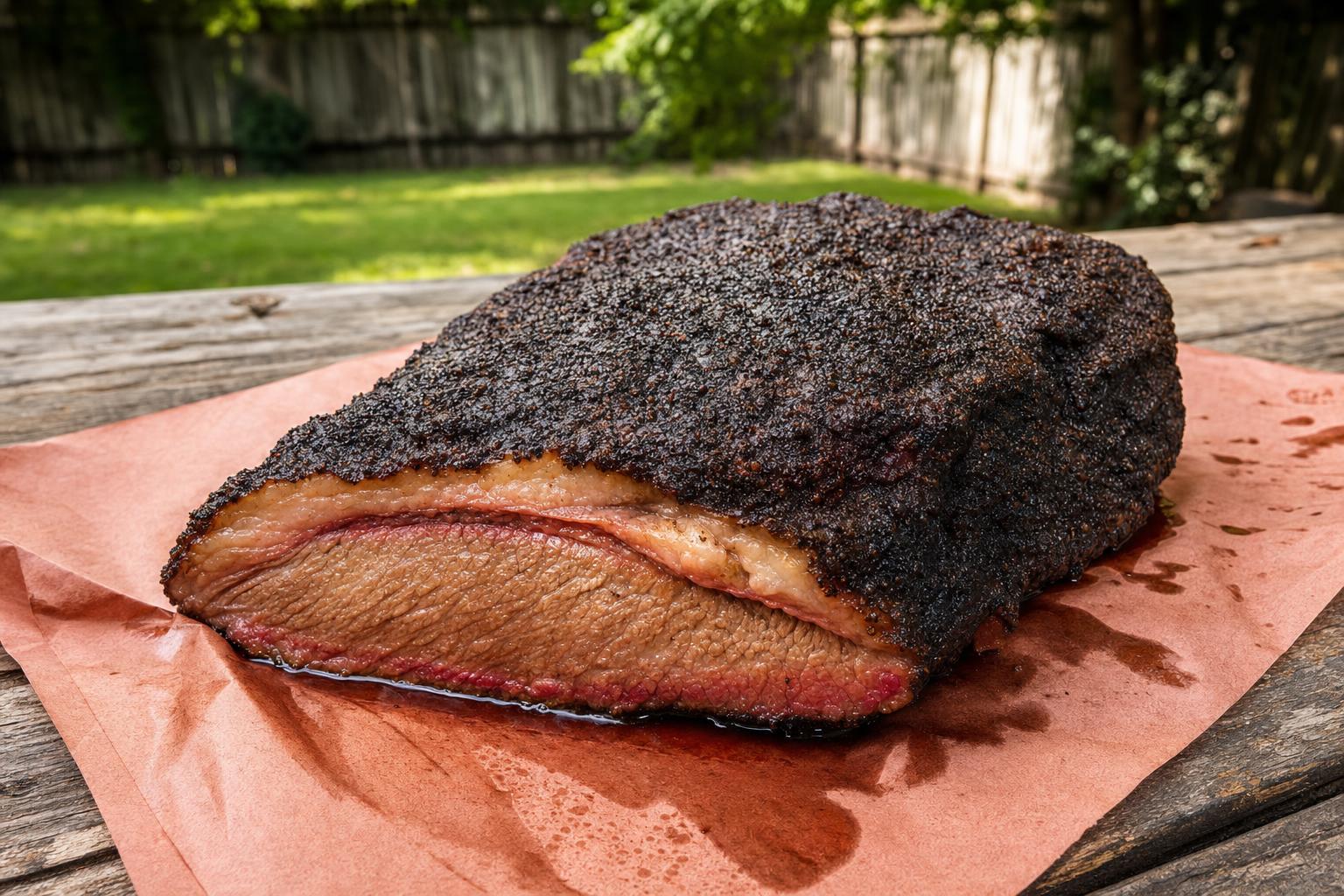
The brisket burnt-end skewer is not decoration — it is a self-dosing flavor enhancer. Brisket point, having survived 12 or more hours at 250°F, contains a fully hydrolyzed collagen matrix: the type III collagen that cross-links between muscle fibers has converted to soluble gelatin, coating each muscle strand in a glossy, lipid-rich layer. The bark is a dense crust of Maillard and Strecker degradation products — melanoidins, pyrazines, and furanones. When that skewer rests in the Bloody Mary for 30 to 60 seconds before the first sip, rendered fat and water-soluble bark compounds migrate into the drink via fat-phase partitioning: the lipophilic smoke phenolics in the burnt end redistribute into the vodka-water continuous phase, measurably extending the aromatic complexity of each sip.
What equipment and ingredients do I need?
- Cold-smoking setup: A handheld smoke infuser (like a Breville smoking gun or Polyscience unit) works perfectly for smoking tomato juice in a covered pitcher or sealed container. Cherry or applewood chips produce fruity-sweet phenolics that complement tomato better than hickory or mesquite. Target ambient temperature below 85°F during smoke contact — you want phenolic deposition, not heat-induced stewing.
- Tomato juice quality: Canned tomato juice works, but low-sodium varieties give better sodium control. If you have access to San Marzano tomatoes, juicing them fresh and straining through a fine-mesh sieve produces a richer, less metallic base. The pH difference is real — fresh juice runs pH 4.0 to 4.2 versus pH 3.8 to 4.0 for most commercial versions.
- Horseradish: Fresh-grated is categorically different from jarred. Grate immediately before mixing. Pre-grated horseradish loses 50% of its AITC potency within 30 minutes of exposure to air at room temperature.
- Vodka selection: A neutral, clean 80-proof vodka is correct here. The smoked tomato juice and garnish carry the flavor — a heavily flavored or wheat-forward vodka will compete. Unflavored, triple-distilled options are ideal.
- Worcestershire: Full-sodium, original formulation. Low-sodium versions reduce the fermented anchovy concentration, directly cutting umami intensity.
- Burnt ends: Point-cut brisket burnt ends that have been cubed, returned to the smoker or oven with sauce, and caramelized until bark re-forms. The cubes need to be firm enough to skewer without falling apart — internal temperature will be well past 200°F. If brisket is unavailable, smoked short-rib cubes are the correct backup.
- Smoked salt rim: Mixing coarse kosher salt with smoked paprika and coarsely cracked black pepper at a 3:1:0.5 ratio by weight creates a rim compound that primes sodium and volatile aromatic channels before the first sip reaches the palate.
Smoked Bloody Mary with Brisket Burnt-End Skewer
Equipment
- 1 Pint glass or highball glass (16 oz) Chilled if possible
- 1 Handheld smoke infuser or cold-smoke setup For cold-smoking the tomato juice; cherry or applewood chips recommended
- 1 Bar spoon
- 1 Jigger or measuring cups
- 1 Fine-mesh sieve For straining fresh horseradish if desired
- 2 Wooden cocktail skewers (6-inch)
- 1 Shallow plate for rim mixture
Ingredients
Smoked Rim
- 1 tbsp coarse kosher salt
- 1 tsp smoked paprika
- 0.5 tsp coarsely cracked black pepper
- 0.5 wedge lemon For wetting the glass rim
Cold-Smoked Tomato Juice Base
- 4 oz tomato juice Low-sodium preferred; or fresh-juiced and strained San Marzano tomatoes
- 1 tsp cherry or applewood chips For cold-smoking; smoke below 85°F
Cocktail Build
- 1.5 oz vodka Neutral, unflavored 80-proof; chilled
- 0.5 oz fresh lemon juice Squeezed immediately before building
- 1 tsp fresh horseradish Grated immediately before use; adjust to heat preference
- 0.5 tsp Worcestershire sauce Full-sodium, original formulation
- 0.25 tsp hot sauce Tabasco or Crystal; adjust to taste
- 0.125 tsp celery salt
- 3 cracks black pepper Freshly cracked
Garnish
- 2 pieces brisket burnt ends Point-cut, caramelized, bark re-formed; firm enough to skewer
- 1 piece smoked olive Green or Castelvetrano; smoked in a smoker or with a smoke infuser
- 1 spear pickled okra Store-bought or homemade; adds vinegar brightness and crunch
- 1 wedge lemon For garnish
- 3 pieces large-format ice cubes 2-inch cubes preferred for slow melt rate
Instructions
Cold-Smoke the Tomato Juice (Do This the Night Before)
- Pour the tomato juice into a sealed container or covered pitcher with enough headspace for smoke to accumulate. Using a handheld smoke infuser loaded with cherry or applewood chips, inject cold smoke into the container. Seal immediately and let the smoke contact the juice for 10 to 15 minutes at ambient temperature — the juice surface temperature should remain below 85°F throughout. Do not heat the juice.1.5 oz vodka, 0.5 oz fresh lemon juice
- After the smoke contact period, refrigerate the smoked juice uncovered for 30 minutes to allow volatile surface compounds to dissipate, then cover and refrigerate for a minimum of 8 hours (overnight is ideal). The phenolic compounds need time to equilibrate through the full volume of juice. Juice used immediately will taste sharp and unintegrated.1.5 oz vodka
Prep the Rim and Glass
- Combine the coarse kosher salt, smoked paprika, and cracked black pepper on a shallow plate. Stir to distribute evenly. Run a lemon wedge around the outer lip of a pint or highball glass, wetting only the outermost half-inch of the rim. Roll the moistened rim lightly through the spice-salt mixture, applying even pressure to build a thin, consistent layer. Shake off any excess.1 tsp smoked paprika, 0.5 tsp coarsely cracked black pepper, 0.5 wedge lemon
- Fill the rimmed glass with large-format ice cubes. Cold glass and slow-melting ice are non-negotiable — a warm Bloody Mary degrades the aromatic profile and turns the horseradish harsh.
Build the Cocktail
- Add the chilled vodka directly over the ice, followed by the cold-smoked tomato juice, fresh lemon juice, fresh-grated horseradish, Worcestershire sauce, hot sauce, celery salt, and cracked black pepper. Do not pre-mix the spice components — add them individually so you can taste and adjust before the final stir.1 tsp fresh horseradish, 1.5 oz vodka, 0.5 tsp Worcestershire sauce, 0.25 tsp hot sauce, 0.125 tsp celery salt, 3 cracks black pepper, 2 pieces brisket burnt ends, 1 piece smoked olive
- Using a bar spoon, stir the drink five to six times with a gentle, sweeping motion from the bottom of the glass upward. The goal is to integrate the components and chill the liquid further without over-aerating the tomato juice. Taste through the straw. Adjust horseradish, hot sauce, or lemon to your preference before adding garnish.0.25 tsp hot sauce, 3 cracks black pepper, 0.5 tsp Worcestershire sauce
Assemble and Add the Garnish
- Thread two brisket burnt ends and one smoked olive onto a 6-inch cocktail skewer, alternating for visual balance. Leave enough skewer handle exposed for easy gripping above the rim of the glass.1 spear pickled okra, 1 wedge lemon
- Lay the pickled okra spear against the inside of the glass, angled outward. Place the lemon wedge on the rim. Rest the burnt-end skewer across the top of the glass so it sits partly submerged in the drink. Allow the skewer to rest in the drink for 45 to 60 seconds before serving or drinking. This is the fat-migration window — bark compounds and rendered beef fat will begin dissolving into the liquid, enriching each subsequent sip.3 pieces large-format ice cubes, 1 spear pickled okra, 1 wedge lemon
Notes
Nutrition
How do I nail it every time? Tips for a perfect build
- Smoke the juice the night before. Cold-smoked tomato juice needs 8 to 12 hours of refrigerated resting time for phenolic compounds to equilibrate fully through the liquid. Juice smoked and used immediately tastes sharp and linear. Rested juice is integrated and deep — smoke it the same night as the brisket cook.
- Build over ice, do not shake. Shaking a Bloody Mary over-aerates the tomato juice and breaks the emulsion of oil-soluble spice compounds. Build directly in the glass over large-format ice and stir five or six times with a bar spoon. Large-format ice melts more slowly, preserving concentration.
- Control the horseradish dose precisely. The AITC in fresh horseradish is aggressively volatile — one teaspoon delivers heat, two teaspoons delivers pain. Taste the mix before adding the full amount and adjust. The heat should register at the back of the sinuses, not override the tomato.
- Rest the skewer in the drink before the first sip. Allow 45 to 60 seconds for burnt-end bark and rendered fat to begin dissolving into the drink. This is not impatience management — it is a deliberate flavor step. The Smoked Bloody Mary is measurably better at the 90-second mark than it is immediately upon garnishing.
- Season the rim precisely. A thick, uneven rim is an extraction problem — too much salt on each sip. Roll only the outer half-inch of the glass rim in the salt mixture, applying even pressure. The goal is a controlled sodium dose per sip, not a salt wall.
- Temperature matters. All liquid components — juice, vodka, Worcestershire — should be refrigerator-cold before building. A warm Bloody Mary is a failed Bloody Mary. AITC volatility increases with temperature, turning the horseradish harsh rather than bright.
What are the best variations on this recipe?
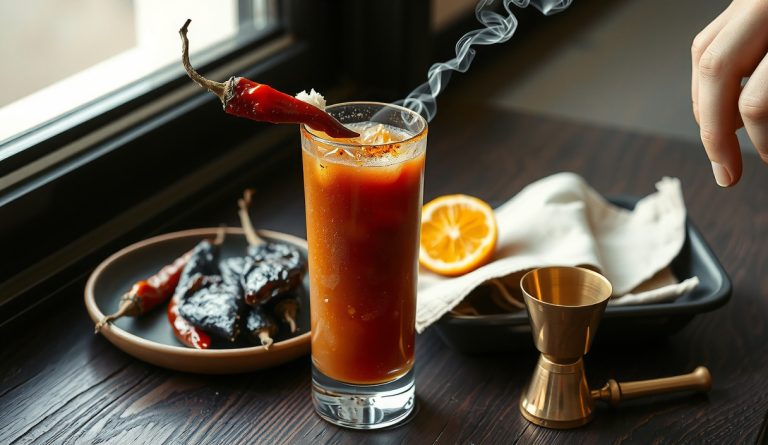
Texas-style heat build: Replace the prepared horseradish with one teaspoon of fresh-grated horseradish plus half a teaspoon of chipotle hot sauce and a quarter teaspoon of ancho chile powder. The chipotle introduces a second layer of smoke phenolics from the dried pod, while the ancho contributes mild capsaicin heat that activates TRPV1 rather than TRPA1, producing a slower-building warmth that lingers differently from horseradish. Finish with a smoked beef rib bone as the garnish if one is available.
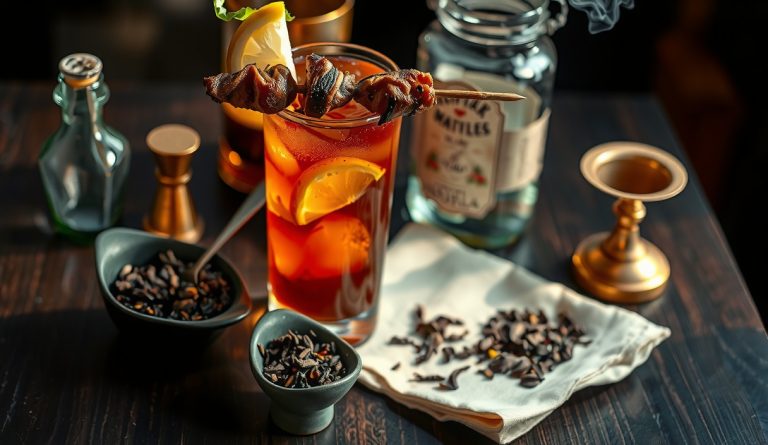
Non-alcoholic build: Substitute the vodka with an equal volume of cold-brewed, filtered strong black tea — specifically a lapsang souchong or other smoked tea variety. The tannic structure and subtle smoke of the tea base fills the mouthfeel gap left by vodka’s ethanol contribution, and lapsang souchong carries its own guaiacol-driven smoke phenolics that mirror the cold-smoked juice. All other components remain identical. This is a complete drink, not a compromise.
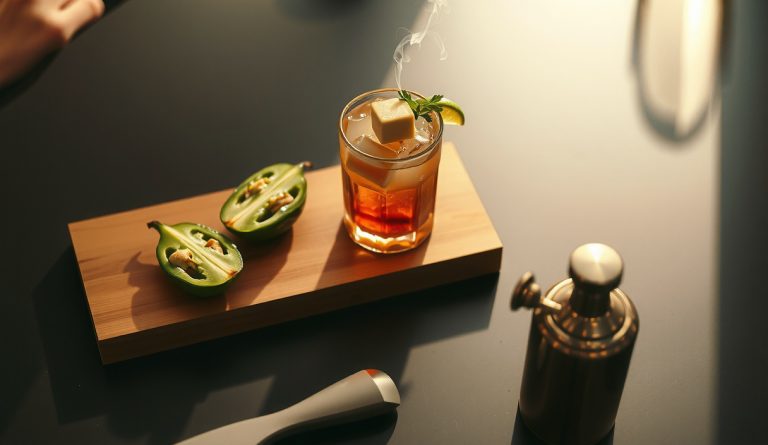
Green version: Replace the smoked tomato juice with cold-pressed tomatillo juice blended with roasted poblano and a small amount of cucumber juice, then cold-smoked with pecan wood. Switch Worcestershire for a vegan coconut aminos-based version. Garnish with smoked white cheddar cubes, a pickled serrano, and a celery spear. The tomatillo base runs naturally lower in pH (around 3.5) and higher in malic acid, creating a sharper, cleaner acid profile that benefits from the fatty richness of smoked cheese in the same way the standard version benefits from the brisket burnt end.
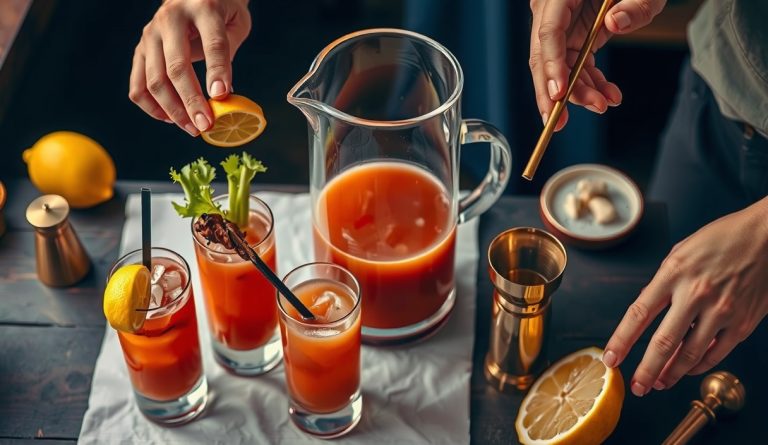
Scaling for brunch service: The smoked tomato base and spice mix — everything except the vodka and fresh lemon juice — can be pre-batched up to 48 hours in advance and stored refrigerated. Per serving, combine 4 ounces of the batch with 1.5 ounces of vodka and 0.5 ounce of fresh lemon juice over ice, stir, and garnish. Pre-batching the lemon juice degrades top-note volatile compounds and introduces oxidation — squeeze fresh per order for correct aroma. For large parties, prepare a burnt-end skewer station alongside the drink station so guests can place their own.
Frequently asked questions
Can I use liquid smoke instead of cold-smoking the juice? Liquid smoke is compositionally valid — it contains the same guaiacol and syringol phenolics produced by cold-smoking — but concentration control is the challenge. A full teaspoon of liquid smoke will aggressively overpower four cups of tomato juice. Start with one-eighth teaspoon per cup of juice, stir thoroughly, taste, and adjust in increments of one-sixteenth of a teaspoon. The flavor profile will be flatter than cold-smoking because the non-phenolic volatile compounds deposited during actual smoke contact are absent, but the result is structurally acceptable.
My Bloody Mary always ends up too thin or too thick — how do I control the texture? Tomato juice viscosity is driven by suspended pectin and cell-wall debris content. Commercial tomato juices are filtered to varying degrees — V8 is thicker than most standard brands due to a higher suspended solids fraction. If the Smoked Bloody Mary feels thin and watery, switch to a higher-solids juice or blend no more than one tablespoon of canned tomato puree per serving into the base before smoking. If the drink feels too thick and pasty, thin with a small amount of cold water or additional lemon juice. The target viscosity coats the glass slightly on the pour without resisting the straw — roughly the consistency of a well-shaken commercial V8.
How far in advance can I make the burnt-end skewers? Assembled skewers hold well under refrigeration for up to 24 hours. The key concern is carryover: pickled okra will begin to soften and smoked olive brine may migrate onto the meat if the components are in contact too long. Skewer the burnt ends and olives together and store them separately from the okra, adding the okra at service. If the burnt ends have been refrigerated, allow them to rest at room temperature for 15 minutes before skewering so the fat is slightly softened and the cubes release flavor more readily into the drink.