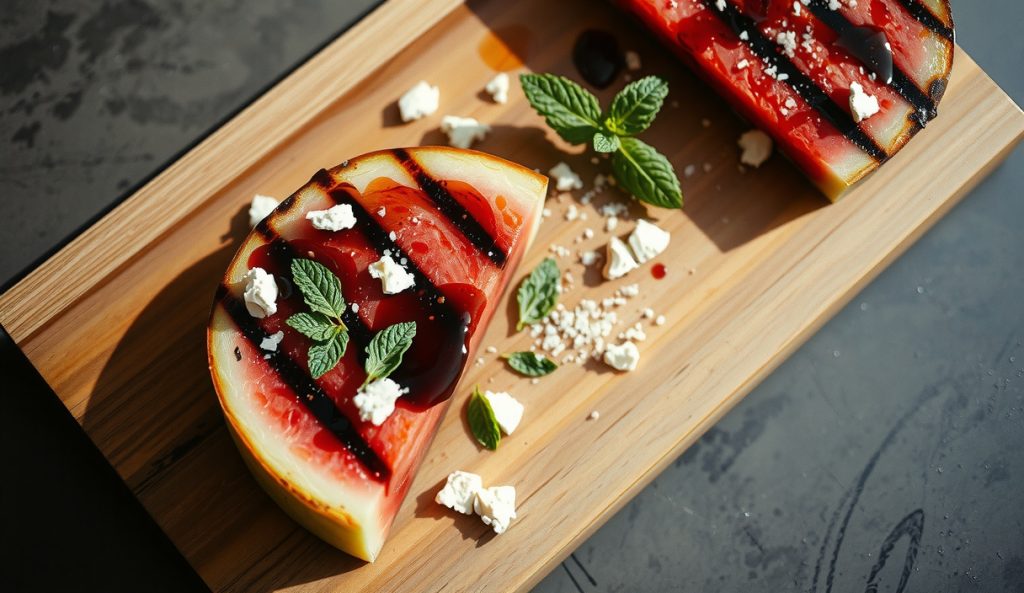
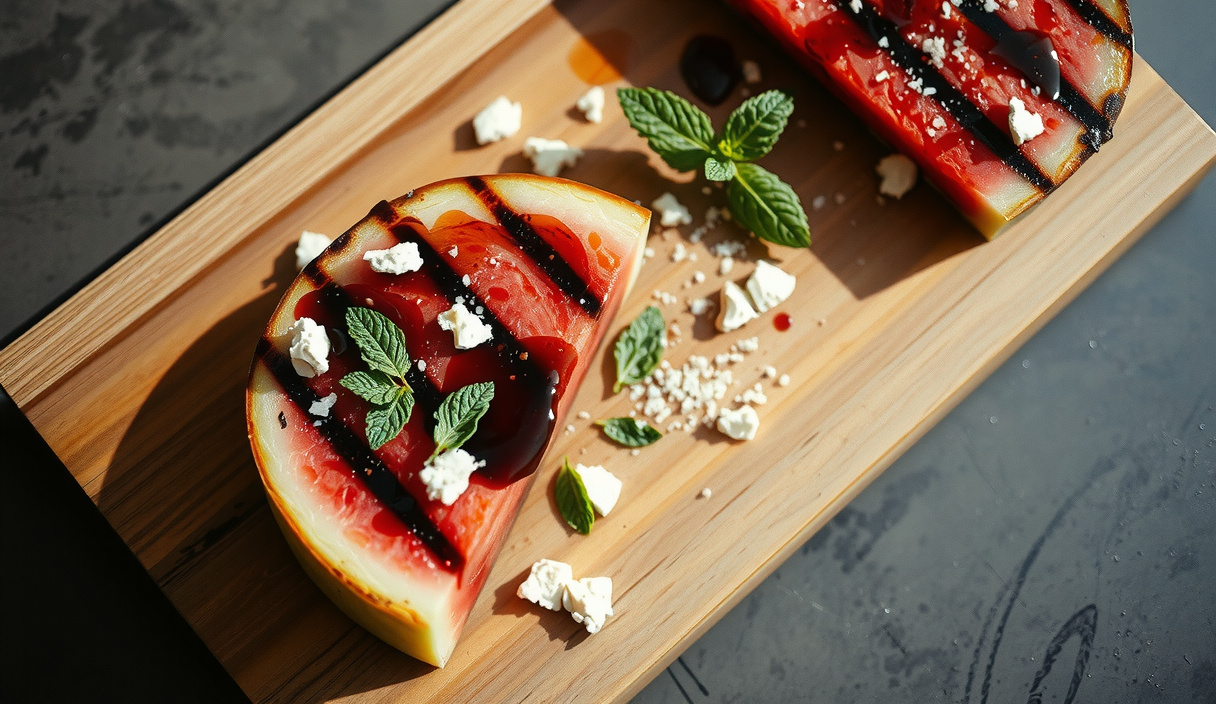
Grilled Watermelon Steak with Feta, Mint, and Balsamic

Equipment
- 1 Gas or charcoal grill Preheat to high — target grate temperature 550°F to 650°F (290°C to 345°C). Clean and oil the grates immediately before grilling.
- 1 Large cutting board
- 1 Sharp chef’s knife A long blade makes it easier to cut clean, even 1-inch slabs through a large melon.
- Several sheets Paper towels For blotting the salt-drawn moisture off the watermelon surface before grilling.
- 1 pair Grill tongs
- 1 Small saucepan (optional) Only needed if making balsamic glaze from scratch.
Ingredients
Watermelon
- 1 small seedless watermelon (6 to 8 lb / 2.7 to 3.6 kg) Fully ripe — look for a yellow ground spot and a hollow sound when tapped.
- 1 teaspoon kosher salt For the surface draw. Do not substitute fine table salt.
- 1 tablespoon neutral oil (vegetable or canola) For oiling the grill grates, not the watermelon.
Finish
- 3 oz brined feta cheese Block-style packed in brine, hand-crumbled just before serving. About 85g.
- 2 tablespoons balsamic glaze (condimento) Store-bought balsamic glaze works well, or reduce 1 cup balsamic vinegar by half over medium-low heat.
- 15 leaves fresh spearmint Torn or roughly chopped immediately before serving. Do not pre-cut.
- 1 pinch flaky sea salt (such as Maldon) Optional finishing salt. The feta provides significant sodium — taste first.
- 1 tablespoon extra-virgin olive oil Optional drizzle for richness and sheen.

Instructions
Prep
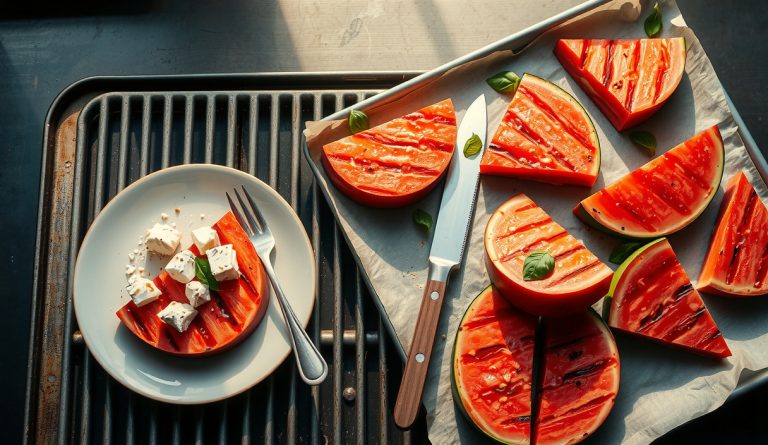
- Slice the ends off the watermelon to create flat, stable surfaces. Stand it upright and slice down the sides to remove the rind, following the curve of the fruit. Cut the peeled melon into 1-inch-thick slabs — you should get 6 to 8 slabs depending on the melon’s diameter. Reserve any irregular pieces for eating out of hand.
- Lay the watermelon slabs in a single layer on a sheet pan or cutting board. Sprinkle both cut faces lightly and evenly with kosher salt — about 1/8 teaspoon per face. You will see moisture begin to bead on the surface within 60 to 90 seconds. Let the slabs rest for 5 minutes.1 teaspoon kosher salt
- Using paper towels, firmly blot both faces of each slab to absorb the drawn surface moisture. Press down with conviction — you want the surface to look visually dry, not damp. This step is what enables Maillard browning; do not rush it.
Grill
- Preheat your grill on high for at least 10 to 15 minutes with the lid closed, targeting a grate temperature of 550°F to 650°F (290°C to 345°C). Fold a paper towel into a thick pad, grip it with tongs, dip it in neutral oil, and wipe the grates firmly in a single direction. Repeat 2 to 3 times until the grates are visibly glossy.1 tablespoon neutral oil (vegetable or canola)
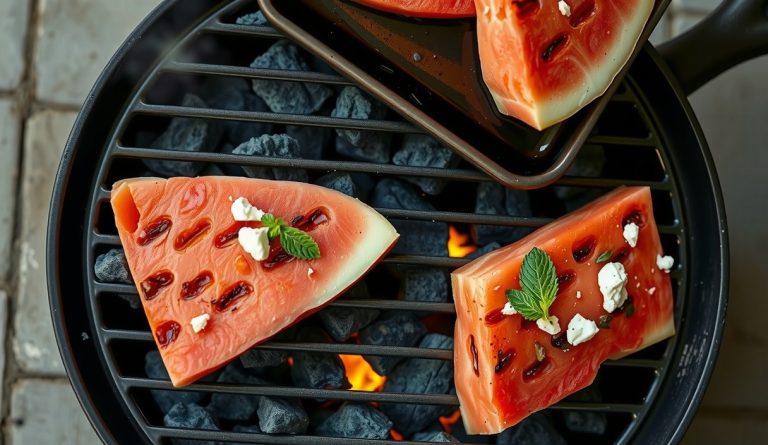
- Place the blotted watermelon slabs directly on the hot grates in a single layer with at least 2 inches of space between them. Do not move them for 2 full minutes. You should hear an immediate sizzle and see grill marks developing. If the slab sticks when you attempt to lift a corner at 2 minutes, wait 20 to 30 seconds — it will release cleanly when the crust sets.
- Flip the slabs using tongs or a wide spatula. Grill the second side for 2 minutes without moving. The slabs should have deep amber-to-mahogany grill marks on both sides and smell faintly smoky and sweet. Transfer immediately to a serving platter.
Finish and Serve
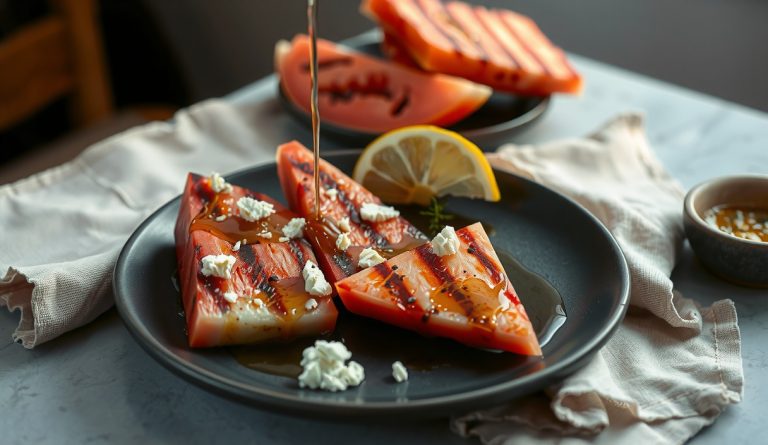
- Working quickly while the slabs are still warm, crumble the feta generously over the top of each slab.3 oz brined feta cheese
- Drizzle the balsamic glaze in a thin stream across all the slabs. Use restraint — the glaze is intensely flavored and the watermelon is already sweet. You can always add more at the table.2 tablespoons balsamic glaze (condimento)
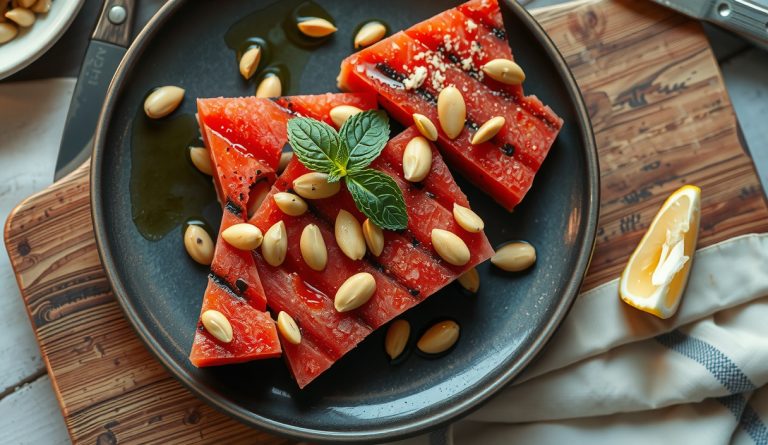
- Tear the mint leaves over the platter immediately before serving. Taste and decide if a pinch of flaky sea salt and a drizzle of olive oil are needed — both are optional but excellent. Serve within 5 minutes.15 leaves fresh spearmint, 1 pinch flaky sea salt (such as Maldon), 1 tablespoon extra-virgin olive oil
Notes
Nutrition
The first time I slapped a thick slab of watermelon onto a 600°F grate, I was half-convinced it would just melt into sugary water. What came off two minutes later stopped me cold: deep mahogany grill marks, a faintly smoky crust, and a warm, concentrated interior that tasted like someone had turned the volume knob on summer all the way up. That moment rewired how I think about fruit on fire.
The genius is the salt-blot step, which sounds fussy but takes ninety seconds and changes everything. Watermelon is roughly 92% water by weight. Without intervention, that surface moisture vaporizes the instant it hits the grates, anchoring the boundary layer at 212°F and physically preventing the Maillard reaction from igniting. Salt the cut face, give it five minutes, blot it dry, and now the surface is dehydrated enough to get out of its own way. The grill can actually brown it. Feta, mint, and balsamic do the rest.
Why does grilled watermelon actually work? The science
Grilled watermelon browns because removing surface moisture with salt drops the water activity enough for the grill to drive the surface past the Maillard threshold — but only if you execute the salt-blot step correctly. Watermelon presents what food physicists call a high water-activity matrix: its free water fraction (a_w) sits close to 0.99, barely below pure water. When that surface contacts a hot grill, latent heat of vaporization absorbs energy at roughly 2,260 joules per gram of water evaporated, pinning the surface temperature at 100°C (212°F) regardless of how hot the grates run.
The Maillard reaction — the non-enzymatic amino-carbonyl browning cascade that generates hundreds of volatile aroma compounds — requires surface temperatures above approximately 140°C to 150°C to initiate Schiff base formation and the subsequent Strecker degradation pathway that produces roasty, complex flavor. A soaking-wet surface simply cannot get there. Osmotic dehydration via salt is the engineering fix: sodium chloride draws surface-bound water out through the cell walls by osmotic pressure differential, physically lowering the local a_w at the cut face and giving the grill a fighting chance to drive temperature past the browning threshold before the interior moisture replenishes the surface.
The 1-inch slab geometry matters too. Thinner cuts lose structural integrity under direct radiant and conductive heat — the pectin-rich cell walls, already weakened once the fruit was cut and exposed to air, collapse before the interior warms. At one inch, the thermal wave from the grate needs roughly 90 to 120 seconds to conduct to the midpoint of the slab, which aligns precisely with the 2-minute per-side target. The exterior gets its char; the interior reaches approximately 50°C to 55°C — warm enough to amplify volatile aromatics and slightly concentrate the lycopene-rich flesh, but cool enough that the cell structure holds and the slab remains sliceable. Going beyond 3 minutes per side collapses that window rapidly.
The balsamic finish is a pH and volatility play. Aged balsamic sits at pH 2.7 to 3.2, providing sharp acidity that electrostatically contrasts the sweetness of the fruit’s residual sucrose and the saline, slightly bitter character of the feta. Feta itself is a brined, semi-soft cheese with approximately 4% to 5% sodium chloride content, and its crumbled geometry creates dozens of tiny fat-protein droplets that melt slightly on the warm fruit surface, lubricating each bite and acting as a hydrophobic buffer that slows the release of fat-soluble volatile aromatics — effectively extending the aromatic window. Fresh mint provides a trigeminal cooling effect via TRPM8 receptor activation from l-menthol, giving the dish a perceived brightness that reads as refreshing even though the fruit is warm.
What equipment and ingredients do I need?
- The grill: This recipe demands direct, high heat — gas burners on high or a charcoal chimney fully lit and dumped. A clean, well-oiled grate is non-negotiable. Watermelon has almost no intramuscular fat to protect it from sticking; wipe the grates with an oiled folded paper towel right before the slabs go on.
- Watermelon selection: Choose a seedless variety with dense, dark-red flesh. “Personal” or “mini” watermelons (4 to 8 lb range) have a higher flesh-to-rind ratio and tend to be more uniform in diameter, making it easier to cut consistent 1-inch slabs. Tap for a hollow sound — that indicates high water content and intact cellular structure.
- Salt for blotting: Kosher salt works perfectly; its larger crystals draw moisture without dissolving as quickly as table salt, giving you more control over the process. Do not use fine sea salt — it dissolves fast and risks over-seasoning the surface.
- Feta quality: Buy a block packed in brine, not pre-crumbled. Pre-crumbled feta has surface area exposed to oxidation and drying agents added to prevent clumping, which dulls flavor. Crumble it yourself just before plating.
- Balsamic glaze: A commercial balsamic glaze (condimento) is fine and convenient. If you want to make your own, simmer 1 cup of good balsamic in a small saucepan over medium-low heat until reduced by half and coats a spoon — roughly 12 to 15 minutes. Watch it: it scorches fast at the end.
- Mint: Spearmint is more complex here than peppermint. Add it at the very last second — mint bruises and oxidizes quickly, turning brown and losing volatile menthol within minutes of being torn.
Grilled Watermelon Steak with Feta, Mint, and Balsamic
Equipment
- 1 Gas or charcoal grill Preheat to high — target grate temperature 550°F to 650°F (290°C to 345°C). Clean and oil the grates immediately before grilling.
- 1 Large cutting board
- 1 Sharp chef’s knife A long blade makes it easier to cut clean, even 1-inch slabs through a large melon.
- Several sheets Paper towels For blotting the salt-drawn moisture off the watermelon surface before grilling.
- 1 pair Grill tongs
- 1 Small saucepan (optional) Only needed if making balsamic glaze from scratch.
Ingredients
Watermelon
- 1 small seedless watermelon (6 to 8 lb / 2.7 to 3.6 kg) Fully ripe — look for a yellow ground spot and a hollow sound when tapped.
- 1 teaspoon kosher salt For the surface draw. Do not substitute fine table salt.
- 1 tablespoon neutral oil (vegetable or canola) For oiling the grill grates, not the watermelon.
Finish
- 3 oz brined feta cheese Block-style packed in brine, hand-crumbled just before serving. About 85g.
- 2 tablespoons balsamic glaze (condimento) Store-bought balsamic glaze works well, or reduce 1 cup balsamic vinegar by half over medium-low heat.
- 15 leaves fresh spearmint Torn or roughly chopped immediately before serving. Do not pre-cut.
- 1 pinch flaky sea salt (such as Maldon) Optional finishing salt. The feta provides significant sodium — taste first.
- 1 tablespoon extra-virgin olive oil Optional drizzle for richness and sheen.
Instructions
Prep
- Slice the ends off the watermelon to create flat, stable surfaces. Stand it upright and slice down the sides to remove the rind, following the curve of the fruit. Cut the peeled melon into 1-inch-thick slabs — you should get 6 to 8 slabs depending on the melon’s diameter. Reserve any irregular pieces for eating out of hand.
- Lay the watermelon slabs in a single layer on a sheet pan or cutting board. Sprinkle both cut faces lightly and evenly with kosher salt — about 1/8 teaspoon per face. You will see moisture begin to bead on the surface within 60 to 90 seconds. Let the slabs rest for 5 minutes.1 teaspoon kosher salt
- Using paper towels, firmly blot both faces of each slab to absorb the drawn surface moisture. Press down with conviction — you want the surface to look visually dry, not damp. This step is what enables Maillard browning; do not rush it.
Grill
- Preheat your grill on high for at least 10 to 15 minutes with the lid closed, targeting a grate temperature of 550°F to 650°F (290°C to 345°C). Fold a paper towel into a thick pad, grip it with tongs, dip it in neutral oil, and wipe the grates firmly in a single direction. Repeat 2 to 3 times until the grates are visibly glossy.1 tablespoon neutral oil (vegetable or canola)
- Place the blotted watermelon slabs directly on the hot grates in a single layer with at least 2 inches of space between them. Do not move them for 2 full minutes. You should hear an immediate sizzle and see grill marks developing. If the slab sticks when you attempt to lift a corner at 2 minutes, wait 20 to 30 seconds — it will release cleanly when the crust sets.
- Flip the slabs using tongs or a wide spatula. Grill the second side for 2 minutes without moving. The slabs should have deep amber-to-mahogany grill marks on both sides and smell faintly smoky and sweet. Transfer immediately to a serving platter.
Finish and Serve
- Working quickly while the slabs are still warm, crumble the feta generously over the top of each slab.3 oz brined feta cheese
- Drizzle the balsamic glaze in a thin stream across all the slabs. Use restraint — the glaze is intensely flavored and the watermelon is already sweet. You can always add more at the table.2 tablespoons balsamic glaze (condimento)
- Tear the mint leaves over the platter immediately before serving. Taste and decide if a pinch of flaky sea salt and a drizzle of olive oil are needed — both are optional but excellent. Serve within 5 minutes.15 leaves fresh spearmint, 1 pinch flaky sea salt (such as Maldon), 1 tablespoon extra-virgin olive oil
Notes
Nutrition
How do I nail grilled watermelon every time?
- The blot is not optional. Skipping it means you are steaming the watermelon, not grilling it. You will get pale, soft slabs with zero caramelization. Budget five minutes for the salt draw and thirty seconds for the paper towel pass — it is the highest-return step in the recipe.
- Do not move the slabs for the full two minutes. Lifting them early breaks the Maillard crust before it has time to form and release cleanly from the grate. If the slab sticks when you try to flip, it is not ready — give it another 20 to 30 seconds. It will release when the char sets.
- Rotate 45 degrees at the one-minute mark if you want a crosshatch pattern. This is purely aesthetic but makes a dramatic presentation. Still do not flip early.
- Work in batches if needed. Crowding the grill drops grate temperature precipitously. Space the slabs at least 2 inches apart. A watermelon steak that fails to char is just warm, mushy watermelon — all of the structural damage with none of the flavor payoff.
- Plate immediately and finish fast. The residual heat from the grill will continue to soften the interior. Finish with feta, mint, and balsamic the moment the slabs come off and serve within 5 minutes. Watermelon that sits warm quickly weeps free liquid and loses its structural integrity.
- Failure mode — too wet, collapses on the grill: Either the slabs were cut too thin (under 3/4 inch), the blotting was insufficient, or the grill temperature was too low. Preheat longer and blot more aggressively next time.
What variations can I try with grilled watermelon steak?
Spiced honey version: Swap the balsamic glaze for a tablespoon of honey stirred with a pinch of Aleppo pepper or smoked paprika. Drizzle right before serving. The residual heat from the grill blooms the fat-soluble capsaicinoids in the pepper, amplifying their TRPV1-activating pungency and creating a sweet-heat contrast against the cool feta.
Vegan adaptation: Replace the feta with a cashew-based brine-fermented crumble, or simply omit the cheese and lean on a scatter of toasted pumpkin seeds for texture and a drizzle of good olive oil for fat-phase richness. The aromatic structure of the dish holds without dairy — the balsamic and mint carry significant sensory weight on their own.
Charcoal vs. gas: Charcoal adds a meaningful smoke dimension. Hickory or cherry wood chips thrown onto the coals just before the watermelon goes on deposit volatile phenolic compounds — guaiacol, syringol — onto the fruit surface, creating a savory, almost meat-like aromatic layer that plays beautifully against the sweet flesh. Gas grills can approximate this with a smoker box, but the effect is subtler.
Scaling for a crowd: This recipe scales linearly — each additional person needs roughly two 1-inch slabs. Work in two rounds on a standard two-burner gas grill to maintain grate temperature. Pre-blot and pre-cut all slabs before the first batch goes on; they can rest salt-blotted for up to 20 minutes in the refrigerator without issue.
Frequently asked questions
Can I use a grill pan on the stove instead of an outdoor grill? Yes, with caveats. A cast-iron grill pan preheated over high heat for at least 3 minutes will give you grill marks and Maillard browning, but you lose the radiant heat component of an outdoor grill and the smoke. The result is still excellent — just open a window, because the salt-blotted watermelon will produce a significant amount of steam as it hits the pan.
Why does my watermelon taste bland after grilling? Three likely causes: insufficient salt-blotting (leaving too much surface moisture to allow browning), grill temperature too low (below 500°F grate temp), or the watermelon itself was under-ripe. Under-ripe watermelon has lower sucrose content, fewer Maillard-reactive amino acids in the flesh, and a more watery, less concentrated flavor baseline that grilling cannot rescue. Use a fully ripe melon.
How long can I prep the watermelon slabs in advance? You can cut the slabs and refrigerate them, uncovered, up to 4 hours ahead. The drying effect of the refrigerator air actually helps pre-dehydrate the surface slightly, reducing the required salt-blot time. Do not salt them more than 10 minutes before grilling — prolonged salting begins to break down the cell walls and makes the flesh mushy rather than firm.