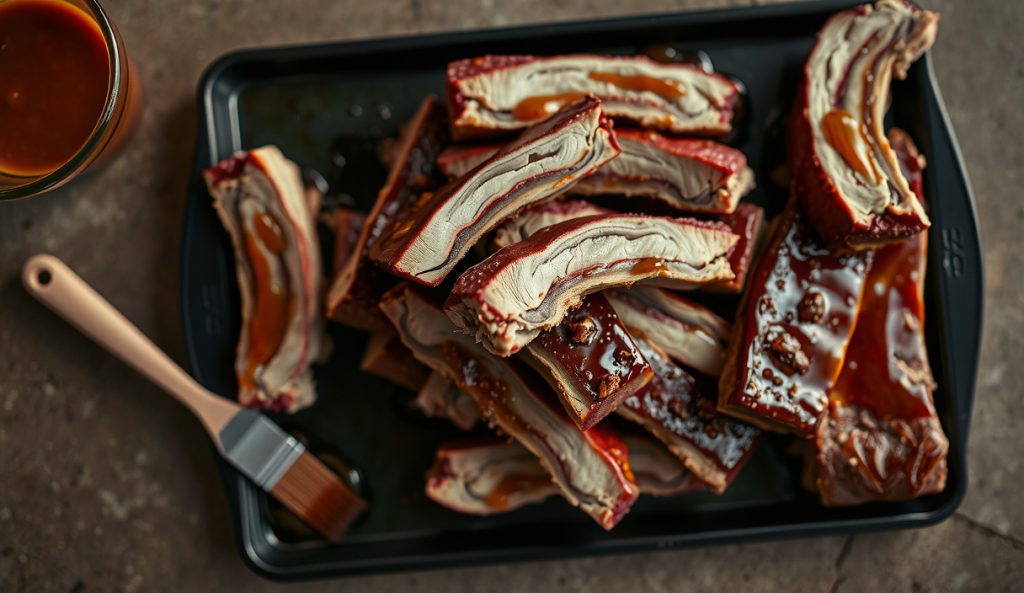
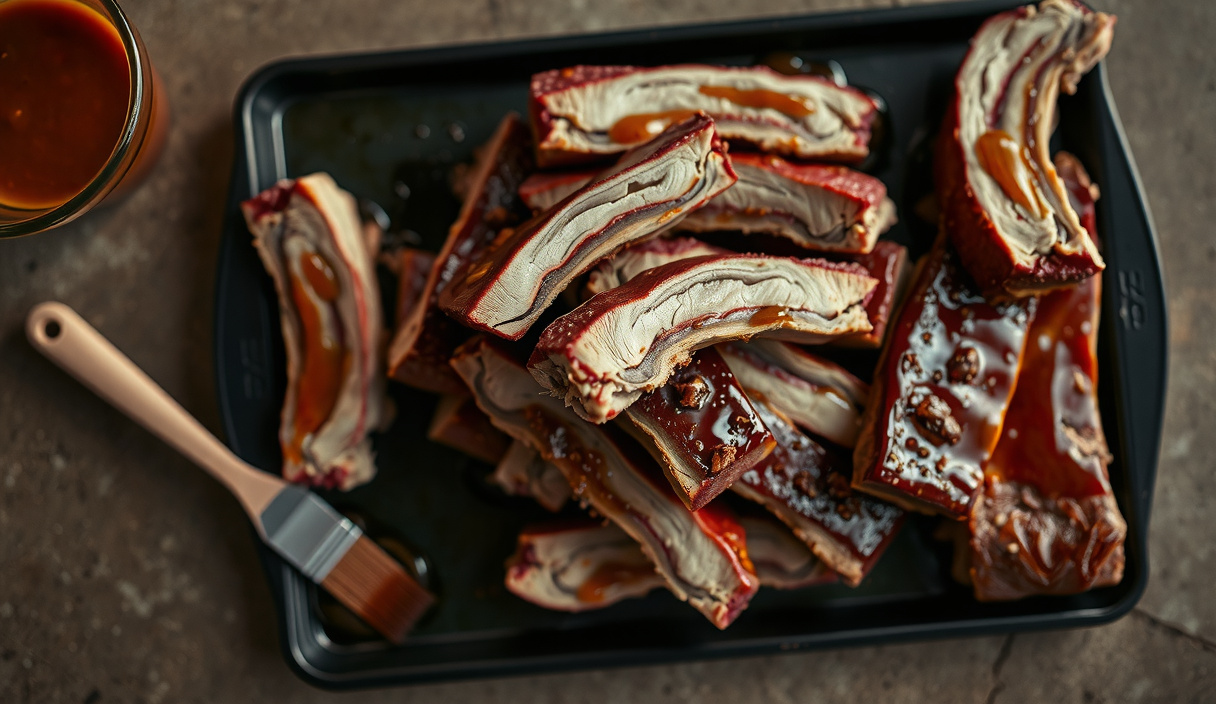
Smoked Country-Style Pork Ribs
Equipment
- 1 Smoker or kettle grill Set up for indirect heat, 225°F with apple or cherry wood chunks
- 1 Two-probe digital thermometer One probe at grate level, one for internal meat temperature — non-negotiable for hitting the 170°F smoke pull and 195°F braise finish
- 1 Disposable aluminum half-sheet foil pan Deep-sided, large enough to hold ribs in a single layer with at least 1 inch of liquid
- 1 roll Heavy-duty aluminum foil For sealing the foil pan airtight during the braise
- 1 Wire cooling rack For resting the ribs after the caramelization step
- 1 Basting brush
Ingredients
Ribs
- 4 lbs blade-end country-style pork ribs Bone-in or boneless; look specifically for the blade end — darker meat with visible fat striations, not the leaner center-cut loin version
Dry Brine
- 2 tsp kosher salt Diamond Crystal; if using Morton’s, reduce to 1.25 tsp — its denser crystal structure delivers more sodium by volume
Dry Rub
- 2 tbsp brown sugar Packed; provides reducing sugars for Maillard crust development and caramel depth
- 1 tbsp smoked paprika
- 1 tsp garlic powder
- 1 tsp onion powder
- 1 tsp black pepper Freshly ground
- 1 tsp dry mustard powder Colman’s or equivalent; amplifies the sulfurous umami baseline
- 0.5 tsp cayenne pepper Adjust up or down for heat preference
- 0.5 tsp celery salt
Braise Liquid
- 1 cup BBQ sauce Tomato-based; use your preferred brand — the pectin and soluble solids in the sauce act as a viscous moisture barrier around the meat during the braise
- 0.5 cup apple juice Unfiltered preferred; pH 3.5 to 4.0 contributes mild acid hydrolysis of collagen and fructose for finishing caramelization
- 2 tbsp apple cider vinegar Balances sweetness and adds brightness to the braise liquid
- 1 tbsp Worcestershire sauce
Finishing Glaze
- 0.5 cup BBQ sauce Same sauce used in the braise; applied during the open-lid caramelization step

Instructions
Dry Brine
- Pat the country-style pork ribs dry with paper towels. Sprinkle kosher salt evenly over all surfaces — approximately 0.5 tsp per pound of meat. Place on a wire rack set over a rimmed sheet pan, uncovered, and refrigerate for 12 to 24 hours. The salt will initially draw surface moisture out through osmosis, then migrate back into the muscle, denaturing a portion of the myosin and restructuring the water-holding matrix. The surface will appear slightly dry and tacky after brining — this is correct and promotes crust formation.
Apply Rub and Prep Smoker
- Combine brown sugar, smoked paprika, garlic powder, onion powder, black pepper, dry mustard powder, cayenne pepper, and celery salt in a small bowl. Mix thoroughly. Apply the rub generously to all surfaces of the ribs, pressing firmly so it adheres to the tacky brined exterior. Let the ribs rest at room temperature for 30 minutes while the smoker comes up to temperature. This brief equilibration allows the rub to begin drawing surface moisture, forming a paste that will set into bark.1 tbsp smoked paprika, 1 tsp garlic powder, 1 tsp onion powder, 1 tsp black pepper, 1 tsp dry mustard powder, 0.5 tsp cayenne pepper, 0.5 tsp celery salt
- Set up your smoker for indirect heat at 225°F. Add two to three chunks of apple or cherry wood — not chips — to the coals or wood box. Allow the smoker to stabilize at temperature before loading the ribs. Verify temperature with your ambient grate-level probe, not the lid thermometer, which typically reads 15°F to 25°F higher than actual grate temperature.
Smoke Phase
- Place the ribs on the smoker grate in a single layer, with at least 1 inch of clearance between pieces for even smoke and convective heat circulation. Insert the meat probe into the thickest section of the largest rib, parallel to the bone if bone-in, positioned away from any fat pockets. Smoke at 225°F with the lid closed for approximately 2 hours, until the internal temperature reads 170°F. Do not open the lid during the first 90 minutes — every lid-lift drops smoker temperature 25°F to 40°F and releases accumulated smoke. Expect a stall around 155°F to 165°F as surface evaporative cooling temporarily absorbs energy as fast as the smoker delivers it; hold temperature and wait it out.
Build Braise Liquid
- While the ribs smoke, combine BBQ sauce, apple juice, apple cider vinegar, and Worcestershire sauce in a bowl and whisk to combine. The mixture should be pourable but viscous — the tomato pectin and soluble solids in the sauce provide yield stress that will slow moisture migration from the meat surface during the sealed braise. Pour the braise liquid into the disposable foil pan and set aside.1 cup BBQ sauce, 0.5 cup apple juice, 2 tbsp apple cider vinegar, 1 tbsp Worcestershire sauce
Braise Phase
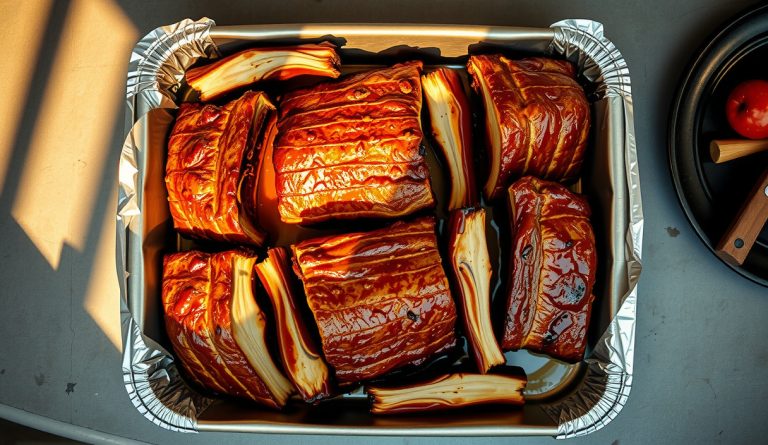
- When the ribs reach 170°F internal, transfer them directly from the smoker into the foil pan containing the braise liquid. Arrange in a single layer, meat-side down if possible. The ribs should be at least half-submerged — add a splash of additional apple juice if the liquid level is low. Seal the pan tightly with two layers of heavy-duty aluminum foil, crimping the edges firmly so no steam can escape. Return the sealed pan to the smoker and re-insert the meat probe through the foil into the thickest rib section.1 cup BBQ sauce, 0.5 cup apple juice, 2 tbsp apple cider vinegar, 1 tbsp Worcestershire sauce
- Continue cooking at 225°F, sealed, until the internal temperature reaches 195°F. This will take approximately 60 to 90 minutes depending on rib thickness and smoker consistency. At 195°F, the collagen hydrolysis is complete — the connective tissue has fully converted to soluble gelatin that coats each muscle fiber. Check the liquid level once at the 45-minute mark by carefully lifting one corner of the foil. If liquid is below half an inch, add a quarter cup of apple juice before resealing.
Caramelization and Rest
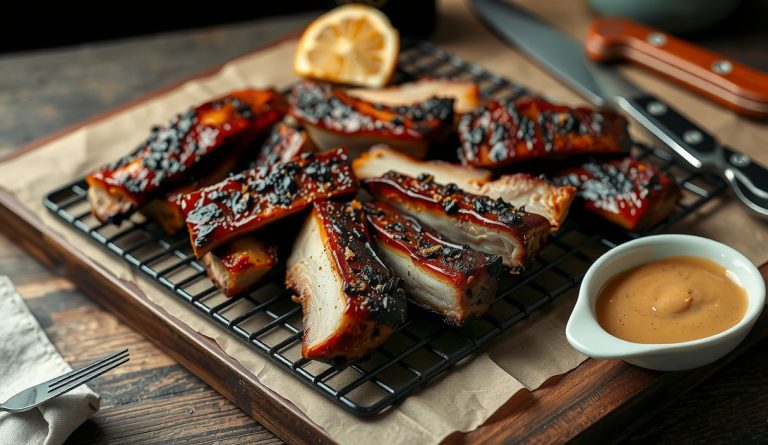
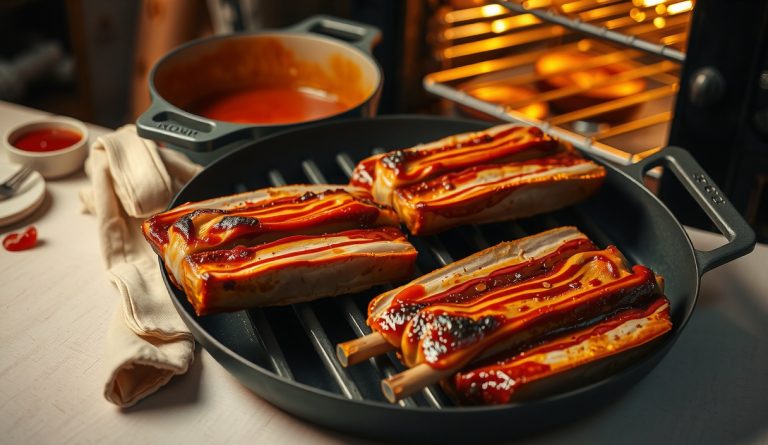
- When the ribs hit 195°F, carefully remove the foil pan from the smoker. Open the foil away from you — the steam is extremely hot. Transfer the ribs from the braise liquid to the smoker grate, or to a grill running at 225°F to 250°F. Using a basting brush, apply a generous coat of BBQ sauce to all exposed surfaces. Cook open for 2 to 3 minutes per side, brushing with additional sauce once per side, until the glaze is set and visibly caramelized. The reducing sugars in the sauce and the residual apple juice fructose on the surface will brown rapidly — watch closely and do not walk away.0.5 cup BBQ sauce
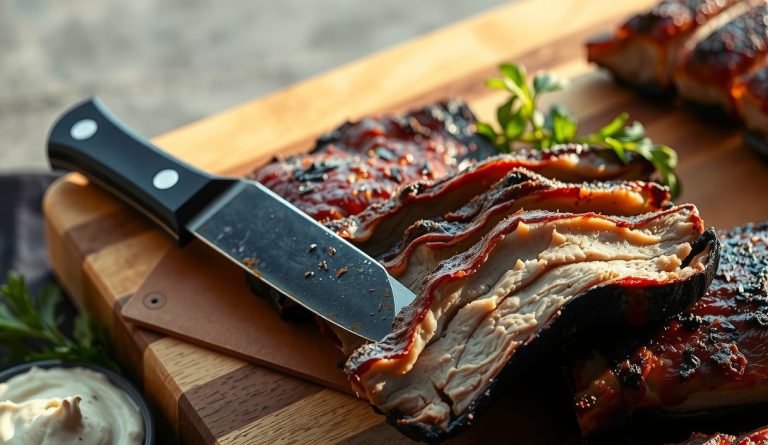
- Transfer the glazed ribs to a wire rack. Rest for 10 minutes uncovered — do not tent with foil, which would trap steam and soften the crust you just built. During the rest, the gelatin in the muscle transitions from a fully fluid state back to a cohesive gel phase, the surface moisture redistributes into the fiber structure, and the glaze firms from sticky to a set lacquered finish. Slice or pull to serve.
Notes
Nutrition
Country-style pork ribs are one of the great misnomers of the butcher case. There is not a rib bone in sight — what you are actually buying is a cross-section of the blade end of the pork loin, the meat sitting right on the shoulder side of the loin eye. That anatomical address matters enormously: this cut carries more intramuscular fat and connective tissue than any other section of the loin, which makes it a disaster at 400°F in fifteen minutes and a revelation at low-and-slow temperatures over three hours. The combination of smoke followed by a foil-pan braise is not a shortcut. It is the precise sequence that first builds a Maillard crust and smoke ring, then delivers the prolonged moist heat required to hydrolyze every strand of collagen in the meat into silky, self-basting gelatin.
Country-style ribs are the cut this kitchen keeps returning to on a Tuesday night when full pitmaster payoff is the goal without committing to a twelve-hour brisket. They are forgiving, affordable, and structurally engineered by biology to reward exactly what a backyard smoker does best. The smoke-and-braise technique below is not guesswork — it is built from first principles on what is happening inside the muscle at each temperature milestone.
Why does the smoke-and-braise method work? The science
The smoke-and-braise method works because it sequences two distinct heat-transfer regimes to accomplish tasks that neither can complete alone: dry smoke heat builds the crust and smoke ring, while a closed moist-heat braise drives collagen hydrolysis to completion. The blade-end pork loin is a composite tissue built from myofibrillar proteins (predominantly myosin and actin), sarcoplasmic proteins, and a dense three-dimensional collagen network that sheaths each muscle bundle. When 225°F smoker heat is applied, the surface temperature climbs toward the Maillard onset window — the amino-carbonyl condensation cascade that requires local water activity below roughly 0.70 and surface temperatures above 280°F to run efficiently. Evaporative cooling at the meat’s boundary layer provides exactly that desiccation, while combustion gases deposit nitrogen dioxide onto the surface, reducing surface myoglobin to the characteristic pink nitrosylmyoglobin that forms the smoke ring.
Inside the meat, protein denaturation proceeds sequentially. Myosin begins unfolding between 104°F and 136°F, and sarcoplasmic proteins denature through 140°F to 154°F. The dangerous threshold is actin, which collapses its water-holding network violently between 166°F and 172°F. Driving country-style ribs to 195°F dry would leave the denatured actomyosin complex having expelled most of its bound water, producing shoe leather. The foil-pan braise changes everything: surrounding the meat in BBQ sauce and apple juice supplies an exogenous moisture reservoir that compensates for water expelled by denatured actomyosin. The closed foil environment simultaneously holds internal temperature past 160°F for the extended interval required for first-order collagen hydrolysis kinetics to run to completion. Collagen cross-links begin hydrolyzing above 140°F, but the reaction rate increases exponentially above 176°F. At 195°F internal with a 30-to-40 minute hold, the triple-helix collagen strands unravel into soluble gelatin — tri-peptide chains with a molecular weight around 100 kDa — re-coating every muscle fiber in a self-lubricating gel phase that produces pork that reads as simultaneously moist and rich, with a pull-apart texture no amount of direct high-heat cooking can replicate.
The apple juice in the braise is not merely flavor theater. Its pH of roughly 3.5 to 4.0 provides mild acid hydrolysis of collagen, slightly accelerating the conversion rate. More importantly, the fructose and glucose in unfiltered apple juice are reducing sugars that participate in the Maillard cascade during the brief open-lid caramelization step at the end, deepening the glaze color without requiring additional sugar. The BBQ sauce simultaneously acts as a high-viscosity continuous phase that retards moisture evaporation from the meat surface during the braise, functioning exactly as a hydrocolloid-thickened liquid shield would in a laboratory context — the tomato pectin and corn-syrup solids in most commercial sauces sit at roughly 0.3 to 0.5 percent w/w hydrocolloid, sufficient to build measurable yield stress against moisture migration.
What equipment and ingredients do I need?
Country-style ribs vs. blade chops: Look specifically for blade-end cuts, not center-cut loin country-style ribs. The blade end has visible fat striations and darker meat. Center-cut versions are leaner and will dry out even with the braise step. Ask the butcher if you are unsure — the two cuts come from opposite ends of the loin.
Smoker temperature management: 225°F is not a target — it is a ceiling. Running 215°F to 225°F is ideal. Higher temperatures accelerate moisture loss before the crust is fully set and can push the stall earlier than expected. Use a reliable two-probe thermometer: one ambient probe at grate level, one meat probe inserted into the thickest section parallel to the bone.
Wood selection: Apple or cherry wood keeps the smoke profile mild and complementary to the fruit-forward braise liquid. Hickory works but can produce a more assertive smoke flavor that may compete with the sauce. Use chunks, not chips, for a 2-hour smoke run — chips burn out in 20 to 30 minutes.
Foil pan depth: A standard half-sheet disposable aluminum pan with high sides is essential. The ribs need at least 1 inch of liquid in the pan during the braise, and they should sit in a single layer. Crowding prevents even heat distribution and extends the braise time unpredictably.
BBQ sauce selection: Use a sauce with tomato as the primary base. Vinegar-forward Carolina-style sauces work but require cutting with a bit of brown sugar or honey to provide sufficient reducing-sugar content for the finishing caramelization step. Mustard-based sauces can interact poorly with the apple juice acidity and produce a slightly bitter finish.
Smoked Country-Style Pork Ribs
Equipment
- 1 Smoker or kettle grill Set up for indirect heat, 225°F with apple or cherry wood chunks
- 1 Two-probe digital thermometer One probe at grate level, one for internal meat temperature — non-negotiable for hitting the 170°F smoke pull and 195°F braise finish
- 1 Disposable aluminum half-sheet foil pan Deep-sided, large enough to hold ribs in a single layer with at least 1 inch of liquid
- 1 roll Heavy-duty aluminum foil For sealing the foil pan airtight during the braise
- 1 Wire cooling rack For resting the ribs after the caramelization step
- 1 Basting brush
Ingredients
Ribs
- 4 lbs blade-end country-style pork ribs Bone-in or boneless; look specifically for the blade end — darker meat with visible fat striations, not the leaner center-cut loin version
Dry Brine
- 2 tsp kosher salt Diamond Crystal; if using Morton’s, reduce to 1.25 tsp — its denser crystal structure delivers more sodium by volume
Dry Rub
- 2 tbsp brown sugar Packed; provides reducing sugars for Maillard crust development and caramel depth
- 1 tbsp smoked paprika
- 1 tsp garlic powder
- 1 tsp onion powder
- 1 tsp black pepper Freshly ground
- 1 tsp dry mustard powder Colman’s or equivalent; amplifies the sulfurous umami baseline
- 0.5 tsp cayenne pepper Adjust up or down for heat preference
- 0.5 tsp celery salt
Braise Liquid
- 1 cup BBQ sauce Tomato-based; use your preferred brand — the pectin and soluble solids in the sauce act as a viscous moisture barrier around the meat during the braise
- 0.5 cup apple juice Unfiltered preferred; pH 3.5 to 4.0 contributes mild acid hydrolysis of collagen and fructose for finishing caramelization
- 2 tbsp apple cider vinegar Balances sweetness and adds brightness to the braise liquid
- 1 tbsp Worcestershire sauce
Finishing Glaze
- 0.5 cup BBQ sauce Same sauce used in the braise; applied during the open-lid caramelization step
Instructions
Dry Brine
- Pat the country-style pork ribs dry with paper towels. Sprinkle kosher salt evenly over all surfaces — approximately 0.5 tsp per pound of meat. Place on a wire rack set over a rimmed sheet pan, uncovered, and refrigerate for 12 to 24 hours. The salt will initially draw surface moisture out through osmosis, then migrate back into the muscle, denaturing a portion of the myosin and restructuring the water-holding matrix. The surface will appear slightly dry and tacky after brining — this is correct and promotes crust formation.
Apply Rub and Prep Smoker
- Combine brown sugar, smoked paprika, garlic powder, onion powder, black pepper, dry mustard powder, cayenne pepper, and celery salt in a small bowl. Mix thoroughly. Apply the rub generously to all surfaces of the ribs, pressing firmly so it adheres to the tacky brined exterior. Let the ribs rest at room temperature for 30 minutes while the smoker comes up to temperature. This brief equilibration allows the rub to begin drawing surface moisture, forming a paste that will set into bark.1 tbsp smoked paprika, 1 tsp garlic powder, 1 tsp onion powder, 1 tsp black pepper, 1 tsp dry mustard powder, 0.5 tsp cayenne pepper, 0.5 tsp celery salt
- Set up your smoker for indirect heat at 225°F. Add two to three chunks of apple or cherry wood — not chips — to the coals or wood box. Allow the smoker to stabilize at temperature before loading the ribs. Verify temperature with your ambient grate-level probe, not the lid thermometer, which typically reads 15°F to 25°F higher than actual grate temperature.
Smoke Phase
- Place the ribs on the smoker grate in a single layer, with at least 1 inch of clearance between pieces for even smoke and convective heat circulation. Insert the meat probe into the thickest section of the largest rib, parallel to the bone if bone-in, positioned away from any fat pockets. Smoke at 225°F with the lid closed for approximately 2 hours, until the internal temperature reads 170°F. Do not open the lid during the first 90 minutes — every lid-lift drops smoker temperature 25°F to 40°F and releases accumulated smoke. Expect a stall around 155°F to 165°F as surface evaporative cooling temporarily absorbs energy as fast as the smoker delivers it; hold temperature and wait it out.
Build Braise Liquid
- While the ribs smoke, combine BBQ sauce, apple juice, apple cider vinegar, and Worcestershire sauce in a bowl and whisk to combine. The mixture should be pourable but viscous — the tomato pectin and soluble solids in the sauce provide yield stress that will slow moisture migration from the meat surface during the sealed braise. Pour the braise liquid into the disposable foil pan and set aside.1 cup BBQ sauce, 0.5 cup apple juice, 2 tbsp apple cider vinegar, 1 tbsp Worcestershire sauce
Braise Phase
- When the ribs reach 170°F internal, transfer them directly from the smoker into the foil pan containing the braise liquid. Arrange in a single layer, meat-side down if possible. The ribs should be at least half-submerged — add a splash of additional apple juice if the liquid level is low. Seal the pan tightly with two layers of heavy-duty aluminum foil, crimping the edges firmly so no steam can escape. Return the sealed pan to the smoker and re-insert the meat probe through the foil into the thickest rib section.1 cup BBQ sauce, 0.5 cup apple juice, 2 tbsp apple cider vinegar, 1 tbsp Worcestershire sauce
- Continue cooking at 225°F, sealed, until the internal temperature reaches 195°F. This will take approximately 60 to 90 minutes depending on rib thickness and smoker consistency. At 195°F, the collagen hydrolysis is complete — the connective tissue has fully converted to soluble gelatin that coats each muscle fiber. Check the liquid level once at the 45-minute mark by carefully lifting one corner of the foil. If liquid is below half an inch, add a quarter cup of apple juice before resealing.
Caramelization and Rest
- When the ribs hit 195°F, carefully remove the foil pan from the smoker. Open the foil away from you — the steam is extremely hot. Transfer the ribs from the braise liquid to the smoker grate, or to a grill running at 225°F to 250°F. Using a basting brush, apply a generous coat of BBQ sauce to all exposed surfaces. Cook open for 2 to 3 minutes per side, brushing with additional sauce once per side, until the glaze is set and visibly caramelized. The reducing sugars in the sauce and the residual apple juice fructose on the surface will brown rapidly — watch closely and do not walk away.0.5 cup BBQ sauce
- Transfer the glazed ribs to a wire rack. Rest for 10 minutes uncovered — do not tent with foil, which would trap steam and soften the crust you just built. During the rest, the gelatin in the muscle transitions from a fully fluid state back to a cohesive gel phase, the surface moisture redistributes into the fiber structure, and the glaze firms from sticky to a set lacquered finish. Slice or pull to serve.
Notes
Nutrition
How do I nail it every time? Tips and technique
- Do not skip the overnight dry brine. Salt applied 12 to 24 hours ahead migrates into the muscle, dissolves a portion of the myosin, and restructures the water-holding matrix. Ribs brined overnight hold measurably more moisture through the braise than salted-and-immediately-smoked ribs. If pressed for time, salt at minimum 1 hour ahead and leave uncovered on a wire rack in the refrigerator.
- Pull the ribs from smoke at 170°F internal, not 165°F. The collagen needs to be already beginning its thermal contraction phase before the foil pan is sealed. Ribs pulled at 160°F will need a longer braise to complete conversion and may finish with residual toughness in the connective tissue sheaths.
- Keep at least 1 inch of liquid in the foil pan throughout the braise. Check at the 45-minute mark by carefully peeling back one corner of the foil. If liquid is below half an inch, add another quarter cup of apple juice. Running dry causes the bottom of the ribs to sear against the pan and stalls internal temperature by pulling energy into the Maillard reaction rather than into protein hydrolysis.
- The 195°F target is non-negotiable for collagen conversion. Pulling at 185°F leaves significant un-hydrolyzed collagen intact — the ribs will feel slightly chewy in a way that reads as undercooked rather than pleasantly firm. Use a thermometer, not the clock. Bone-in sections near fat pockets can read up to 8°F higher than the true muscle temperature.
- The open-lid caramelization step is brief for a reason. Two to three minutes per side at 225°F to 250°F with sauce applied is sufficient to set the glaze and trigger surface Maillard reactions on the reducing sugars. Going longer pushes internal temperature above 205°F, converting too much gelatin into a watery state and causing the ribs to fall apart structurally rather than pull apart pleasantly.
- Rest before serving. A 10-minute rest on a wire rack — not in the foil pan — allows the gelatin in the muscle to re-set from a fully fluid state to a cohesive gel and redistributes surface moisture back into the fiber structure. Cutting immediately releases a puddle of liquid onto the board and leaves the interior drier than necessary.
What are the best variations on smoked country-style pork ribs?
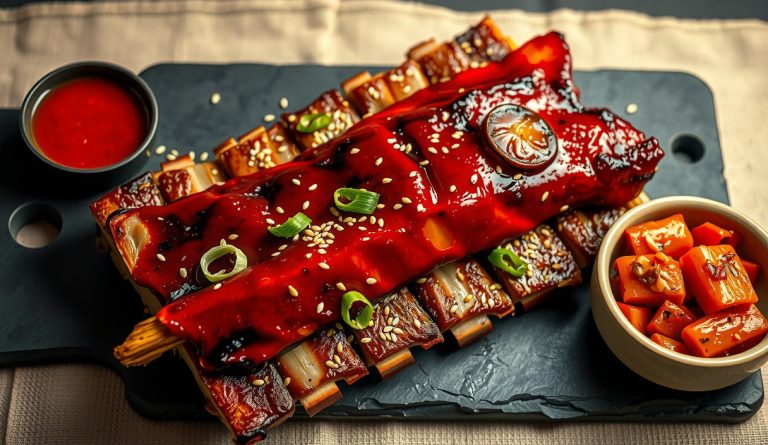
Korean-style glaze: Replace the BBQ sauce in both the braise and the finishing glaze with a mixture of gochujang (2 tablespoons), soy sauce (2 tablespoons), rice wine vinegar (1 tablespoon), sesame oil (1 teaspoon), and honey (2 tablespoons). The gochujang provides capsaicin-driven TRPV1 activation for heat perception, while the soy sauce contributes free glutamic acid and IMP nucleotides for synergistic umami amplification. Apple juice in the braise still works perfectly here. Finish with toasted sesame seeds and thinly sliced scallion greens.
Low-sodium option: Reduce the dry brine to 1 teaspoon of salt total across all the ribs and extend the brine time to 24 hours to allow full equilibration at the lower concentration. Use a no-salt-added or low-sodium BBQ sauce in the braise. The apple juice contributes negligible sodium. The braise liquid will still function as a moisture reservoir even with lower ionic strength, though the slight reduction in osmotic pressure means a very small increase in surface moisture loss during smoke.
Oven version for apartment cooks: Set the oven to 275°F with convection if available. Arrange the dry-brined, spice-rubbed ribs on a wire rack set over a foil-lined sheet pan. Roast uncovered for 90 minutes to replicate the drying and initial Maillard work the smoker performs — a smoke ring and smoke flavor will not develop, but the surface crust will form. Transfer to a foil pan, add braise liquid, seal tightly, and continue at 300°F until internal temperature hits 195°F, approximately 60 to 75 minutes. Finish under the broiler at 450°F for 2 to 3 minutes per side with sauce applied, watching closely.
Scaling for a crowd: The recipe scales cleanly to 6 to 8 pounds without adjustment to the rub ratios — use the same proportion of rub to meat weight. Two foil pans running side by side in the smoker are needed for the braise step at that volume. Larger batches can hold in a 170°F oven in the sealed foil pan for up to 45 minutes without quality loss, which makes timing a large cookout dramatically easier. The gelatin produced during the long braise provides a self-basting buffer against drying during the hold period.
Frequently asked questions
Why do my country-style ribs always come out dry even when I follow a recipe? The most common cause is overshooting the smoke phase without a braise. Dry-smoking blade-end ribs to any internal temperature above 175°F without a moisture-supply phase — even at 225°F — allows actin denaturation and actomyosin contraction to expel most of the intracellular water before collagen can convert to gelatin and compensate. The second most common cause is using center-cut loin country-style ribs instead of blade-end cuts — the leaner protein matrix has no intramuscular fat buffer and dries out even with perfect technique.
Can I use bone-in country-style ribs, and does it change the cook? Yes, and the cook changes slightly. Bone acts as an insulator and a heat sink simultaneously. The meat directly adjacent to the bone will read 5°F to 10°F lower than the surrounding muscle. Always probe the thickest section of muscle away from the bone and target 195°F there. Bone-in sections will also extend the total braise time by roughly 15 to 20 minutes compared to fully boneless cuts of the same thickness.
What wood smoke pairs best with pork loin country-style ribs? Apple and cherry are the canonical answers for good reason: their low resin content and high sugar concentration in the wood produce a mild, slightly sweet smoke with minimal phenolic bitterness. The fruit-forward aroma compounds produced — primarily furfural and 5-methylfurfural from hemicellulose pyrolysis — have a direct flavor affinity with the apple juice in the braise, creating cohesive flavor architecture across the entire cook. Hickory is acceptable but dominant; limit hickory to one chunk added in the first 30 minutes if smoke presence without overwhelming the sauce is the goal.