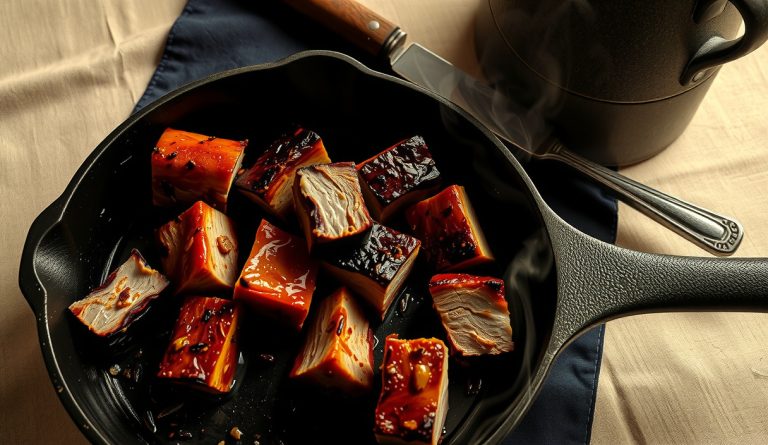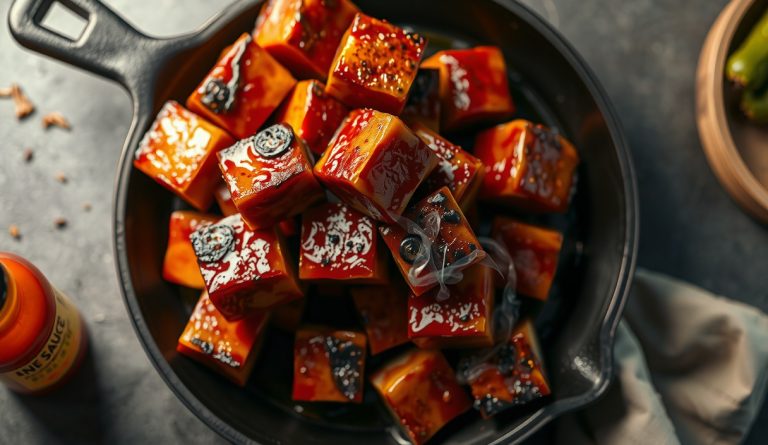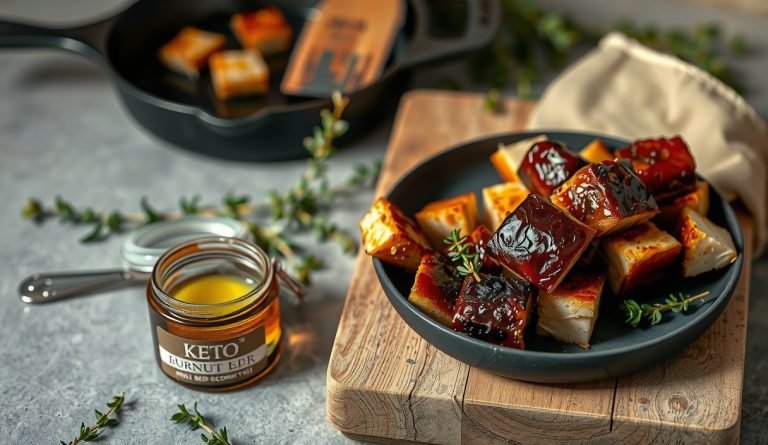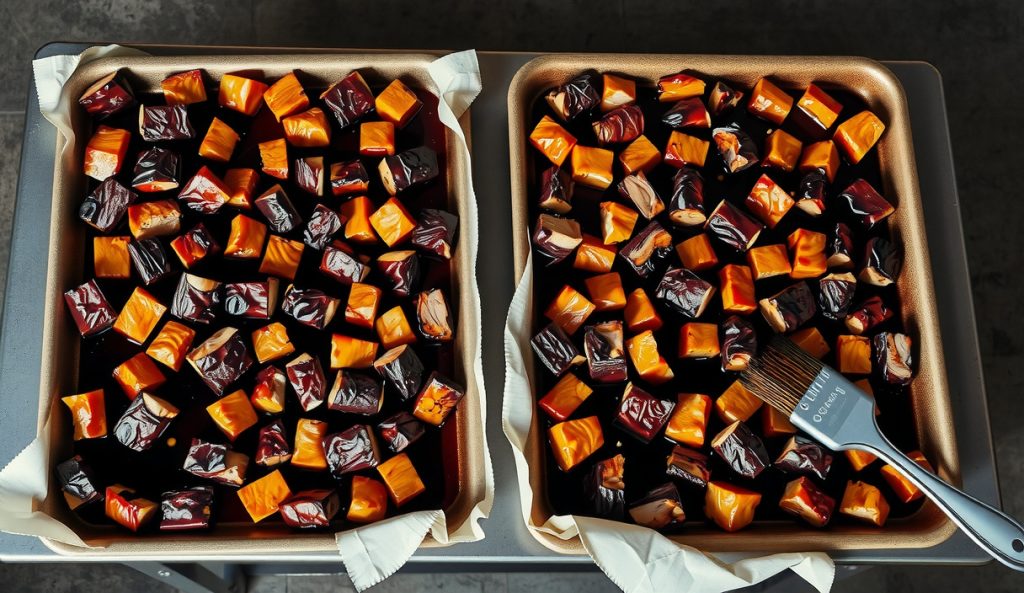
The canonical recipe centers on a 3-to-3.5-pound pork belly slab — a quantity that fits in one foil pan and yields burnt ends for four to six people. Doubling to 6 or 7 pounds is straightforward in principle, but two specific phases demand deliberate adjustment to prevent uneven results: the initial smoke and the foil braise. Handling these correctly at scale is the difference between a uniform batch and a tray of cubes with inconsistent bark and underrendered fat pockets.
What changes when you double the batch?
Scale the dry rub and glaze ingredients linearly — every quantity in the canonical recipe doubles exactly. Allulose, xanthan gum, butter, apple cider vinegar, and all spices follow a strict 2:1 ratio with no further adjustment; there are no non-linear flavor or emulsification thresholds crossed at this scale.
The initial smoke phase is where the first timing change applies. A 6-to-7-pound pork belly slab carries roughly twice the thermal mass of the canonical 3-to-3.5-pound portion, and the center of the slab will lag the surface temperature by a wider margin. Expect the initial smoke phase to run 60 to 90 minutes longer than the canonical time. Do not rely on elapsed time alone — use an instant-read thermometer to confirm the internal temperature at the thickest point has reached the target before cubing. The cubing procedure itself is unchanged.
The critical constraint arrives at the braise phase. Overcrowding the cubes in a single foil pan traps steam between surfaces, prevents full fat rendering on interior faces, and produces a steamed rather than braised texture on those sides. The collagen-to-gelatin conversion still occurs — that is a time-and-temperature function — but rendered fat cannot evacuate from a tightly packed cube, and the crust will be soft rather than set. Use two foil pans, arranged side by side in a single smoker layer so each pan receives equal convective heat. Do not stack pans. Once the pans are correctly loaded, the braise and glaze phases remain the same duration as the canonical recipe.
What stays exactly the same at double scale?
Cube dimensions, braise duration, glaze-phase temperature and time, xanthan gum concentration in the glaze, and the visual doneness benchmark — a deep mahogany lacquer with slight crust resistance when pressed — are all unchanged at double scale. The flavor profile of the scaled pork belly burnt ends is identical to the canonical batch at any batch size.
When is the scaled approach the better choice?
Use the doubled batch for cookouts, tailgates, or any event where the canonical four-to-six-person yield falls short. Scaled burnt ends also make an efficient meal-prep strategy: the finished cubes reheat well under foil at 300°F for 10 to 12 minutes without significant texture loss, making the extra cook time a worthwhile investment when prepping multiple portions at once.
Use the full method, equipment notes, and canonical temperatures from the original Keto Pork Belly Burnt Ends with Allulose Glaze, applying the 60-to-90-minute smoke extension and the two-pan loading rule described above.