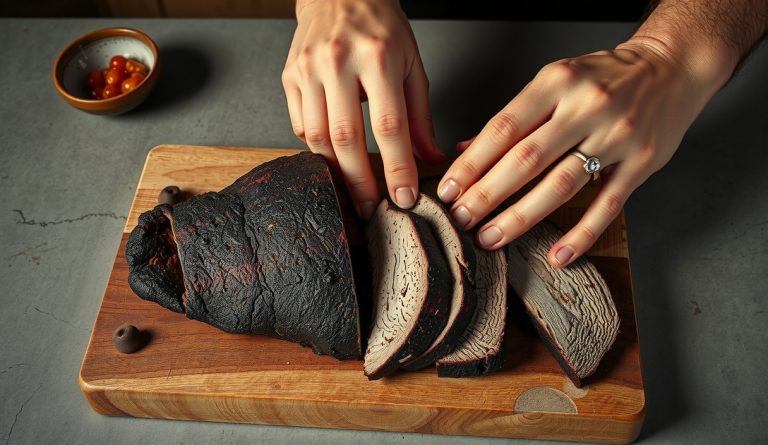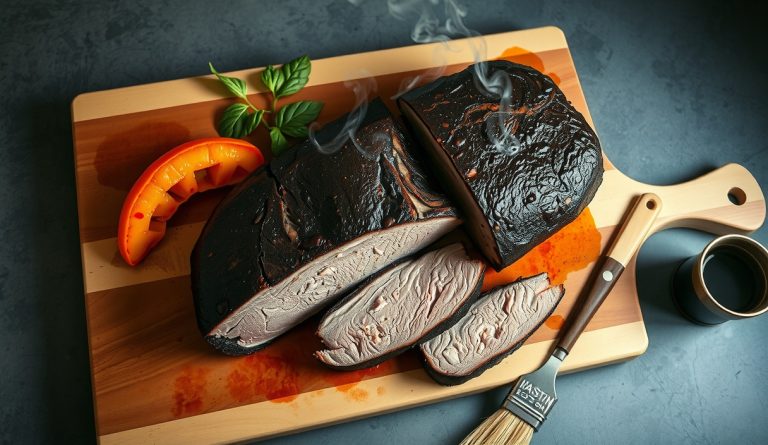
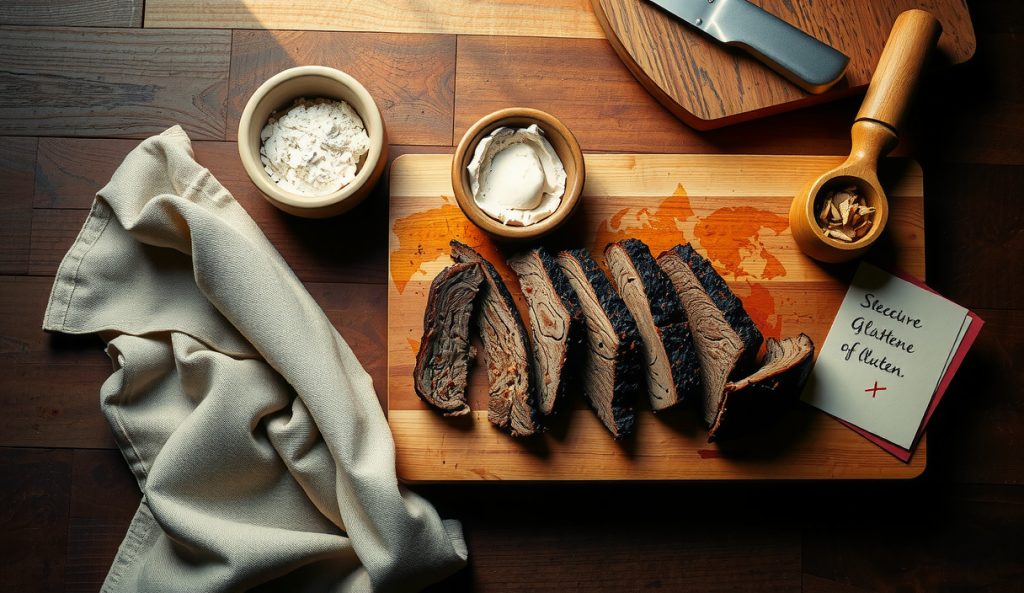
Requests for a gluten-free version of this Vegan Smoked ‘Brisket’ arrive regularly, and the honest answer is that a gluten-free seitan substitute does not exist — not as a minor ingredient swap, and not as a reformulation. This is not a labeling or allergen issue. It is a structural chemistry issue. Understanding precisely why the substitution fails is useful both for anyone attempting to adapt this recipe and for anyone sourcing a genuinely gluten-free smoked plant protein that delivers comparable fibrous, sliceable results.
Why can’t you simply swap in a gluten-free flour? The structural chemistry
The Vegan Smoked ‘Brisket’ cannot be made gluten-free because no gluten-free flour contains the high-molecular-weight glutenin subunits required to form disulfide cross-links under mechanical stress. The entire structural premise of the recipe depends on the viscoelastic disulfide network formed when glutenin and gliadin proteins hydrate and are worked mechanically. Repeated lamination and folding aligns these gluten strands into long, oriented fibers — the same process that gives the finished slab its grain, its pull resistance, and its sliceability.
Rice flour, chickpea flour, and tapioca starch each lack the high-molecular-weight glutenin subunits necessary to form those disulfide cross-links. Hydrocolloid additions such as xanthan gum and psyllium husk can simulate elastic behavior in baked goods at low moisture, but at the hydration levels and shear forces required for lamination they produce a sticky, extensible mass without meaningful fiber alignment. The result after smoking is a dense, crumbly protein block — edible, but neither fibrous nor sliceable in the way this recipe requires. The protein architecture simply does not transfer. There is no workaround within the seitan format.
What parts of the recipe stay the same regardless of substrate?
The smoking technique, rub profile, betacyanin application, and bark-development approach are all fully transferable to a different protein substrate. The BBQ method is not the limitation — the base protein is. Any gluten-free adaptation retains the smoke, temperature, and seasoning logic from the canonical recipe while replacing seitan with a structurally appropriate alternative.
Which gluten-free substrates actually work — and when should you use one?
For a genuinely gluten-free smoked plant protein that achieves fibrous, sliceable texture, two substrate categories produce reliable results. High-moisture extruded soy or pea protein — sold in block or chunk form, sometimes labeled HMEC or textured vegetable protein block — carries a fibrous internal structure created during the extrusion process that survives smoking intact. Mycelium-based products in whole-cut formats, derived from fungal mycelium, carry a naturally fibrous mat structure that takes smoke well and slices cleanly.
Both gluten-free substrates can be used with the rub, betacyanin, and smoke protocol from the canonical recipe, adjusted for their individual recommended cook times and internal temperatures. The choice between them comes down to availability and desired texture: HMEC blocks tend toward a denser, more muscle-like chew, while mycelium formats offer a slightly lighter, more open fibrous structure.
- High-moisture extruded soy or pea protein (HMEC / TVP block): fibrous structure formed during extrusion; survives smoking; denser chew.
- Mycelium-based whole-cut formats: naturally fibrous fungal mat; takes smoke cleanly; lighter, more open texture.
- Rice flour, chickpea flour, tapioca starch (as seitan replacements): no disulfide cross-linking capacity; produce crumbly, non-sliceable results after smoking. Not recommended.
All seasoning ratios, betacyanin quantities, and smoking guidance are documented in the original Vegan Smoked ‘Brisket’ — Seitan-Based with Myoglobin-Mimicking Bark.