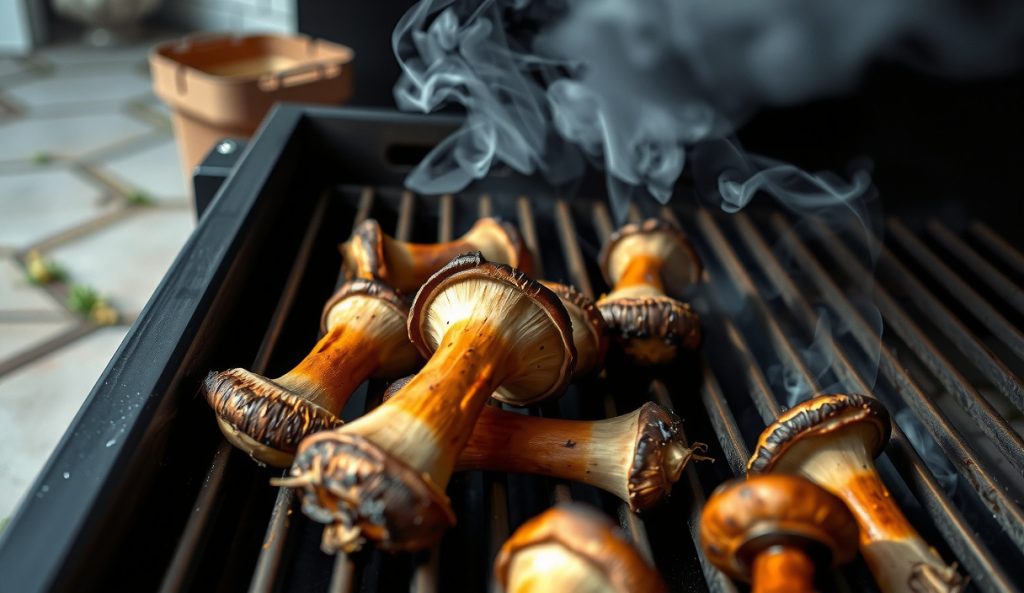
Pellet smokers run cleanly and consistently, but that efficiency works against smoke absorption when the cook begins at high temperature: the mushroom surface desiccates and seals before smoke-borne compounds have penetrated the tissue. A two-phase temperature protocol corrects this problem directly. Starting at the smoker’s lowest smoke-generating setting and stepping up after an extended low-temperature opening phase is the mechanical equivalent of cold-smoking a dense protein before the final cook — the open, porous window of the mushroom’s surface is exploited before it closes.
What changes with the pellet-smoker method?
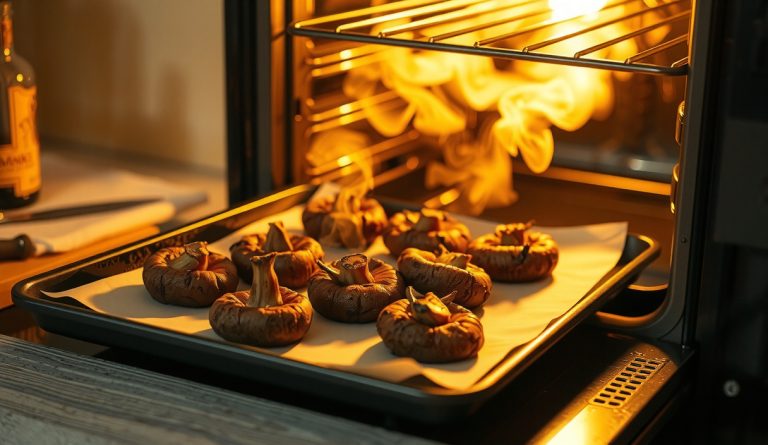
Set the pellet smoker to its minimum smoke-generating temperature — typically 180 to 200°F depending on the unit — and hold there for the first 60 minutes. Then raise the setpoint to 250°F for the remaining 30 minutes, after which glazing proceeds as normal. Total active cook time remains 90 minutes; only the temperature split changes from a single 250°F hold to a 60-minute low phase followed by a 30-minute high phase.
The reasoning is structural. King trumpet and oyster mushrooms have a highly porous, open-cell tissue matrix. At sub-200°F, that matrix remains vapor-permeable, allowing smoke-borne volatile organic compounds — phenols, guaiacol, and syringol — to diffuse inward along concentration gradients. Once temperature climbs above approximately 220°F, surface proteins and polysaccharides begin to contract, forming the incipient bark layer that progressively restricts further smoke penetration. The low-temperature phase front-loads absorption; the high-temperature phase builds texture and drives moisture loss to the target final weight.
What stays the same in this variant?
The dry rub composition, scoring pattern, glaze formula, two-stage glaze application timing, and resting protocol are all unchanged from the canonical recipe. The only modification is the temperature curve during the initial smoke phase. Wood species selection — cherry, applewood, or oak — remains at the cook’s discretion per the original guidance.
When is the pellet-smoker method the better choice?
This method is the right choice whenever a pellet smoker is the only live-fire equipment available. It is also worth adopting on any cooker — offset or kettle — when maximum smoke character is the goal from a relatively thin piece of produce. If guests are accustomed to heavily smoked meats and the mushroom burnt ends need to hold their own by comparison, the extended 60-minute low-temperature phase is the specific lever that delivers that result.
Use the full method, glaze quantities, and rub measurements from the original Plant-Based Smoked Mushroom Burnt Ends.