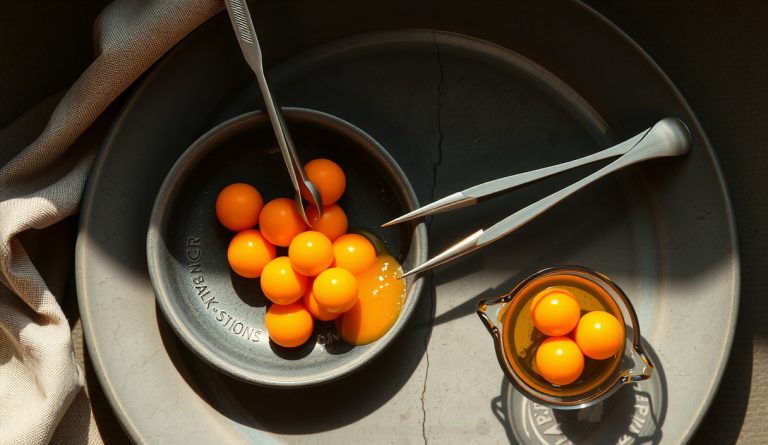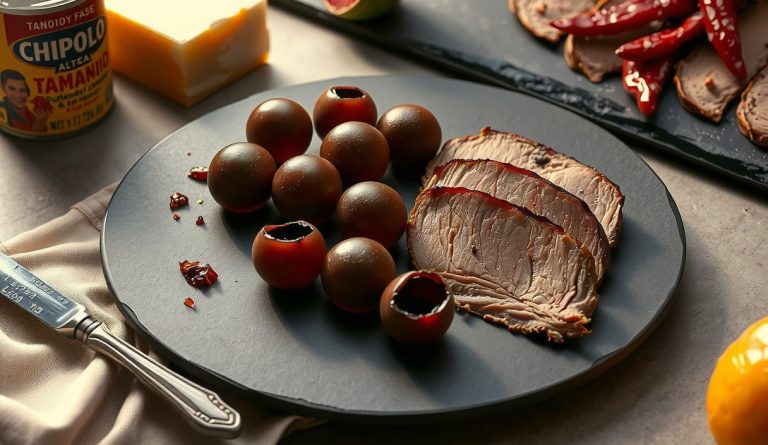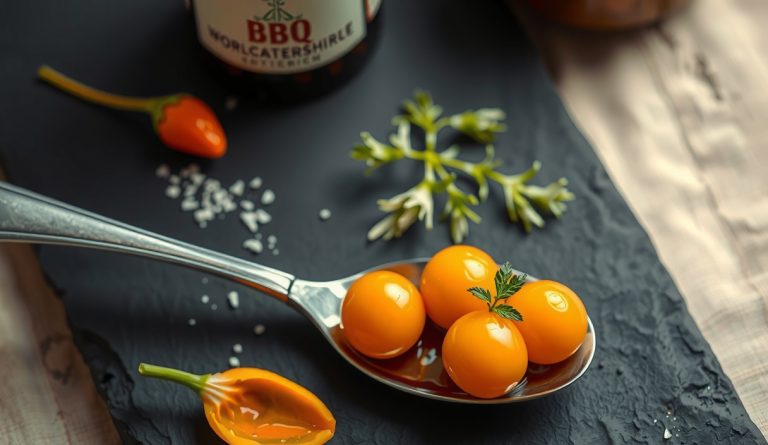
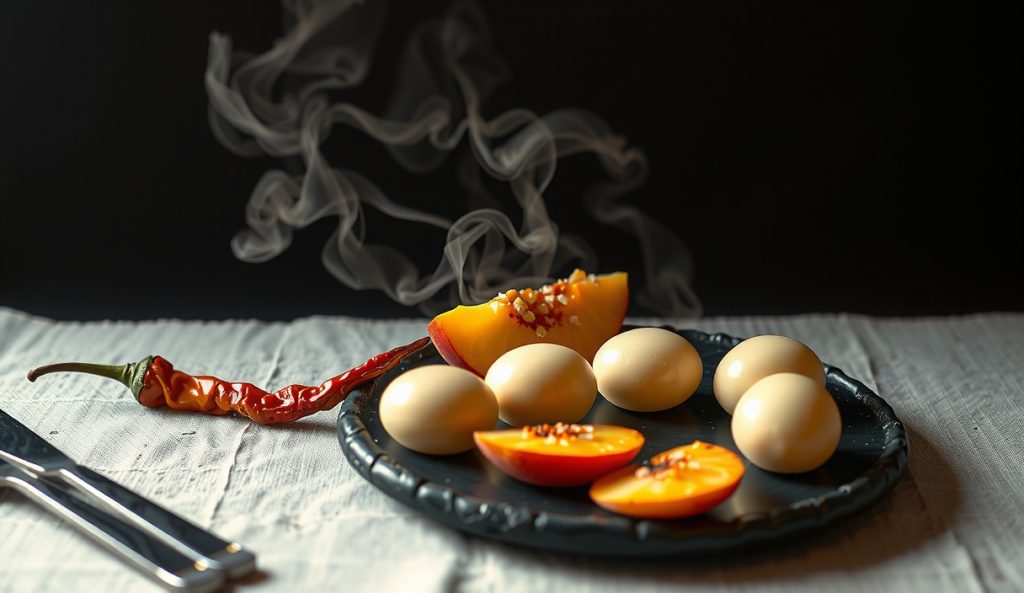
The peach-ghost pepper substitution keeps the spherification architecture intact while shifting both the flavor profile and the heat dynamic entirely. Where mango delivers a bright, tropical bloom and habanero hits fast with fruity, immediate fire, ripe peach brings a softer, more floral sweetness — and ghost pepper (Bhut jolokia) delivers capsaicin in a slow, escalating wave rather than an instant spike. The result is a sphere that pops clean on the palate, then builds heat over thirty to forty-five seconds, long after the membrane has dissolved.
What changes in the peach-ghost pepper version?
Replace the mango puree with an equal weight of ripe peach puree, strained of fibrous strands for a smooth sodium alginate dispersion. Swap the habanero for one-quarter of a ghost pepper with seeds removed — the seeds concentrate capsaicin-bearing placental tissue, and even a quarter fruit without seeds will register 400,000–500,000 Scoville units in the finished sauce.
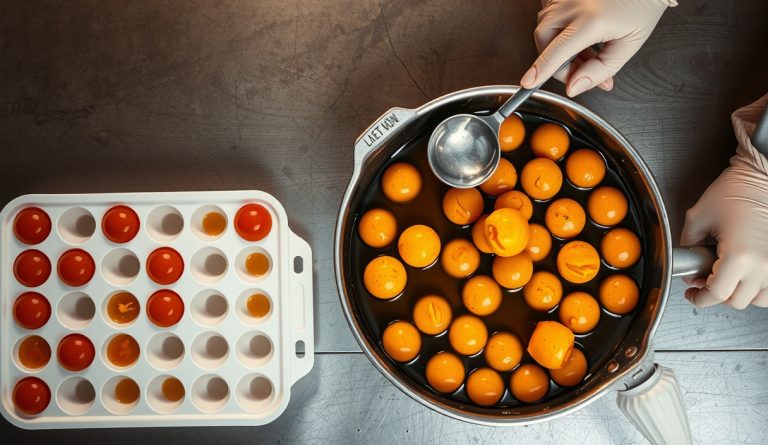
The more significant technical adjustment is bath time: peach contains measurably less fructose than Alphonso or Ataulfo mango, which means the sugar-to-water ratio in the dropping solution is slightly lower. A thinner solute concentration produces a marginally looser alginate gel network at the sphere surface. Extend immersion to 35 seconds (versus the canonical 25–28) to allow the calcium-alginate cross-linking to reach the same membrane thickness and structural integrity.
Capsaicin is lipophilic and does not interfere with the hydrocolloid chemistry, but the adobo-free, oil-light base in this variation means capsaicin remains loosely suspended in the dropping mixture. Shake or stir the dropping mixture between batches to maintain even heat distribution across spheres.
What stays the same as the original recipe?
Sodium alginate concentration, the calcium chloride bath ratio, the dropper technique, and the two-stage rinse protocol all remain identical to the canonical method. Sphere diameter, yield per batch, and refrigerated hold time are unchanged. The membrane behaves the same way under pressure — it bursts cleanly when bitten.
When is the peach-ghost pepper version the better choice?
Choose the peach-ghost pepper variation when the dish needs a heat component that does not compete with a complex smoke profile on the palate simultaneously. The creeping capsaicin build of ghost pepper allows the diner to register the fruit, the smoke from the underlying meat, and then the heat in sequence — a more structured tasting experience than the immediate habanero bloom that arrives with the mango base.
The peach-ghost pepper caviar is also a strong pairing for fatty cuts like pork belly or duck breast, where peach’s lower acidity is less likely to cut through rendered fat too aggressively. Use the full method, equipment, and alginate measurements from the original Spherified Mango-Habanero BBQ Sauce Caviar.