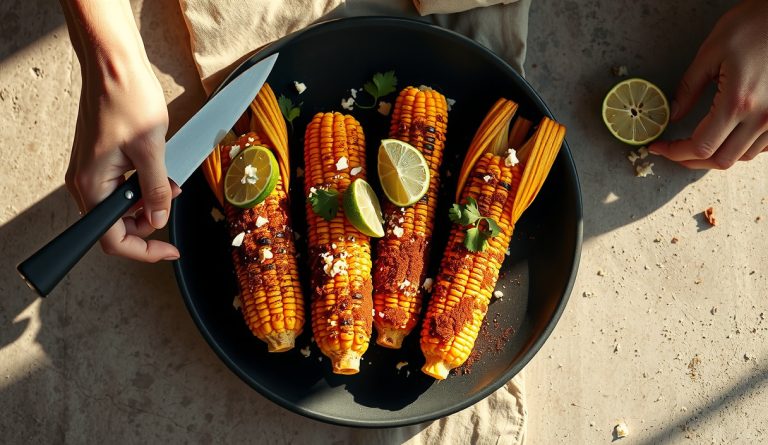
Elote scales cleanly in terms of ingredient ratios — the sauce, the cheese, the chili, and the lime all multiply linearly without any chemistry surprises. The real constraint at scale is operational, not culinary: grate space, rotation timing, and assembly throughput are the three variables that determine whether a large batch lands on the table hot and properly coated or arrives as a staggered, lukewarm queue. Mastering those three variables is the entire discipline of this crowd-scale variant.
What changes when you scale elote for a crowd?
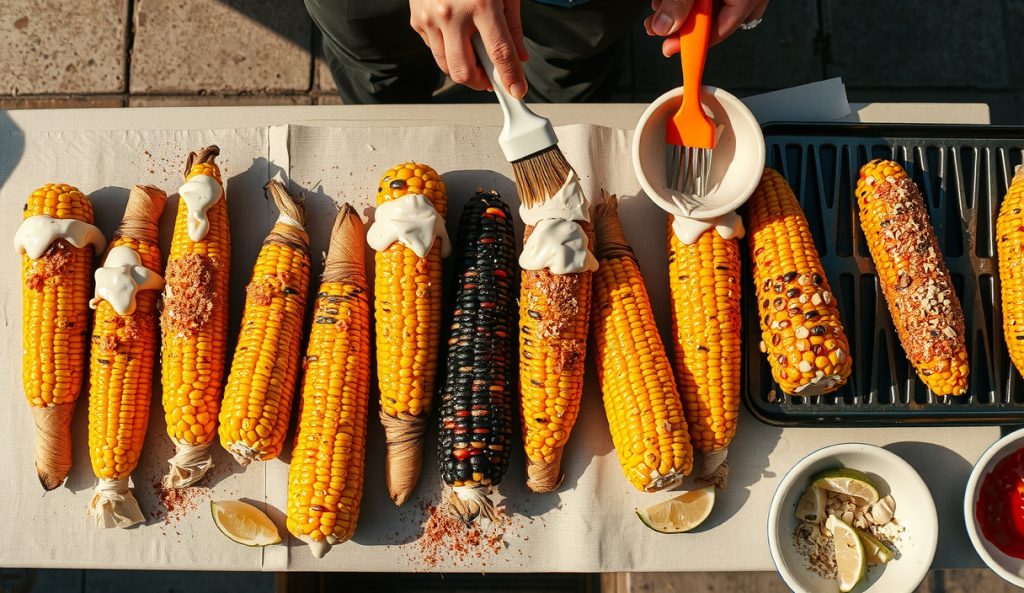
Double or triple the sauce quantities from the canonical recipe directly — no ratio adjustment is needed at any batch size. On the grill, the spatial constraint is concrete: six ears of corn require approximately 18 inches of linear grate space at standard cob diameter. A standard 22-inch kettle handles six ears comfortably, and a two-zone gas grill can typically manage eight to ten before rotation access becomes awkward.
When cooking more than eight ears in a single session, stagger grill starts by four minutes per batch group rather than loading all cobs simultaneously. Staggered loading distributes rotation and pull windows across time instead of stacking them — the cook is never rotating eight cobs at once, and never trying to sauce and top four cobs while four more are finishing on the grate without supervision. That four-minute offset is the single most effective operational adjustment at scale.
Prepare the mayo-crema sauce up to four hours ahead and refrigerate in a covered bowl or squeeze bottle. The emulsion in commercial mayo is stable at refrigerator temperatures across that four-hour window without separation; the crema is similarly stable. Pre-crumble the cotija and hold it dry at room temperature in a shallow bowl — moisture is the enemy of clean crumble adhesion, so keeping the cotija dry until service is non-negotiable.
Set up a dedicated assembly station adjacent to the grill with sauce, cotija, chili, and lime wedges arranged in sequence. At ninety seconds per cob for topping and plating, that assembly station is the actual production-rate bottleneck — not the grill itself. A second pair of hands at the assembly station doubles throughput precisely, which matters once the batch exceeds eight ears.
What stays the same when grilling elote at volume?
The grill temperature, char target, husk-on or husk-off method, and topping ratios from the canonical recipe are entirely unchanged at any batch size. Scaling elote for a crowd means increasing volume, not adjusting technique. Each individual cob is grilled and assembled exactly as the canonical recipe describes — the crowd-scale discipline lives entirely in logistics, not in the food itself.
When is the crowd-scale approach the better choice?
This approach is the right choice for cookouts of twelve or more people, tailgates, or any event where corn is a primary side rather than a supplementary one. Pre-staged sauce and staggered grill starts allow consistent quality across the full batch, preventing the quality degradation that typically sets in toward the back of a large, unmanaged run as the cook fatigues and timing slips.
Use the full sauce ratios, grill method, and topping sequence from the original Grilled Corn Mexican Street-Style Elote.