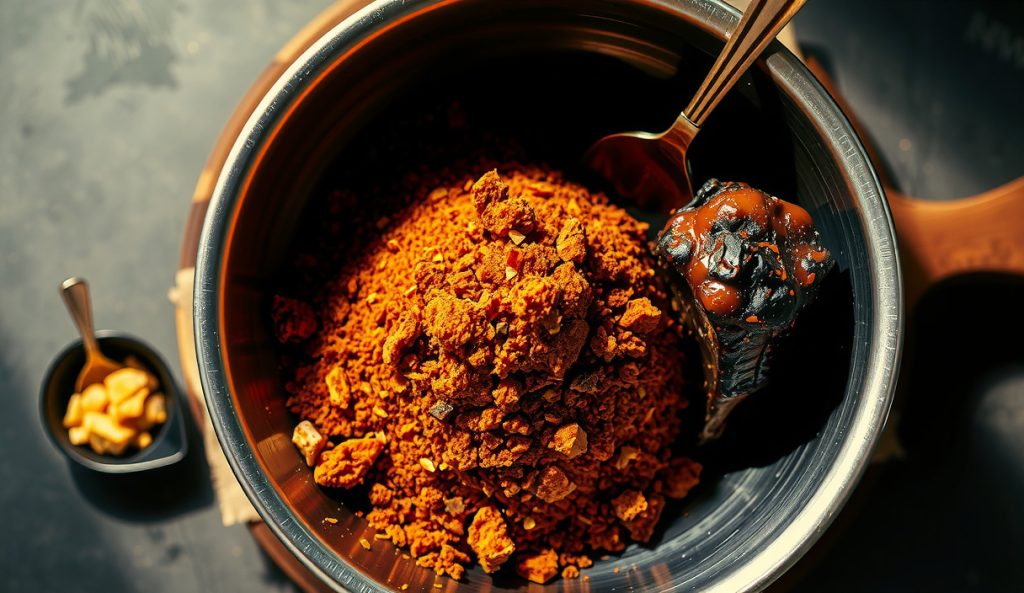
Competition barbecue demands precision that backyard cooks rarely need. Brown sugar is a workhorse in most rub formulas — cheap, hygroscopic, and reliable — but its fine crystal size means it melts and begins caramelizing almost immediately when surface temperatures climb, giving the pitmaster a narrow window before the bark darkens past the ideal deep amber. This no-sugar competition build swaps brown sugar for a 1:1 split of turbinado and tapioca maltodextrin, each solving a different part of the problem.
What exactly changes in this competition rub build?
Replace the 20g of brown sugar in the canonical formula with 10g of turbinado sugar and 10g of tapioca maltodextrin. Turbinado’s larger, coarser crystals carry a lower surface-area-to-mass ratio than brown sugar crystals, which slows their dissolution rate on the meat surface. This delay pushes back the onset of caramelization — sucrose converts to glucose and fructose and begins browning at around 160°C (320°F) — giving the cook a longer plateau where the bark is building structure without committing to color. The practical result is more control during high-heat or variable-temperature cooks where brown sugar would already be darkening.
Tapioca maltodextrin is a food-grade starch derivative used in modernist kitchens to encapsulate oil-soluble compounds. Paprika’s key volatile aromatics — primarily carotenoid-derived aldehydes — are fat-soluble. Maltodextrin at roughly 4–6% w/w of the rub formula physically surrounds those volatiles, protecting them from early volatilization during the rub stage at ambient temperature. As surface temperature rises during the cook, the maltodextrin matrix breaks down and releases the paprika aromatics in a concentrated burst timed to bark formation. The result is a more pronounced paprika-forward nose in the finished product than the brown-sugar base allows, because fewer volatiles have already escaped before the meat ever hits the pit.
What stays exactly the same in this variant?
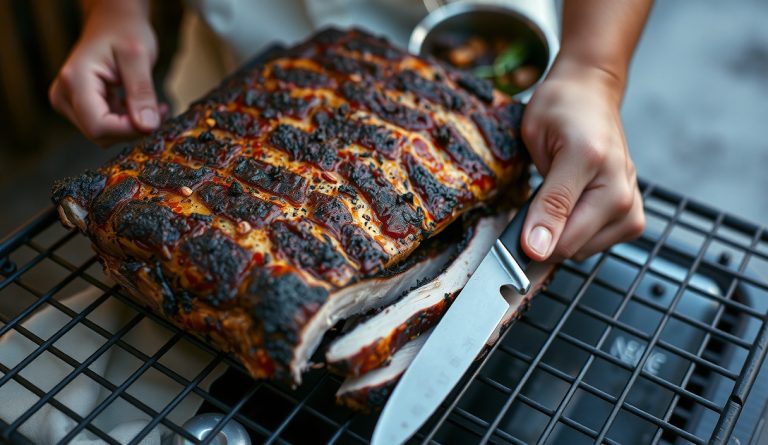
Salt, paprika, chili powder, black pepper, garlic, and cayenne (if using the spicy variant) all remain at their canonical weights. Application method and timing do not change. The Memphis Pork Rub — No-Sugar Competition Build still reads as Memphis-style — smoke-forward and paprika-dominant — producing a bark that is dark mahogany rather than black.
When is this competition build the better choice?
Use this build when precision bark color and aromatic intensity are being evaluated — competition turn-in boxes, catering presentations, or any cook where the surface is being judged visually before it is tasted. The no-sugar competition build is a meaningful upgrade over the canonical formula for high-heat applications above 275°F, where brown sugar would over-darken quickly. It also outperforms the standard base in low-humidity environments where faster-than-normal moisture loss from the surface accelerates browning reactions.
Use the full spice weights, mixing method, and cook-temperature guidance from the original Memphis Pork Rub — Paprika-Brown-Sugar Base.