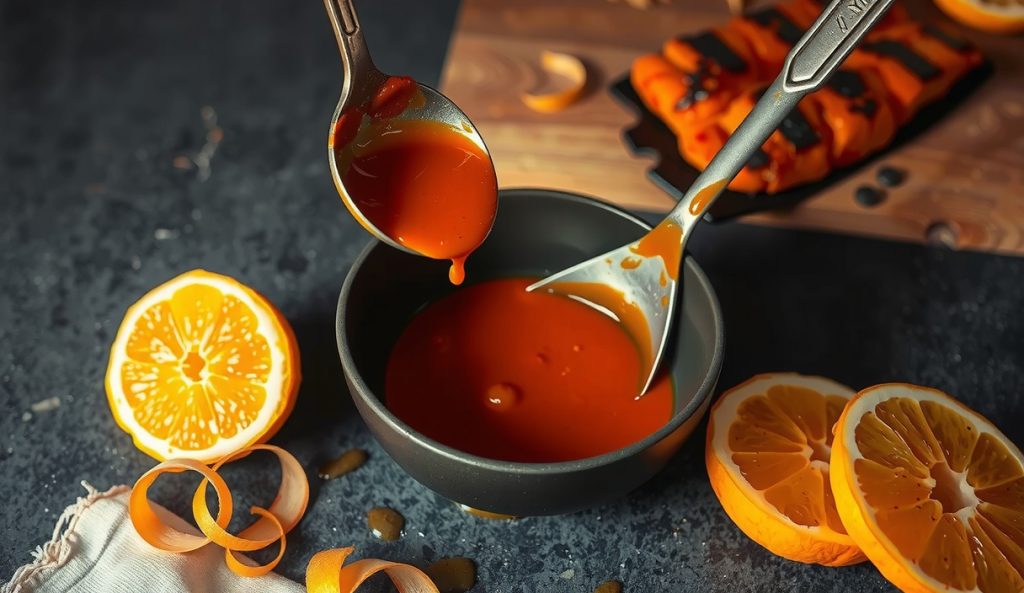
Rice vinegar’s role in the canonical Korean Gochujang BBQ Sauce is structural: it provides acidity — roughly pH 2.8–3.2 in solution — to balance the deep sweetness of the gochujang and cut through sesame oil’s richness. Yuzu juice, or a Meyer lemon and orange oil combination, accomplishes the same structural job at a slightly lower pH while adding a dense aromatic load that rice vinegar simply cannot provide. The result is a sauce that finishes brighter, more floral, and considerably more complex on fatty, delicate proteins.
This citrus-forward variation is not a dramatic reformulation — the sauce still reads as Korean BBQ — but the citrus version elevates the gochujang sauce from a grilling sauce into something closer to a finishing glaze you would apply at the table alongside cedar-planked salmon or arctic char.
What changes in the citrus-forward variation?
Replace the rice vinegar with 2 tablespoons of fresh yuzu juice — or, if yuzu is unavailable, fresh Meyer lemon juice with 3–4 drops of high-quality orange essential oil or orange oil extract. Do not use bottled yuzu juice that contains stabilizers; the terpene fractions that make this substitution work are volatile and degrade quickly in processed products.
The key mechanism is terpene partitioning. Limonene and linalool — the primary terpenes in yuzu and Meyer lemon peel — are lipophilic and partition preferentially into the sesame oil phase of the emulsion rather than the aqueous phase. This means the terpenes persist through reduction, survive glazing temperatures, and release in the finish when the sauce contacts fat on the protein’s surface, extending the aromatic experience several seconds past the initial bite. The citric acid in fresh juice also delivers a marginally sharper pH counterpoint (pH approximately 2.2–2.5) versus rice vinegar’s pH 2.8–3.2, so the sauce’s perceived acidity is slightly higher even when the added volume is identical.
What stays the same in the citrus variation?
The gochujang quantity, soy sauce ratio, sesame oil addition off-heat, and reduction target all remain unchanged from the base recipe. The sauce body, glaze behavior on a hot plank or grill grate, and fermented umami backbone are identical to the canonical version — only the acid source and aromatic profile shift.
When is the citrus-forward variation the better choice?
This citrus-forward variant performs best on fatty, mild-flavored fish — salmon, arctic char, black cod — where the lipophilic terpenes migrate into the rendered fat during cooking and bloom on the palate. The citrus variation is also the right choice when serving the gochujang sauce as a finishing drizzle rather than a grilling mop, or any time the goal is a sauce that reads as more refined and aromatic rather than aggressively savory.
Use the full method, equipment, and base measurements from the original Korean Gochujang BBQ Sauce.