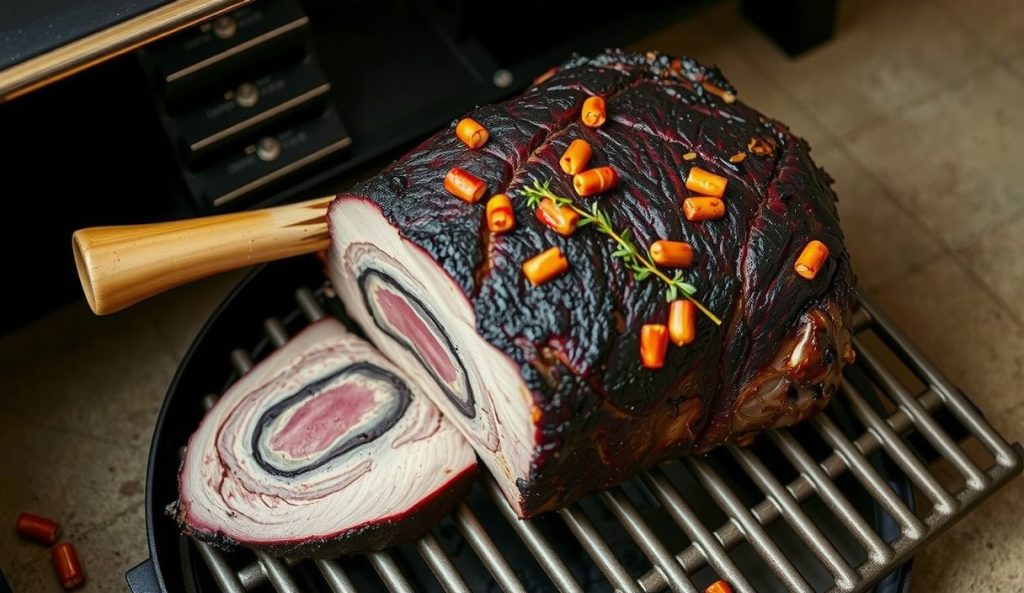
Pellet grills are capable cookers for prime rib — they hold temperature with precision, require minimal tending, and produce genuine wood smoke. Their limitation is smoke density. Because a pellet auger feeds small amounts of compressed wood to a fire pot that burns relatively clean, the concentration of smoke compounds at any given moment is lower than what a stick burner or charcoal offset generates. For a long cook like prime rib, this produces a lighter smoke ring and a less assertive smoke flavor unless you intervene in the first stage of the cook.
The fix is targeted and low-effort: a stainless smoke tube filled with oak pellets, lit with a torch until the end glows, then placed in the cooking chamber alongside the roast for the first two hours of the cook.
What changes when you add a smoke tube to a pellet grill prime rib?
The smoke tube smolders rather than flames, generating a sustained, dense stream of particulate and gas-phase smoke compounds — including nitric oxide — that would otherwise be present only in modest concentrations from the pellet fire pot alone. Nitric oxide reacts with myoglobin near the meat surface to form nitrosomyoglobin, the pink compound responsible for the smoke ring.
This reaction is temperature-gated: it slows dramatically as the surface of the prime rib rises above approximately 140°F, because myoglobin denatures and can no longer bind nitric oxide effectively. By concentrating additional smoke exposure during the first two hours — when surface temperatures are still low and myoglobin is intact — you extend ring penetration as far as the biology allows without altering the cook itself.
Use oak pellets in the smoke tube if you are matching the flavor profile of the canonical recipe. Cherry or hickory are acceptable alternatives: cherry adds a faint sweetness, hickory a more assertive, classic American barbecue note. Position the tube at the opposite end of the cooking grate from the roast so the smoke drifts across the surface rather than impinging directly on it.
What stays the same as the canonical smoked prime rib method?
Smoker temperature, pull temperature, rub, dry brine, and the reverse-sear sequence are identical to the canonical method. The pellet grill’s temperature controller handles the low-and-slow phase without adjustment. Remove the smoke tube after two hours — continuing past that point adds no additional ring depth and risks pushing the smoke flavor past the point of balance.
When is a pellet grill the better choice for smoked prime rib?
A pellet grill with a smoke tube is the right approach when a pellet cooker is your primary or only smoker and you want the finished roast to look and taste as close to an offset-cooked version as possible. It is also well suited to cooks who want the set-it-and-monitor convenience of a pellet cooker without accepting the visual compromise of a faint or absent smoke ring on a showpiece cut.
Use the full method, equipment, and rub measurements from the original Smoked Prime Rib — Bone-In, adding the smoke tube only for the first two hours of the cook.