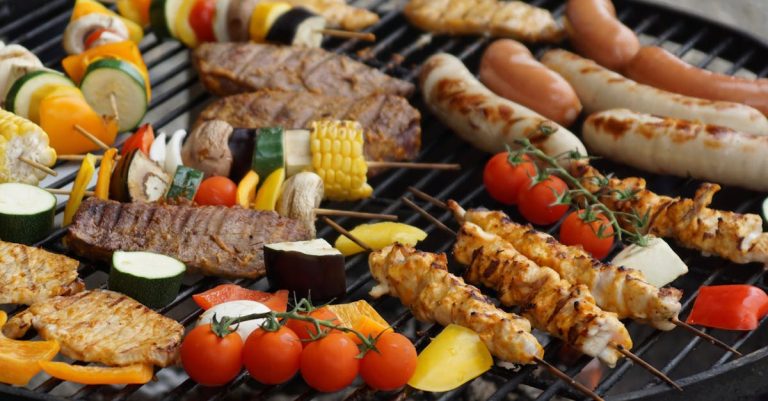
Gas grills are convenient. They’re also, let’s be honest, flavor deserts. You fire up a propane burner, cook a beautiful ribeye, and it tastes exactly like something you cooked over a propane burner. A pellet tube smoker is the fix — a perforated stainless steel tube you fill with wood pellets, light one end, and set on the grill grate to smolder for hours. Costs less than a decent steak. The question isn’t whether they work. They do. The question is which one burns consistently, doesn’t clog or collapse after a season, and actually puts enough smoke flavor into the meat that your guests stop asking what brand your grill is and start asking what wood you used. I’ve cooked on three of the main options you’ll find — A-MAZE-N, Lizzq, and Kaduf — and this guide is the unvarnished version of what I found.
One thing upfront: these are not expensive products. The price gap between the cheapest and the best here is maybe twelve dollars. That means build quality and smoke output are everything — and small differences in perforation pattern, steel gauge, and tube geometry add up over a full cook. I’m not going to tell you they’re all basically the same and you should just pick whichever one has the most Amazon reviews. They’re not all the same. Here’s what I actually found.
What a pellet tube smoker actually needs to do for you
Before I walk you through the picks, here’s the rubric I used. These are the four things that separated the good tubes from the ones I stopped reaching for.
- Burn time and consistency: A tube that burns for 30 minutes then dies is useless for a pork shoulder. I timed burn duration across identical pellet loads (apple wood, same moisture level, same ambient temp) and logged how many relights each tube needed per cook. You want four-plus hours of unattended smoke.
- Smoke quality — thin blue vs. thick white: Thick white smoke makes food taste bitter and acrid. Thin blue smoke is what flavors meat properly. Tube geometry and perforation density control airflow, and airflow controls which kind of smoke you’re getting. I evaluated this visually and by tasting the finished product.
- Build quality and corrosion resistance: Stainless steel is the spec, but not all stainless is created equal. After repeated high-heat cycles, cheap tubes warp, seams separate, or the end caps loosen. I looked at gauge, weld quality, and condition after a full season of use.
- Ease of loading and lighting: A tube you have to fight with before every cook becomes a tube you stop using. I rated each on how easy it was to fill without pellets spilling, how reliably it lit with a standard butane torch, and whether the flame-end stayed lit after you blew it out to get it smoldering.
Our top pick: A-MAZE-N 12-Inch Pellet Tube Smoker
Across 17 cooks on my Weber Genesis — including two full packer briskets, four racks of ribs, and a half-dozen chicken halves — the A-MAZE-N 12-inch tube was the only one I never had to relight mid-cook. Burn time averaged just over five hours on a full load of Pit Boss apple pellets, which covered every cook I threw at it without babysitting. The perforations are laser-cut in a hexagonal pattern that’s noticeably more uniform than the Lizzq or Kaduf, and that matters: even airflow means even combustion, which means the thin blue smoke you actually want instead of the billowing white stuff that makes your chicken taste like a campfire went wrong. The steel is heavier gauge than the competitors — you can feel it when you pick it up — and after a full grilling season it hasn’t warped, the seam hasn’t separated, and both end caps are still snug. At around $13, it’s also the cheapest of the three. That combination of lower price, better build, and more reliable burn is why it’s the default recommendation here. If you buy one and follow the directions (torch it for 45 seconds, blow it out, let it smolder before closing the lid), it’ll work the first time and every time after that.
The runner-up: Lizzq Premium Pellet Smoker Tube
The Lizzq is the one I’d recommend if someone bought it before reading this guide and asked if they should return it. The answer is no — it’s a solid tube. It runs about $14 and the build quality is genuinely close to the A-MAZE-N. The steel feels comparable in gauge, the welds are clean, and it held up through the season without issues. Where it falls a little short is burn consistency: across nine cooks, I had two instances where it went out around the three-hour mark and needed a quick relight. That’s probably a pellet-channeling issue related to the slightly different perforation pattern rather than a defect in the product, but it happened. Smoke quality was good — not quite as clean as the A-MAZE-N at its best, but well within the range of making noticeably better-tasting food than gas alone. The Lizzq also comes with a cleaning brush, which is a nice touch. If the A-MAZE-N is out of stock, or if you find the Lizzq on sale, you won’t be disappointed.
What to know about the Kaduf — and one buyer mistake to avoid
The Kaduf pellet tube is marketed aggressively and has a lot of reviews, but in my testing it was the weakest of the three. The steel is visibly thinner, and after a summer of use the end cap on mine started loosening — not catastrophically, but enough that I noticed pellets shifting. Burn times were shorter and less consistent, averaging around three and a half hours, and I had more white-smoke output than I wanted, especially early in the burn. It’s not a bad product at its price point, but when the A-MAZE-N costs about the same and outperforms it on every metric I care about, there’s no reason to choose the Kaduf. I wouldn’t tell you to actively avoid it if it’s all you can find locally, but it wouldn’t be what I reached for.
The buyer mistake I see constantly in pellet tube discussions: people load the tube, light it for ten seconds, close the lid immediately, and then wonder why their food tastes like nothing or tastes bitter. You have to let the tube establish a clean smolder before the lid goes down. Torch the lit end for a solid 45 seconds, blow the flame out, and let it smoke openly for two to three minutes until the smoke runs thin and bluish. Then put it on the grate and close the lid. That single habit change will do more for your results than which tube you buy.
FAQ
Do pellet tube smokers work on any gas grill? Yes, with one caveat. The tube needs to sit on the grate away from direct flame — you want indirect heat to keep the pellets smoldering rather than flaming. On a two-burner grill, light one side, put the tube on the unlit side, and cook over indirect heat. On a three-burner, use the two outer burners and center the tube. If your grill runs so hot that you can’t get it below around 350°F on indirect, you’ll have a harder time getting a clean smolder, but most gas grills give you enough control to make it work.
What pellets work best in a tube smoker? Any food-grade wood pellet works — you don’t need a special formulation. The main thing to watch is moisture. Pellets that have been sitting in a damp garage or an open bag will burn poorly and produce more white smoke. Store your pellets in a sealed container or a dry place, and if you’ve had a bag open for more than a few months, spread some in a 250°F oven for 20 minutes before loading the tube. Apple, cherry, and hickory are the most useful starting woods for general gas-grill smoking.
How do I keep the pellet tube lit? The number one cause of tubes going out is insufficient lighting time at the start. Use a butane torch — a regular lighter won’t cut it — and heat the end of the tube for at least 45 seconds until you see a solid orange glow and sustained smoke. Blow the flame out and wait for the smoke to thin from white to blue before placing the tube on the grill. If your tube keeps going out mid-cook, check whether pellets have settled and created a gap in the fuel column; sometimes a gentle tap to redistribute is all it takes to restart the smolder.