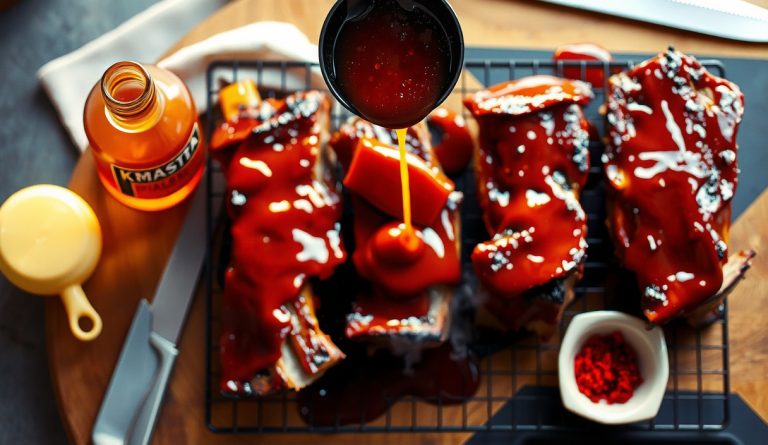

The canonical Kansas City BBQ Sauce finishes at approximately 420 mg of sodium per 2-tablespoon serving — acceptable for most diets, but a meaningful concern for anyone managing blood pressure, following post-surgical sodium restrictions, or simply trying to reduce aggregate daily sodium across a full BBQ meal. This low-sodium adaptation brings that figure down to roughly 280 mg per serving — a 33% reduction — without producing a flat, one-dimensional sauce. The mechanism is replacing lost sodium-driven savoriness with nucleotide-amplified umami from a non-sodium source.
What changes in the low-sodium adaptation?
Replace the Worcestershire sauce with an equal volume of reduced-sodium tamari-based substitute. San-J reduced-sodium tamari is a reliable benchmark, carrying approximately 40% less sodium per tablespoon than standard Worcestershire while retaining fermented depth and a comparable umami register. Omit any added table salt entirely. The tomato paste and blackstrap molasses both carry inherent sodium from their own processing, and those background contributions are sufficient to reach the 280 mg per serving target without further supplementation.
To compensate for the reduced umami intensity that comes with cutting sodium, add 1 teaspoon of dried mushroom powder — porcini or shiitake — alongside the other dry spices. Mushroom powder is rich in guanosine-5-monophosphate (GMP), a guanylate nucleotide. GMP synergizes with the free glutamate naturally present in tomato paste through a well-characterized nucleotide-glutamate interaction: the two compounds together produce perceived savoriness that is disproportionately greater than either compound alone. This single addition closes most of the umami gap without adding any measurable sodium load to the sauce.
What stays exactly the same?
The complete build sequence, reduction method, sweetness and acid balance, full spice profile, and viscosity target remain unchanged from the original recipe. This adaptation is a targeted sodium-management modification, not a wholesale reformulation. The finished sauce should taste unmistakably like Kansas City sauce — layered, smoky-sweet, and glossy — just kinder to restricted diets.
When is the low-sodium version the better choice?
This adaptation is the appropriate version for any table where at least one guest is managing sodium intake medically or by preference — cardiac rehabilitation diets, DASH diet protocols, or general wellness goals. It is also a sound default when the Kansas City BBQ Sauce is being applied as a glaze over the full cook rather than served only as a condiment at the table. Repeated basting layers accumulate sodium quickly in the finished dish, and starting from 280 mg per serving instead of 420 mg provides meaningful headroom across multiple applications.
- Use reduced-sodium tamari in a 1-for-1 swap for Worcestershire sauce.
- Omit all added table salt — tomato paste and blackstrap molasses supply sufficient background sodium.
- Add 1 teaspoon dried porcini or shiitake mushroom powder with the dry spices to restore umami via GMP-glutamate synergy.
- All other measurements, timing, and technique follow the base recipe exactly.
Use the full method, equipment, and base measurements from the original Kansas City BBQ Sauce — Molasses-Tomato.