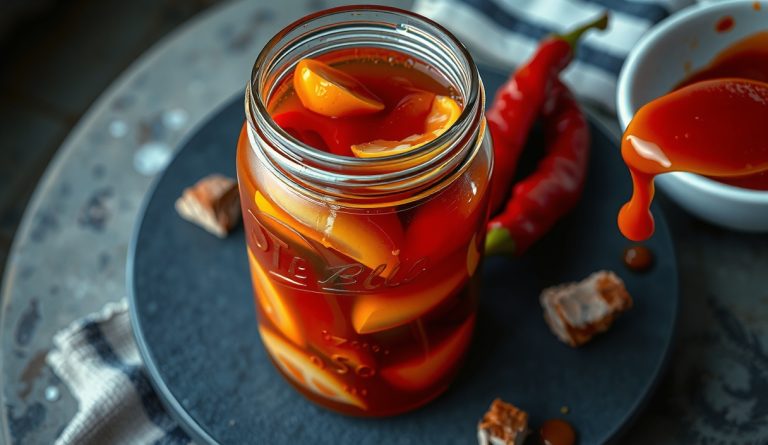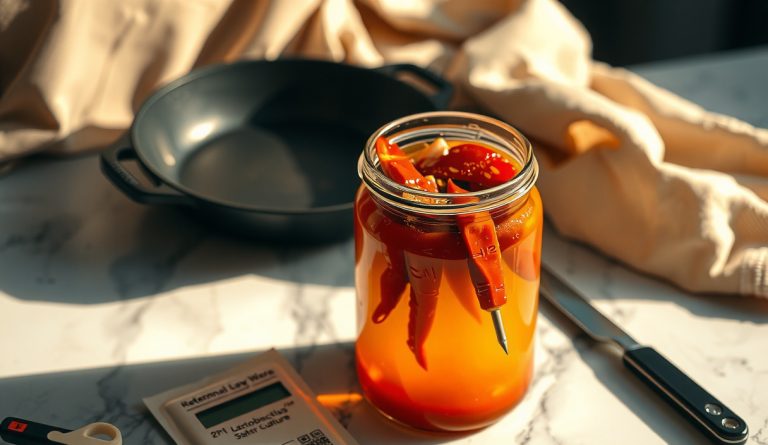
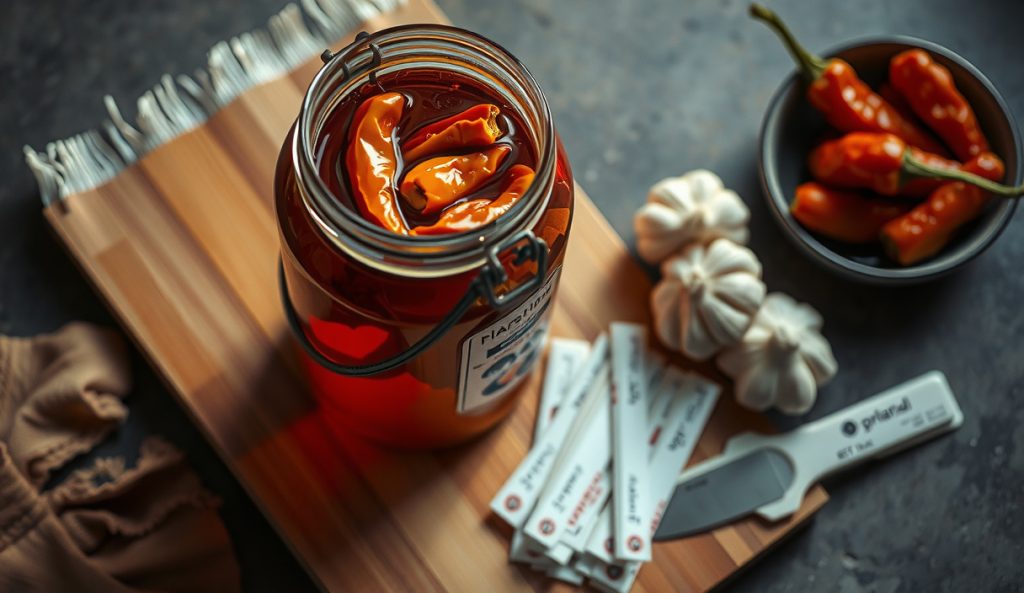
This Carolina Reaper build applies the identical lacto-fermentation framework as the canonical recipe to the hottest commercially recognized pepper cultivar on the market. Carolina Reapers register between 1.4 and 2.2 million Scoville Heat Units — a heat level that changes not just the eating experience but every handling requirement throughout the entire process. The fermentation chemistry is unchanged; the risk profile is not.
What changes in the Carolina Reaper build?
All Fresno chiles are replaced one-for-one by weight with Carolina Reapers. Wear nitrile gloves from the moment you handle raw Reapers through the entire blending and bottling sequence. Capsaicin and its analogues (capsaicinoids) aerosolize readily during high-speed blending at these concentrations, and mucosal exposure at 1.4–2.2 million SHU causes serious irritation to eyes, nasal passages, and lungs. Blend in short pulses in a well-ventilated space or outdoors, and keep the blender lid sealed with a folded towel pressed firmly over it.
Two flavor adjustments improve the finished Carolina Reaper hot sauce. First, increase garlic by 30–40% above the canonical quantity — the added allium compounds provide a structural counterweight that gives the heat somewhere to sit rather than arriving as an undifferentiated wave. Second, add one medium roasted sweet red bell pepper to the fermentation vessel. Bell pepper contains zero capsaicinoids but carries natural sugars that caramelize during roasting and contribute inherent sweetness to the brine without introducing refined sugar, which is excluded from the ferment. The roasted bell pepper is not a heat-reduction mechanism; it adds sweetness and body that widen the sensory window before the Reaper heat peaks.
What stays the same as the original recipe?
Fermentation behavior — brine salinity, timeline, pH targets, temperature range, and submersion method — is unchanged from the canonical recipe. Carolina Reapers do not produce different microbial dynamics than Fresnos; the Lactobacillus population responds to salt concentration and sugar availability, not to capsaicin content. The smoking step is applied to the Reapers before fermentation exactly as in the canonical recipe.
When is the Carolina Reaper build the better choice?
This variant is the right choice when the explicit goal is maximum heat paired with the structural complexity of a fermented sauce rather than a pure extract product. A small amount — measured in drops — is appropriate per serving. The Carolina Reaper hot sauce functions as a culinary tool more than a condiment, best suited for seasoning large-format braises, cooking oils, or collaborative dishes where the sauce is diluted into a larger preparation.
Use the full method, equipment, and brine measurements from the original Lacto-Fermented Smoked Pepper Hot Sauce.