
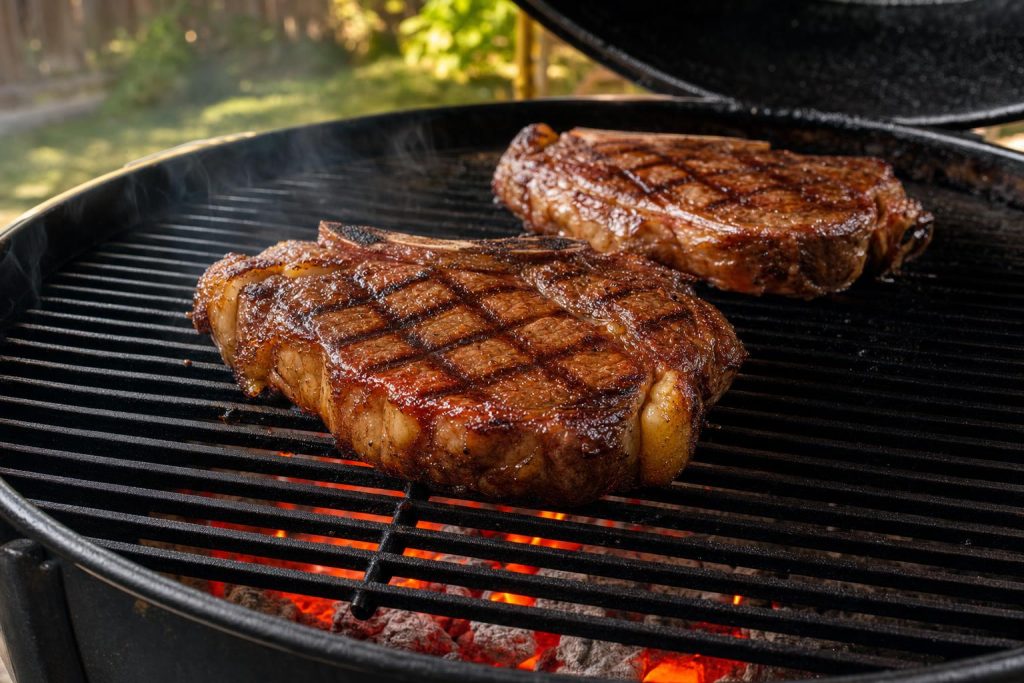
The stock porcelain-coated wire grate that ships with a Weber kettle is fine. It’s also kind of a lie — because the moment you drop a ribeye on it and get those sad, thin little crosshatch lines instead of a real sear, you know something’s missing. Cast iron grates fix that. They hold more heat, they transfer it faster to the meat surface, and the marks they leave look like you actually know what you’re doing. But here’s the thing: not every cast iron grate sold for a Weber kettle is worth the money or the seasoning ritual. I’ve seen guides that give every option a trophy. This isn’t that. After cooking on three different setups across a full grilling season — everything from weeknight burgers to a couple of low-and-slow overnighters — I have a real answer for you.
The three products worth your time in this category are the Weber Gourmet BBQ System (GBS) cast iron grate, the Craycort cast iron grate system, and the Kingsford cast iron cooking grate. Everything else in this space is either a rebranded version of one of these or a cheaper casting that warps or rusts inside a season. Here’s how they stack up and which one I’d put my own money on.
What a cast iron grate for your Weber actually needs to do
Before I get into picks, let me tell you what I was measuring — because “sear marks” is the obvious answer but it’s only half the story.
- Heat retention and recovery: Cast iron’s whole job is thermal mass. A grate that drops more than 15°F when you lay down four cold steaks isn’t doing its job. I monitored surface temps with an IR gun before and 60 seconds after loading the grate on every cook.
- Bar width and spacing: Wider bars mean better contact sear marks. But spacing matters too — too tight and you lose airflow for indirect cooking, too wide and smaller items fall through or you lose the sear pattern entirely. The sweet spot for a 22-inch kettle is bars around 5/16 to 3/8 of an inch wide with roughly half-inch spacing.
- Fit and stability: A grate that rocks, gaps at the edge, or sits proud of the kettle rim is a safety issue and a heat-retention problem. I checked fit on a standard Weber 22-inch kettle (the most common size by a wide margin).
- Rust resistance and seasoning hold: Raw cast iron needs seasoning. The question is whether the casting is porous enough to hold it or rough enough to shed it. I looked at surface finish out of the box and checked for rust at the 30-day and 90-day marks with normal outdoor storage covered but not indoors.
Our top pick: Weber Gourmet BBQ System Cast Iron Grate
Across 18 cooks on the Weber GBS grate — including three reverse-sear sessions on thick-cut ribeyes, one spatchcocked chicken, and a lot of weekend burgers — this is the grate I kept reaching for. The fit on a standard 22-inch Weber kettle is essentially perfect, which shouldn’t be a surprise since Weber made both. The center insert system is the real differentiator: you can pull the middle section and drop in a wok insert, a sear grate, or a griddle without lifting the entire cooking surface. That modularity sounds like a gimmick until the third time you use it and realize you’ve stopped moving food around trying to hit a hot spot. Surface temps on the cast iron section held within 10°F after loading four half-pound burger patties from the fridge — recovery was faster than I expected at medium-high coal bed depth. The bars are wide enough to produce marks I’m proud to photograph. The outer ring is also cast iron (not wire), which matters for edge cooking that the cheaper alternatives handle with a thin rolled-wire perimeter.
Two honest caveats: this grate is heavier than you expect the first time you lift it, and the center insert system means there’s a seam where grease can collect if you’re not cleaning it after each cook. Neither is a dealbreaker, but Upgrade Steve should know going in. Price runs around $80 to $100 depending on where you buy. That’s fair for what you get.
The modular upgrade: Craycort Cast Iron Grate
Craycort is the obsessive choice — and I mean that as a compliment. The system uses a cast iron outer ring that fits the Weber 22-inch kettle, with interchangeable pie-slice inserts that let you mix and match cooking surfaces in the same session. Run cast iron on one half for searing and a standard grate on the other half for indirect. It’s genuinely clever. The casting quality is noticeably smoother out of the box than both the Weber GBS and the Kingsford option, which means seasoning adheres better and cleanup is easier. On a side-by-side cook where I put NY strips on the Craycort and the Weber GBS simultaneously over identical coal beds, the Craycort produced slightly more defined marks — bar contact was more consistent across the surface.
Here’s the catch: Craycort is harder to find in stock than it used to be, and the price reflects a premium product. You’re looking at $120 and up for the full system with inserts. If you cook on your Weber five days a week and treat gear the way some people treat kitchen knives — seasoned, stored right, used hard — Craycort is worth every dollar. If you’re cooking weekends only and want a plug-and-play solution, the Weber GBS is a better everyday pick.
The budget option: Kingsford Cast Iron Grate
The Kingsford cast iron grate is the affordable entry point, and it does the core job: it’s heavier than the stock Weber wire grate, it holds heat better, and it produces real sear marks. For $35 to $50, it’s a legitimate upgrade. But there are tradeoffs I want you to know about before you click buy. The surface finish is rougher than either of the other two options, which means the initial seasoning takes more effort and the grate is more prone to surface rust if you’re not diligent about oiling it after each cook. I saw light surface rust on mine at the 30-day mark after one rain event where I forgot to cover the kettle. It cleaned off without drama, but it’s a signal about the casting porosity. The fit on a 22-inch Weber is adequate but not snug — there’s minor movement if you’re flipping aggressively. None of this is catastrophic, but it’s the difference between a tool you trust and a tool you manage.
If you’re buying your first cast iron grate and want to feel the difference before committing more money, the Kingsford is a reasonable test. If you already know you want cast iron for the long haul, spend the extra $40 and get the Weber GBS.
FAQ
Do cast iron grates work on all Weber kettle sizes? The grates listed in this guide are sized for the standard 22-inch Weber kettle, which is the most common size. Weber does make GBS-compatible grates for the 26-inch kettle, but fitment is not interchangeable — check your kettle diameter before ordering. Craycort also offers a 26-inch compatible ring. The 18-inch Weber Smokey Joe is a different animal and these won’t fit.
How do I season a new cast iron grate before the first cook? Wash it once with mild soap to remove any manufacturing residue, dry it completely — I put mine over a low flame for five minutes — then apply a thin coat of a high-smoke-point oil (flaxseed or Crisco work well) and run your kettle lid-on at high heat for 45 minutes. Let it cool in place. One round is enough to protect it; two rounds is better. Never soak cast iron, and never let it air-dry wet.
Will a cast iron grate make my food taste different? Not in a magical way — the cast iron itself doesn’t impart flavor. What changes is the Maillard reaction at the surface contact points. More thermal mass, faster crust formation, deeper sear marks. The fat that polymerizes into the grate over time can add a faint seasoned character to the first few minutes of contact, similar to a well-used cast iron skillet, but it’s subtle. What you’ll actually notice is a better crust and a cleaner release once the grate is properly seasoned.