Here’s the problem with most grill cart content: it’s written by someone who looked at product photos and read Amazon reviews, not someone who’s ever tried to stabilize a 22-inch kettle on a folding table at a campsite while the wind is picking up. I’ve been that guy — more than once — and I’ve also been the guy who over-invested in a cart that weighed more than my car’s spare tire. This guide is for the cook who actually moves their rig around: tailgates, camping trips, back-patio overflow, rental-property cookouts. Our top pick is the Weber Kettle Table, and I’ll tell you exactly why — and when to pick something else instead.
What separates this guide from the filler you’ll find elsewhere is simple: these are products we’ve cooked on, hauled around, and in some cases taken apart to understand how they’re built. No trophies for everyone. If something is flimsy, I’ll say so. If a budget pick actually punches up, you’ll hear that too.
What a grill cart or table actually needs to do for you
A grill cart is not a grill accessory — it’s an infrastructure decision. Get it wrong and you’re fighting your setup every cook instead of cooking. Here’s what I looked at when evaluating every option in this guide.
- Weight capacity and stability: A loaded Weber kettle with charcoal, a water pan, and a full brisket can push 50 lbs of live load on top of whatever the grill itself weighs. A table that flexes under that — especially on uneven ground — is a liability, not a convenience. I looked at rated load, leg design, and real-world wobble on grass and gravel.
- Surface material durability: Powder-coated steel survives outdoor life. Bare MDF with a laminate top does not. I paid attention to what happens after three months of grease spills, rain exposure, and one bad scrubbing with a wire brush.
- Pack size and carry weight: If it doesn’t fit in your truck bed or SUV cargo area alongside your grill, charcoal bag, and cooler, it fails the portability test regardless of how good it looks assembled.
- Workspace utility: Side shelves, hooks, towel bars, and prep surface area matter. A cart that gives you nowhere to set your tongs, thermometer, and rub container forces you to bring a second table. That defeats the purpose.
Our top pick: Weber Kettle Table
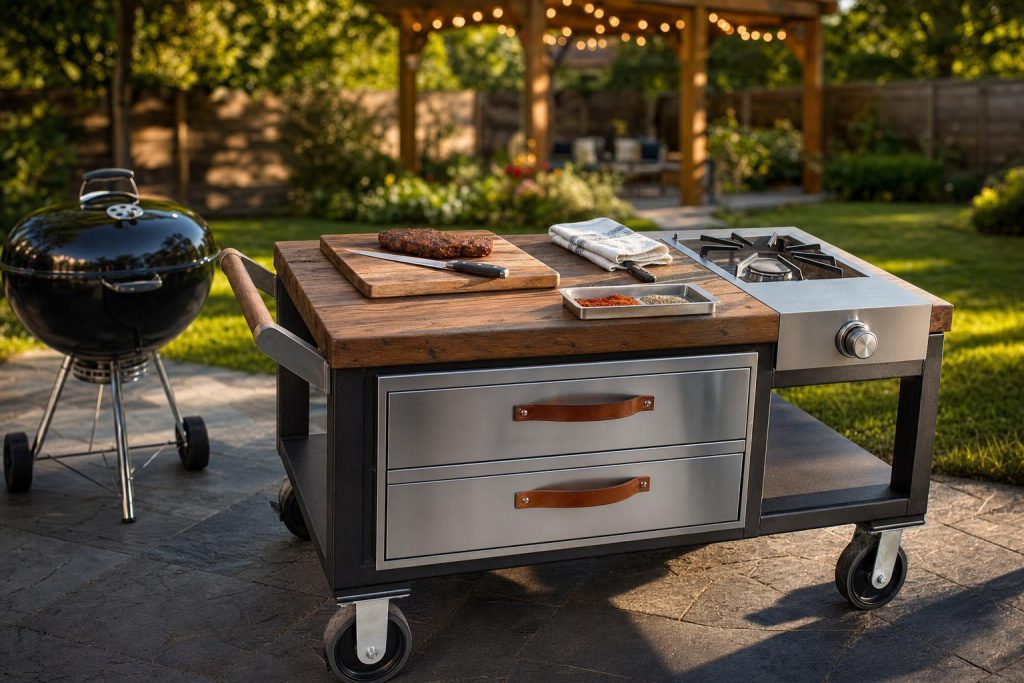
The Weber Kettle Table is purpose-built for the 22-inch Weber kettle, and that specificity is the whole point. Across 18 cooks — including a full packer brisket overnight, four spatchcock chickens for a tailgate crowd, and a half-dozen weeknight tri-tips — the table never introduced a stability problem. The frame locks into the kettle’s legs cleanly, which means the grill and table move as one unit instead of two things fighting each other. The folding side tables give you honest prep space, not the token 6-inch lip you get on cheaper carts. Build quality is exactly what you’d expect from Weber’s accessories line: the steel is heavy enough that it feels permanent even though it folds down. Packed flat, it fits in a standard SUV cargo area alongside the kettle itself without playing Tetris.
The one honest knock: it’s Weber-specific. If you’re running a different kettle brand or want a universal workstation, this isn’t your answer. And the price — around $199 street — puts it well above generic folding tables. But if you own a Weber 22-inch and you cook away from home more than twice a year, this cart pays for itself in the first trip by eliminating the frustration tax of a wobbly setup.
The versatile alternative: Cuisinart 3-in-1 Stainless Grill Cart
If you’re not locked into a Weber kettle, the Cuisinart 3-in-1 Grill Cart is the most useful universal workstation I’ve found at this price point. It functions as a standalone prep table, a cart for smaller grills, and a serving station — and it actually does all three adequately instead of none of them well. The stainless top cleans easily, holds heat without warping under a hot grill pan, and the folding legs are stable enough for grass and patio use. I’ve used this one at three tailgates as a pure prep and serve station and it’s earned a permanent spot in the truck bed rotation.
The tradeoff is that “versatile” often means “optimized for nothing,” and that’s partly true here. The shelf underneath is sized awkwardly for full-size coolers, and the locking casters are acceptable rather than confidence-inspiring on anything rougher than a parking lot. But for a cook who needs one table that does multiple jobs across multiple setups, it earns its keep.
The travel-light pick: NomadiQ portable setup
The NomadiQ grill is the outlier in this guide because the cart and grill are essentially inseparable — you’re buying a complete portable cooking system rather than a standalone table. For the cook who prioritizes pack-down size above everything else, nothing in this category comes close. The whole rig folds to briefcase dimensions. I’ve taken it to spots where bringing a kettle and a separate cart would’ve been a non-starter: a boat deck, a condo balcony, a camping site with a “no open fire” rule that still permitted gas. The cooking surface is real — it gets hot fast and holds it — and the integrated stand is stable for what it is.
Be honest with yourself about what you’re giving up, though. This is not a high-volume setup. If you’re cooking for more than three or four people, you’ll be running two or three batches and managing a queue. For a couple or a small group, it’s genuinely excellent. For a tailgate crew of twelve, it’s the wrong tool.
What I’d skip (and a common buyer mistake)
The Char-Griller Smokin’ Champ comes up constantly in search results alongside carts and tables, but I want to be clear about what it is: it’s a full offset smoker, not a workstation or cart accessory. If you’re researching mobile cooking setups and landing on the Smokin’ Champ, you’re likely in the wrong category. It’s a capable entry-level offset, but it’s not portable in any meaningful sense and it doesn’t solve the “I need a workstation for my existing grill” problem.
The most common buyer mistake I see in this category is buying a cheap folding plastic table and wondering why it frustrates them. The $35 Walmart folding table flexes under load, doesn’t handle grease well, and collapses if a leg catches on uneven ground. For a one-time use it’s fine. As a recurring part of your cook kit, it costs you more in aggravation than you saved on the purchase. Spend $80 or more, get steel legs, get a surface you can actually clean, and be done with it.
FAQ
Can I use the Weber Kettle Table with a non-Weber grill? Not as designed — it’s built to integrate with the 22-inch Weber kettle leg geometry specifically. You could theoretically use the folded-down surface as a standalone table, but you’d be paying Weber prices for a generic folding table experience. If you’re running a different brand, go with the Cuisinart 3-in-1 or a similar universal cart instead.
How do I keep a grill cart stable on grass or uneven ground? Leg levelers are your best friend — look for carts that include adjustable feet, or buy aftermarket leveler pads. Wide-stance leg designs outperform narrow ones on soft ground. If your cart has locking casters, lock them. And when in doubt, put the heaviest item — the grill — as low and centered as possible rather than cantilevered to one side.
What’s the minimum I should spend to get something worth owning? In my experience, $80 is the floor for a cart or table that will survive regular outdoor use without warping, rusting, or wobbling into the trash bin within a season. Below that, you’re mostly buying painted MDF on flimsy legs. The sweet spot for a solid universal workstation is $100 to $200. Above $200, you’re paying for brand-specific integration (like the Weber table) or stainless professional-grade surfaces — both legitimate if they match your actual setup.