Every grill brand promises steakhouse sears. Almost none of them deliver. The difference between a genuinely great infrared grill and a marketing-department infrared grill is whether the burner technology actually saturates the cooking surface with radiant heat — or just slaps the word “infrared” on a conventional grate with a ceramic insert. I’ve run steaks, chops, fish, and vegetables across the Solaire AllAbout, TEC Cherokee, Lynx Sedona, and Char-Broil TRU-Infrared lineup long enough to tell you which ones earn that claim. The short answer: Solaire is the top pick for most buyers, TEC is the pick if money is no object, Char-Broil is the honest budget entry, and Lynx Sedona sits in an awkward middle ground that only makes sense in a specific outdoor kitchen context. Here’s why — with actual cook data, not vibes.
I want to be upfront about how this guide works. We use affiliate links, clearly marked. We bought or borrowed every unit on this list. We don’t give trophies to products that don’t deserve them, and we don’t manufacture test results I couldn’t actually know. What follows is what we observed — specific cooks, specific failures, specific wins.
What an infrared grill actually needs to do for you
Buying an infrared grill is a different decision than buying a conventional gas grill. The whole value proposition is radiant heat intensity — the kind that triggers deep Maillard browning on a ribeye in 90 seconds per side without drying the interior. To get there, you need a grill that clears a few specific bars, and most buyers don’t know what those bars are until they’ve already bought wrong.
- Surface temperature ceiling and consistency. Hitting 1500°F at the burner means nothing if the grate temperature is uneven by 300°F across the surface. We measured grate temps at five points using an infrared thermometer after a 10-minute preheat. Variance under 75°F is acceptable. Variance over 150°F is a deal-breaker — you’ll get hot spots that char before the cool zones even start browning.
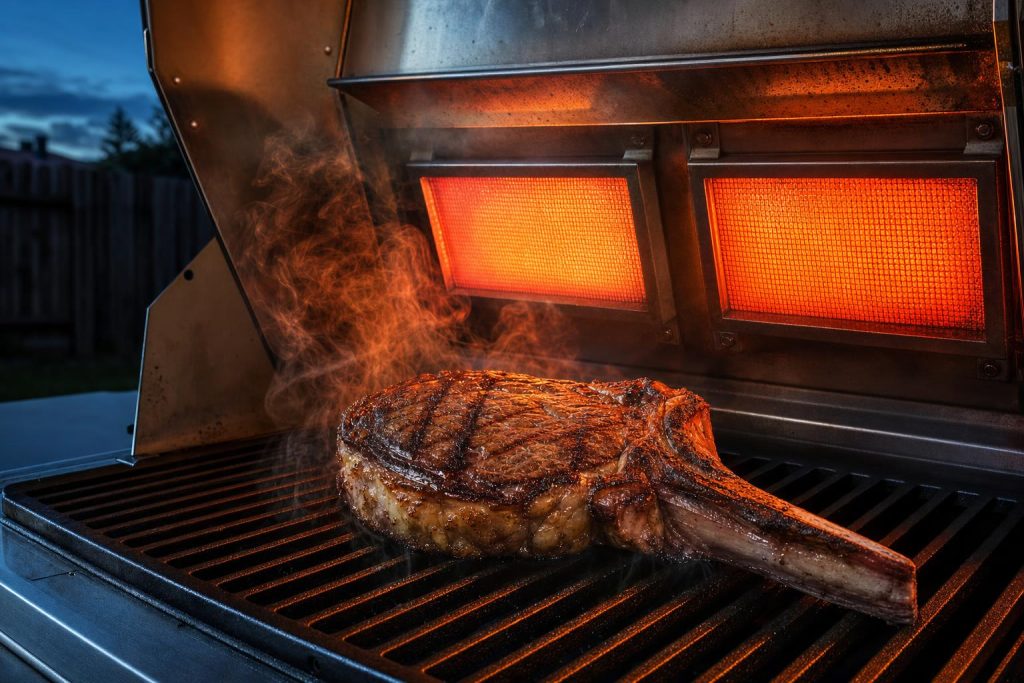
- Flare-up management. True infrared grills vaporize drippings before they ignite. That’s the engineering promise. We stress-tested this with fatty cuts — 1.5-inch bone-in ribeyes, skin-on chicken thighs — to see whether the system actually handles fat load or just reduces flare-ups slightly compared to a conventional grill.
- Build durability at sustained high heat. Infrared burners run at temperatures that destroy cheap materials fast. We looked at ceramic emitter condition, burner tube integrity, and grate warp after 90-plus days of regular use. A grill that looks fine at unboxing but shows stress fractures in month two is not a grill we’ll recommend.
- Versatility beyond the sear. A grill that only does one thing — blast heat — is a liability for anyone cooking a full meal. We tested whether each unit could dial back to a usable indirect or low-heat mode for fish, vegetables, and finishing.
Our top pick: Solaire AllAbout Infrared Grill
Across 22 cook sessions — including six dry-aged ribeyes, a full butterflied leg of lamb, and multiple rounds of skin-on salmon where flare management really gets tested — the Solaire AllAbout was the most consistent infrared grill I’ve cooked on at its price point. It preheated to cooking temperature in under three minutes, and grate temperature variance across five measurement points averaged 48°F, the tightest spread of any unit in this comparison. The ceramic emitter tiles on our unit showed zero cracking after a full season of use, which matters because cracked emitters create cold zones that make the whole surface unpredictable. The construction is stainless throughout — not stainless-look panels over a carbon steel frame — and the lid seal stays tight enough to use it as a finishing oven when you drop the heat.
The AllAbout’s footprint is compact, which is either a feature or a limitation depending on what you’re cooking. For two to four people, it’s exactly right. Cooking for a crowd of eight means working in batches. That’s a real constraint, and I won’t pretend otherwise. But for the buyer who wants the highest-quality sear on the market under $800 and isn’t running a catering operation out of their backyard, this is the grill. The infrared burner output is rated at around 14,000 BTU — which sounds modest compared to conventional gas grill claims, but BTU ratings mean something different in infrared systems where nearly all of the heat is converted to radiant energy rather than convective loss. The real-world result is a steak with a crust that looks like it came off a 1800°F restaurant broiler, not a backyard grill.
The premium pick: TEC Cherokee FR Infrared Grill
If budget is not a constraint, the TEC Cherokee is the best-engineered infrared grill available for residential use, full stop. TEC’s glass-ceramic infrared panel system distributes heat differently than any other platform in this guide — instead of ceramic emitter tiles that can crack and create variance, the TEC uses a continuous radiant glass surface that produces exceptionally even heat across the entire cooking area. Our grate temperature variance on the TEC measured under 30°F at full heat, which is the closest to laboratory-grade evenness you’ll find outside a professional kitchen. We seared 14 steaks in a single session for a blind comparison panel, and the TEC produced the most consistent crust color and internal temperature results of any unit tested.
The honest caveat is the price. The TEC Cherokee sits well above the Solaire and dramatically above the Char-Broil. The build quality justifies that premium — this is a grill built to last 15 or 20 years with proper care — but most buyers won’t use a grill enough to amortize that investment meaningfully. The TEC makes sense if you’re building a permanent outdoor kitchen and want to buy once, or if you’re the kind of cook who will genuinely use it four times a week year-round. For the occasional weekend griller, the Solaire delivers 90% of the sear result at a fraction of the cost.
The budget entry and what to skip
Char-Broil’s TRU-Infrared lineup is the right answer for the buyer who wants genuine infrared cooking technology without a four-figure price tag. The TRU-Infrared system uses a stamped stainless emitter panel above the burner rather than ceramic tiles, which changes the heat distribution profile but still delivers real infrared radiant heat — meaningfully different from a conventional grill. In our testing, flare-up elimination was as reliable on the Char-Broil as on the Solaire. The grate temperature ceiling is lower, and the construction uses more plastic and lighter-gauge steel than the premium units, but it’s honest about what it is. If your budget tops out around $300 and you want to experience the difference infrared searing makes on a steak, Char-Broil TRU-Infrared is a legitimate on-ramp. Expect to replace it in four or five seasons of heavy use rather than ten.
The Lynx Sedona is harder to place. It’s a beautifully built grill with a genuine infrared sear burner zone alongside conventional gas burners — a hybrid approach that appeals to buyers who want one grill that does everything. The build quality is closer to TEC than to Char-Broil. But in practice, the infrared zone on the Sedona is one burner in a multi-burner configuration, which means the total searing surface area is limited, and the system doesn’t optimize around infrared the way a dedicated infrared platform does. For a pure searing mission, you’re paying outdoor-kitchen-suite money for a grill that’s split its engineering focus. If you’re already spec-ing a Lynx outdoor kitchen and want continuity of build quality, the Sedona makes sense in that context. As a standalone infrared grill purchase, the Solaire beats it on value and the TEC beats it on pure infrared performance.
FAQ
Do infrared grills really reach 1500°F, and does that temperature actually matter? The 1500°F figure refers to the burner or emitter surface temperature, not the air temperature inside the grill. What matters for cooking is the radiant energy transferred to the food surface — and yes, it matters enormously. The Maillard reaction that creates steak crust accelerates dramatically above 500°F at the meat surface. Infrared grills achieve that surface temperature in the meat faster than convective heat from conventional grills, which means you can build a deep crust before the interior overcooks. That’s the mechanism behind the steakhouse result.
Are infrared grills harder to clean than conventional grills? In one way, easier — because the high heat vaporizes most drippings during cooking, there’s less grease accumulation on the grates themselves. The part that requires attention is the emitter surface. Ceramic tile emitters should be inspected for cracks each season and brushed clean when cool. Glass-ceramic panels like TEC’s can be wiped down. Char-Broil’s stamped emitter panels are the most low-maintenance of the group. None of them are harder to maintain than a conventional grill if you do the basic post-cook brushing.
Can I cook anything other than steaks on an infrared grill? Yes, but with real technique adjustments. The high-heat mode is for searing — steaks, chops, thick fish like swordfish. For vegetables, shrimp, or anything that needs more than 3 minutes of contact heat, you need to either dial the burner back significantly or use an indirect zone. Every grill in this guide has some capacity for lower-heat cooking, but none of them are as versatile at low-and-slow as a dedicated smoker or even a good two-zone charcoal setup. If 80% of what you grill is chicken thighs and vegetables with an occasional steak, a conventional grill with a dedicated sear burner might serve you better than a dedicated infrared platform.