St. Louis Pork Steaks
Equipment
- 1 Charcoal or gas grill Set up for direct high heat; charcoal preferred for maximum surface temperature and drier heat environment.
- 1 Half-size steam-table foil pan Approximately 12 x 10 inches. Must be deep enough to hold steaks and braising liquid without overflowing.
- 1 roll Heavy-duty aluminum foil For sealing the foil pan during the braise phase. Double-crimp the edges to prevent steam loss.
- 1 Instant-read thermometer Non-negotiable for verifying 195°F internal temperature in the coolest zone of each steak.
- 1 pair Tongs
- 1 Wire rack and sheet pan For the pre-grill dry brine rest in the refrigerator.
Ingredients
Pork Steaks
- 4 bone-in pork shoulder steaks, 3/4-inch thick Approximately 10 to 14 oz each. Cut from the Boston butt cross-section. Ask your butcher if not pre-packaged.
- 1 tbsp kosher salt For dry brining. Diamond Crystal preferred; reduce by one-third if using Morton.
- 1 tsp coarse black pepper
- 1 tsp garlic powder
- 1 tsp smoked paprika
Braising Liquid
- 12 oz lager or amber ale One standard can or bottle. Avoid IPAs and dark stouts. Budweiser is the authentic St. Louis choice.
- 1 cup Maull’s Original BBQ sauce Or substitute any tomato-forward, tangy barbecue sauce with low-to-moderate sweetness.
- 2 tbsp apple cider vinegar Reinforces the acid environment (target pH 3.8 to 4.2) that accelerates collagen hydrolysis.
- 1 tbsp Worcestershire sauce
- 1 tsp onion powder
Finishing Glaze
- ½ cup Maull’s Original BBQ sauce Applied directly to steaks during the open glaze phase. Additional sauce for serving on the side.

Instructions
Prep and Dry Brine
- Pat the pork steaks completely dry on both sides with paper towels. Combine the kosher salt, black pepper, garlic powder, and smoked paprika in a small bowl and mix well.1 tbsp kosher salt, 1 tsp coarse black pepper, 1 tsp garlic powder, 1 tsp smoked paprika
- Season the steaks generously on all surfaces with the dry rub. Place on a wire rack set over a sheet pan and refrigerate uncovered for at least 30 minutes, or up to 4 hours. The dry brine draws surface moisture outward and then reabsorbs it as a seasoned brine. The uncovered refrigeration desiccates the surface — lower surface water activity is essential for rapid Maillard browning onset when the steaks hit the grill.1 tbsp kosher salt, 1 tsp coarse black pepper, 1 tsp garlic powder, 1 tsp smoked paprika
Build the Grill and Braise
- While the steaks rest, mix the braising liquid: combine the beer, 1 cup Maull’s BBQ sauce, apple cider vinegar, Worcestershire sauce, and onion powder in the foil steam-table pan. Whisk until the sauce is evenly incorporated into the beer. Set aside.12 oz lager or amber ale, 1 cup Maull’s Original BBQ sauce, 2 tbsp apple cider vinegar, 1 tbsp Worcestershire sauce, 1 tsp onion powder
- Set up your grill for direct high heat — charcoal banked to a single even layer, or gas burners on high. Target grate temperature of 450°F to 500°F. Allow at least 10 minutes of preheating with the lid closed so the grates accumulate maximum thermal mass for a hard sear.
Grill Phase: Building the Maillard Crust
- Remove steaks from the refrigerator. Their surface should be visibly dry — no glistening moisture. Place the steaks directly over the hottest zone of the grill in a single layer with at least 1 inch of space between each steak to prevent steam buildup between them.
- Grill without moving for 4 to 5 minutes. You are driving surface temperature above 280°F and driving off the final boundary-layer moisture so the Maillard cascade can ignite. Resist the urge to flip early — the steak will release naturally from the grate when sufficient crust has formed. Flip once and grill the second side for 4 to 5 minutes. Target strong grill marks and a deep, mahogany-brown color across at least 70 percent of each surface. Some flare-ups from rendering fat are normal and desirable for smoky char notes.
- Transfer the grilled steaks immediately into the foil pan containing the braising liquid, arranging them in a single layer. They should be partially submerged — braising liquid should come roughly halfway up the sides of the steaks. If stacking is necessary for very large steaks, alternate the orientation so the thicker parts of one steak rest over the thinner parts of the steak below.12 oz lager or amber ale, 1 cup Maull’s Original BBQ sauce, 2 tbsp apple cider vinegar, 1 tbsp Worcestershire sauce, 1 tsp onion powder
Braise Phase: Collagen Conversion
- Seal the foil pan tightly with a double layer of heavy-duty aluminum foil, crimping the edges firmly to prevent steam escape. A tight seal maintains internal steam pressure and keeps the effective braising temperature at or above 212°F — critical for the rate of collagen hydrolysis.
- Place the sealed foil pan on the grill over indirect heat (move coals to one side for charcoal, or turn off the burner directly beneath the pan for gas). Close the grill lid. Maintain an ambient grill temperature of 325°F to 375°F. Braise for 60 to 75 minutes.
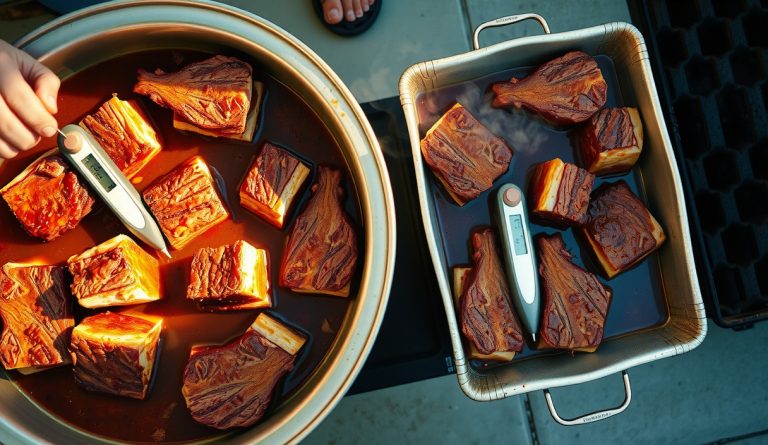
- After 60 minutes, carefully open one corner of the foil — steam will escape aggressively, so use tongs and keep your hands clear. Insert your instant-read thermometer into the thickest part of one steak, away from the bone. Target 195°F internal temperature. At 195°F, collagen hydrolysis is well advanced and the gelatin released from the connective tissue has had sufficient time to re-infiltrate the muscle bundles. Below 185°F the steaks will still be chewy; above 205°F the gelatin matrix begins to break down and the meat turns mushy. Check at least two steaks per pan. Re-seal and continue braising in 10-minute increments if the target has not been reached.
Open Glaze Phase: Rebuilding the Bark
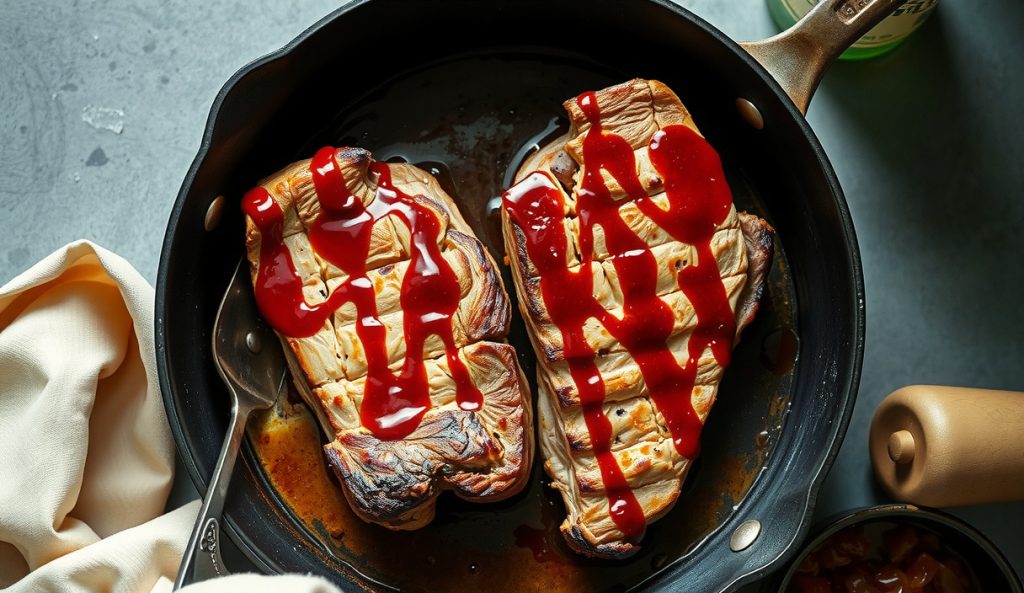
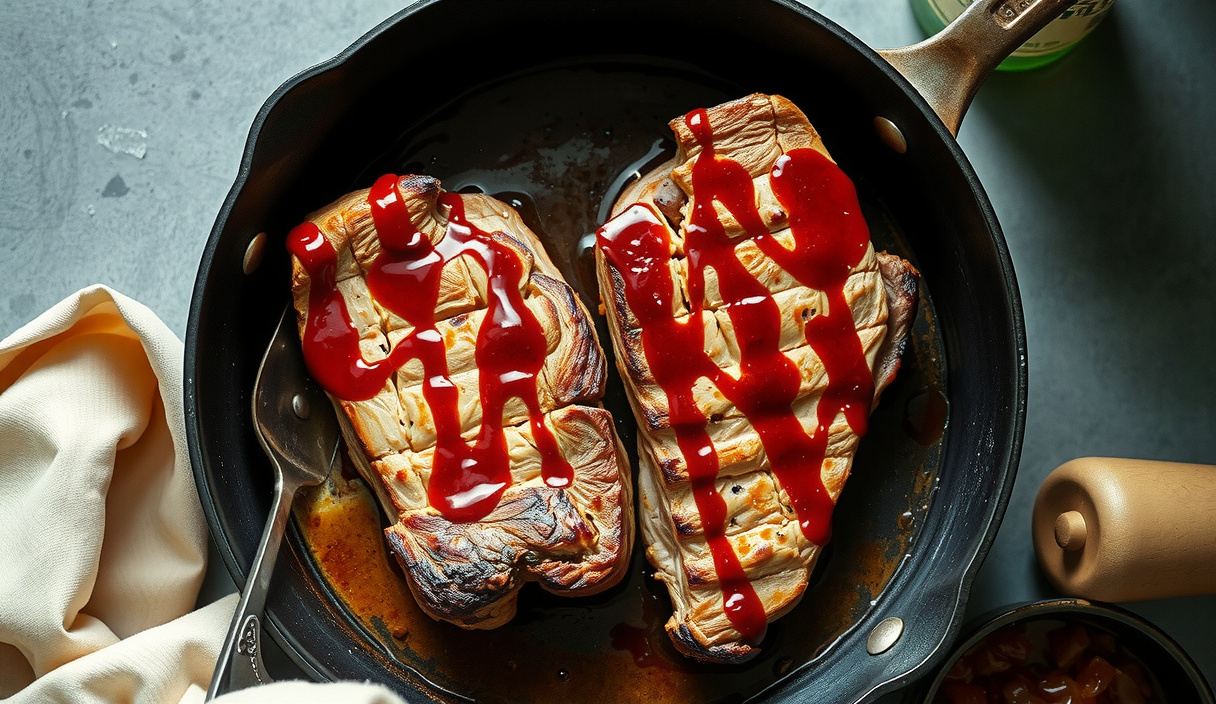
- Once the steaks reach 195°F internal, remove the foil from the pan completely and discard it. Using tongs, transfer the steaks from the braising liquid back onto the grill grates over direct medium-high heat. Brush the top surface of each steak generously with the finishing glaze Maull’s sauce.1/2 cup Maull’s Original BBQ sauce
- Grill open and uncovered for 4 to 5 minutes per side, brushing additional sauce each time you flip. The braising liquid that has soaked into the surface of the steaks contains dissolved gelatin, malt sugars, and Maull’s reducing sugars. As surface moisture evaporates under the direct heat, the concentration of these compounds skyrockets, triggering a secondary Maillard and caramelization event that produces the glossy, tightly lacquered bark that defines a proper St. Louis pork steak. Watch carefully — the sugars will go from deep amber to burnt in under 60 seconds if heat is excessive. Pull any steaks that start to blacken aggressively.1/2 cup Maull’s Original BBQ sauce
Rest and Serve
- Transfer the glazed steaks to a cutting board or platter. Rest uncovered for 5 minutes. During this rest, the thermally driven pressure gradient inside the steak equalizes, allowing the gelatin-rich braising liquid that has infiltrated the muscle matrix to redistribute evenly. Serve whole — these are traditionally eaten on the bone — with additional warm Maull’s sauce on the side.1/2 cup Maull’s Original BBQ sauce
Notes
Nutrition
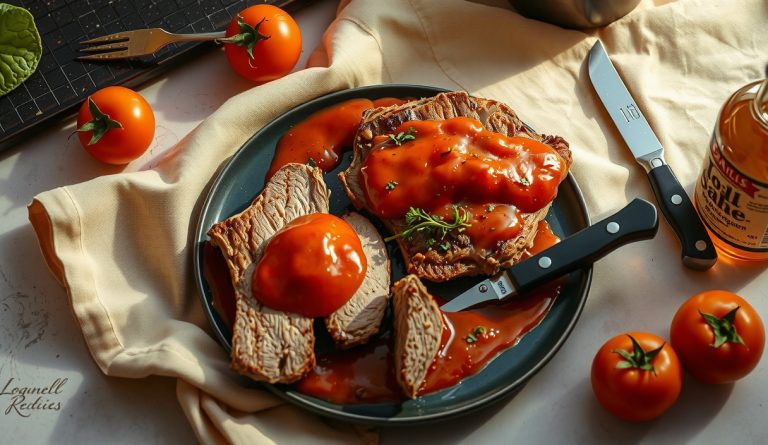
St. Louis pork steaks are a civic religion. Cut from the pork shoulder — specifically the Boston butt, cross-sectioned into three-quarter-inch planks — they carry all the intramuscular fat and connective tissue that makes shoulder barbecue legendary. The problem is that shoulder tissue is architecturally tough: dense networks of collagen interlace the myofibrillar bundles. You can grill a pork steak to a gorgeous char and still bite into something that punishes your jaw. Every St. Louis pitmaster who ever did it right solved that problem the same way, without necessarily knowing the molecular mechanics: grill first for the crust, then braise in beer and Maull’s until the connective tissue surrenders.
This recipe fuses that working-class St. Louis tradition with the exact thermodynamic logic that makes it work. Once you understand what is happening inside the meat between 175°F and 195°F, you will never cook a pork steak any other way.
Why does a St. Louis pork steak work? The science
Pork shoulder is dominated by two protein systems that respond very differently to heat, and understanding both is the key to a perfect pork steak. The myofibrillar proteins — myosin and actin — govern juiciness. Myosin begins denaturing at roughly 120°F, forming the primary gelled network responsible for the pleasant, set texture of cooked pork. The critical danger threshold arrives when actin collapses, somewhere between 167°F and 172°F: at that point the actomyosin complex violently contracts, expelling bound water in a wave of moisture loss. Left unattended at those temperatures, the pork steak turns dry and stringy.
Shoulder carries a structural ace card that rescues the steak: collagen. The connective tissue that makes raw shoulder chewy begins thermally shrinking at 140°F to 145°F and, given sufficient time and temperature above 160°F, undergoes hydrolysis — long tropocollagen triple-helices unwind and break into shorter soluble gelatin chains. That gelatin re-infiltrates the meat matrix, lubricating the now-dehydrated protein fibers and delivering the glossy, sticky, pull-apart tenderness that defines a proper St. Louis pork steak. The kinetics of collagen hydrolysis are first-order and time-temperature dependent: the conversion rate approximately doubles with every 18°F increase above the threshold. Targeting 195°F internal for 15 to 20 minutes in a closed braise accelerates the process dramatically compared to low-and-slow smoking.
The Maillard reaction is why you grill before you braise rather than simply dropping raw steaks into a foil pan. Maillard browning — the non-enzymatic cascade between amino groups and carbonyl groups — requires surface temperatures well above 280°F and a water activity below 0.7 at the boundary layer. A wet braise environment keeps surface temperatures locked near the boiling point of the liquid, making the Maillard cascade thermodynamically impossible once the meat is submerged. You must drive the crust first, over direct charcoal or high gas heat, desiccating the boundary layer so surface temps climb into Maillard territory and generate the hundreds of volatile aromatic compounds — pyrazines, furans, and sulfur species — that define grilled pork flavor. That crust also provides a physical scaffold that resists the braising liquid’s tendency to leach soluble proteins outward, keeping the steaks structurally intact through the long wet phase.
Beer is not arbitrary in this recipe. Its pH — typically 3.8 to 4.5 — mildly acidifies the braising environment, lowering the activation energy for collagen hydrolysis and helping solubilize connective tissue proteins slightly faster than a neutral braise would. The ethanol evaporates early and largely completely during the braise, leaving behind malt-derived Maillard melanoidins, hop iso-alpha acids for bitterness balance, and dissolved CO2 that creates micro-turbulence in the liquid phase, improving heat transfer uniformity. Maull’s BBQ sauce — the St. Louis standard, tomato-forward, moderately sweet — adds reducing sugars and amino acids that thicken and caramelize onto the surface during the final open glaze, creating a second Maillard event that reinforces the crust lost during the wet phase. Together they form a braising medium that is simultaneously acidic enough to accelerate collagen conversion, flavorful enough to season the meat from the outside in, and sugar-rich enough to produce a stunning lacquered finish when the foil comes off.
What equipment and ingredients do I need?
- Pork shoulder steaks, 3/4-inch: Ask a butcher to cross-cut a bone-in Boston butt. Avoid pre-packaged steaks thinner than 1/2-inch — they braise too fast and dry out before full collagen conversion. Thicker than 1-inch extends the grill phase awkwardly.
- Maull’s BBQ sauce: The St. Louis original. Its tomato base has a relatively low sugar content compared to Kansas City-style sauces, which means it can take the heat of the open glaze phase without scorching as aggressively. Substitute with any tangy, tomato-forward sauce if unavailable.
- Lager or amber ale: Avoid hoppy IPAs — their iso-alpha acids become harsh with prolonged heat. Lagers and amber ales provide clean malt flavors. Avoid dark stouts, which can make the braising liquid bitter and astringent at high temperatures.
- Charcoal vs. gas: Charcoal runs hotter and drier, which accelerates surface water activity drop during the initial sear — this is mechanically advantageous for Maillard onset. Gas works fine; just ensure grates are screaming hot before the steaks land.
- Heavy-duty foil pan: Half-size steam-table pans (approximately 12 x 10 inches) are ideal. They distribute heat evenly on the grill grate and seal tightly with a double layer of foil, which is critical for maintaining the internal steam pressure that drives the braise.
- Instant-read thermometer: Non-negotiable. The target is 195°F internal, confirmed in the thickest part away from bone. Below 185°F, collagen conversion is incomplete. Above 205°F, the gelatin matrix itself begins to break down and the meat turns mushy.
St. Louis Pork Steaks
Equipment
- 1 Charcoal or gas grill Set up for direct high heat; charcoal preferred for maximum surface temperature and drier heat environment.
- 1 Half-size steam-table foil pan Approximately 12 x 10 inches. Must be deep enough to hold steaks and braising liquid without overflowing.
- 1 roll Heavy-duty aluminum foil For sealing the foil pan during the braise phase. Double-crimp the edges to prevent steam loss.
- 1 Instant-read thermometer Non-negotiable for verifying 195°F internal temperature in the coolest zone of each steak.
- 1 pair Tongs
- 1 Wire rack and sheet pan For the pre-grill dry brine rest in the refrigerator.
Ingredients
Pork Steaks
- 4 bone-in pork shoulder steaks, 3/4-inch thick Approximately 10 to 14 oz each. Cut from the Boston butt cross-section. Ask your butcher if not pre-packaged.
- 1 tbsp kosher salt For dry brining. Diamond Crystal preferred; reduce by one-third if using Morton.
- 1 tsp coarse black pepper
- 1 tsp garlic powder
- 1 tsp smoked paprika
Braising Liquid
- 12 oz lager or amber ale One standard can or bottle. Avoid IPAs and dark stouts. Budweiser is the authentic St. Louis choice.
- 1 cup Maull’s Original BBQ sauce Or substitute any tomato-forward, tangy barbecue sauce with low-to-moderate sweetness.
- 2 tbsp apple cider vinegar Reinforces the acid environment (target pH 3.8 to 4.2) that accelerates collagen hydrolysis.
- 1 tbsp Worcestershire sauce
- 1 tsp onion powder
Finishing Glaze
- ½ cup Maull’s Original BBQ sauce Applied directly to steaks during the open glaze phase. Additional sauce for serving on the side.
Instructions
Prep and Dry Brine
- Pat the pork steaks completely dry on both sides with paper towels. Combine the kosher salt, black pepper, garlic powder, and smoked paprika in a small bowl and mix well.1 tbsp kosher salt, 1 tsp coarse black pepper, 1 tsp garlic powder, 1 tsp smoked paprika
- Season the steaks generously on all surfaces with the dry rub. Place on a wire rack set over a sheet pan and refrigerate uncovered for at least 30 minutes, or up to 4 hours. The dry brine draws surface moisture outward and then reabsorbs it as a seasoned brine. The uncovered refrigeration desiccates the surface — lower surface water activity is essential for rapid Maillard browning onset when the steaks hit the grill.1 tbsp kosher salt, 1 tsp coarse black pepper, 1 tsp garlic powder, 1 tsp smoked paprika
Build the Grill and Braise
- While the steaks rest, mix the braising liquid: combine the beer, 1 cup Maull’s BBQ sauce, apple cider vinegar, Worcestershire sauce, and onion powder in the foil steam-table pan. Whisk until the sauce is evenly incorporated into the beer. Set aside.12 oz lager or amber ale, 1 cup Maull’s Original BBQ sauce, 2 tbsp apple cider vinegar, 1 tbsp Worcestershire sauce, 1 tsp onion powder
- Set up your grill for direct high heat — charcoal banked to a single even layer, or gas burners on high. Target grate temperature of 450°F to 500°F. Allow at least 10 minutes of preheating with the lid closed so the grates accumulate maximum thermal mass for a hard sear.
Grill Phase: Building the Maillard Crust
- Remove steaks from the refrigerator. Their surface should be visibly dry — no glistening moisture. Place the steaks directly over the hottest zone of the grill in a single layer with at least 1 inch of space between each steak to prevent steam buildup between them.
- Grill without moving for 4 to 5 minutes. You are driving surface temperature above 280°F and driving off the final boundary-layer moisture so the Maillard cascade can ignite. Resist the urge to flip early — the steak will release naturally from the grate when sufficient crust has formed. Flip once and grill the second side for 4 to 5 minutes. Target strong grill marks and a deep, mahogany-brown color across at least 70 percent of each surface. Some flare-ups from rendering fat are normal and desirable for smoky char notes.
- Transfer the grilled steaks immediately into the foil pan containing the braising liquid, arranging them in a single layer. They should be partially submerged — braising liquid should come roughly halfway up the sides of the steaks. If stacking is necessary for very large steaks, alternate the orientation so the thicker parts of one steak rest over the thinner parts of the steak below.12 oz lager or amber ale, 1 cup Maull’s Original BBQ sauce, 2 tbsp apple cider vinegar, 1 tbsp Worcestershire sauce, 1 tsp onion powder
Braise Phase: Collagen Conversion
- Seal the foil pan tightly with a double layer of heavy-duty aluminum foil, crimping the edges firmly to prevent steam escape. A tight seal maintains internal steam pressure and keeps the effective braising temperature at or above 212°F — critical for the rate of collagen hydrolysis.
- Place the sealed foil pan on the grill over indirect heat (move coals to one side for charcoal, or turn off the burner directly beneath the pan for gas). Close the grill lid. Maintain an ambient grill temperature of 325°F to 375°F. Braise for 60 to 75 minutes.
- After 60 minutes, carefully open one corner of the foil — steam will escape aggressively, so use tongs and keep your hands clear. Insert your instant-read thermometer into the thickest part of one steak, away from the bone. Target 195°F internal temperature. At 195°F, collagen hydrolysis is well advanced and the gelatin released from the connective tissue has had sufficient time to re-infiltrate the muscle bundles. Below 185°F the steaks will still be chewy; above 205°F the gelatin matrix begins to break down and the meat turns mushy. Check at least two steaks per pan. Re-seal and continue braising in 10-minute increments if the target has not been reached.
Open Glaze Phase: Rebuilding the Bark
- Once the steaks reach 195°F internal, remove the foil from the pan completely and discard it. Using tongs, transfer the steaks from the braising liquid back onto the grill grates over direct medium-high heat. Brush the top surface of each steak generously with the finishing glaze Maull’s sauce.1/2 cup Maull’s Original BBQ sauce
- Grill open and uncovered for 4 to 5 minutes per side, brushing additional sauce each time you flip. The braising liquid that has soaked into the surface of the steaks contains dissolved gelatin, malt sugars, and Maull’s reducing sugars. As surface moisture evaporates under the direct heat, the concentration of these compounds skyrockets, triggering a secondary Maillard and caramelization event that produces the glossy, tightly lacquered bark that defines a proper St. Louis pork steak. Watch carefully — the sugars will go from deep amber to burnt in under 60 seconds if heat is excessive. Pull any steaks that start to blacken aggressively.1/2 cup Maull’s Original BBQ sauce
Rest and Serve
- Transfer the glazed steaks to a cutting board or platter. Rest uncovered for 5 minutes. During this rest, the thermally driven pressure gradient inside the steak equalizes, allowing the gelatin-rich braising liquid that has infiltrated the muscle matrix to redistribute evenly. Serve whole — these are traditionally eaten on the bone — with additional warm Maull’s sauce on the side.1/2 cup Maull’s Original BBQ sauce
Notes
Nutrition
How do I nail it every time? Tips for perfect pork steaks
- Dry the steaks before grilling. Pat them completely dry with paper towels and let them sit uncovered on a wire rack in the fridge for at least 30 minutes before hitting the grill. Surface moisture is the enemy of Maillard browning — even a thin water film anchors surface temperature at 212°F until it evaporates, stalling color development.
- Do not flip constantly. Flip once per side maximum during the grill phase. Frequent flipping keeps the surface temperature in a continuous dip-and-recover cycle that prevents the sustained high-heat exposure needed for pyrazine and furan formation.
- Seal the foil pan tight. Any steam leak drops the internal pressure of the braise, which lowers the effective boiling temperature of the liquid and slows the whole collagen hydrolysis cascade. Crimp the foil over the pan edges and check for gaps before the pan goes back on the grill.
- Verify temperature in multiple spots. Shoulder steaks are architecturally inconsistent — the blade bone, fat seams, and muscle bundles all have different thermal conductivities. Read the temperature in at least two locations per steak. You want the coolest zone to read 195°F, not the warmest.
- The open glaze phase is mandatory. Removing the foil for the final 10 to 15 minutes allows surface evaporation to concentrate the braising liquid back onto the steaks, driving a secondary Maillard reaction and converting the sauce coating from wet and loose to tight and lacquered. Skipping this step is what separates a braised pork steak from a grey, steam-cooked one.
- Rest before serving. Five minutes of rest allows the gelatin-enriched braising liquid that has infiltrated the muscle to redistribute. Cut immediately and you lose it to the cutting board.
What variations can I try?
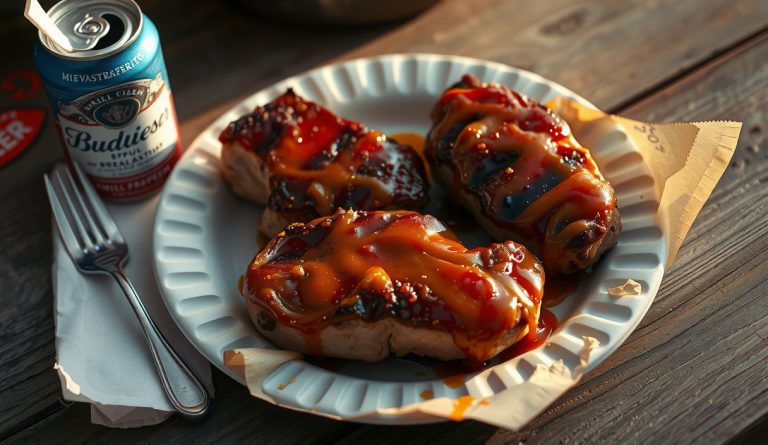
The St. Louis street-fair version: Use a full can of Budweiser and double the Maull’s in the braise. Add a tablespoon of brown sugar to the braising liquid. The extra reducing sugars push the final glaze into territory that is frankly more candy than barbecue — and that is exactly what you want if you are eating this off a paper plate at a summer block party. Finish directly over the hottest part of the grill for an extra 90 seconds per side after the glaze phase to develop a slightly charred edge.
Low-sodium version: Swap the BBQ sauce for a homemade blend of crushed tomatoes, apple cider vinegar, smoked paprika, and a small amount of molasses. Skip salting the brine and reduce any added salt in the dry rub by half. The braising mechanics are identical; you simply lose some of the osmotic salt gradient that helps season the interior of the steak during the wet phase. Compensate by extending the initial dry brine from 30 minutes to 4 hours.
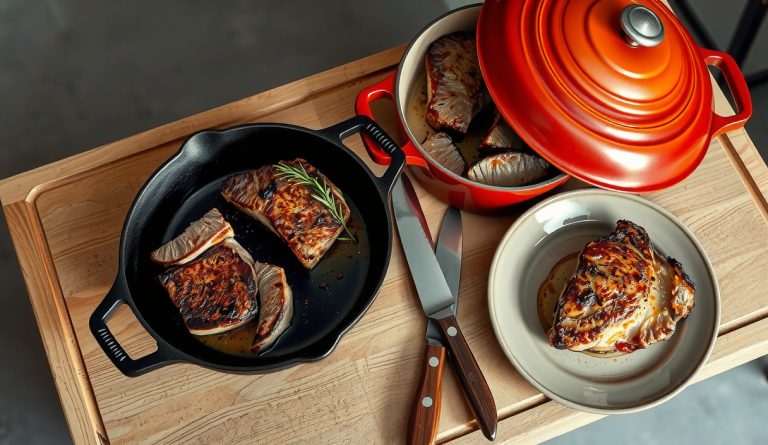
Oven-to-grill hybrid: If weather or equipment makes outdoor grilling impractical, sear the steaks in a screaming-hot cast-iron skillet with a high smoke-point oil (avocado or refined sunflower) for 3 minutes per side, then transfer to a covered Dutch oven in a 300°F oven for the braise phase. The Maillard chemistry is identical; only the radiant and convective heat sources differ. Finish under the broiler for 5 minutes with the foil or lid removed to replicate the open glaze phase.
Scaling for a crowd: The recipe scales linearly — double or triple the steaks and stack them in deeper full-size steam-table pans. Add approximately 20 to 25 minutes to the covered braise time when cooking more than 8 steaks simultaneously, as the increased thermal mass slows the rate at which the braising liquid reaches a rolling simmer. Verify internal temperature in the center steaks of each pan, which will always be the last to reach 195°F.
Frequently asked questions about St. Louis pork steaks
Can I use boneless pork shoulder steaks instead of bone-in? Yes, but the bone contributes collagen and connective tissue to the braising liquid, enriching the gelatin concentration of the braising medium over time. Boneless steaks braise fine and are easier to eat, but the bone-in version produces a thicker, stickier sauce in the pan. If going boneless, add one split pig’s foot or a tablespoon of unflavored powdered gelatin to the braising liquid to compensate.
Why does the meat look grey and unappetizing after the braise phase before the glaze? That grey color is completely normal and expected. The braising steam environment keeps the surface temperature below Maillard onset, and the moisture re-softens the exterior crust developed during grilling. The grey color is simply oxidized myoglobin — hemichrome — from the sarcoplasmic protein denaturation that occurs between 140°F and 160°F. The open glaze phase restores the color and bark through re-evaporation and re-caramelization of surface sugars. Trust the process and do not panic when you lift the foil.
Do I have to use Maull’s specifically? Maull’s is the authentic St. Louis choice and its tomato-forward, moderately acidic profile works particularly well with the beer-based braise because it does not add excessive sweetness that would overwhelm the pork. Any barbecue sauce with a pH in the 3.5 to 4.5 range and a tomato base will work mechanically. Avoid very sweet, high-fructose sauces during the braise — their higher sugar concentration raises the viscosity of the braising medium and reduces convective heat transfer, slowing the collagen hydrolysis kinetics.