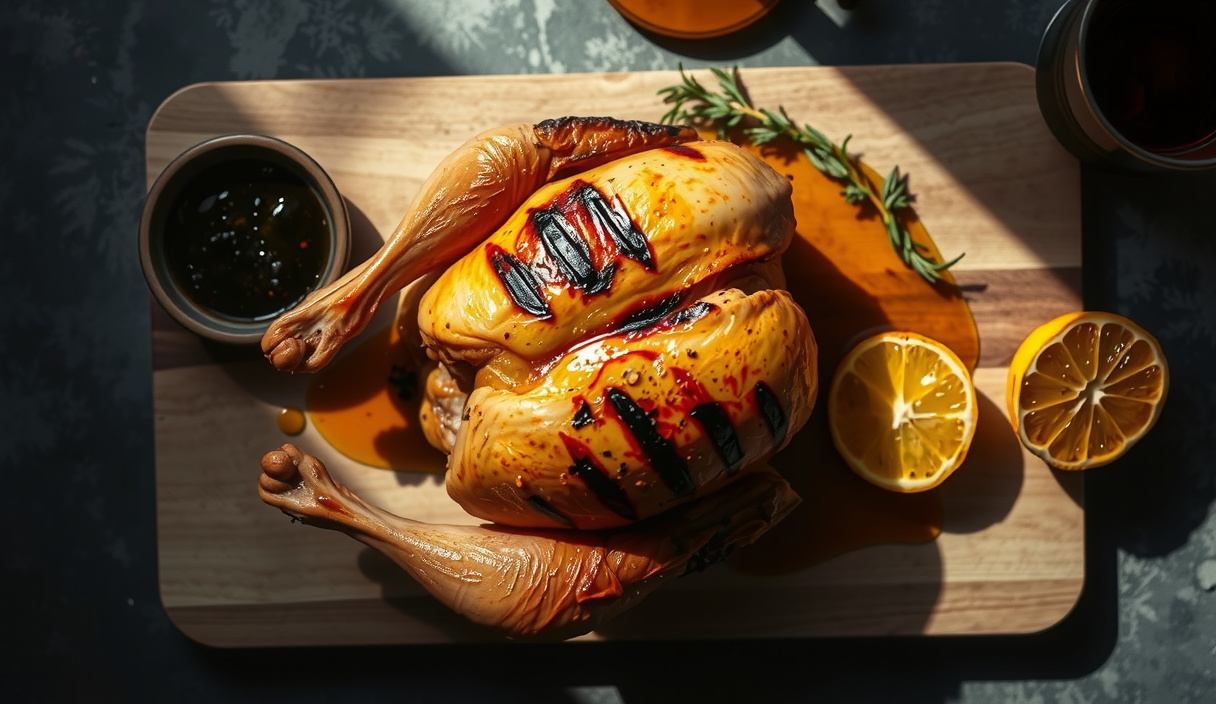
Grilled Spatchcock Chicken — Lemon-Garlic

Equipment
- 1 Gas or charcoal grill Needs a two-zone indirect setup — at least 450 sq in of grate space recommended
- 1 Kitchen shears or boning knife For removing the backbone
- 1 Instant-read thermometer Mandatory — insert horizontally into thickest part of breast, away from bone
- 1 Large zip-lock bag or baking dish For marinating
- Paper towels For patting the bird completely dry before marinating
- Aluminum foil For tenting during rest
Ingredients
The Chicken
- 1 whole chicken (3.5–4 lb), preferably air-chilled Backbone removed, bird flattened
Lemon-Garlic-Thyme Marinade
- 3 tablespoons extra-virgin olive oil Lipid carrier for volatile aromatic compounds
- 3 tablespoons fresh lemon juice (from about 1 large lemon) Use fresh only — bottled is heat-pasteurized and loses key aromatic esters
- 1 teaspoon lemon zest Concentrates limonene and linalool from the flavedo layer
- 5 cloves garlic, finely minced or pressed Mincing ruptures cell walls, maximizing allicin formation
- 1 tablespoon fresh thyme leaves Dried works in a pinch — use 1 teaspoon
- 1.5 teaspoons kosher salt Diamond Crystal; reduce by one-third if using Morton
- 0.5 teaspoon freshly ground black pepper
- 0.25 teaspoon red pepper flakes Optional — activates TRPV1 receptors and amplifies perceived heat from the char
For Serving
- 1 lemon, halved Char cut-side down on the grill for 2 minutes — caramelizes the sugars and concentrates aroma
- 2 tablespoons fresh flat-leaf parsley, roughly chopped Optional garnish

Instructions
Spatchcock the Chicken
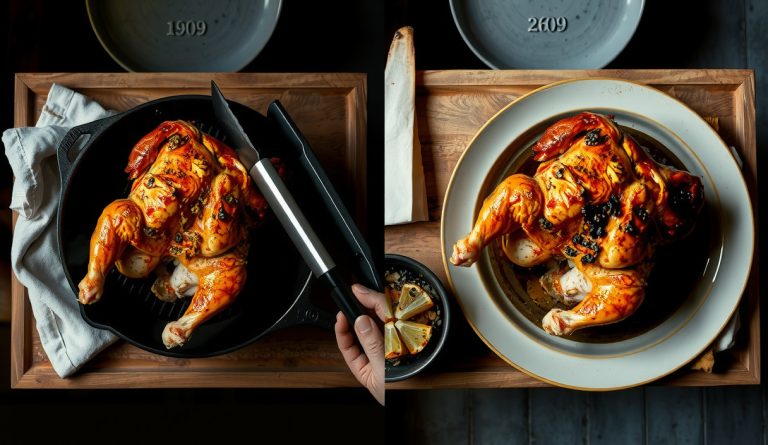
- Place the chicken breast-side down on a sturdy cutting board. Using sharp kitchen shears, cut along both sides of the backbone from the tail to the neck, removing the spine entirely. Save the backbone for stock — freeze it in a zip-lock bag.
- Flip the bird breast-side up. Locate the sternum (keel bone) running down the center of the breast. Press firmly on the center of the breast with both palms until you hear and feel the cartilage crack. The bird should now lie completely flat with the legs splaying outward. This is the architecture that defeats the geometry problem.
- Pat the entire bird completely dry — top, bottom, under the wings, inside the cavity — with paper towels. Any residual moisture on the skin will inhibit Maillard browning later. This step is not optional.
Make the Marinade and Marinate
- Whisk together the olive oil, fresh lemon juice, lemon zest, minced garlic, thyme, kosher salt, black pepper, and red pepper flakes in a small bowl. The olive oil and lemon juice will not fully emulsify — that is fine. Give it a stir just before applying.3 tablespoons fresh lemon juice (from about 1 large lemon), 1 teaspoon lemon zest, 5 cloves garlic, finely minced or pressed, 1 tablespoon fresh thyme leaves, 1.5 teaspoons kosher salt, 0.5 teaspoon freshly ground black pepper, 0.25 teaspoon red pepper flakes, 1 lemon, halved
- Place the spatchcocked chicken in a large zip-lock bag or a baking dish. Pour the marinade over, ensuring it coats both sides. Work the marinade under the skin over the breast and thigh meat if you can do so without tearing the skin. Set a timer for 45 minutes. Do not exceed 60 minutes — the citric acid in the lemon juice at pH 2.0–2.5 will begin denaturing myofibrillar proteins beyond the surface layer, resulting in a mushy texture.3 tablespoons fresh lemon juice (from about 1 large lemon), 1 teaspoon lemon zest, 5 cloves garlic, finely minced or pressed, 1 tablespoon fresh thyme leaves, 1.5 teaspoons kosher salt, 0.5 teaspoon freshly ground black pepper, 0.25 teaspoon red pepper flakes, 1 lemon, halved
Set Up the Grill
- Gas grill: Light only one side of burners on high. Close the lid and preheat until the grill thermometer at grate level reads 400°F — this takes 10–15 minutes. The unlit side is your indirect cooking zone.Charcoal grill: Light two-thirds of a chimney of charcoal. When the coals are ashed over, bank them all to one side with a drip pan on the opposite side. Grill temperature at the grate level on the indirect side should read 390°F–410°F.
Grill the Chicken
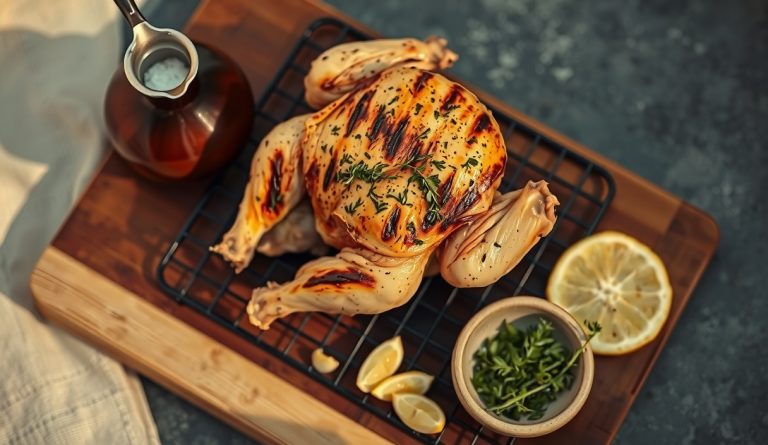
- Remove the chicken from the marinade and shake off any excess. Pat the skin side lightly with a paper towel if the surface looks very wet — a thin coating of oil is fine; pooling liquid is not. Place the chicken skin-side up on the indirect (cool) side of the grill. Close the lid.
- Cook with the lid closed over indirect heat at 400°F for 40–50 minutes. Do not flip the chicken. Convective heat inside the closed grill drives the core temperature upward uniformly. Resist the urge to open the lid frequently — each opening drops the grill temperature by 50°F–75°F and extends cook time.
- Begin probing the breast at the 35-minute mark. Insert the thermometer horizontally into the thickest part of the breast, keeping the probe tip away from bone. Pull the chicken when the breast reads 157°F internal temperature. At this point, confirm the thigh reads at or above 165°F — it almost certainly will, often 175°F–180°F, which is ideal for dark meat collagen conversion.
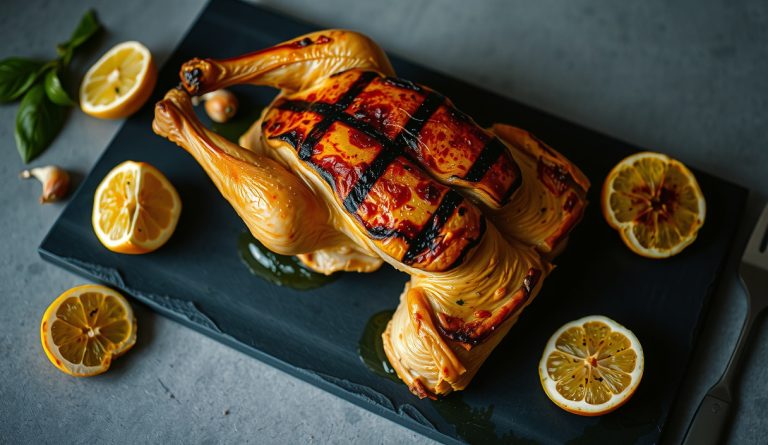
- Optional skin crisping step: If the skin is not yet deeply golden (sometimes residual marinade moisture delays the color), move the chicken skin-side down over direct heat for 2–3 minutes only, watching carefully to prevent charring. Remove the moment you see aggressive browning and hear a pronounced sizzle. This is the Maillard cascade accelerating as surface moisture is eliminated.
- While the chicken rests, place the lemon halves cut-side down directly over the hot side of the grill for 2 minutes until caramelized. The heat drives Maillard browning of the lemon’s natural sugars and concentrates the juice, eliminating harsh raw acidity.2 tablespoons fresh flat-leaf parsley, roughly chopped
Rest and Carve
- Transfer the chicken to a cutting board and tent loosely with aluminum foil. Rest for a minimum of 5 minutes. Carryover heat will carry the breast temperature from 157°F to approximately 160°F–163°F during this window, completing the pasteurization curve safely while the juices redistribute.
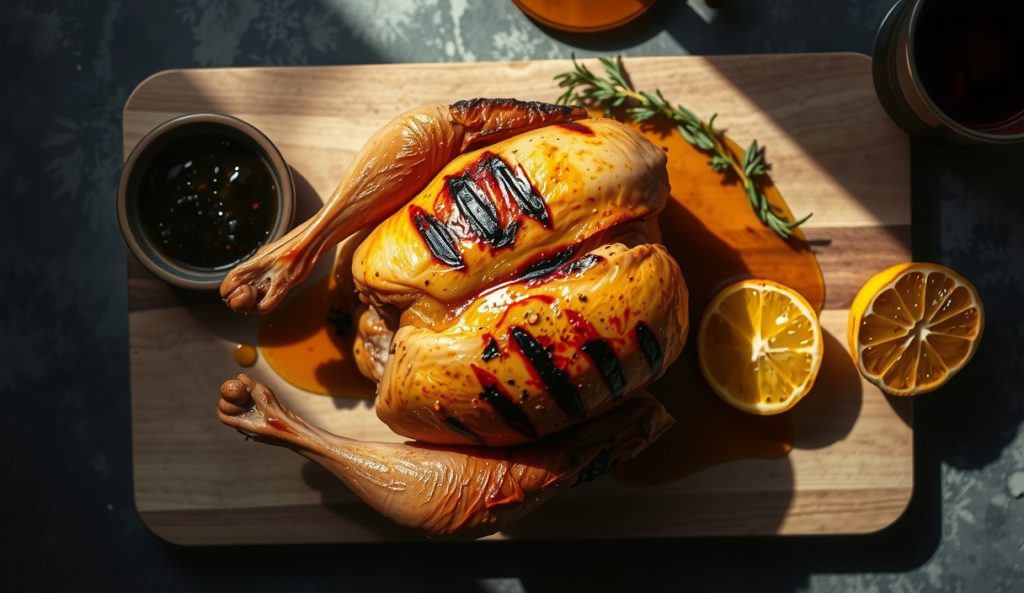
- Carve by first separating the leg quarters at the hip joint, then cutting through the thigh-drumstick joint. Remove the breasts by slicing along the keel bone and following the rib cage. Serve with the charred lemon halves for squeezing and scatter with fresh parsley if desired.
Notes
Nutrition
The spatchcock technique is not a culinary trend. It is a thermodynamic solution. A whole chicken is a geometry problem: the thick breast and the thin wing tip exist in different thermal universes on the same carcass. Remove the spine, press the bird flat, and you collapse that geometry. Every millimeter of skin faces the same radiant heat simultaneously. Every muscle group reaches its target temperature within the same window. The result is a chicken that looks like it belongs on a magazine cover and eats like the best roast you have ever had — pulled off a live-fire grill.
This lemon-garlic spatchcock chicken has been cooked dozens of times, with the marinade acid concentration, grill setup, and pull temperature each refined through iteration. What follows is the version worth returning to: a lemon-garlic-thyme marinade held to a precise 45-minute window, indirect heat at 400°F, and a breast pull temp of 157°F — which is not a typo. The physics that makes that temperature safe, and the technique that makes it exceptional, are both explained below.
Why does spatchcock chicken work? The science
Spatchcock chicken works because flattening the bird eliminates the geometry gap between thin and thick muscle groups, allowing every section to reach its target internal temperature in the same cook window. Myosin, the primary contractile protein in muscle tissue, begins unfolding between 39°C and 58°C (102°F–136°F). It is the most heat-labile structural protein in meat. When myosin denatures, it forms the gel network that traps moisture and gives cooked chicken its satisfying bite rather than a raw, slippery texture.
Actin, the second major myofibrillar protein, does not catastrophically denature until 74°C–78°C (165°F–172°F). When actin collapses, the actomyosin complex undergoes violent transverse contraction, expelling bound water and leaving the meat fibrous and dry. Every dry chicken breast you have ever eaten crossed that actin threshold. The USDA’s 165°F recommendation is an instant-kill target; pasteurization, however, is time-and-temperature dependent. At 157°F (69°C) held for a minimum of 42 seconds — which carryover heat easily provides — you achieve the same 7-log10 Salmonella reduction. Pull at 157°F, tent for five minutes, and you serve a breast that is genuinely moist because the actin network was never destroyed.
The lemon marinade is where food chemistry intersects with restraint. Citric acid at the pH of fresh lemon juice (roughly pH 2.0–2.5) attacks myofibrillar proteins aggressively. A brief acid soak — 45 minutes maximum — denatures the surface proteins just enough to open the muscle structure for flavor penetration without denaturing the interior. The visible sign of over-marination is a pale, mushy surface layer: the acid has denatured the proteins too deeply, destroying the water-holding capacity before the grill ever touches the bird. Garlic contributes a roster of organosulfur volatile compounds — predominantly allicin and its thiosulfinate breakdown products — that partition into the olive oil phase of the marinade, ensuring they survive thermal exposure and deposit on the skin as the lipid phase renders.
Thyme’s carvacrol and thymol are robust phenolic VOCs with low vapor pressure; they cling to fat-coated surfaces and persist through the Maillard reaction occurring on the skin surface, which requires surface temperatures well above 140°C (284°F) to generate the full cascade of pyrazines and furanones responsible for the roasted aroma. The two-zone indirect setup is a heat-transfer instrument, not a shortcut. Convective heat from the grill’s interior air mass surrounds the flattened bird uniformly, driving the core temperature upward without the direct radiative and conductive flux that chars skin before the breast climbs out of the danger zone. Finishing the last five degrees over direct heat — optional, but recommended — dehydrates the skin surface rapidly, pushing the boundary-layer water activity below the threshold where evaporative cooling would otherwise pin the skin temperature near 100°C. Once that surface moisture is gone, the skin temperature spikes and the Maillard cascade accelerates into the visible amber-to-mahogany color shift.
What equipment and ingredients do I need?
Kitchen shears or boning knife: Shears are faster for removing the spine. Cut along both sides of the backbone — the vertebrae are cartilaginous in younger birds and will yield without excessive force. A sharp boning knife works if you follow the line of the backbone closely. Save the spine for stock.
Instant-read thermometer: Non-negotiable. The breast is your governing probe location: insert horizontally into the thickest part of the breast, away from bone. Confirm the thigh reads at least 165°F on its own — it will, because dark meat tolerates higher temps without quality loss (collagen hydrolysis actually improves thigh texture above 165°F).
The chicken: A 3.5–4 lb bird is the sweet spot for this technique. Larger birds extend the cook time disproportionately and make the geometry advantage of spatchcocking less pronounced. Air-chilled chickens have lower surface moisture than water-chilled, which aids skin crisping.
Lemon: Use fresh. Bottled lemon juice has been heat-pasteurized, which degrades the delicate ester VOCs (limonene, linalool) that give fresh lemon its brightness. You need one large lemon for the marinade, plus a second to halve and char on the grill for serving.
Olive oil: Extra-virgin olive oil is the lipid carrier for the garlic and herb VOCs. Its natural phenolic content (oleocanthal, oleuropein) contributes additional bitter-back complexity on the finish. Do not substitute a refined neutral oil — you lose a layer of flavor.
Marinade timing: 30–45 minutes at room temperature is the target. Do not exceed 60 minutes. The acid will visibly whiten and soften the surface proteins if you push past this window, signaling that the myofibrillar network is compromised.
Grilled Spatchcock Chicken — Lemon-Garlic
Equipment
- 1 Gas or charcoal grill Needs a two-zone indirect setup — at least 450 sq in of grate space recommended
- 1 Kitchen shears or boning knife For removing the backbone
- 1 Instant-read thermometer Mandatory — insert horizontally into thickest part of breast, away from bone
- 1 Large zip-lock bag or baking dish For marinating
- Paper towels For patting the bird completely dry before marinating
- Aluminum foil For tenting during rest
Ingredients
The Chicken
- 1 whole chicken (3.5–4 lb), preferably air-chilled Backbone removed, bird flattened
Lemon-Garlic-Thyme Marinade
- 3 tablespoons extra-virgin olive oil Lipid carrier for volatile aromatic compounds
- 3 tablespoons fresh lemon juice (from about 1 large lemon) Use fresh only — bottled is heat-pasteurized and loses key aromatic esters
- 1 teaspoon lemon zest Concentrates limonene and linalool from the flavedo layer
- 5 cloves garlic, finely minced or pressed Mincing ruptures cell walls, maximizing allicin formation
- 1 tablespoon fresh thyme leaves Dried works in a pinch — use 1 teaspoon
- 1.5 teaspoons kosher salt Diamond Crystal; reduce by one-third if using Morton
- 0.5 teaspoon freshly ground black pepper
- 0.25 teaspoon red pepper flakes Optional — activates TRPV1 receptors and amplifies perceived heat from the char
For Serving
- 1 lemon, halved Char cut-side down on the grill for 2 minutes — caramelizes the sugars and concentrates aroma
- 2 tablespoons fresh flat-leaf parsley, roughly chopped Optional garnish
Instructions
Spatchcock the Chicken
- Place the chicken breast-side down on a sturdy cutting board. Using sharp kitchen shears, cut along both sides of the backbone from the tail to the neck, removing the spine entirely. Save the backbone for stock — freeze it in a zip-lock bag.
- Flip the bird breast-side up. Locate the sternum (keel bone) running down the center of the breast. Press firmly on the center of the breast with both palms until you hear and feel the cartilage crack. The bird should now lie completely flat with the legs splaying outward. This is the architecture that defeats the geometry problem.
- Pat the entire bird completely dry — top, bottom, under the wings, inside the cavity — with paper towels. Any residual moisture on the skin will inhibit Maillard browning later. This step is not optional.
Make the Marinade and Marinate
- Whisk together the olive oil, fresh lemon juice, lemon zest, minced garlic, thyme, kosher salt, black pepper, and red pepper flakes in a small bowl. The olive oil and lemon juice will not fully emulsify — that is fine. Give it a stir just before applying.3 tablespoons fresh lemon juice (from about 1 large lemon), 1 teaspoon lemon zest, 5 cloves garlic, finely minced or pressed, 1 tablespoon fresh thyme leaves, 1.5 teaspoons kosher salt, 0.5 teaspoon freshly ground black pepper, 0.25 teaspoon red pepper flakes, 1 lemon, halved
- Place the spatchcocked chicken in a large zip-lock bag or a baking dish. Pour the marinade over, ensuring it coats both sides. Work the marinade under the skin over the breast and thigh meat if you can do so without tearing the skin. Set a timer for 45 minutes. Do not exceed 60 minutes — the citric acid in the lemon juice at pH 2.0–2.5 will begin denaturing myofibrillar proteins beyond the surface layer, resulting in a mushy texture.3 tablespoons fresh lemon juice (from about 1 large lemon), 1 teaspoon lemon zest, 5 cloves garlic, finely minced or pressed, 1 tablespoon fresh thyme leaves, 1.5 teaspoons kosher salt, 0.5 teaspoon freshly ground black pepper, 0.25 teaspoon red pepper flakes, 1 lemon, halved
Set Up the Grill
- Gas grill: Light only one side of burners on high. Close the lid and preheat until the grill thermometer at grate level reads 400°F — this takes 10–15 minutes. The unlit side is your indirect cooking zone.Charcoal grill: Light two-thirds of a chimney of charcoal. When the coals are ashed over, bank them all to one side with a drip pan on the opposite side. Grill temperature at the grate level on the indirect side should read 390°F–410°F.
Grill the Chicken
- Remove the chicken from the marinade and shake off any excess. Pat the skin side lightly with a paper towel if the surface looks very wet — a thin coating of oil is fine; pooling liquid is not. Place the chicken skin-side up on the indirect (cool) side of the grill. Close the lid.
- Cook with the lid closed over indirect heat at 400°F for 40–50 minutes. Do not flip the chicken. Convective heat inside the closed grill drives the core temperature upward uniformly. Resist the urge to open the lid frequently — each opening drops the grill temperature by 50°F–75°F and extends cook time.
- Begin probing the breast at the 35-minute mark. Insert the thermometer horizontally into the thickest part of the breast, keeping the probe tip away from bone. Pull the chicken when the breast reads 157°F internal temperature. At this point, confirm the thigh reads at or above 165°F — it almost certainly will, often 175°F–180°F, which is ideal for dark meat collagen conversion.
- Optional skin crisping step: If the skin is not yet deeply golden (sometimes residual marinade moisture delays the color), move the chicken skin-side down over direct heat for 2–3 minutes only, watching carefully to prevent charring. Remove the moment you see aggressive browning and hear a pronounced sizzle. This is the Maillard cascade accelerating as surface moisture is eliminated.
- While the chicken rests, place the lemon halves cut-side down directly over the hot side of the grill for 2 minutes until caramelized. The heat drives Maillard browning of the lemon’s natural sugars and concentrates the juice, eliminating harsh raw acidity.2 tablespoons fresh flat-leaf parsley, roughly chopped
Rest and Carve
- Transfer the chicken to a cutting board and tent loosely with aluminum foil. Rest for a minimum of 5 minutes. Carryover heat will carry the breast temperature from 157°F to approximately 160°F–163°F during this window, completing the pasteurization curve safely while the juices redistribute.
- Carve by first separating the leg quarters at the hip joint, then cutting through the thigh-drumstick joint. Remove the breasts by slicing along the keel bone and following the rib cage. Serve with the charred lemon halves for squeezing and scatter with fresh parsley if desired.
Notes
Nutrition
How do I nail it every time? Tips for grilled spatchcock chicken
- Dry the bird before marinating. Pat every surface completely dry with paper towels before the marinade goes on. Residual surface moisture dilutes the marinade and later inhibits Maillard browning on the skin. This is not optional.
- Watch your acid clock. Set a timer when the chicken goes into the marinade. At 45 minutes, the citric acid has opened the surface proteins enough for deep flavor penetration. Past 60 minutes, you are destroying the architecture you need for a juicy final product. A mushy, pale surface on raw chicken is the visual signal that over-marination has occurred.
- Two-zone setup is mandatory, not optional. If both burners are on high or all coals are lit, you are applying direct radiant heat to the skin before the interior can catch up. The breast will char externally and read raw internally. Light one side only on a gas grill or bank all coals to one side on charcoal. The chicken goes over the unlit side, skin up, lid down.
- Do not flip. Skin side up the entire indirect phase. Flipping exposes the skin to direct heat at the wrong moment and drives condensation moisture back into the skin surface. The skin self-renders from above via convective heat, setting up the crisp finish.
- Pull at 157°F, not 165°F. Carryover heat will carry the breast another 3–5 degrees during the rest. If you wait for 165°F on the grill, you are serving 168°F–170°F breast meat — deep into the actin collapse zone. Trust the thermometer. Tent with foil and rest five minutes minimum before carving.
- Thigh confirmation: After pulling at 157°F breast temp, probe the thickest part of the thigh, avoiding the femur. It should be at or above 175°F — dark meat benefits from the higher temperature as collagen converts to gelatin, adding lubricity to each bite.
What variations can I make to this recipe?
Charcoal vs. gas: Charcoal delivers genuine smoke-ring chemistry — carbon monoxide and nitric oxide diffuse into the surface of the meat and react with myoglobin to form the pink smoke ring. Gas grills produce neither gas in meaningful quantity, so the smoke ring is absent. Both produce excellent results. For charcoal, use a chimney starter with two-thirds of a chimney of lit coals banked to one side with a drip pan on the cool side. For gas, light one burner on high, preheat the grill to 400°F measured at grate level with a grill thermometer, then place the chicken over the unlit side.
Herb swaps: The thyme-heavy profile is a Mediterranean classic. Swap thyme for fresh rosemary and add one teaspoon of smoked paprika for a Spanish-inflected version. Add two tablespoons of harissa paste to the marinade for a North African register — the capsaicin activates TRPV1 receptors and amplifies the perception of the charred, Maillard-heavy skin notes. All substitutions maintain the same acid concentration and marinade timing.
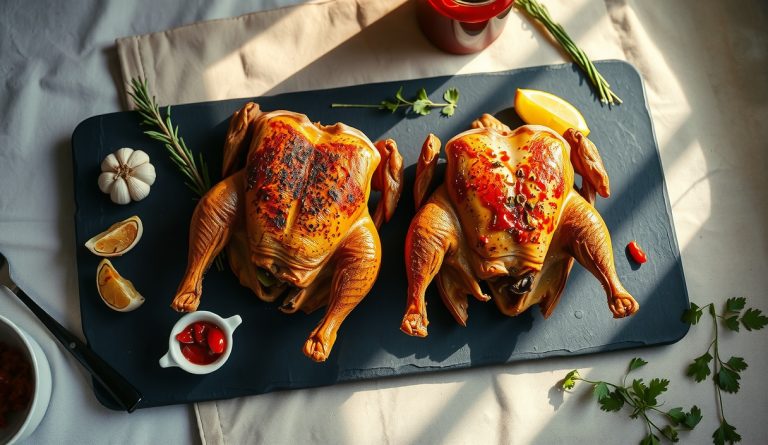
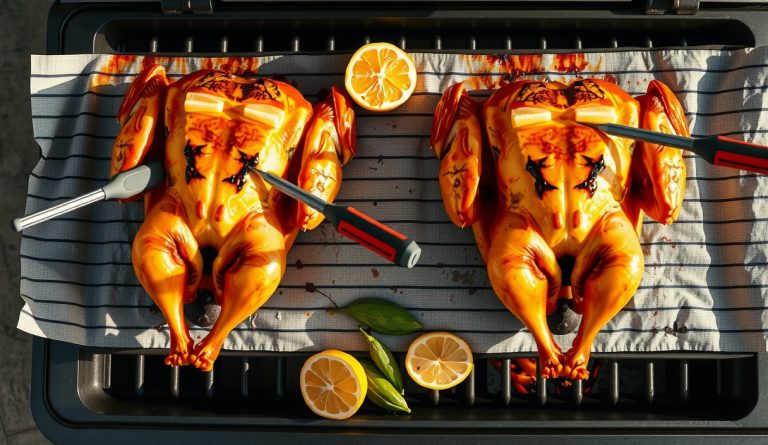
Scaling up: This recipe scales cleanly to two birds if your grill has sufficient indirect cooking area (typically a grill larger than 450 square inches). Maintain the same cook temp and pull at the same internal targets. Do not crowd the birds — leave at least two inches between them so convective airflow is not impeded. Expect cook time to extend by 10–15 minutes due to the increased thermal mass.
Dietary considerations: The recipe is naturally gluten-free and dairy-free as written. For a low-sodium approach, omit the kosher salt from the marinade and season only at the table — the lemon and garlic carry enormous aromatic weight without salt amplification, though the Maillard reaction on the skin will be slightly less pronounced without the water-activity reduction that salt provides to the surface.
Frequently asked questions about grilled spatchcock chicken
Why pull at 157°F when the USDA says 165°F? The USDA’s 165°F target is an instantaneous kill temperature. Pasteurization of poultry is a time-temperature relationship — at 157°F held for 42 seconds or longer, you achieve the same 7-log10 Salmonella reduction required for safety. Carryover heat during a five-minute rest accomplishes this easily. Pulling at 165°F on the grill means the breast reaches 168°F–170°F at the table, well inside the actin denaturation zone (74°C–78°C) that produces dry, fibrous meat. The thermodynamics support 157°F; the food safety science supports 157°F with proper rest.
Can I marinate the chicken overnight? No. The citric acid in lemon juice operates at roughly pH 2.0–2.5. At this pH, extended exposure causes progressive denaturation of myofibrillar proteins far beyond the surface. After several hours, the visible cue is a pale, mealy texture on the raw meat — the structural proteins that normally hold moisture during cooking have already been compromised. Limit marination to 30–45 minutes, 60 minutes absolute maximum.
My skin is not crisping during the indirect phase. What went wrong? Two likely causes: surface moisture or insufficient grill temperature. Surface moisture is the primary culprit — any residual water on the skin surface, whether from inadequate patting dry or from a marinade that was too watery, creates an evaporative cooling effect that pins the skin surface near 100°C, preventing Maillard browning. Fix it by patting the bird completely dry before marinating. The second cause is grill temperature below 375°F at the grate level. Verify with an independent grill thermometer placed at the grate. If needed, move the chicken briefly over direct heat in the final three minutes of cooking to drive off the last moisture and trigger the color shift.