Low-Sodium Smoked Brisket — Herb-Forward
Equipment
- 1 Offset smoker, kamado, kettle, or pellet grill Must hold 225°F–250°F with indirect heat for 10–14 hours. Pellet grill users: add a smoke tube for dense smoke in the first 4 hours.
- 1 Instant-read thermometer For probe-tender check and final internal temperature verification.
- 1 Leave-in probe thermometer Insert into the thickest part of the flat, not the point. Grate-level placement of the pit sensor, not dome.
- 4 feet Pink butcher paper Unwaxed. Do not substitute aluminum foil — foil traps steam and softens bark.
- 1 Wire rack set over a half-sheet pan For the 60–90 minute post-cook rest. Resting in a cooler traps steam and ruins the bark.
- 1 Sharp 12-inch slicing knife or long chef’s knife A dull knife drags and shreds. Sharpen before service.
- 1 Large cutting board
- 1 Spray bottle For apple juice spritz during the unwrapped post-stall phase.
Ingredients
The Brisket
- 1 full packer brisket (point + flat), 12–15 lb USDA Choice or Prime. Do not use flat-only unless you plan to inject with gelatin-fortified broth (see Variations).
KCl Salt-Substitute Dry Brine
- 2 tablespoons kosher salt (NaCl) Diamond Crystal preferred. Contributes ~50% of the salt-blend sodium.
- 2 tablespoons potassium chloride salt substitute (100% KCl) Morton Salt Substitute or Nu-Salt. Blended 1:1 with kosher salt to create the 50/50 KCl/NaCl blend.
Coffee-Cocoa-Paprika Rub
- 3 tablespoons finely ground dark roast coffee (espresso grind) Provides pyrazines and methylfurfuryl compounds that mask KCl metallic bitterness. Fine grind maximizes surface contact area.
- 2 tablespoons natural (non-alkalized) cocoa powder Do not use Dutch-process or sweetened mixes. Theobromine content is critical for bitter-receptor competition against KCl.
- 3 tablespoons smoked paprika Provides carotenoid pigments (capsanthin, capsorubin) that deepen bark color and compensate for reduced ionic-strength Maillard progression.
- 2 tablespoons coarse black pepper, freshly cracked 1/4-inch crack preferred. Provides aromatic complexity and contributes to bark texture.
- 1 tablespoon garlic powder Sodium-free. Provides sulfurous depth that partially compensates for reduced NaCl umami amplification.
- 1 tablespoon onion powder Sodium-free. Adds a base-note sweetness that rounds the KCl’s metallic edge.
- 1 teaspoon dried thyme, crumbled The herb-forward element. Thymol and carvacrol compounds add a resinous note that complements smoke.
- 1 teaspoon dried rosemary, finely ground Grind whole dried rosemary in a spice grinder or with a mortar and pestle to prevent large needles that don’t adhere to the bark.
- 1 teaspoon sweet paprika Adds sweetness depth to complement the smoked paprika.
- ½ teaspoon cayenne pepper Optional. Capsaicin stimulates TRPV1 thermoreceptors, creating a perceived warmth that amplifies savory character.
Smoke and Spritz
- 6 chunks oak or hickory wood chunks (fist-sized) For offset or kettle. Pellet grill users: use a smoke tube loaded with oak pellets in addition to the hopper charge.
- 1 cup unsweetened apple juice For spritz bottle. Applied after butcher paper comes off during the final unwrapped phase only. Do not spritz before wrapping — it interferes with pellicle formation.

Instructions
Trim and Dry Brine (12–24 hours before cook)
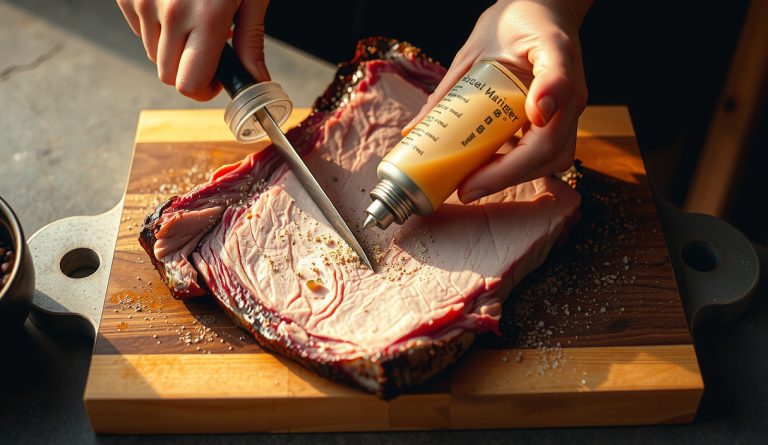
- Place the brisket fat-side up on a large cutting board. Using a sharp boning or chef’s knife, trim the fat cap to a uniform 1/4 inch. Remove any hard “flap” fat between the point and flat that will not render during the cook. Trim excess fat from the sides of the flat down to the meat. Flip and remove any remaining silver skin or hard sinew from the meat side.
- Combine the kosher salt and potassium chloride salt substitute in a small bowl and mix thoroughly — this is your 50/50 KCl/NaCl blend. Apply the blend evenly across all surfaces of the brisket, including the sides. Use approximately 1 tablespoon of the combined blend per 5 lb of meat. Do not skip the dry brine: the potassium ions need 12–24 hours to penetrate the surface muscle layers where they can suppress bitter receptor activation from within during eating.2 tablespoons potassium chloride salt substitute (100% KCl)
- Place the dry-brined brisket uncovered on a wire rack set over a sheet pan and refrigerate for 12–24 hours. The uncovered refrigeration allows the surface to dry further, tightening the pellicle the smoke will adhere to.
Build the Rub and Prep the Smoker
- Combine all rub ingredients — ground coffee, cocoa powder, smoked paprika, cracked black pepper, garlic powder, onion powder, dried thyme, ground rosemary, sweet paprika, and cayenne — in a bowl and whisk until uniform. The rub will look very dark; this is correct. The cocoa and coffee give it a near-black appearance that becomes your bark base.3 tablespoons finely ground dark roast coffee (espresso grind), 2 tablespoons natural (non-alkalized) cocoa powder, 3 tablespoons smoked paprika, 2 tablespoons coarse black pepper, freshly cracked, 1 tablespoon garlic powder, 1 tablespoon onion powder, 1 teaspoon dried thyme, crumbled, 1 teaspoon dried rosemary, finely ground, 1 teaspoon sweet paprika, 1/2 teaspoon cayenne pepper
- Remove the brisket from the refrigerator 45–60 minutes before cook time to allow the outer surface to temper slightly. Apply the rub generously across all surfaces, pressing it into the meat rather than dusting it on. Aim for a dense, even coating — do not be shy. Place the brisket back on the wire rack, fat-side up, while you prepare the smoker.3 tablespoons finely ground dark roast coffee (espresso grind), 2 tablespoons natural (non-alkalized) cocoa powder, 3 tablespoons smoked paprika, 2 tablespoons coarse black pepper, freshly cracked, 1 tablespoon garlic powder, 1 tablespoon onion powder, 1 teaspoon dried thyme, crumbled, 1 teaspoon dried rosemary, finely ground, 1 teaspoon sweet paprika, 1/2 teaspoon cayenne pepper
- Fire your smoker and bring it to a stable 225°F at grate level. Add 3 fist-sized wood chunks of oak or hickory (or load a smoke tube on a pellet grill). No water pan for the first 4 hours — lower ambient humidity in the pit accelerates surface desiccation, which drives the bark surface into the low water-activity window (a_w 0.50–0.65) where Maillard reactions run efficiently despite reduced ionic strength from the KCl blend.6 chunks oak or hickory wood chunks (fist-sized)
First 4-Hour Smoke Phase (Bark Development)
- Place the brisket fat-side up over the indirect zone of your smoker. Close the lid and do not open it for the first 4 hours. Every lid-lift loses 15–20 minutes of accumulated smoke and disrupts the convective heat environment around the developing pellicle. Add 1–2 additional wood chunks at the 2-hour mark by feeding through the firebox (offset) or adding a second smoke tube charge (pellet grill) without opening the main chamber.6 chunks oak or hickory wood chunks (fist-sized)
- At the 4-hour mark, check the bark development: the surface should be deeply mahogany-to-black, dry to the touch, and show the beginning of surface cracking at the fat cap edges. If it still looks wet or tacky, give it another 30–45 minutes uncovered before proceeding.
The Stall and Butcher Paper Wrap
- Continue smoking at 225°F–235°F with your leave-in probe monitoring the thickest part of the flat. The stall will occur when the internal temperature plateaus — typically anywhere in the 155°F–168°F range — for 30 minutes or longer without moving. This is evaporative cooling at work: surface moisture is absorbing heat as fast as the smoker delivers it. This is normal. Do not panic and raise the pit temperature.
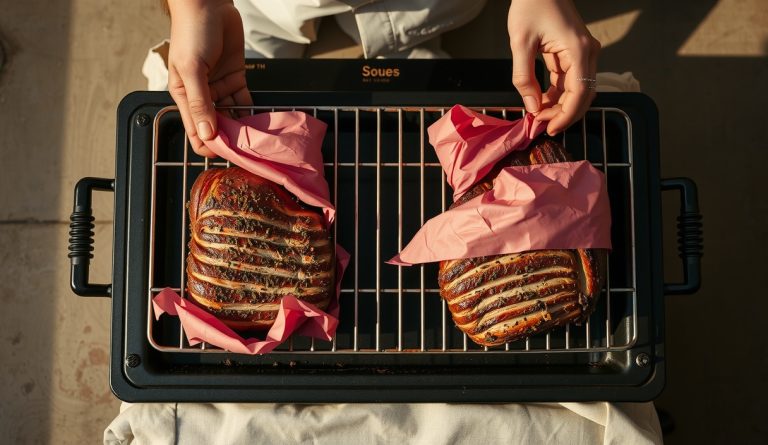
- When the stall begins, bump the pit temperature to 245°F–250°F and prepare two overlapping sheets of unwaxed pink butcher paper (approximately 4 feet total). Lay the brisket fat-side down on the paper and wrap tightly, folding the edges over firmly. The butcher paper wrap suppresses evaporation (ending the stall) while allowing steam to slowly escape through the paper’s pores, preventing the bark from going soft the way foil-wrapping would.
- Return the wrapped brisket to the smoker fat-side down. The higher pit temperature (245°F–250°F) combined with the humid wrapped environment accelerates collagen hydrolysis in the connective tissue, converting the remaining tough cross-linked collagen into soluble gelatin. This is the phase where the flat transitions from tight to pull-apart.
Final Cook Phase and Probe-Tender Test
- Cook wrapped until the internal temperature of the flat reaches approximately 195°F–205°F, then perform the probe-tender test: insert the probe into the thickest part of the flat at multiple points. The brisket is done when the probe slides in with zero resistance — like inserting a hot skewer into softened butter. Stiff resistance means the collagen hydrolysis is incomplete; continue cooking.
- Optional final unwrapped phase: If you want to re-crisp the bark after the wrapped phase, unwrap the brisket, return it to the smoker fat-side up at 250°F for 20–30 minutes, and spritz lightly with apple juice every 10 minutes. The apple juice provides trace reducing sugars that reactivate the Maillard surface chemistry as the bark dries and re-sets. Watch carefully — the bark darkens quickly at this stage.1 cup unsweetened apple juice
Rest and Slice
- Remove the brisket from the smoker and place it — still wrapped in butcher paper — on a wire rack set over a sheet pan at room temperature. Rest for 60–90 minutes minimum. Do not rest in a cooler: the trapped steam will soften the bark. During the rest, internal juices redistribute via capillary action into the denatured muscle fibers as the myosin gel network cools and stiffens slightly. Cutting too early causes all the juice to run onto the board instead of staying in the slice.
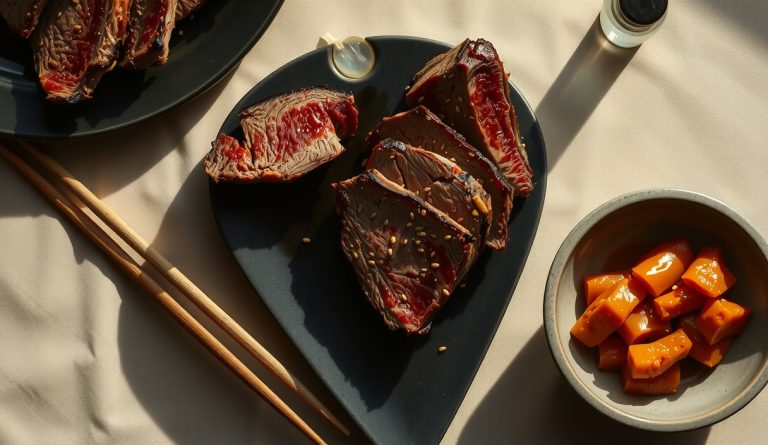
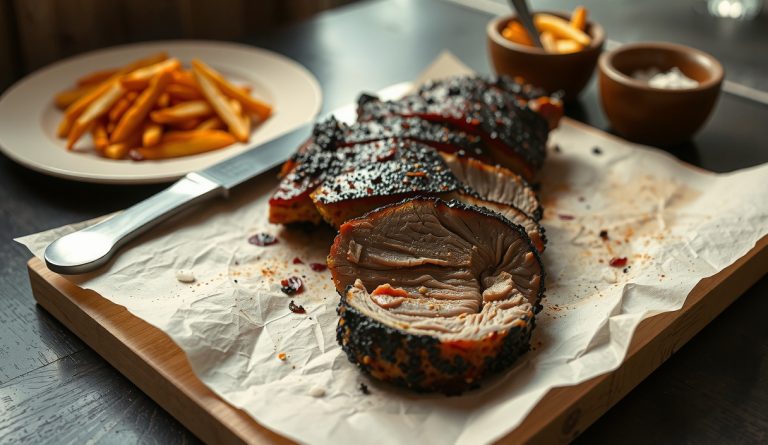
- Unwrap and transfer to a large cutting board. Separate the point from the flat by cutting along the fat seam between them. Slice the flat against the grain into 1/4-inch pencil-thick slices. When you reach the point, rotate the cutting board 90° and slice the point against its own grain direction. Serve immediately with low-sodium sides.
Notes
Nutrition
I did not want to write this recipe. Low-sodium brisket felt like a contradiction — the kind of project that ends in pale, flabby bark and a pitmaster’s existential crisis. Sodium chloride does three irreplaceable things in barbecue: it draws surface moisture out via osmosis, concentrating the pellicle that smoke adheres to; it suppresses bitterness receptors, allowing sweet and savory notes to bloom; and it raises the water activity inflection point, slowing surface desiccation just enough to let the Maillard cascade run long before char sets in. Strip that out and you have, in theory, a culinary disaster. In practice, you have a formulation problem — and formulation problems have solutions.
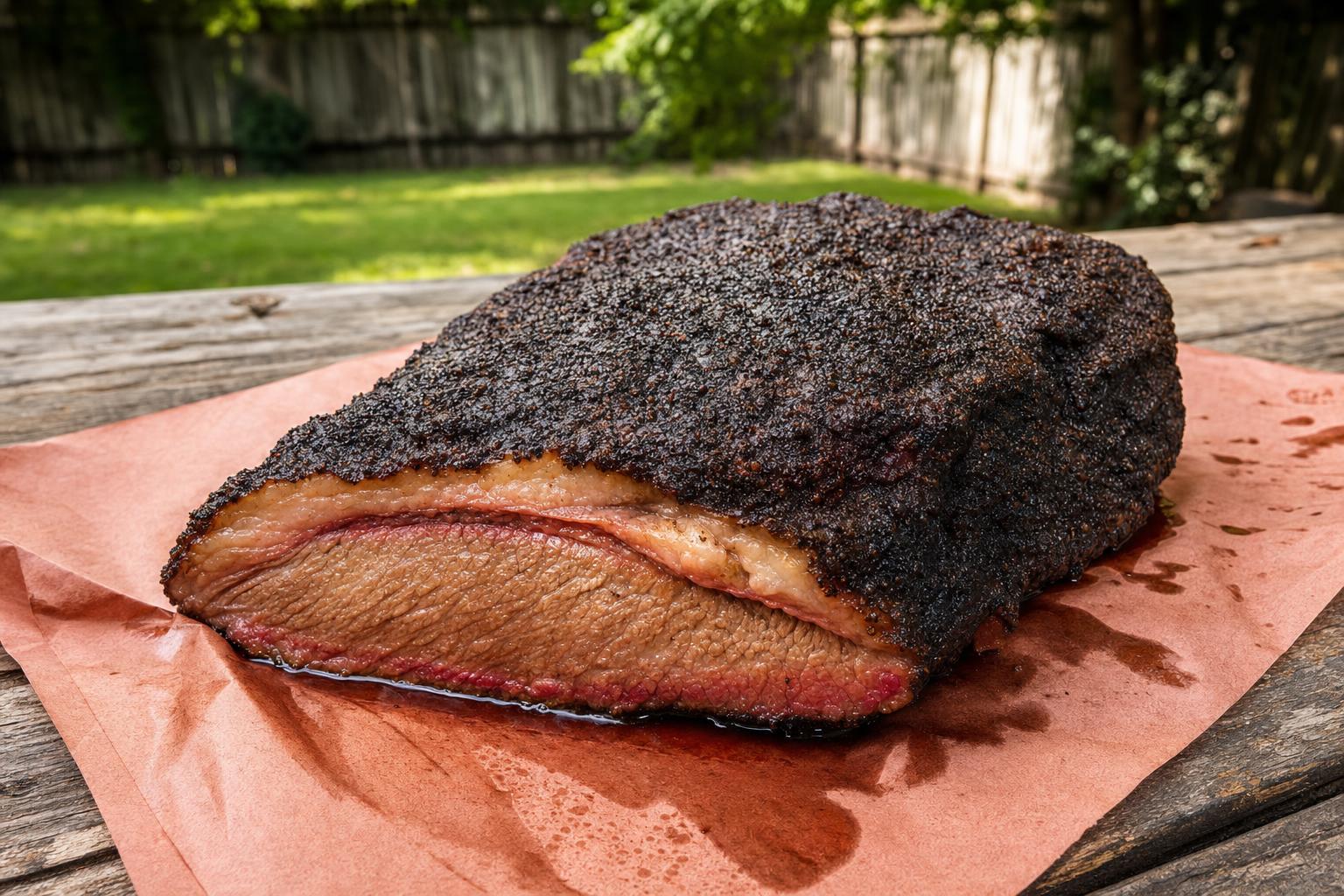
What you are holding is the result of weeks of iteration on a KCl-forward brisket protocol that hits every sensory checkpoint of a great Texas-style flat: a lacquered, near-black bark with audible crunch, a smoke ring that goes a full centimeter deep, pull-apart collagen-rich point meat, and a flavor profile layered enough that you do not notice the salt is missing until someone tells you. This is that recipe. Sodium: under 300mg per serving.
Why does low-sodium smoked brisket work? The science
Collagen hydrolysis is the central event in smoked brisket. The pectoralis major of cattle — what we call brisket — contains extraordinary concentrations of type I collagen threading through its fibrous muscle architecture. At internal temperatures between 160°F and 170°F, this collagen begins a thermally accelerated phase transition from its native triple-helix structure into soluble gelatin, governed by first-order kinetics. The reaction rate roughly doubles for every 18°F increase in temperature above the 140°F threshold. At a pit temperature of 225°F–250°F, the internal environment spends three to six hours in the critical 185°F–205°F window where hydrolysis runs near-completely — yielding the unctuous, slippery mouthfeel that defines great brisket. Rushing the cook with high heat destroys the product: you push the internal temperature through the collagen window too fast and never accumulate the kinetic integral needed for full conversion.
NaCl at conventional BBQ rub concentrations — 1.5–2% by meat weight — performs two distinct biochemical roles. First, NaCl acts as a flavor amplifier by competitively suppressing bitter TAS2R taste receptors, allowing pyrazines, lactones, and Maillard-derived furans to register cleanly on the palate without interference. Second, NaCl modulates surface water activity: by pulling free moisture via osmotic pressure, NaCl concentrates the soluble amino acids and reducing sugars at the bark surface, creating the high-reactant-density microenvironment that drives rapid Maillard browning. A potassium chloride (KCl) 50/50 blend with NaCl addresses the first problem almost completely — K+ ions hit the same sodium-potassium cotransporters that transmit saltiness, delivering roughly 70% of the perceived salinity of pure NaCl. But KCl carries a notorious metallic-bitter aftertaste driven by TAS2R38 receptor activation. This is where the coffee-cocoa-paprika rub earns its keep: roasted coffee provides 2-furfurylthiol and methylpyrazines that mask the metallic register; natural cocoa brings theobromine and phenylethylamine compounds that bind the same bitter receptors competitively; and smoked paprika floods the surface with carotenoid pigments that deepen visual color, compensating for the slightly slower Maillard progression at reduced ionic strength.
Bark formation in this recipe depends on a modified pellicle protocol. Without full NaCl concentration, surface osmotic pressure is lower, meaning less free moisture migrates to the bark during the initial uncovered smoke phase. The low-sodium brisket compensates with an extended dry-brine period of 12–24 hours using the KCl blend, and by keeping pit humidity on the drier side — no water pan — for the first four hours. This forces the surface into the low water activity window (target a_w 0.50–0.65) where Maillard onset temperature drops and the reaction runs efficiently even without peak ionic strength. The fat-soluble paprika pigments capsanthin and capsorubin undergo concurrent oxidative polymerization at bark temperatures above 300°F, adding reddish-brown color that visually mimics a higher-sodium crust. The stall — the plateau at 155°F–165°F internal where evaporative cooling absorbs heat as fast as the smoker delivers it — is managed by wrapping in butcher paper at 165°F internal, which suppresses evaporation while allowing steam to escape and bark to continue setting. Foil is avoided because it traps steam and softens the crust.
What equipment and ingredients do I need?
The smoker: Offset stick-burner, kettle, kamado, or pellet grill all work. What matters is the ability to hold 225°F–250°F with indirect heat for 10–14 hours. On a pellet grill, use a smoke tube with oak or hickory pellets alongside the hopper charge for denser smoke production during the first four hours.
KCl salt-substitute blend: Use a commercial 50% NaCl / 50% KCl product (Morton Salt Substitute blended 1:1 with kosher salt achieves this). Do not substitute with 100% KCl alone — the metallic bitterness becomes intolerable above 0.5% concentration. The 50/50 blend keeps NaCl contribution under 75mg per serving across the full rub dose while preserving perceived saltiness at roughly 85% of the conventional target.
Coffee: Use finely ground dark roast, preferably espresso grind. The fine particle size maximizes surface contact area, increasing pyrazine extraction into the bark matrix. Pre-ground is fine; fresh-ground is better.
Natural cocoa powder: Dutch-process is acceptable, but natural (non-alkalized) cocoa provides higher free theobromine concentration and more aggressive bitter-masking capacity against the KCl metallic note. Do not use sweetened cocoa mix.
The brisket: Buy a full packer (point + flat) in the 12–15 lb range. The point carries enough intramuscular fat to self-baste the flat during the stall. A flat-only brisket at low sodium is a significantly harder problem — the lack of salt slows moisture retention in an already lean muscle, and you risk desiccation in the flat by hour ten.
Thermometers: You need two — one for the pit grate level (not the dome, which reads 15–25°F hotter) and one leave-in probe for the thickest part of the flat. The brisket is done when the probe slides in with zero resistance, like inserting a hot skewer into room-temperature butter. This texture-based doneness check matters more than any specific internal temperature, which typically falls between 195°F and 210°F depending on the individual cut.
Low-Sodium Smoked Brisket — Herb-Forward
Equipment
- 1 Offset smoker, kamado, kettle, or pellet grill Must hold 225°F–250°F with indirect heat for 10–14 hours. Pellet grill users: add a smoke tube for dense smoke in the first 4 hours.
- 1 Instant-read thermometer For probe-tender check and final internal temperature verification.
- 1 Leave-in probe thermometer Insert into the thickest part of the flat, not the point. Grate-level placement of the pit sensor, not dome.
- 4 feet Pink butcher paper Unwaxed. Do not substitute aluminum foil — foil traps steam and softens bark.
- 1 Wire rack set over a half-sheet pan For the 60–90 minute post-cook rest. Resting in a cooler traps steam and ruins the bark.
- 1 Sharp 12-inch slicing knife or long chef’s knife A dull knife drags and shreds. Sharpen before service.
- 1 Large cutting board
- 1 Spray bottle For apple juice spritz during the unwrapped post-stall phase.
Ingredients
The Brisket
- 1 full packer brisket (point + flat), 12–15 lb USDA Choice or Prime. Do not use flat-only unless you plan to inject with gelatin-fortified broth (see Variations).
KCl Salt-Substitute Dry Brine
- 2 tablespoons kosher salt (NaCl) Diamond Crystal preferred. Contributes ~50% of the salt-blend sodium.
- 2 tablespoons potassium chloride salt substitute (100% KCl) Morton Salt Substitute or Nu-Salt. Blended 1:1 with kosher salt to create the 50/50 KCl/NaCl blend.
Coffee-Cocoa-Paprika Rub
- 3 tablespoons finely ground dark roast coffee (espresso grind) Provides pyrazines and methylfurfuryl compounds that mask KCl metallic bitterness. Fine grind maximizes surface contact area.
- 2 tablespoons natural (non-alkalized) cocoa powder Do not use Dutch-process or sweetened mixes. Theobromine content is critical for bitter-receptor competition against KCl.
- 3 tablespoons smoked paprika Provides carotenoid pigments (capsanthin, capsorubin) that deepen bark color and compensate for reduced ionic-strength Maillard progression.
- 2 tablespoons coarse black pepper, freshly cracked 1/4-inch crack preferred. Provides aromatic complexity and contributes to bark texture.
- 1 tablespoon garlic powder Sodium-free. Provides sulfurous depth that partially compensates for reduced NaCl umami amplification.
- 1 tablespoon onion powder Sodium-free. Adds a base-note sweetness that rounds the KCl’s metallic edge.
- 1 teaspoon dried thyme, crumbled The herb-forward element. Thymol and carvacrol compounds add a resinous note that complements smoke.
- 1 teaspoon dried rosemary, finely ground Grind whole dried rosemary in a spice grinder or with a mortar and pestle to prevent large needles that don’t adhere to the bark.
- 1 teaspoon sweet paprika Adds sweetness depth to complement the smoked paprika.
- ½ teaspoon cayenne pepper Optional. Capsaicin stimulates TRPV1 thermoreceptors, creating a perceived warmth that amplifies savory character.
Smoke and Spritz
- 6 chunks oak or hickory wood chunks (fist-sized) For offset or kettle. Pellet grill users: use a smoke tube loaded with oak pellets in addition to the hopper charge.
- 1 cup unsweetened apple juice For spritz bottle. Applied after butcher paper comes off during the final unwrapped phase only. Do not spritz before wrapping — it interferes with pellicle formation.
Instructions
Trim and Dry Brine (12–24 hours before cook)
- Place the brisket fat-side up on a large cutting board. Using a sharp boning or chef’s knife, trim the fat cap to a uniform 1/4 inch. Remove any hard “flap” fat between the point and flat that will not render during the cook. Trim excess fat from the sides of the flat down to the meat. Flip and remove any remaining silver skin or hard sinew from the meat side.
- Combine the kosher salt and potassium chloride salt substitute in a small bowl and mix thoroughly — this is your 50/50 KCl/NaCl blend. Apply the blend evenly across all surfaces of the brisket, including the sides. Use approximately 1 tablespoon of the combined blend per 5 lb of meat. Do not skip the dry brine: the potassium ions need 12–24 hours to penetrate the surface muscle layers where they can suppress bitter receptor activation from within during eating.2 tablespoons potassium chloride salt substitute (100% KCl)
- Place the dry-brined brisket uncovered on a wire rack set over a sheet pan and refrigerate for 12–24 hours. The uncovered refrigeration allows the surface to dry further, tightening the pellicle the smoke will adhere to.
Build the Rub and Prep the Smoker
- Combine all rub ingredients — ground coffee, cocoa powder, smoked paprika, cracked black pepper, garlic powder, onion powder, dried thyme, ground rosemary, sweet paprika, and cayenne — in a bowl and whisk until uniform. The rub will look very dark; this is correct. The cocoa and coffee give it a near-black appearance that becomes your bark base.3 tablespoons finely ground dark roast coffee (espresso grind), 2 tablespoons natural (non-alkalized) cocoa powder, 3 tablespoons smoked paprika, 2 tablespoons coarse black pepper, freshly cracked, 1 tablespoon garlic powder, 1 tablespoon onion powder, 1 teaspoon dried thyme, crumbled, 1 teaspoon dried rosemary, finely ground, 1 teaspoon sweet paprika, 1/2 teaspoon cayenne pepper
- Remove the brisket from the refrigerator 45–60 minutes before cook time to allow the outer surface to temper slightly. Apply the rub generously across all surfaces, pressing it into the meat rather than dusting it on. Aim for a dense, even coating — do not be shy. Place the brisket back on the wire rack, fat-side up, while you prepare the smoker.3 tablespoons finely ground dark roast coffee (espresso grind), 2 tablespoons natural (non-alkalized) cocoa powder, 3 tablespoons smoked paprika, 2 tablespoons coarse black pepper, freshly cracked, 1 tablespoon garlic powder, 1 tablespoon onion powder, 1 teaspoon dried thyme, crumbled, 1 teaspoon dried rosemary, finely ground, 1 teaspoon sweet paprika, 1/2 teaspoon cayenne pepper
- Fire your smoker and bring it to a stable 225°F at grate level. Add 3 fist-sized wood chunks of oak or hickory (or load a smoke tube on a pellet grill). No water pan for the first 4 hours — lower ambient humidity in the pit accelerates surface desiccation, which drives the bark surface into the low water-activity window (a_w 0.50–0.65) where Maillard reactions run efficiently despite reduced ionic strength from the KCl blend.6 chunks oak or hickory wood chunks (fist-sized)
First 4-Hour Smoke Phase (Bark Development)
- Place the brisket fat-side up over the indirect zone of your smoker. Close the lid and do not open it for the first 4 hours. Every lid-lift loses 15–20 minutes of accumulated smoke and disrupts the convective heat environment around the developing pellicle. Add 1–2 additional wood chunks at the 2-hour mark by feeding through the firebox (offset) or adding a second smoke tube charge (pellet grill) without opening the main chamber.6 chunks oak or hickory wood chunks (fist-sized)
- At the 4-hour mark, check the bark development: the surface should be deeply mahogany-to-black, dry to the touch, and show the beginning of surface cracking at the fat cap edges. If it still looks wet or tacky, give it another 30–45 minutes uncovered before proceeding.
The Stall and Butcher Paper Wrap
- Continue smoking at 225°F–235°F with your leave-in probe monitoring the thickest part of the flat. The stall will occur when the internal temperature plateaus — typically anywhere in the 155°F–168°F range — for 30 minutes or longer without moving. This is evaporative cooling at work: surface moisture is absorbing heat as fast as the smoker delivers it. This is normal. Do not panic and raise the pit temperature.
- When the stall begins, bump the pit temperature to 245°F–250°F and prepare two overlapping sheets of unwaxed pink butcher paper (approximately 4 feet total). Lay the brisket fat-side down on the paper and wrap tightly, folding the edges over firmly. The butcher paper wrap suppresses evaporation (ending the stall) while allowing steam to slowly escape through the paper’s pores, preventing the bark from going soft the way foil-wrapping would.
- Return the wrapped brisket to the smoker fat-side down. The higher pit temperature (245°F–250°F) combined with the humid wrapped environment accelerates collagen hydrolysis in the connective tissue, converting the remaining tough cross-linked collagen into soluble gelatin. This is the phase where the flat transitions from tight to pull-apart.
Final Cook Phase and Probe-Tender Test
- Cook wrapped until the internal temperature of the flat reaches approximately 195°F–205°F, then perform the probe-tender test: insert the probe into the thickest part of the flat at multiple points. The brisket is done when the probe slides in with zero resistance — like inserting a hot skewer into softened butter. Stiff resistance means the collagen hydrolysis is incomplete; continue cooking.
- Optional final unwrapped phase: If you want to re-crisp the bark after the wrapped phase, unwrap the brisket, return it to the smoker fat-side up at 250°F for 20–30 minutes, and spritz lightly with apple juice every 10 minutes. The apple juice provides trace reducing sugars that reactivate the Maillard surface chemistry as the bark dries and re-sets. Watch carefully — the bark darkens quickly at this stage.1 cup unsweetened apple juice
Rest and Slice
- Remove the brisket from the smoker and place it — still wrapped in butcher paper — on a wire rack set over a sheet pan at room temperature. Rest for 60–90 minutes minimum. Do not rest in a cooler: the trapped steam will soften the bark. During the rest, internal juices redistribute via capillary action into the denatured muscle fibers as the myosin gel network cools and stiffens slightly. Cutting too early causes all the juice to run onto the board instead of staying in the slice.
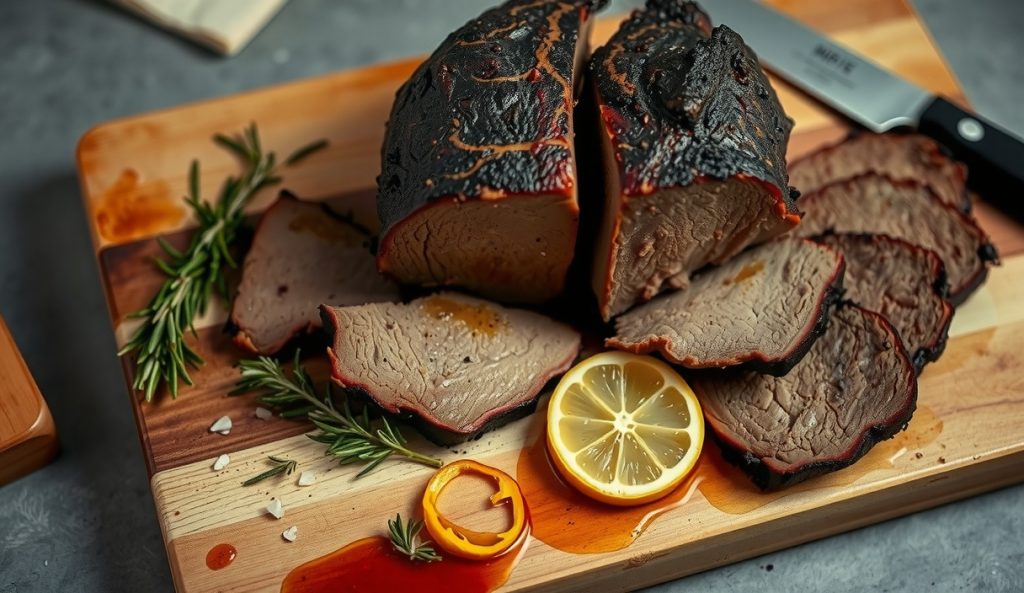
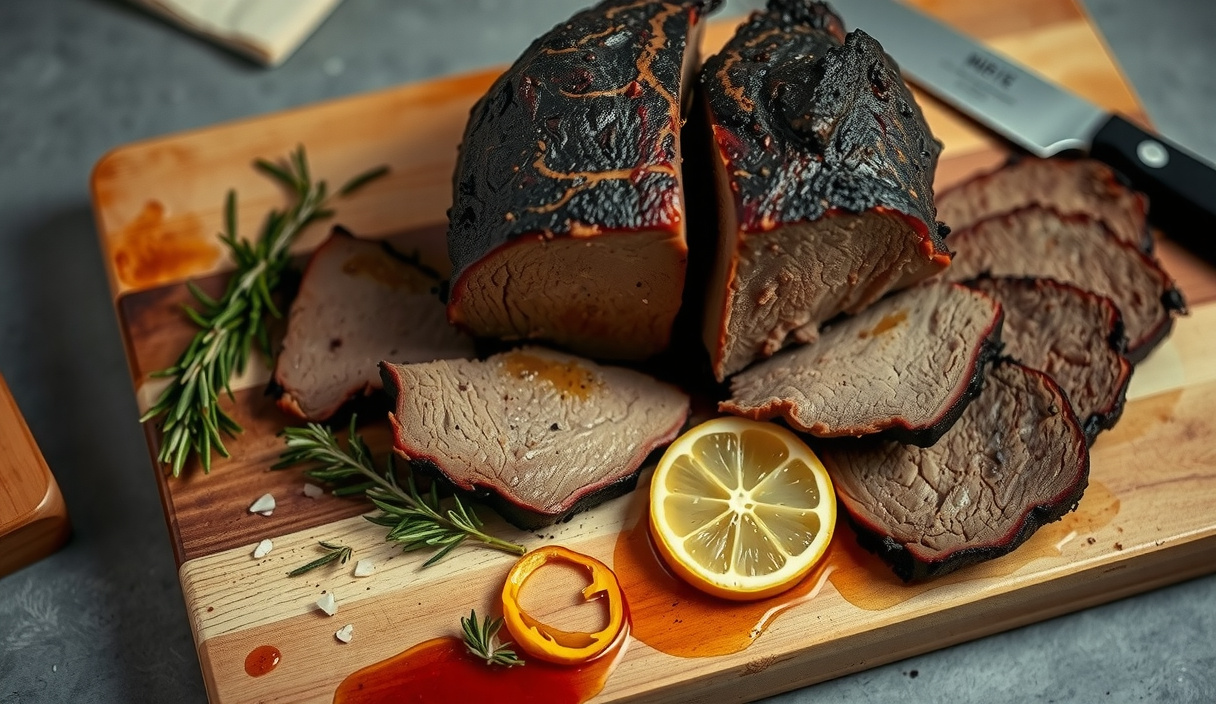
- Unwrap and transfer to a large cutting board. Separate the point from the flat by cutting along the fat seam between them. Slice the flat against the grain into 1/4-inch pencil-thick slices. When you reach the point, rotate the cutting board 90° and slice the point against its own grain direction. Serve immediately with low-sodium sides.
Notes
Nutrition
How do I nail it every time? Tips for success
- Dry-brine for the full 24 hours if possible. Shorter brines under 6 hours leave the KCl blend sitting on the surface without time to penetrate the muscle and suppress the metallic aftertaste from the inside out. The potassium ions need time to diffuse into the surface layers of the meat where they compete with bitter receptor activation during eating.
- Trim the fat cap to exactly 1/4 inch. Too thin and the fat renders off before it can baste the flat through the stall; too thick and the fat forms an insulating barrier that slows internal temperature rise, extending the cook unnecessarily and creating a greasy, unrendered layer in the finished brisket.
- Do not open the smoker during the first four hours. Every lid-lift dumps 15–20 minutes of accumulated smoke and heat. The bark pellicle needs uninterrupted low-humidity convective heat to set during this window. Resist.
- Wrap at the stall, not on a clock. The stall onset is triggered by evaporative cooling, which varies by fat content, ambient humidity, and pit design. Use the thermometer — wrap when internal temperature plateaus anywhere in the 155°F–168°F range for 30 or more minutes.
- Rest on a wire rack, never in a closed cooler. Resting in a cooler traps steam and softens the bark you spent 10+ hours building. A wire rack set over a sheet pan at room temperature for 60–90 minutes allows the bark to firm while the internal juices redistribute via capillary forces into the denatured muscle fibers.
- Slice against the grain and adjust your plane at the point. The flat and point run at roughly a 45° angle to each other. Cut straight through the flat against the grain, then rotate your board 90° when you reach the point. A blunt knife will drag and shred — use a sharp 12-inch slicing knife or a long chef’s knife.
What are the best variations on this recipe?
Pure Texas minimalist: Drop the herb crust and reduce the rub to equal parts KCl blend and coarse black pepper only. This is Aaron Franklin’s coarse-pepper-and-salt approach translated to low-sodium, and the brisket works beautifully if your smoke game is dialed. The pepper crack provides the textural and aromatic complexity that salt normally helps amplify, and the fat cap takes on a beautiful cracked-pepper bark. Expect slightly less Maillard color without the cocoa and paprika, but the flavor is remarkably clean.
Korean-inflected: Add 2 tablespoons of gochugaru and 1 tablespoon of toasted sesame seeds to the base rub. Spritz with a 50/50 mixture of unseasoned rice vinegar and water (rather than apple juice) every 90 minutes after the wrap comes off. The acetic acid in the vinegar lowers surface pH slightly, which shifts the Maillard reaction toward producing more pyrazines and furans — the nutty, toasty notes associated with Korean barbecue char.
Scaling up for a competition or large group: This rub formula scales linearly by weight of the meat. For two full packers on a large offset or barrel smoker, double all rub quantities and stagger the placement so the thinner flat of one brisket is not directly above the thicker point of another — the radiant heat differential causes uneven cooking. Wrap each brisket independently; do not tent them together, as the steam environment becomes uncontrolled.
Flat-only adaptation: If you can only source a flat, inject the flat with a low-sodium beef broth (sodium-free commercial broth or homemade from unsalted bones) blended with 1 teaspoon of unflavored gelatin per cup of broth, warmed to 140°F to dissolve the gelatin. Inject at 1-inch intervals across the flat at a 45° angle. This injection replaces the self-basting function of the point’s intramuscular fat, and the gelatin increases the water-holding capacity of the lean muscle during the extended cook.
Frequently asked questions
Why does KCl taste metallic and what actually fixes it? Potassium chloride activates the TAS2R38 bitter taste receptor — the same receptor that makes Brussels sprouts bitter to certain people. The fix is not more salt; it is competitive receptor masking. Natural cocoa, roasted coffee, and theobromine-bearing compounds bind TAS2R38 and occupy the receptor before potassium can, suppressing the metallic note at the neurological level rather than trying to dilute it. This is why the rub composition is non-negotiable: the coffee and cocoa are not decorative, they are functional bitter-masking agents doing chemistry on your tongue.
Is 225°F or 250°F better for this low-sodium protocol? Run 225°F for the first four hours to maximize smoke absorption and bark pellicle development, then bump to 245°F–250°F after wrapping. The higher temperature post-wrap accelerates collagen hydrolysis in the wrapped environment (where internal humidity is elevated), converting the remaining tough connective tissue faster without the evaporative cooling penalty that would stall the surface at lower pit temperatures. The net effect is a faster post-wrap finish without sacrificing the slow pellicle-building phase.
Can I use a gas grill with a smoke box for this recipe? Yes, with significant caveats. A two-zone gas grill setup with a cast-iron smoke box or foil pouch of soaked chips over the lit burner can hold 225°F–245°F with the lit burner on low and the brisket over the unlit side. The limitation is smoke density — gas grills produce a more diffuse, humid combustion environment than wood or charcoal smokers. Compensate by using a maximum amount of wood chips, replenishing every 45 minutes for the first four hours, and accepting that the smoke ring will be shallower and the bark will be lighter in color. The flavor will still be excellent; the brisket will just look less dramatic than a stick-burner result.