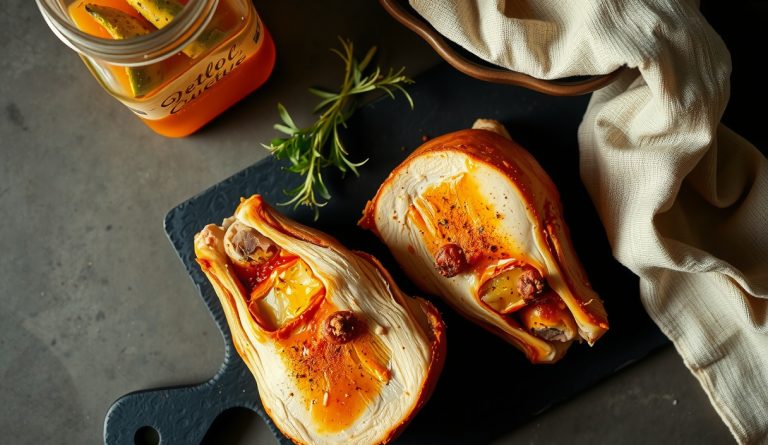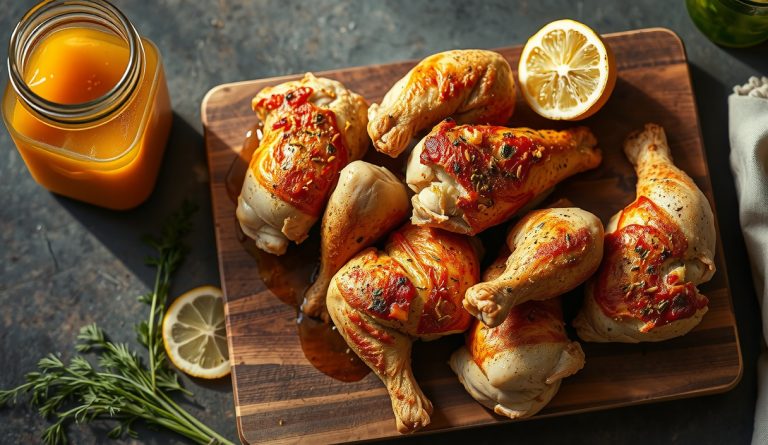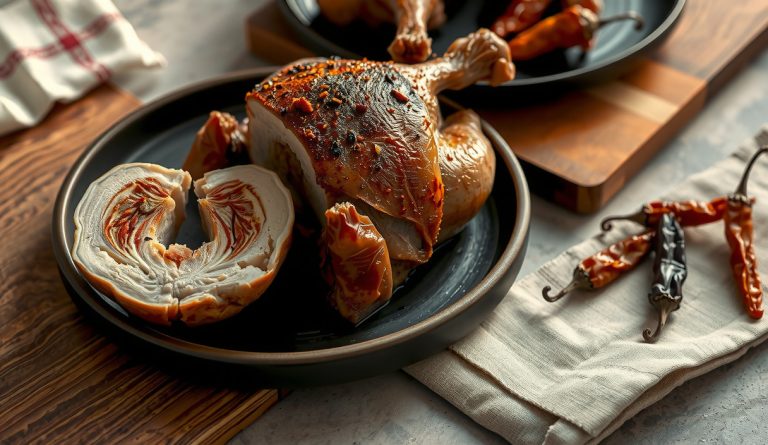
Fermented Pickle Brine Smoked Chicken

Equipment
- 1 Offset smoker or kettle grill set up for indirect smoking Maintain 250–275°F throughout the cook; temperature swings beyond 25°F in either direction will compromise bark development and moisture retention.
- 2 Half-gallon wide-mouth mason jar For the lacto-ferment. Must be scrupulously clean but not sterile — residual chlorine from dishwasher rinsing will inhibit Lactobacillus colonization.
- 1 Dual-probe wireless thermometer One probe monitors smoker ambient temperature at grate level; the second monitors thigh internal temperature. Do not rely on lid thermometers — they typically read 25–50°F higher than actual grate temperature.
- 1 Wire rack set inside a rimmed sheet pan Used for drying the brined chicken uncovered in the refrigerator before smoking. Airflow under the bird is critical for pellicle formation.
- 1 Kitchen shears or boning knife For spatchcocking — removing the backbone requires firm, confident cuts through the rib cage on either side of the spine.
Ingredients
Lacto-Fermented Pickle Brine (make 6 weeks ahead)
- 1 quart filtered or well water (not chlorinated tap water) Chlorine kills Lactobacillus. If tap water is your only option, let it sit uncovered 30 minutes to off-gas chlorine, or use a Brita-filtered source.
- 20 grams non-iodized kosher salt Exactly 2% w/v salt — this is the critical threshold that selects for Lactobacillus and suppresses pathogenic bacteria. Do not eyeball it; weigh it.
- 4 small Kirby cucumbers, halved lengthwise Kirby cucumbers have thinner skins and firmer flesh than standard slicing cucumbers, maintaining texture over the 6-week ferment.
- 6 garlic cloves, smashed Smashing (not mincing) releases allicin while keeping the pieces large enough to fish out after fermentation.
- 2 teaspoons whole black peppercorns
- 1 teaspoon whole coriander seeds
- 1 teaspoon whole mustard seeds
- 4 fresh dill heads, or 2 tablespoons dried dill weed
- 1 dried bay leaf
- 1 small grape leaf or horseradish leaf (optional) Contains tannins that inhibit pectin methylesterase, helping the cucumbers stay firm. Omit if unavailable — it affects texture, not fermentation safety.
Chicken and Dry Rub
- 1 whole chicken, 3.5 to 4.5 pounds, spatchcocked (backbone removed) Pat completely dry before spatchcocking. Ask your butcher to remove the backbone if kitchen shears are unavailable.
- 1 quart finished lacto-fermented pickle brine (strained, cold) Brine should taste aggressively sour — pH 3.8 to 4.2. Dilute 50/50 with cold water if pH reads below 3.5 on a meter.
- 1 tablespoon coarse kosher salt
- 2 teaspoons coarsely ground black pepper
- 1 teaspoon smoked paprika
- 0.5 teaspoon garlic powder
- 2 cherry wood chunks, fist-sized Soak-free. Modern consensus supports dry wood chunks for more controlled, less steamy combustion. Fruit woods (apple, peach) work equally well.

Instructions
Make the Lacto-Fermented Brine (6 weeks ahead)
- Dissolve the kosher salt completely in the filtered water, stirring until no granules remain. This is your 2% w/v brine solution.20 grams non-iodized kosher salt
- Pack the halved cucumbers, smashed garlic, peppercorns, coriander seeds, mustard seeds, dill, bay leaf, and the grape or horseradish leaf (if using) into two clean half-gallon mason jars. Divide evenly between the jars.4 small Kirby cucumbers, halved lengthwise, 6 garlic cloves, smashed, 2 teaspoons whole black peppercorns, 1 teaspoon whole coriander seeds, 1 teaspoon whole mustard seeds, 4 fresh dill heads, or 2 tablespoons dried dill weed, 1 dried bay leaf, 1 small grape leaf or horseradish leaf (optional)
- Pour the salt brine over the vegetables, ensuring all solids are fully submerged. Leave 1 inch of headspace. Weight the cucumbers below the brine line using a small zip-lock bag filled with brine, or a purpose-built fermentation weight. Exposure to air allows kahm yeast and mold to colonize the surface. Cover the jar loosely with a cloth secured with a rubber band, or use an airlock lid.
- Ferment at room temperature (68–75°F ideal) for 6 weeks. In the first 48 to 72 hours you will see active bubbling — carbon dioxide produced by Lactobacillus metabolism. The brine will turn progressively cloudier as lactic acid concentration increases. Taste weekly: at 2 weeks the brine is pleasantly tart; at 6 weeks it should be aggressively sour and tangy. Transfer to the refrigerator when the fermentation activity slows (minimal bubbling) or when the sour level satisfies you.
- Strain the finished brine through a fine-mesh sieve, discarding solids (or eat the pickled cucumbers — they are excellent). Refrigerate the strained brine until ready to use. Properly fermented brine keeps refrigerated for up to 3 months.
Spatchcock and Brine the Chicken
- Place the chicken breast-side down on a cutting board. Using sturdy kitchen shears, cut along both sides of the spine from the tail to the neck opening, removing the backbone entirely. Reserve the backbone for stock. Flip the bird breast-side up and press firmly on the breastbone with the heel of your hand until you hear and feel the cartilage crack — the bird should now lie flat.1 whole chicken, 3.5 to 4.5 pounds, spatchcocked (backbone removed)
- Place the spatchcocked chicken in a large zip-lock bag or a snug-fitting container. Pour the cold strained pickle brine over the chicken. The bird should be fully submerged; if needed, add a small amount of cold water to ensure coverage. Seal and refrigerate for exactly 12 hours — no longer. Set a timer.1 whole chicken, 3.5 to 4.5 pounds, spatchcocked (backbone removed), 1 quart finished lacto-fermented pickle brine (strained, cold)
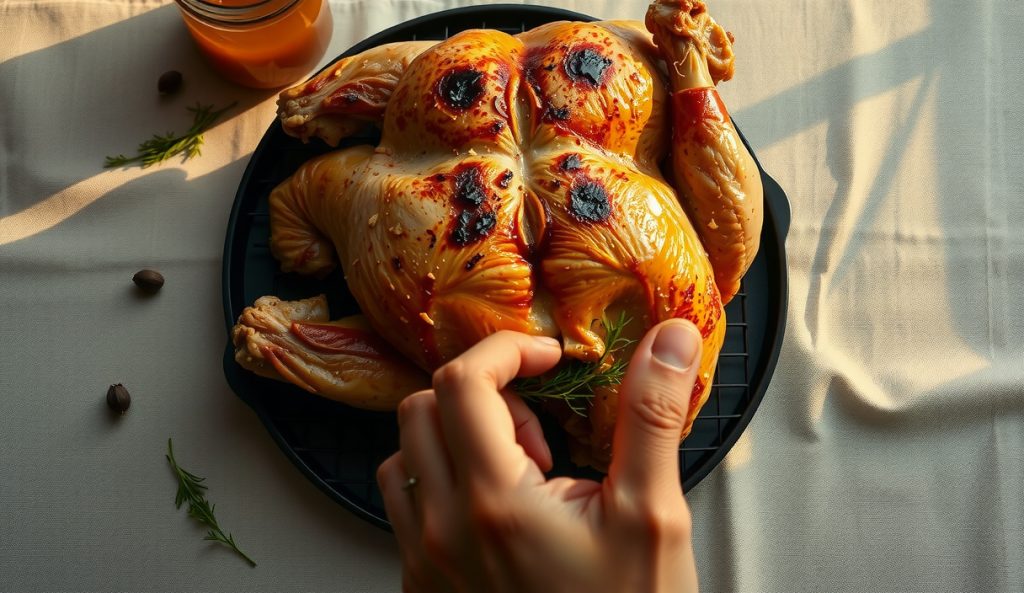
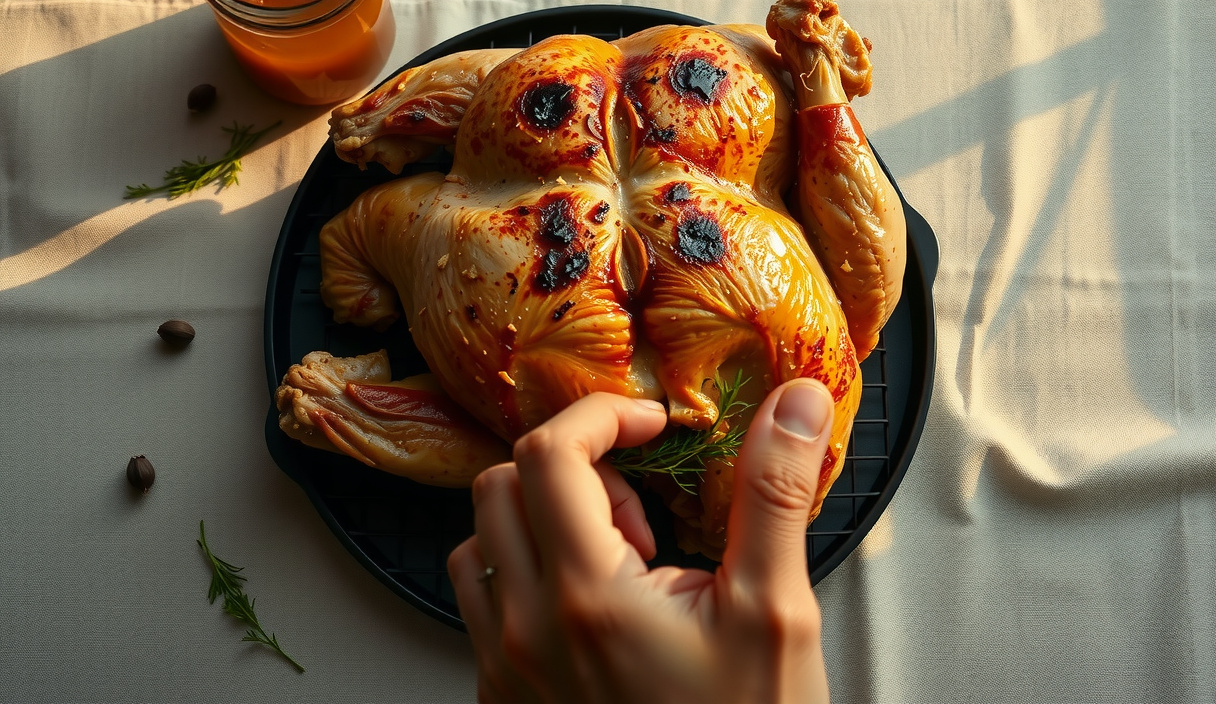
- Remove the chicken from the brine and rinse briefly under cold running water. Pat aggressively dry on all surfaces — including the cavity side — using paper towels. Place breast-side up on a wire rack set inside a sheet pan. Return uncovered to the refrigerator for a minimum of 2 hours, or up to 12 hours overnight. The surface must be completely dry and slightly tacky (the pellicle) before it enters the smoker. A visibly wet surface will steam rather than absorb smoke in the critical early phase of the cook.
Apply the Rub and Smoke
- Mix the kosher salt, black pepper, smoked paprika, and garlic powder together in a small bowl. The rub is intentionally minimal — the brine has already seasoned the interior of the meat. Apply a thin, even coat to all external surfaces of the dried chicken, including under the loosened skin over the breast and thighs wherever possible.1 tablespoon coarse kosher salt, 2 teaspoons coarsely ground black pepper, 1 teaspoon smoked paprika, 0.5 teaspoon garlic powder
- Set up your smoker for indirect cooking. Establish a stable ambient temperature of 250–275°F at grate level before adding the chicken. Add the cherry wood chunks directly to the coals or wood supply. You want thin blue smoke — not thick white billowing smoke, which indicates incomplete combustion and will impart a bitter, acrid note to the bark.2 cherry wood chunks, fist-sized
- Place the chicken skin-side up on the smoker grate, thighs oriented toward the heat source (firebox side on an offset, or closer to the coals on a kettle). Insert one probe thermometer into the deepest part of the inner thigh without touching bone. Insert the second probe to monitor ambient smoker temperature at grate level. Close the lid.
- Smoke undisturbed at 250–275°F until the thigh registers 157°F internal temperature — approximately 2.5 to 3.5 hours depending on bird size and smoker efficiency. Resist opening the lid in the first 90 minutes; this is the critical smoke-deposition window where the phenolic bark is forming. After 90 minutes, you may open briefly to assess color and add additional wood if the smoker has gone clean.
- When the thigh reads 157°F, remove the chicken from the smoker. Tent loosely with aluminum foil and rest undisturbed on a cutting board for 15 minutes. Carryover heat will bring the internal temperature to 165°F during rest. Do not skip or shorten the rest — this is when the denatured protein matrix partially relaxes and reabsorbs expelled moisture.
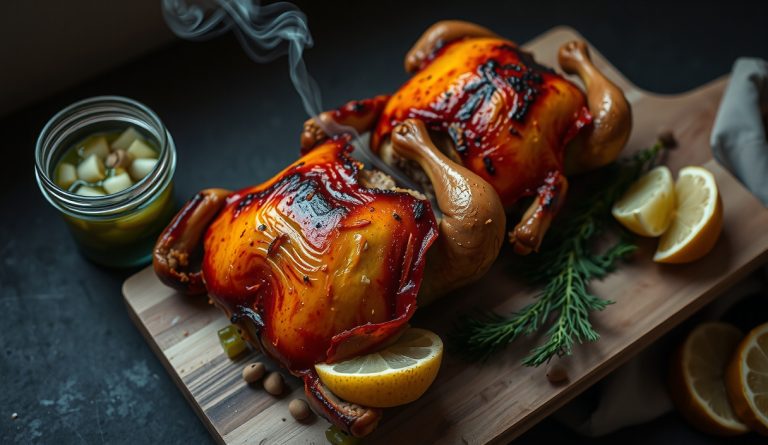
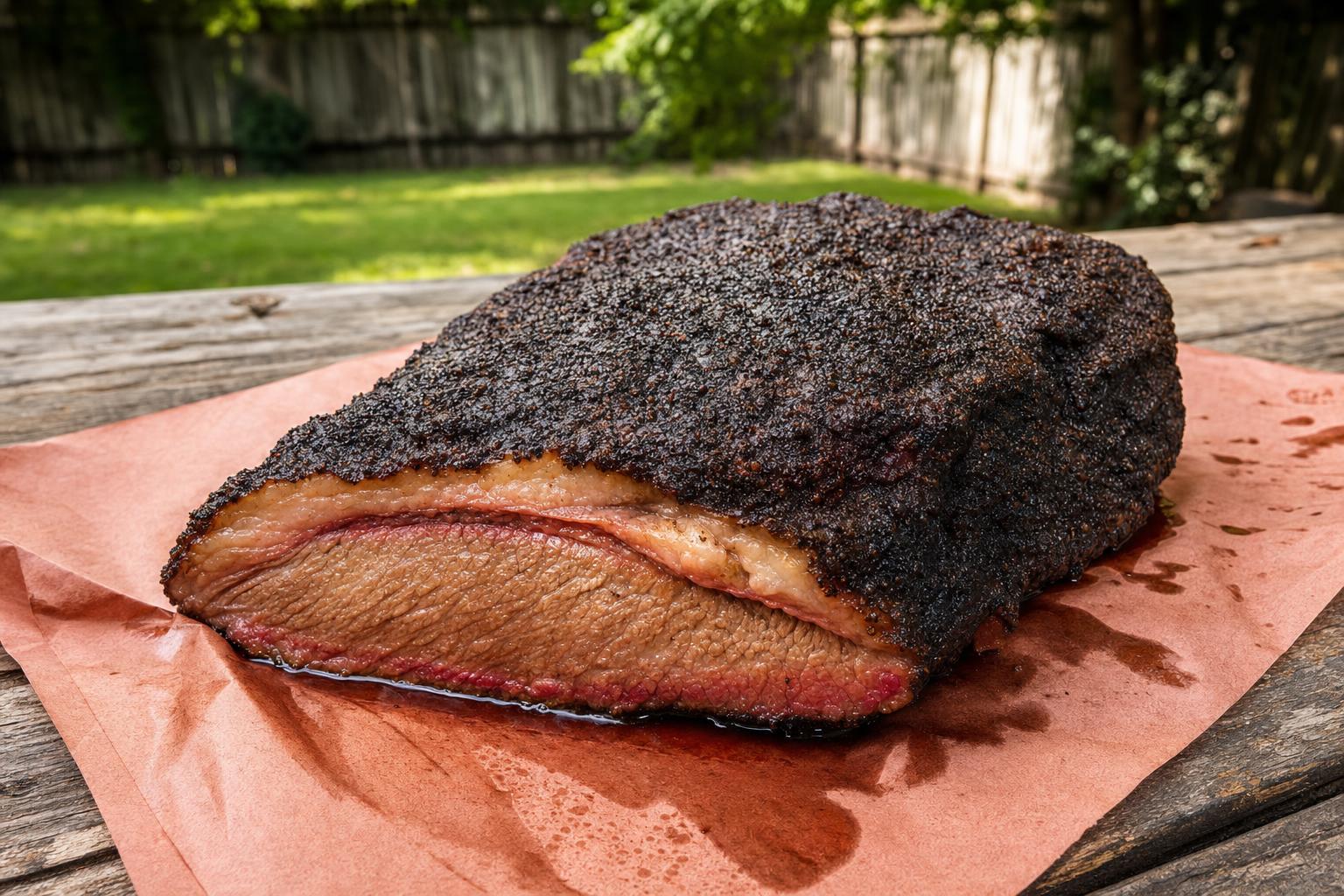
- Carve by first separating the leg quarters at the hip joint, then slicing along the breastbone to remove each breast half. Serve immediately, skin-side up. The bark should be dry, mahogany-colored, and audibly crisp when tapped with a fingernail.
Notes
Nutrition
There is a jar of cloudy, funky, aggressively sour pickle brine sitting at the back of my refrigerator right now, and I am convinced it is the single most underused ingredient in American barbecue. Not the bright-green vinegar stuff from a shelf-stable jar. I mean real lacto-fermented brine — the liquid left behind after six weeks of wild Lactobacillus bacteria have been slowly converting cucumber sugars into lactic acid. That liquid is a precision chemical tool, and once you understand what it is doing to muscle protein at the molecular level, you will never brine chicken in plain salt water again.
The idea is not entirely new — buttermilk fried chicken has exploited lactic acid tenderization for generations, and every pitmaster who has ever soaked brisket in a beer-and-salt bath is chasing adjacent chemistry. But fermented pickle brine concentrates that lactic acid to a degree that simple buttermilk cannot match, and it does it while delivering a layered aromatic payload of dill terpenes, garlic thiosulfinates, and peppercorn volatiles that will survive the smokehouse intact. This is where fermentation and fire converge.
Why does fermented pickle brine smoked chicken work? The science
Fermented pickle brine tenderizes chicken through two sequential mechanisms: acid-driven proteolysis and Maillard surface chemistry. A six-week lacto-fermented brine reaches a terminal pH of approximately 3.8 to 4.2, driven by the accumulation of L-lactic acid produced by homofermentative Lactobacillus species including L. plantarum and L. brevis. When chicken muscle tissue is submerged in this environment, that free proton load attacks the triple-helical collagen cross-links in the endomysium and perimysium — the connective tissue sheaths wrapping individual muscle fibers and fiber bundles.
Collagen begins to swell and partially denature near its shrinkage temperature of 60–65°F in an acid environment, effectively loosening the mechanical grip those sheaths have on the muscle cells long before any heat is applied. The result is a reduction in cooking-induced moisture expulsion: when actin finally denatures at 74°F internal, the surrounding matrix has already been relaxed, so the violent longitudinal and transverse contraction of the actomyosin complex expels significantly less bound water than it would from an unbrined bird. You keep juice that would otherwise run onto the drip pan.
Simultaneously, the brine delivers sodium chloride that penetrates the muscle tissue via diffusion governed by Fick’s second law, increasing the ionic strength of the intracellular fluid. This ionic shift causes the myosin filaments to partially dissolve into the aqueous phase — the classic mechanism behind the sticky, gelatin-rich pellicle that forms on the surface of properly brined proteins. That pellicle is the smoke adhesion layer. Smoke-derived phenolic compounds (guaiacol, syringol, 4-methylsyringol) are hydrophobic and partition preferentially into the lipid and protein film on the surface rather than the bulk aqueous phase; a fully developed pellicle maximizes the amount of bark-building phenolic absorption during the first two hours of the cook.
The lactic acid in the brine further contributes to bark development: on a pH scale, the slightly acidic surface of the meat suppresses early Maillard onset ever so slightly, extending the window of phenolic deposition before crust formation seals the surface. The net effect is a bark with more aromatic complexity and better color — deeper mahogany rather than quick-darkening charcoal.
The volatile organic compound profile of the brine matters as well. Dill contains significant concentrations of carvone (a bicyclic monoterpenoid) and limonene, both of which have low boiling points (around 230°F and 349°F respectively) and will volatilize early in the cook. But their water-soluble precursors remain bound to the surface protein film and contribute a residual herbaceous background note that is perceptible in the finished bark. Garlic contributes allicin-derived diallyl disulfide, which undergoes thermolysis above 250°F into a spectrum of smaller, intensely aromatic sulfur compounds that marry beautifully with the aldehyde and furan fraction of hickory or cherry smoke. This is not a flavored brine in the casual sense — it is a pre-programmed volatile delivery system.
What equipment and ingredients do I need?
The brine: You need genuine lacto-fermented pickle brine — not the vinegar-acidified commercial product. The simplest path is to make your own cucumbers six weeks before you plan to smoke (see the recipe card below for the quick-ferment method), or source from a local deli or farmers market vendor who ferments traditionally. The brine must be sour enough to make you wince. If it tastes like lightly flavored water, it will not work as a tenderizer.
Chicken: Spatchcocked whole chickens (backbone removed, bird flattened) cook far more evenly than intact birds in a smoker. The skin-to-meat ratio improves, the thigh and breast reach target temperatures within 10 to 15 minutes of each other, and the flattened geometry maximizes smoke exposure. A 3.5 to 4.5 pound bird is ideal. Two fit side by side on most offset smoker grates.
Wood: Cherry wood is the recommended primary fuel source. Its relatively mild phenolic output (dominated by syringol derivatives) complements the lactic tang of the brine without overwhelming the dill-garlic volatiles. Apple wood is an excellent substitute. Hickory is acceptable in small quantities (no more than one small chunk alongside cherry) — it brings bold guaiacol and creosol notes that can overpower the ferment character if used exclusively.
Thermometer: A dual-probe wireless thermometer is mandatory for this cook. The thermometer lets you monitor both smoker ambient temperature and chicken internal temperature simultaneously. Pull the bird at 157°F internal in the thickest part of the thigh — carryover heat will bring the chicken to the USDA safe threshold of 165°F during the rest, and every degree past 165°F is moisture permanently lost to evaporation and actomyosin contraction.
Dry rub: Keep the rub minimal. The brine has already done the seasoning and tenderizing work. A rub of coarse kosher salt, cracked black pepper, and smoked paprika is sufficient. Resist the urge to add sugar — the pellicle will darken fast enough with the ferment sugars already present on the surface.
Fermented Pickle Brine Smoked Chicken
Equipment
- 1 Offset smoker or kettle grill set up for indirect smoking Maintain 250–275°F throughout the cook; temperature swings beyond 25°F in either direction will compromise bark development and moisture retention.
- 2 Half-gallon wide-mouth mason jar For the lacto-ferment. Must be scrupulously clean but not sterile — residual chlorine from dishwasher rinsing will inhibit Lactobacillus colonization.
- 1 Dual-probe wireless thermometer One probe monitors smoker ambient temperature at grate level; the second monitors thigh internal temperature. Do not rely on lid thermometers — they typically read 25–50°F higher than actual grate temperature.
- 1 Wire rack set inside a rimmed sheet pan Used for drying the brined chicken uncovered in the refrigerator before smoking. Airflow under the bird is critical for pellicle formation.
- 1 Kitchen shears or boning knife For spatchcocking — removing the backbone requires firm, confident cuts through the rib cage on either side of the spine.
Ingredients
Lacto-Fermented Pickle Brine (make 6 weeks ahead)
- 1 quart filtered or well water (not chlorinated tap water) Chlorine kills Lactobacillus. If tap water is your only option, let it sit uncovered 30 minutes to off-gas chlorine, or use a Brita-filtered source.
- 20 grams non-iodized kosher salt Exactly 2% w/v salt — this is the critical threshold that selects for Lactobacillus and suppresses pathogenic bacteria. Do not eyeball it; weigh it.
- 4 small Kirby cucumbers, halved lengthwise Kirby cucumbers have thinner skins and firmer flesh than standard slicing cucumbers, maintaining texture over the 6-week ferment.
- 6 garlic cloves, smashed Smashing (not mincing) releases allicin while keeping the pieces large enough to fish out after fermentation.
- 2 teaspoons whole black peppercorns
- 1 teaspoon whole coriander seeds
- 1 teaspoon whole mustard seeds
- 4 fresh dill heads, or 2 tablespoons dried dill weed
- 1 dried bay leaf
- 1 small grape leaf or horseradish leaf (optional) Contains tannins that inhibit pectin methylesterase, helping the cucumbers stay firm. Omit if unavailable — it affects texture, not fermentation safety.
Chicken and Dry Rub
- 1 whole chicken, 3.5 to 4.5 pounds, spatchcocked (backbone removed) Pat completely dry before spatchcocking. Ask your butcher to remove the backbone if kitchen shears are unavailable.
- 1 quart finished lacto-fermented pickle brine (strained, cold) Brine should taste aggressively sour — pH 3.8 to 4.2. Dilute 50/50 with cold water if pH reads below 3.5 on a meter.
- 1 tablespoon coarse kosher salt
- 2 teaspoons coarsely ground black pepper
- 1 teaspoon smoked paprika
- 0.5 teaspoon garlic powder
- 2 cherry wood chunks, fist-sized Soak-free. Modern consensus supports dry wood chunks for more controlled, less steamy combustion. Fruit woods (apple, peach) work equally well.
Instructions
Make the Lacto-Fermented Brine (6 weeks ahead)
- Dissolve the kosher salt completely in the filtered water, stirring until no granules remain. This is your 2% w/v brine solution.20 grams non-iodized kosher salt
- Pack the halved cucumbers, smashed garlic, peppercorns, coriander seeds, mustard seeds, dill, bay leaf, and the grape or horseradish leaf (if using) into two clean half-gallon mason jars. Divide evenly between the jars.4 small Kirby cucumbers, halved lengthwise, 6 garlic cloves, smashed, 2 teaspoons whole black peppercorns, 1 teaspoon whole coriander seeds, 1 teaspoon whole mustard seeds, 4 fresh dill heads, or 2 tablespoons dried dill weed, 1 dried bay leaf, 1 small grape leaf or horseradish leaf (optional)
- Pour the salt brine over the vegetables, ensuring all solids are fully submerged. Leave 1 inch of headspace. Weight the cucumbers below the brine line using a small zip-lock bag filled with brine, or a purpose-built fermentation weight. Exposure to air allows kahm yeast and mold to colonize the surface. Cover the jar loosely with a cloth secured with a rubber band, or use an airlock lid.
- Ferment at room temperature (68–75°F ideal) for 6 weeks. In the first 48 to 72 hours you will see active bubbling — carbon dioxide produced by Lactobacillus metabolism. The brine will turn progressively cloudier as lactic acid concentration increases. Taste weekly: at 2 weeks the brine is pleasantly tart; at 6 weeks it should be aggressively sour and tangy. Transfer to the refrigerator when the fermentation activity slows (minimal bubbling) or when the sour level satisfies you.
- Strain the finished brine through a fine-mesh sieve, discarding solids (or eat the pickled cucumbers — they are excellent). Refrigerate the strained brine until ready to use. Properly fermented brine keeps refrigerated for up to 3 months.
Spatchcock and Brine the Chicken
- Place the chicken breast-side down on a cutting board. Using sturdy kitchen shears, cut along both sides of the spine from the tail to the neck opening, removing the backbone entirely. Reserve the backbone for stock. Flip the bird breast-side up and press firmly on the breastbone with the heel of your hand until you hear and feel the cartilage crack — the bird should now lie flat.1 whole chicken, 3.5 to 4.5 pounds, spatchcocked (backbone removed)
- Place the spatchcocked chicken in a large zip-lock bag or a snug-fitting container. Pour the cold strained pickle brine over the chicken. The bird should be fully submerged; if needed, add a small amount of cold water to ensure coverage. Seal and refrigerate for exactly 12 hours — no longer. Set a timer.1 whole chicken, 3.5 to 4.5 pounds, spatchcocked (backbone removed), 1 quart finished lacto-fermented pickle brine (strained, cold)
- Remove the chicken from the brine and rinse briefly under cold running water. Pat aggressively dry on all surfaces — including the cavity side — using paper towels. Place breast-side up on a wire rack set inside a sheet pan. Return uncovered to the refrigerator for a minimum of 2 hours, or up to 12 hours overnight. The surface must be completely dry and slightly tacky (the pellicle) before it enters the smoker. A visibly wet surface will steam rather than absorb smoke in the critical early phase of the cook.
Apply the Rub and Smoke
- Mix the kosher salt, black pepper, smoked paprika, and garlic powder together in a small bowl. The rub is intentionally minimal — the brine has already seasoned the interior of the meat. Apply a thin, even coat to all external surfaces of the dried chicken, including under the loosened skin over the breast and thighs wherever possible.1 tablespoon coarse kosher salt, 2 teaspoons coarsely ground black pepper, 1 teaspoon smoked paprika, 0.5 teaspoon garlic powder
- Set up your smoker for indirect cooking. Establish a stable ambient temperature of 250–275°F at grate level before adding the chicken. Add the cherry wood chunks directly to the coals or wood supply. You want thin blue smoke — not thick white billowing smoke, which indicates incomplete combustion and will impart a bitter, acrid note to the bark.2 cherry wood chunks, fist-sized
- Place the chicken skin-side up on the smoker grate, thighs oriented toward the heat source (firebox side on an offset, or closer to the coals on a kettle). Insert one probe thermometer into the deepest part of the inner thigh without touching bone. Insert the second probe to monitor ambient smoker temperature at grate level. Close the lid.
- Smoke undisturbed at 250–275°F until the thigh registers 157°F internal temperature — approximately 2.5 to 3.5 hours depending on bird size and smoker efficiency. Resist opening the lid in the first 90 minutes; this is the critical smoke-deposition window where the phenolic bark is forming. After 90 minutes, you may open briefly to assess color and add additional wood if the smoker has gone clean.
- When the thigh reads 157°F, remove the chicken from the smoker. Tent loosely with aluminum foil and rest undisturbed on a cutting board for 15 minutes. Carryover heat will bring the internal temperature to 165°F during rest. Do not skip or shorten the rest — this is when the denatured protein matrix partially relaxes and reabsorbs expelled moisture.
- Carve by first separating the leg quarters at the hip joint, then slicing along the breastbone to remove each breast half. Serve immediately, skin-side up. The bark should be dry, mahogany-colored, and audibly crisp when tapped with a fingernail.
Notes
Nutrition
How do I nail it every time? Tips for perfect fermented pickle brine smoked chicken
- Do not over-brine. Past 18 hours in fermented brine, the surface proteins begin to break down past the point of structural integrity — the outer layer of the breast will cook to a mushy, almost paste-like texture rather than maintaining a clean bite. Set a timer. 12 hours is the sweet spot for a 4-pound spatchcocked bird.
- Dry the surface completely before smoking. After brining, pat the chicken aggressively dry with paper towels and then rest uncovered on a wire rack in the refrigerator for at least 2 hours, ideally overnight. A dry pellicle is a smoke-adhesion layer; a wet surface generates steam and impedes bark formation. This is the most commonly skipped step and the single largest cause of pale, rubbery bark.
- Maintain smoker temperature tightly between 250°F and 275°F. Below 250°F, the fat under the skin will not render fully, producing flabby, greasy skin that no amount of rest will fix. Above 300°F, the lactic-acid-weakened surface proteins can char before the center of the thigh reaches target temperature, producing a bitter crust over a raw center.
- Place thighs toward the firebox on offset smokers. The thigh is the thermal bottleneck — it always runs 10 to 15°F behind the breast. Orienting the thicker, slower-cooking dark meat toward the heat source corrects this natural temperature gradient without requiring you to rotate the bird mid-cook.
- Rest the bird a full 15 minutes tented loosely with foil before carving. During rest, the thermal gradient within the muscle equalizes, and the denatured actin network slowly relaxes its grip on the expelled moisture, allowing some reabsorption into the protein matrix. Carve immediately and you will watch a visible pool of juice run off the board. Wait 15 minutes and that juice stays in the meat where it belongs.
- Check your brine pH if you have a meter. A reading below 3.5 indicates a very aggressive ferment — dilute the brine 50/50 with cold water before brining or the surface proteins will degrade faster than the 12-hour window accommodates. A reading above 4.5 means fermentation did not progress far enough; add a tablespoon of white wine vinegar per quart and allow to acidify another 24 hours before using.
What variations can I try?
Spicy pickle brine variation: Add two dried chiles de arbol and a teaspoon of red pepper flakes to the ferment crock with the cucumbers during the initial ferment. The capsaicin and capsaicinoid compounds are fat-soluble and will not brine into the chicken flesh in any meaningful concentration, but they will leave a gentle residual heat on the skin surface that is perceptible in the bark. Do not expect deep heat penetration — this is a surface effect only.
Chicken parts: The method translates well to bone-in thighs and leg quarters. Reduce the brine time to 6 to 8 hours for individual pieces — the smaller mass means lactic acid penetrates to the bone faster, and the over-brine window arrives sooner. Increase smoker temperature to 275°F for parts to achieve skin crispness given the reduced surface-area-to-mass ratio versus a spatchcocked whole bird.
Scaling up for competition or large gatherings: The brine recipe scales linearly by volume — the fermentation kinetics are not affected by batch size as long as the salt percentage stays at 2% w/v of total water. For 10 or more chickens, ferment brine in food-safe 5-gallon buckets rather than mason jars. Brine all birds simultaneously in a commercial food-safe lexan container, weighted with a plate to ensure full submersion. Smoker temperature management becomes more critical at scale — do not crowd the grate, as airflow restriction will create hot spots and cold pockets that undermine the even cook you are working toward.
The brine as a sauce base: The spent brine after brining the chicken is heavily loaded with chicken-derived gelatin, myoglobin, and residual dill and garlic volatiles. Strain the spent brine, reduce it by 75% in a saucepan over medium heat, and whisk in two tablespoons of cold unsalted butter off heat. The result is a concentrated, tangy, smoky pan jus that serves as an ideal finishing sauce. The lactic acid in the reduced brine will have concentrated past palatability on its own, but the butter fat phase buffers the acidity and the gelatin provides extraordinary body. Serve spooned over carved chicken immediately.
Frequently asked questions
Can I use store-bought pickle brine from a jar of Claussen or Vlasic pickles? Claussen pickles are refrigerator-fermented and contain some genuine lactic acid, making them a usable substitute in a pinch — the brine will test around pH 3.6 to 4.0 and will deliver meaningful tenderization. Vlasic and other shelf-stable pickles are acidified with distilled vinegar rather than fermented; the pH is similar, but the acetic acid (vinegar) lacks the aromatic complexity of lactic acid fermentation and will impart a sharper, one-note tang to the finished chicken. Vlasic brine will work structurally but taste noticeably different from a traditionally fermented product. For best results, ferment your own or seek out a traditionally fermented product.
My brine smells extremely funky and almost sulfurous — is it safe? A moderate sulfurous or yeasty note is normal in extended lacto-ferments, particularly those containing garlic, which produces hydrogen sulfide precursors during fermentation. As long as you see no pink or black mold growing on the surface of the brine, the ferment has maintained sufficient acidity to be safe. A pH below 4.6 prevents the growth of pathogenic Clostridium botulinum; if your brine is sour enough to make you wince, it is acidic enough to be safe. If you see fuzzy mold growth of any color, discard the batch and start fresh with cleaner equipment.
Why spatchcock the chicken rather than smoke it whole? Spatchcocking is the single most effective structural change you can make to improve smoked chicken consistency. Whole-bird smoking creates a fundamental thermodynamic problem: the thigh needs to reach 165°F internal while the breast, which has less collagen insulation and a shorter path to the center, will overshoot past 170°F before the thigh is safe. Spatchcocking collapses the geometry of the bird so that the thigh and breast are at roughly the same height above the grate and the same distance from the heat source, narrowing the finish-temperature gap to 5 to 8°F rather than 15 to 20°F. The breast stays juicier because the breast does not have to wait for the thigh to catch up.