Smoked Mac & Cheese — Three-Cheese Béchamel

Equipment
- 1 12-inch cast iron skillet or 4-quart enameled Dutch oven Must be stovetop-safe and smoker-safe. No plastic handles.
- 1 Smoker (offset, kettle, kamado, or pellet) Set up for indirect heat at 275°F. Use apple or cherry wood chunks or chips.
- 1 Large pot for boiling pasta
- 1 Kitchen scale Required for accurate sodium citrate measurement at 4% w/w.
- 1 Whisk
- 1 Instant-read thermometer To verify internal casserole temperature of 185–190°F.
- 1 Box grater For block cheese — do not use pre-shredded.
Ingredients
Pasta
- 1 lb cavatappi pasta Or cellentani, ridged elbow, or rigatoni
- 1 tbsp kosher salt For pasta water
Three-Cheese Sodium Citrate Béchamel
- 3 cups whole milk 720g; cold from refrigerator
- 29 g food-grade sodium citrate Trisodium citrate dihydrate; 4% of 720g milk = 28.8g, rounded to 29g. Approx 2 tbsp but weigh for accuracy.
- 3 tbsp unsalted butter
- 3 tbsp all-purpose flour
- 1 cup heavy cream
- 8 oz sharp aged cheddar 18-month or older; shredded from block, not pre-shredded
- 6 oz gruyère Shredded from block; cave-aged preferred
- 3 oz Parmigiano-Reggiano Finely grated
- 1 tsp dry mustard powder
- 1 tsp smoked paprika
- ½ tsp garlic powder
- ¼ tsp white pepper Freshly ground
- ½ tsp kosher salt Adjust to taste; sodium citrate contributes saltiness
Topping
- ½ cup panko breadcrumbs
- 2 tbsp unsalted butter Melted
- 2 tbsp Parmigiano-Reggiano Finely grated, for topping
- ½ tsp smoked paprika For topping color

Instructions
Prep & Fire
- Fire your smoker and bring it to a stable 275°F using indirect heat. Add 2–3 apple or cherry wood chunks (or a generous handful of soaked chips if using a kettle). Allow the smoke to run clean — white billowing smoke indicates incomplete combustion and will make food taste acrid. You want thin blue smoke before food goes on.
- Bring a large pot of water to a rolling boil. Add 1 tablespoon kosher salt. Cook the cavatappi for exactly 2 minutes less than the package minimum time — it should be firmly undercooked with a distinct white center when you bite through. Drain and toss with a light drizzle of neutral oil to prevent sticking. Set aside.1 tbsp kosher salt
Build the Sodium Citrate Béchamel
- In your cast iron skillet or Dutch oven, whisk the 29g sodium citrate into the 3 cups cold whole milk until fully dissolved. This is easier in cold liquid — do not skip this step or add it to hot milk.29 g food-grade sodium citrate, 3 cups whole milk
- Over medium heat, warm the milk-sodium citrate mixture, stirring occasionally, until it reaches 140°F (just below a simmer). Do not boil. Meanwhile, in a separate small saucepan, melt 3 tablespoons butter over medium heat. Whisk in 3 tablespoons all-purpose flour and cook, stirring constantly, for 90 seconds until the roux smells nutty and the raw flour aroma dissipates. This activates the starch’s thickening potential.3 tbsp unsalted butter, 3 tbsp all-purpose flour
- Gradually whisk the hot roux into the warm sodium citrate milk, adding it in a thin stream while whisking constantly. Add the 1 cup heavy cream. Raise heat to medium-high and cook, whisking continuously, until the sauce thickens and coats the back of a spoon — about 5–7 minutes. It will reach approximately 190°F. Remove from heat.1 cup heavy cream
- Add the dry mustard powder, smoked paprika, garlic powder, white pepper, and kosher salt to the hot béchamel. Whisk to combine.1/4 tsp white pepper, 1/2 tsp kosher salt, 1/2 cup panko breadcrumbs, 2 tbsp unsalted butter, 2 tbsp Parmigiano-Reggiano
- Remove the pan from heat entirely. Add the shredded cheddar, gruyère, and Parmigiano-Reggiano in three separate additions, stirring vigorously with a silicone spatula after each until fully melted and incorporated before adding the next. The residual heat (around 170–180°F) plus the sodium citrate emulsion will produce a perfectly smooth, glossy sauce. If the cheese is not melting fully, briefly return the pan to the lowest possible heat for 30-second intervals — do not boil.8 oz sharp aged cheddar, 6 oz gruyère, 3 oz Parmigiano-Reggiano
Assemble
- Add the drained, undercooked cavatappi to the cheese sauce in the skillet. Fold gently with a spatula until every piece of pasta is thoroughly coated. The mixture will look slightly looser than you expect — this is correct. It will tighten significantly during the smoke.
- In a small bowl, combine the panko breadcrumbs, melted butter, 2 tablespoons Parmigiano-Reggiano, and 1/2 teaspoon smoked paprika. Toss until the crumbs are evenly coated. Scatter the topping mixture evenly over the surface of the pasta.1/2 tsp smoked paprika
Smoke
- Transfer the uncovered skillet directly to the smoker grate over indirect heat. Close the lid. Smoke at 275°F for 60 minutes, without opening the lid for the first 45 minutes. After 45 minutes, check the surface — it should be deeply golden with some darker browned spots. If it looks pale, verify your chamber temperature with a grate-level thermometer.
- At the 60-minute mark, verify the internal temperature at the center of the casserole with your instant-read thermometer. You are targeting 185–190°F. If it has not reached 180°F yet, continue smoking in 10-minute increments. Once the target temp is hit and the surface is golden-brown with visible smoke-deposit color, pull the skillet from the smoker.
Rest & Serve
- Allow the mac and cheese to rest uncovered for 10 minutes on a heatproof surface. This rest is not optional — the starch network needs time to firm from fluid to spoonable. Serve directly from the skillet. The bottom crust that has formed against the cast iron is a prize — make sure it gets distributed across portions.
Notes
Nutrition
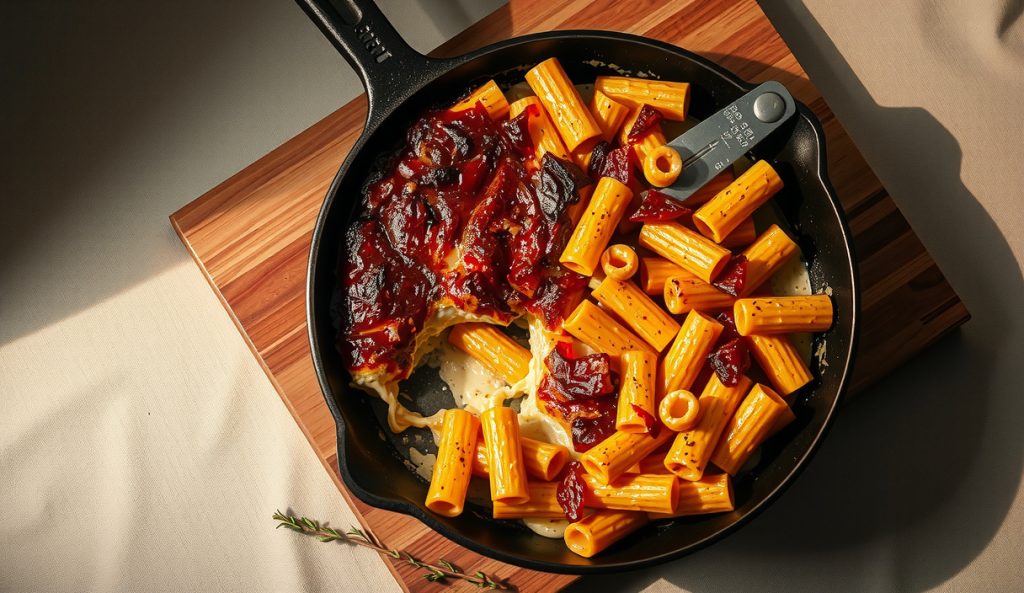
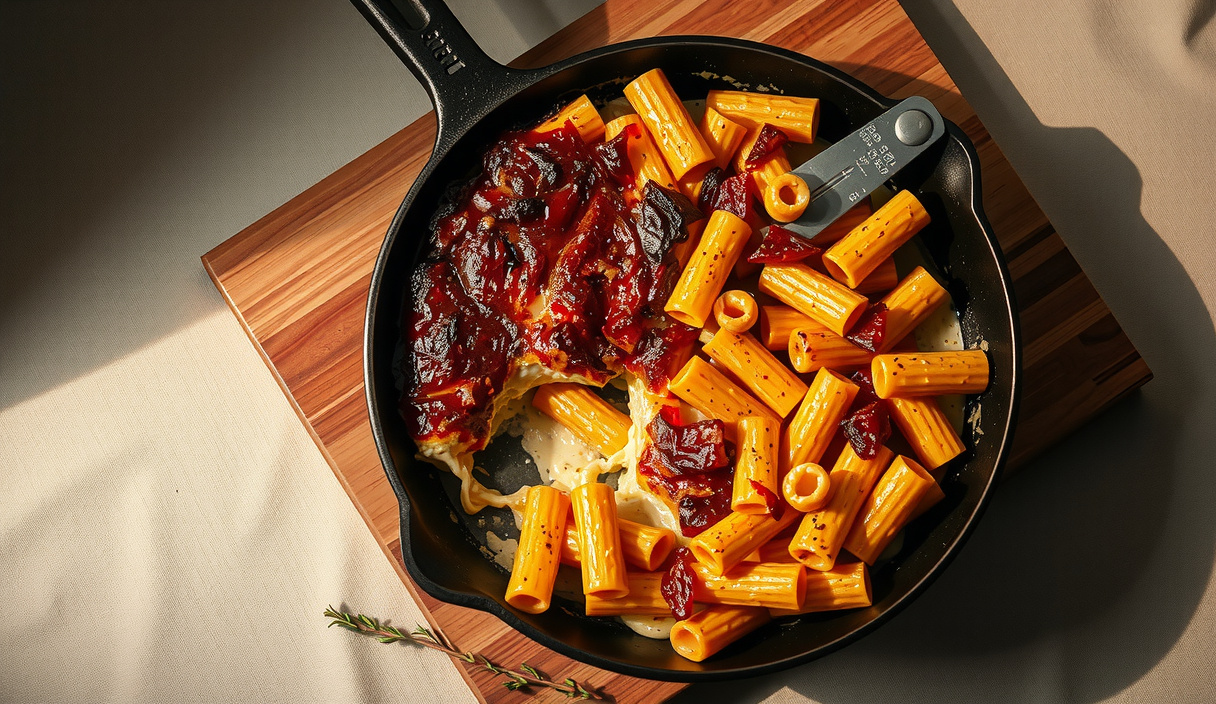
There is a version of mac and cheese that lives on a stovetop, whisked into submission and ladled into bowls. Then there is this version — the one that spends an hour inside a smoker at 275°F, picking up a slow-rendered crust of burnished, caramelized cheese while cherry or apple wood sends its quiet signal into every pore of the pasta. One bite and you understand why the smoker is not a gimmick here. The smoker is doing structural work on the smoked mac and cheese that no stovetop can replicate.
The secret is the béchamel base, and the secret inside that secret is sodium citrate. This recipe uses sodium citrate at 4% w/w of the milk. That single move transforms what would otherwise be a finicky, greasy, broken mess into a lava-smooth emulsion that holds through a full hour of 275°F ambient heat. No velveeta. No processed cheese product. Just real aged cheddar, gruyère, and parmesan — the good stuff — held together by a food-physics intervention that is completely invisible on the plate.
Why does smoked mac and cheese work? The science
Smoked mac and cheese works because sodium citrate stabilizes the cheese emulsion against the heat of the smoker, while 275°F chamber temperature drives Maillard browning rather than scorching. Cheese sauce breaks because the protein and fat phases in aged cheese are poorly emulsified. When sharp cheddar is melted directly into a béchamel and pushed past 160°F, the casein network contracts and squeezes out the milkfat — the result is a greasy, grainy, split sauce.
Sodium citrate (Na₃C₆H₅O₇) prevents this breakdown through ion exchange: the citrate anion chelates the calcium that was cross-linking casein chains together, replacing those calcium bridges with sodium. The proteins remain dispersed rather than contracting into rubbery clumps, and the fat phase stays suspended in a stable oil-in-water emulsion. At 4% w/w — roughly 2 teaspoons per cup of milk — the recipe hits the sweet spot: enough chelation to fully stabilize even high-fat aged cheeses without tipping into a soapy, over-salted finish.
The smoke phase is equally calculated. At a 275°F chamber temperature, the surface of the casserole stays below 300°F throughout the cook, which means the recipe drives Maillard browning — the amino-carbonyl cascade that begins in earnest at roughly 280–300°F on a dry surface — rather than scorching. The lactose in the béchamel and the amino acids in the cheese proteins are the primary Maillard reactants, generating hundreds of volatile aroma compounds including pyrazines, furanones, and thiols. Simultaneously, phenolic compounds from the wood smoke — predominantly guaiacol and syringol from hardwoods — deposit on the protein-rich surface, layering in a barbecue aromatic register that dairy alone cannot produce. The crust tastes simultaneously like a great gratin and a great smoked brisket bark: two entirely different Maillard-pathway outputs converging on one surface.
Pasta geometry is not a trivial choice in a casserole like this. This recipe calls for cavatappi — a ridged, hollow corkscrew — because its surface area-to-volume ratio is high, its ridges mechanically anchor the viscous béchamel, and the hollow tube wicks sauce inside during the bake. Starch released from the pasta into the sauce during the smoke phase also shapes the final texture: as the internal casserole temperature climbs from approximately 140°F to 185°F over the course of an hour, gelatinized starch granules swell and reinforce the continuous phase, pushing the sauce from pourable to spoonable — exactly the consistency needed in a side dish that must hold its shape on a plate.
What equipment and ingredients do I need?
- Sodium citrate: Available online as food-grade trisodium citrate dihydrate (the same compound used in modernist cooking). Do not substitute cream of tartar or citric acid — they are not chemically equivalent for this application. Measure by weight, not volume; precision matters at 4% w/w.
- Cavatappi or similar: Ridged tubular pasta (cellentani, elbow with ridges, or rigatoni) works. Avoid smooth pasta shapes — the sauce will slide off and pool at the bottom.
- Sharp aged cheddar: Shred it yourself from a block. Pre-shredded cheese contains anti-caking agents (cellulose, potato starch) that interfere with the emulsion even with sodium citrate. Buy at least 18-month aged for maximum flavor payoff.
- Gruyère: The nutty, slightly sweet character of gruyère does specific aromatic work here — its high glutamic acid content deepens umami. Cave-aged is worth it if available.
- Smoker at 275°F: This recipe works on any indirect-heat smoker — offset, kettle, pellet, or kamado. Use fruit wood (apple or cherry) for a lighter smoke character that complements dairy; hickory or oak will overpower. If a smoker is unavailable, a charcoal kettle with a 2-zone fire and a handful of soaked chips on the coals approximates it well.
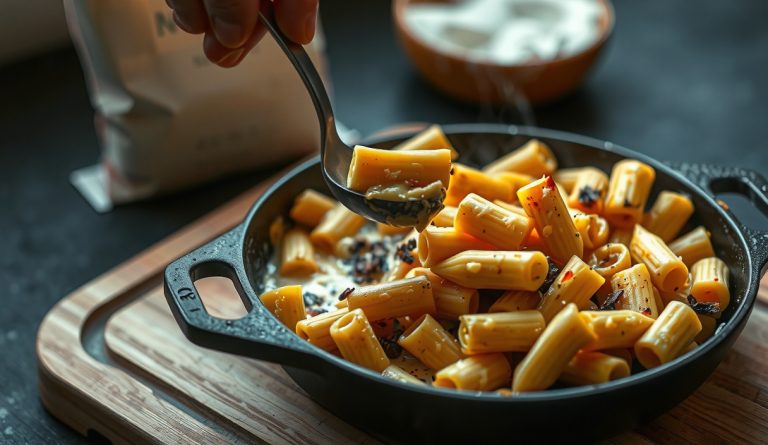
- Cast iron skillet or enameled Dutch oven: A vessel that goes from stovetop to smoker and retains heat is essential. A 12-inch cast iron skillet or a 4-quart enameled Dutch oven works best. Avoid thin aluminum pans — they will cause the bottom layer of pasta to overcook before the top browns.
Smoked Mac & Cheese — Three-Cheese Béchamel
Equipment
- 1 12-inch cast iron skillet or 4-quart enameled Dutch oven Must be stovetop-safe and smoker-safe. No plastic handles.
- 1 Smoker (offset, kettle, kamado, or pellet) Set up for indirect heat at 275°F. Use apple or cherry wood chunks or chips.
- 1 Large pot for boiling pasta
- 1 Kitchen scale Required for accurate sodium citrate measurement at 4% w/w.
- 1 Whisk
- 1 Instant-read thermometer To verify internal casserole temperature of 185–190°F.
- 1 Box grater For block cheese — do not use pre-shredded.
Ingredients
Pasta
- 1 lb cavatappi pasta Or cellentani, ridged elbow, or rigatoni
- 1 tbsp kosher salt For pasta water
Three-Cheese Sodium Citrate Béchamel
- 3 cups whole milk 720g; cold from refrigerator
- 29 g food-grade sodium citrate Trisodium citrate dihydrate; 4% of 720g milk = 28.8g, rounded to 29g. Approx 2 tbsp but weigh for accuracy.
- 3 tbsp unsalted butter
- 3 tbsp all-purpose flour
- 1 cup heavy cream
- 8 oz sharp aged cheddar 18-month or older; shredded from block, not pre-shredded
- 6 oz gruyère Shredded from block; cave-aged preferred
- 3 oz Parmigiano-Reggiano Finely grated
- 1 tsp dry mustard powder
- 1 tsp smoked paprika
- ½ tsp garlic powder
- ¼ tsp white pepper Freshly ground
- ½ tsp kosher salt Adjust to taste; sodium citrate contributes saltiness
Topping
- ½ cup panko breadcrumbs
- 2 tbsp unsalted butter Melted
- 2 tbsp Parmigiano-Reggiano Finely grated, for topping
- ½ tsp smoked paprika For topping color
Instructions
Prep & Fire
- Fire your smoker and bring it to a stable 275°F using indirect heat. Add 2–3 apple or cherry wood chunks (or a generous handful of soaked chips if using a kettle). Allow the smoke to run clean — white billowing smoke indicates incomplete combustion and will make food taste acrid. You want thin blue smoke before food goes on.
- Bring a large pot of water to a rolling boil. Add 1 tablespoon kosher salt. Cook the cavatappi for exactly 2 minutes less than the package minimum time — it should be firmly undercooked with a distinct white center when you bite through. Drain and toss with a light drizzle of neutral oil to prevent sticking. Set aside.1 tbsp kosher salt
Build the Sodium Citrate Béchamel
- In your cast iron skillet or Dutch oven, whisk the 29g sodium citrate into the 3 cups cold whole milk until fully dissolved. This is easier in cold liquid — do not skip this step or add it to hot milk.29 g food-grade sodium citrate, 3 cups whole milk
- Over medium heat, warm the milk-sodium citrate mixture, stirring occasionally, until it reaches 140°F (just below a simmer). Do not boil. Meanwhile, in a separate small saucepan, melt 3 tablespoons butter over medium heat. Whisk in 3 tablespoons all-purpose flour and cook, stirring constantly, for 90 seconds until the roux smells nutty and the raw flour aroma dissipates. This activates the starch’s thickening potential.3 tbsp unsalted butter, 3 tbsp all-purpose flour
- Gradually whisk the hot roux into the warm sodium citrate milk, adding it in a thin stream while whisking constantly. Add the 1 cup heavy cream. Raise heat to medium-high and cook, whisking continuously, until the sauce thickens and coats the back of a spoon — about 5–7 minutes. It will reach approximately 190°F. Remove from heat.1 cup heavy cream
- Add the dry mustard powder, smoked paprika, garlic powder, white pepper, and kosher salt to the hot béchamel. Whisk to combine.1/4 tsp white pepper, 1/2 tsp kosher salt, 1/2 cup panko breadcrumbs, 2 tbsp unsalted butter, 2 tbsp Parmigiano-Reggiano
- Remove the pan from heat entirely. Add the shredded cheddar, gruyère, and Parmigiano-Reggiano in three separate additions, stirring vigorously with a silicone spatula after each until fully melted and incorporated before adding the next. The residual heat (around 170–180°F) plus the sodium citrate emulsion will produce a perfectly smooth, glossy sauce. If the cheese is not melting fully, briefly return the pan to the lowest possible heat for 30-second intervals — do not boil.8 oz sharp aged cheddar, 6 oz gruyère, 3 oz Parmigiano-Reggiano
Assemble
- Add the drained, undercooked cavatappi to the cheese sauce in the skillet. Fold gently with a spatula until every piece of pasta is thoroughly coated. The mixture will look slightly looser than you expect — this is correct. It will tighten significantly during the smoke.
- In a small bowl, combine the panko breadcrumbs, melted butter, 2 tablespoons Parmigiano-Reggiano, and 1/2 teaspoon smoked paprika. Toss until the crumbs are evenly coated. Scatter the topping mixture evenly over the surface of the pasta.1/2 tsp smoked paprika
Smoke
- Transfer the uncovered skillet directly to the smoker grate over indirect heat. Close the lid. Smoke at 275°F for 60 minutes, without opening the lid for the first 45 minutes. After 45 minutes, check the surface — it should be deeply golden with some darker browned spots. If it looks pale, verify your chamber temperature with a grate-level thermometer.
- At the 60-minute mark, verify the internal temperature at the center of the casserole with your instant-read thermometer. You are targeting 185–190°F. If it has not reached 180°F yet, continue smoking in 10-minute increments. Once the target temp is hit and the surface is golden-brown with visible smoke-deposit color, pull the skillet from the smoker.
Rest & Serve
- Allow the mac and cheese to rest uncovered for 10 minutes on a heatproof surface. This rest is not optional — the starch network needs time to firm from fluid to spoonable. Serve directly from the skillet. The bottom crust that has formed against the cast iron is a prize — make sure it gets distributed across portions.
Notes
Nutrition
How do I nail smoked mac and cheese every time?
- Undercook the pasta by 2 full minutes. The pasta continues to hydrate and cook inside the béchamel during the smoke phase. If the pasta is cooked to al dente before it goes in, it will be blown out and mushy after an hour at 275°F. Pull it when it is firmly undercooked — it should have a distinct white center when bitten through.
- Whisk sodium citrate into cold milk before heating. Sodium citrate dissolves most completely in cold liquid. Whisking it into hot milk risks clumping and uneven distribution, which produces inconsistent emulsion stability across the sauce.
- Shred cheese cold, add off-heat. Pull the pan off the burner before adding the cheese. Residual heat (around 170–180°F) is sufficient to melt the fully emulsified cheese slurry without risking protein aggregation from excessive direct heat.
- Do not cover the casserole in the smoker. The golden crust requires direct exposure to convective hot air and smoke. A cover traps steam, keeps the surface moist, and prevents the Maillard cascade from initiating. Leave the smoked mac and cheese bare for the entire 60 minutes.
- Let it rest 10 minutes before serving. The internal temperature at pull (around 185–195°F) means the sauce is very fluid. A 10-minute rest allows the starch network to firm slightly, so the dish holds its shape on the plate rather than flowing like a liquid.
- Failure mode — gritty sauce: If the sauce turns gritty before the cheese is fully incorporated, the sodium citrate concentration was insufficient or the cheese was added too fast over too-high heat. Rescue it by whisking in an additional teaspoon of sodium citrate dissolved in 2 tablespoons of warm water, then gently stirring over low heat until the emulsion reforms.
What variations can I make on this recipe?
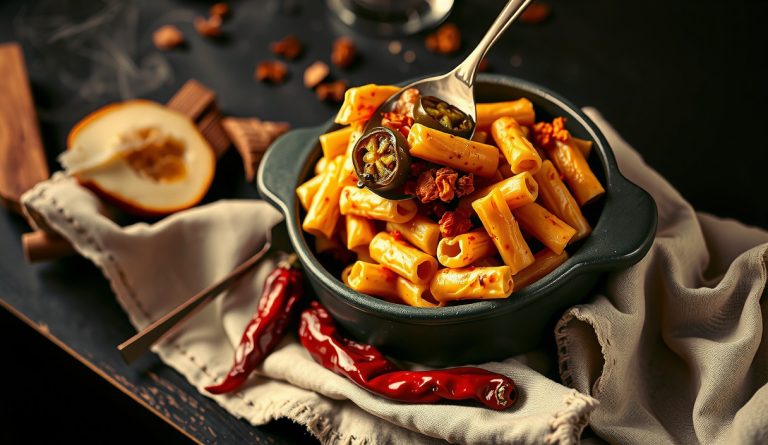
Spicy version: Add 1 teaspoon of chipotle powder and 1/2 teaspoon of cayenne to the béchamel along with the dry spices. The capsaicin activates TRPV1 receptors and amplifies the perception of smokiness — the heat and the wood smoke read as the same sensory register. Swap cheddar for a smoked gouda to double down on the smoke signal. Finish with a layer of pickled jalapeño slices across the top for the last 15 minutes of the smoke.
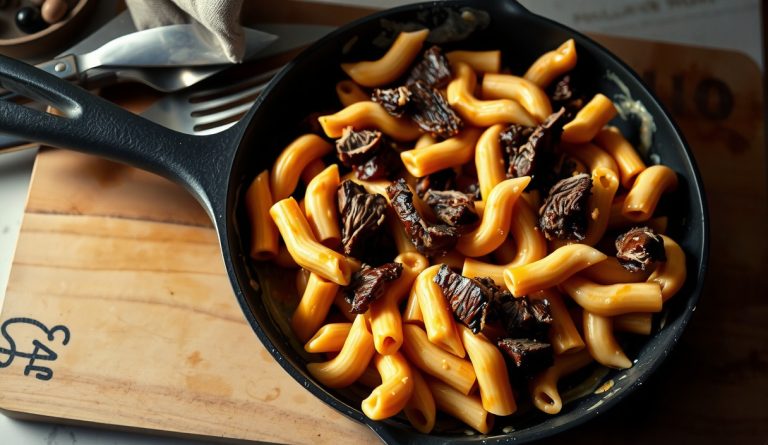
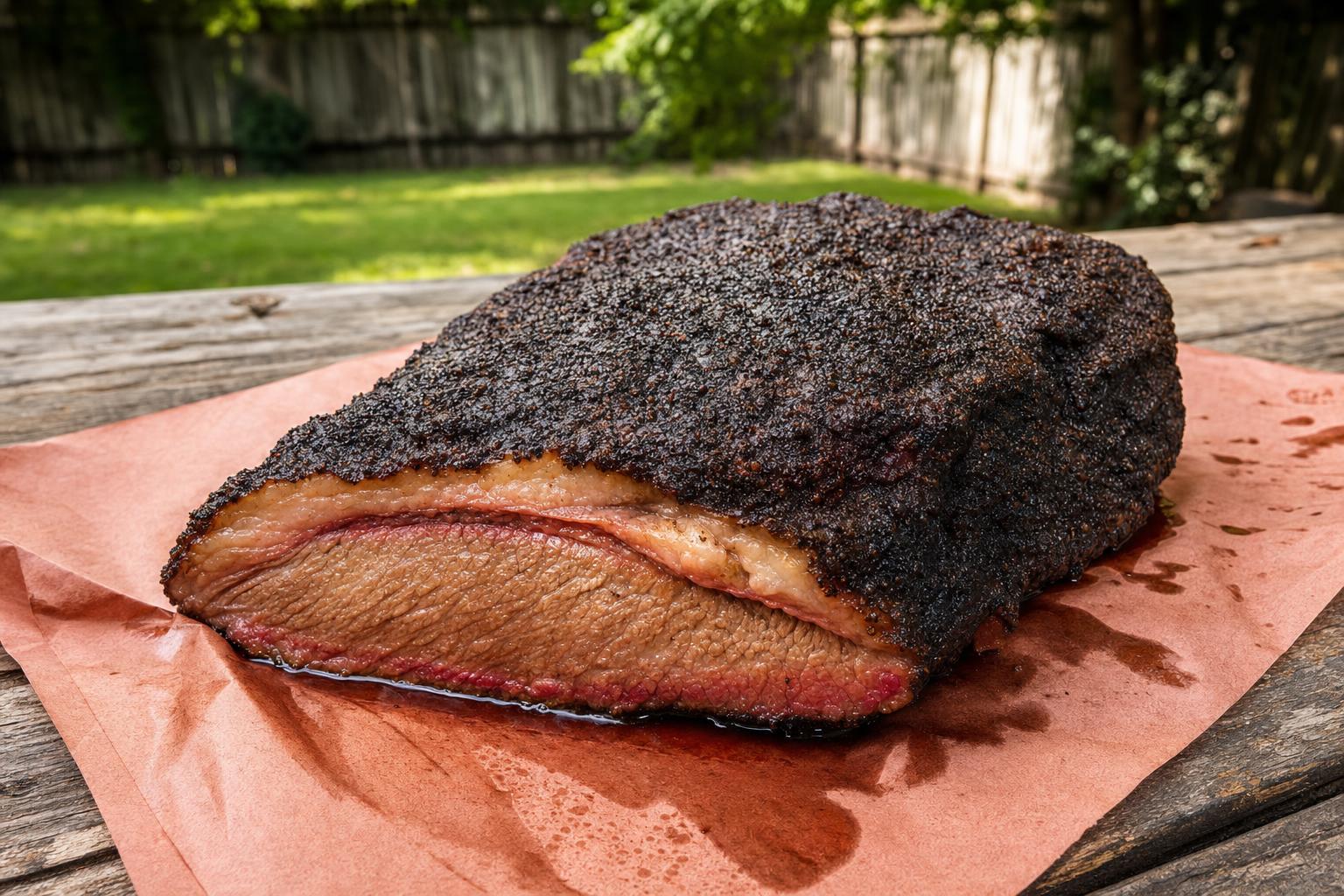
Meat-loaded version: Fold in 8 ounces of pulled smoked pork shoulder or chopped smoked brisket point just before transferring to the smoker. The collagen-rich braised meat adds a separate gelatin network to the sauce, increasing the final body of the dish substantially. Reduce the pasta by about 25% to maintain sauce-to-solid ratio. This turns a side dish into a standalone main.
Gluten-free adaptation: Swap the cavatappi for a high-quality brown rice or chickpea pasta (Banza cavatappi holds up well), and replace the all-purpose flour in the roux with an equal weight of superfine white rice flour. The rice flour roux produces a slightly less opaque béchamel but behaves identically from a viscosity standpoint. The sodium citrate emulsion is entirely gluten-independent — it works the same way regardless of the flour source.
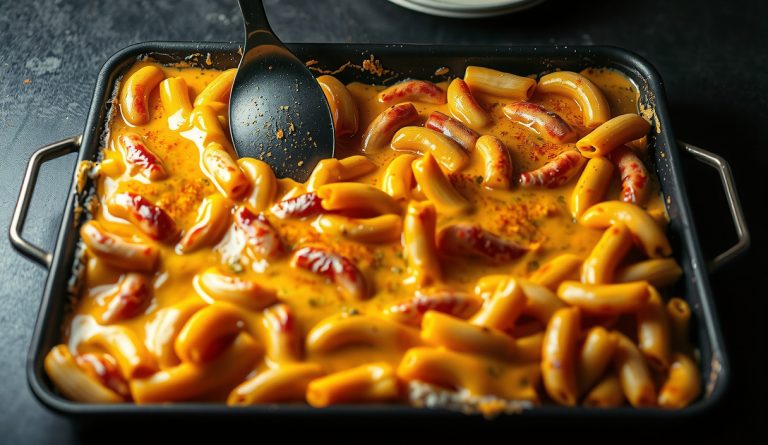
Scaling up for a crowd: This recipe scales linearly. For a full half-sheet hotel pan (feeds 20–24 as a side), triple the recipe, distribute across two 12-inch cast iron skillets or one large enameled roasting pan, and extend the smoke time to 75–80 minutes to account for the increased mass. Maintain the 275°F chamber temperature — do not raise it to compensate for the larger batch, as the surface will over-brown before the interior sets.
Frequently asked questions about smoked mac and cheese
Can I make smoked mac and cheese ahead and smoke it later? Yes, with one caveat. Assemble the dish through the transfer step — pasta tossed in sauce in the skillet — then cool completely and refrigerate covered for up to 24 hours. Pull the dish from the refrigerator 30 minutes before smoking to let the temperature equalize. Add 10–15 minutes to the smoke time, as the cook is now starting from a colder core temperature. Do not add the breadcrumb topping until ready to smoke.
Why does the cheese sauce break even with sodium citrate? The two most common culprits are heat that is too high during the cheese-addition step, and cheese added too quickly without continuous stirring. Sodium citrate modifies the calcium crosslinks in casein, but intense direct heat applied while the cheese proteins are in a transitional unfolded state can still trigger hydrophobic aggregation. Always add cheese off direct heat, in three or four separate additions, stirring constantly between each addition until fully incorporated before adding more.
What internal temperature should smoked mac and cheese reach? Target 185–190°F at the geometric center of the dish when measured with an instant-read thermometer. At this temperature, the starch network has fully set, the cheese emulsion is stable, and any residual dairy food-safety concerns are resolved. Below 165°F, the interior may still be fluid and insufficiently set. Above 200°F, the sauce risks breaking at the bottom of the pan where it contacts the cast iron directly.