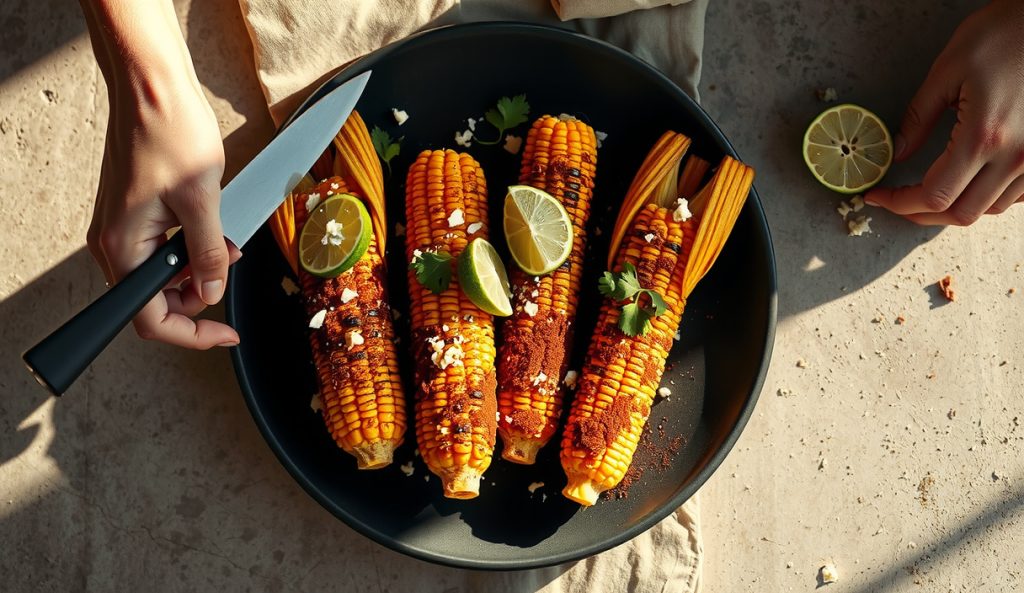
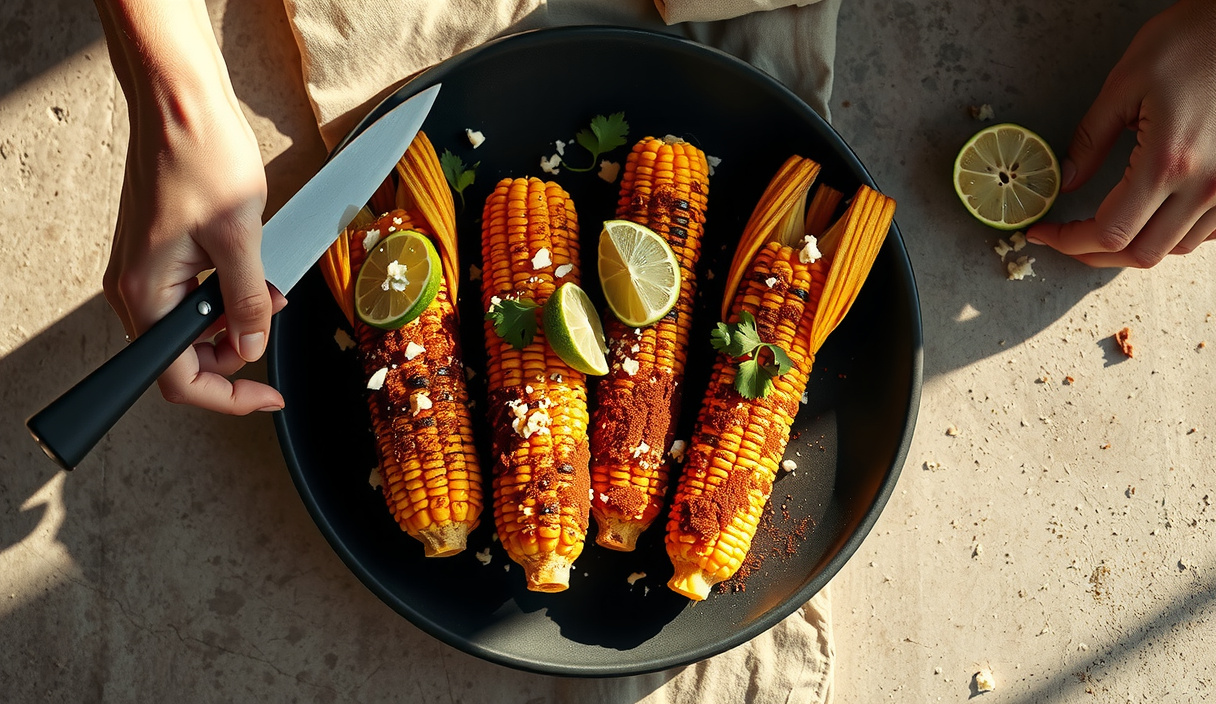
Grilled Corn on the Cob — Mexican Street-Style Elote
Equipment
- 1 Charcoal or gas grill Must reach 500–550°F at the grate. Preheat a minimum of 15 minutes with the lid closed before cooking.
- 1 each Grill brush and tongs Clean and oil the grate immediately before the corn goes on.
- 1 Pastry brush or spoon For applying the mayo-crema coating while the cob is still hot.
- 1 Microplane or zester For lime zest; zest directly over the sauced cob while it is still warm.
- 1 Shallow dish or plate Wide enough to roll the cob through the cotija for full coating.
Ingredients
Corn
- 4 ears fresh sweet corn Husks and silk fully removed. Bicolor or yellow varieties preferred. Do not soak in water.
- 1 tablespoon neutral oil Canola or vegetable oil, for oiling the grate.
Elote Sauce
- ¼ cup full-fat mayonnaise Duke’s or Hellmann’s full-fat. Not light, not mayo-style dressing.
- 3 tablespoons Mexican crema Crema Mexicana (Cacique brand works well). Substitute: 2 tablespoons sour cream plus 1 tablespoon heavy cream plus a pinch of salt.
- ½ teaspoon fine sea salt Stir into the sauce base.
Finishing Toppings
- ¾ cup cotija cheese Aged, dry-style cotija, finely crumbled. Substitute: aged pecorino romano, finely grated. Do not use feta.
- 1 ½ teaspoons ancho chili powder Gebhardt’s or a good ancho-forward blend. For more heat, blend 3 parts ancho to 1 part cayenne.
- 2 limes Zest of both limes, juice of both limes, applied separately — zest while cob is warm, juice immediately before eating.
- 2 tablespoons fresh cilantro leaves Optional. Torn, not chopped. Add just before serving.
- 1 teaspoon hot sauce Optional. Valentina or Tapatío. Drizzle over the finished cob.

Instructions
Prepare and Build the Sauce
- In a small bowl, whisk together the full-fat mayonnaise, Mexican crema, and fine sea salt until smooth and uniform. Set aside at room temperature — do not refrigerate. The sauce needs to be fluid enough to flow into the char crevices on a hot cob.3 tablespoons Mexican crema, 1/2 teaspoon fine sea salt, 3/4 cup cotija cheese
- Crumble the cotija cheese finely onto a wide, shallow plate or dish large enough to roll an ear of corn through. The crumble should be fine enough to adhere to the wet sauce surface — roughly the texture of coarse breadcrumbs. Set aside.1 1/2 teaspoons ancho chili powder
Preheat the Grill
- Preheat your charcoal or gas grill to high heat with the lid closed for a minimum of 15 minutes. You are targeting a grate temperature of 500–550°F. For charcoal, this means a full chimney of lit coals spread in an even layer. For gas, all burners on high. Do not rush this step — a fully preheated grate is the single most important variable for Maillard char formation on the kernel surface.
- Fold a paper towel over itself, dip it in the neutral oil, and use tongs to wipe the grate surface thoroughly. The oil creates a nonstick layer and helps conduct heat directly to the corn surface. Do this immediately before the corn goes on.1 tablespoon neutral oil
Grill the Corn
- Place the husked ears of corn directly on the hot grate. Leave the grill lid open — this allows surface moisture to escape rather than recirculating as steam, which would retard char formation. Do not crowd the cobs; leave at least one inch of space between each ear.
- Grill the corn, turning every 2–3 minutes, for a total of 12–15 minutes. You are targeting scattered, deep char marks across 30–40% of the total kernel surface area — not uniform golden toasting and not wholesale blackening. Some kernels should be deeply browned to near-black; others remain bright yellow. This variation in browning creates the full aromatic complexity: light Maillard notes from the partially browned kernels, and heavy pyrazine-furan roast notes from the deeply charred ones. If flare-ups occur from dripping moisture, close the lid briefly to extinguish, then reopen immediately.
- Pull the corn from the grill when the char distribution is right. Work quickly — the next steps must happen while the cob is still very hot.
Sauce, Coat, and Finish
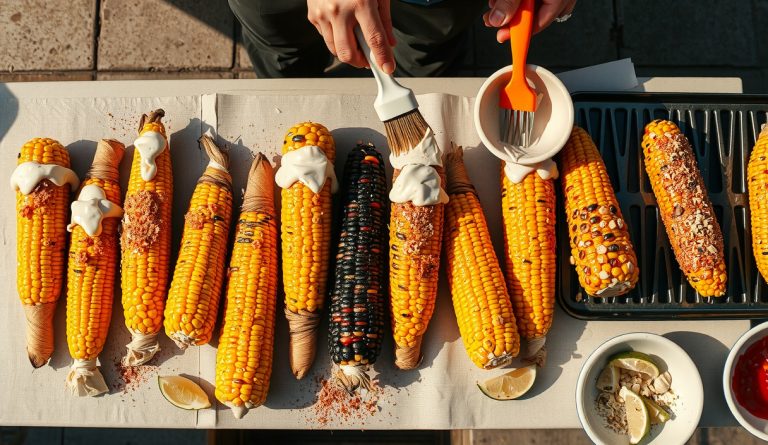
- Using a pastry brush or spoon, immediately coat each hot ear of corn generously with the mayo-crema sauce. The heat of the cob will thin the sauce slightly, encouraging it to flow into the crevices between charred kernels. Turn the cob as you go to coat all sides. Do not be timid — a thick, even coating is the goal.3 tablespoons Mexican crema, 1/2 teaspoon fine sea salt, 3/4 cup cotija cheese
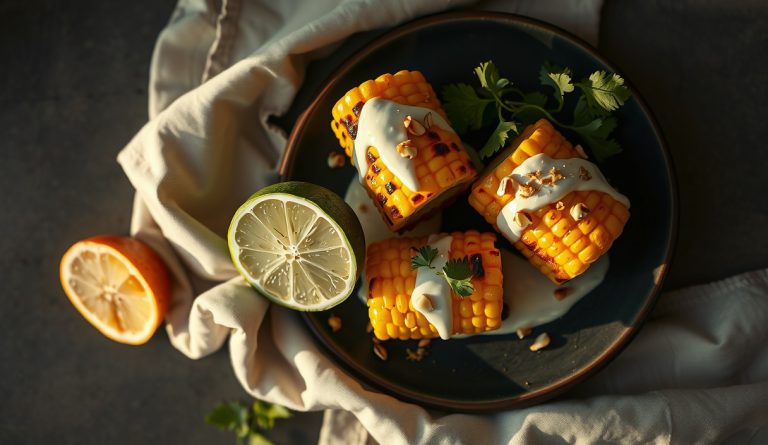
- Roll the sauced cob across the plate of crumbled cotija, pressing gently to pack the cheese into the wet sauce surface. Rotate the cob to cover all faces. The cheese layer should be thick and visually dramatic — this is structurally correct, not excessive.1 1/2 teaspoons ancho chili powder
- Dust each cob evenly with ancho chili powder. Zest both limes directly over the warm, sauced cobs — zest them now while the cob is warm so the citrus essential oils volatilize and integrate with the char aroma. Do not add the juice yet.2 limes, 2 tablespoons fresh cilantro leaves
- Immediately before serving, squeeze fresh lime juice generously over each cob. This is the final acid note — it should arrive sharp and bright on the palate. Add the optional torn cilantro leaves and a drizzle of hot sauce if using. Serve immediately.2 tablespoons fresh cilantro leaves, 1 teaspoon hot sauce
Notes
Nutrition
The first time I stood on Avenida Insurgentes watching a street vendor drag a naked ear of corn across a screaming-hot plancha, I stopped thinking about food as an ingredient list. The char hitting those kernel-faces was not burning — it was building. Every blackened spot was a factory of pyrazines, furans, and alkyl-phenols: the volatile organic compounds that make roasted corn smell like roasted corn and nothing else on earth. We chased that memory straight into the test kitchen, and what follows is the result: a direct-fire, husks-off elote built on the actual chemistry of the char.
This recipe lives at the intersection of pitmaster thinking and molecular gastronomy. The corn goes naked on the grate. The sauce is built in layers — mayo for fat-solubility of aroma compounds, crema for acidity and dairy sheen, cotija for crystalline salt contrast, chili-lime for trigeminal punch. Get the fire right and none of that is flavor-masking; it is flavor-amplification.
Why does grilled elote taste like nothing else? The science
Elote achieves its signature roasted depth because naked corn kernels — roughly 70% moisture — hit the Maillard temperature window within 90 seconds of landing on a 500–550°F grate. The moment a husks-off cob contacts direct flame, two competing thermodynamic processes begin: surface water vaporizes, anchoring the kernel-face temperature near 212°F while absorbing latent heat, and conduction simultaneously drives heat inward toward the starchy interior. As the surface desiccates, water activity at the kernel face drops below 0.7, unlocking the Maillard cascade.
Free amino acids in corn — predominantly asparagine, proline, and lysine — condense with reducing sugars (glucose and fructose from the kernel’s natural sweetness) to form Schiff bases, which rearrange through Amadori products into dozens of aromatic volatile classes. The dominant aroma-active molecules in roasted corn are 2-acetyl-1-pyrroline (popcorn, toasted bread), 2-ethyl-3,5-dimethylpyrazine (nutty, roasted), and multiple furanones — all generated between roughly 280°F and 350°F at the kernel surface. Turning the cob frequently targets that precise window and prevents any single face from pushing past it into acrid incineration territory.
The mayonnaise in elote is not merely condiment — it is a structured oil-in-water emulsion functioning as the primary hydrophobic solvent for lipophilic aroma compounds produced during charring. Fat-soluble pyrazines and alkylphenols partition strongly into the lipid droplets of the mayo layer, depressing their vapor pressure and creating a sustained, time-delayed aromatic release on the palate rather than a sharp spike that fades. Mexican crema’s mild acidity (pH approximately 4.5–5.0) provides a brightening counterpoint without aggressively destabilizing the mayo emulsion; the relatively low acidity keeps the egg-protein interfacial film intact. Cotija cheese contributes crystalline sodium chloride microparticles that dissolve progressively during mastication, generating salt-fat synergy and competitively suppressing bitter Maillard end-products from the deeper char zones.
The chili powder activates TRPV1 receptors via capsaicin — a trigeminal chemesthetic effect that dramatically heightens perceived flavor intensity across all modalities. Lime juice introduces citric acid (pH approximately 2.2–2.4 neat), which, when applied to the hot cob surface, undergoes rapid esterification reactions with the char surface compounds, softening harsh acrid notes and producing new ester volatiles. The lime zest delivers cold-pressed citrus oils dominated by d-limonene, which volatilize rapidly over the warm cob surface, providing the olfactory top-note that ties the entire sensory architecture together.
What equipment and ingredients do I actually need?
- Charcoal vs. gas: Charcoal running at 500–550°F grate temperature produces the highest concentration of pyrazine-generating surface heat with a mild smoke contribution. Gas works fine — crank all burners to high, close the lid for 15 minutes to fully preheat the grates, then cook with the lid open so moisture escapes rather than steaming the cob.
- Corn selection: Use sweet corn at peak season, ideally bicolor or yellow. Silver Queen and Peaches and Cream varieties have higher sucrose-to-starch ratios at the outer pericarp, which accelerates Maillard browning. Avoid pre-husked corn sitting in refrigerated misters — the cold and moisture retard surface desiccation on the grill.
- Mayonnaise quality: Full-fat, egg-yolk-stabilized mayo (not light mayo, not mayo-style dressing) is required. The dispersed fat fraction needs to be high enough to genuinely capture and time-release lipophilic char volatiles. Duke’s or Hellmann’s full-fat are the right call.
- Cotija cheese: Aged cotija is significantly drier and saltier than fresh — it crumbles into sharp crystalline fragments rather than melting. If you cannot source cotija, aged pecorino romano provides a similar crystalline salt structure. Do not substitute feta, which has too high a moisture content and will smear rather than crumble.
- Mexican crema: Look for cultured crema Mexicana (Cacique is widely available). Crema Mexicana has higher fat content (approximately 30%) and lower acidity than American sour cream, making it less likely to break when applied to a warm surface. In a pinch, mix 1/4 cup sour cream with 2 tablespoons heavy cream and a pinch of salt.
- Chili powder blend: Use a good ancho-forward chili powder (Gebhardt’s is the standard). Pure cayenne alone skips the complexity; pure ancho alone lacks heat. A 3:1 blend of ancho to cayenne gives the color, earthiness, and TRPV1 activation simultaneously.
Grilled Corn on the Cob — Mexican Street-Style Elote
Equipment
- 1 Charcoal or gas grill Must reach 500–550°F at the grate. Preheat a minimum of 15 minutes with the lid closed before cooking.
- 1 each Grill brush and tongs Clean and oil the grate immediately before the corn goes on.
- 1 Pastry brush or spoon For applying the mayo-crema coating while the cob is still hot.
- 1 Microplane or zester For lime zest; zest directly over the sauced cob while it is still warm.
- 1 Shallow dish or plate Wide enough to roll the cob through the cotija for full coating.
Ingredients
Corn
- 4 ears fresh sweet corn Husks and silk fully removed. Bicolor or yellow varieties preferred. Do not soak in water.
- 1 tablespoon neutral oil Canola or vegetable oil, for oiling the grate.
Elote Sauce
- ¼ cup full-fat mayonnaise Duke’s or Hellmann’s full-fat. Not light, not mayo-style dressing.
- 3 tablespoons Mexican crema Crema Mexicana (Cacique brand works well). Substitute: 2 tablespoons sour cream plus 1 tablespoon heavy cream plus a pinch of salt.
- ½ teaspoon fine sea salt Stir into the sauce base.
Finishing Toppings
- ¾ cup cotija cheese Aged, dry-style cotija, finely crumbled. Substitute: aged pecorino romano, finely grated. Do not use feta.
- 1 ½ teaspoons ancho chili powder Gebhardt’s or a good ancho-forward blend. For more heat, blend 3 parts ancho to 1 part cayenne.
- 2 limes Zest of both limes, juice of both limes, applied separately — zest while cob is warm, juice immediately before eating.
- 2 tablespoons fresh cilantro leaves Optional. Torn, not chopped. Add just before serving.
- 1 teaspoon hot sauce Optional. Valentina or Tapatío. Drizzle over the finished cob.
Instructions
Prepare and Build the Sauce
- In a small bowl, whisk together the full-fat mayonnaise, Mexican crema, and fine sea salt until smooth and uniform. Set aside at room temperature — do not refrigerate. The sauce needs to be fluid enough to flow into the char crevices on a hot cob.3 tablespoons Mexican crema, 1/2 teaspoon fine sea salt, 3/4 cup cotija cheese
- Crumble the cotija cheese finely onto a wide, shallow plate or dish large enough to roll an ear of corn through. The crumble should be fine enough to adhere to the wet sauce surface — roughly the texture of coarse breadcrumbs. Set aside.1 1/2 teaspoons ancho chili powder
Preheat the Grill
- Preheat your charcoal or gas grill to high heat with the lid closed for a minimum of 15 minutes. You are targeting a grate temperature of 500–550°F. For charcoal, this means a full chimney of lit coals spread in an even layer. For gas, all burners on high. Do not rush this step — a fully preheated grate is the single most important variable for Maillard char formation on the kernel surface.
- Fold a paper towel over itself, dip it in the neutral oil, and use tongs to wipe the grate surface thoroughly. The oil creates a nonstick layer and helps conduct heat directly to the corn surface. Do this immediately before the corn goes on.1 tablespoon neutral oil
Grill the Corn
- Place the husked ears of corn directly on the hot grate. Leave the grill lid open — this allows surface moisture to escape rather than recirculating as steam, which would retard char formation. Do not crowd the cobs; leave at least one inch of space between each ear.
- Grill the corn, turning every 2–3 minutes, for a total of 12–15 minutes. You are targeting scattered, deep char marks across 30–40% of the total kernel surface area — not uniform golden toasting and not wholesale blackening. Some kernels should be deeply browned to near-black; others remain bright yellow. This variation in browning creates the full aromatic complexity: light Maillard notes from the partially browned kernels, and heavy pyrazine-furan roast notes from the deeply charred ones. If flare-ups occur from dripping moisture, close the lid briefly to extinguish, then reopen immediately.
- Pull the corn from the grill when the char distribution is right. Work quickly — the next steps must happen while the cob is still very hot.
Sauce, Coat, and Finish
- Using a pastry brush or spoon, immediately coat each hot ear of corn generously with the mayo-crema sauce. The heat of the cob will thin the sauce slightly, encouraging it to flow into the crevices between charred kernels. Turn the cob as you go to coat all sides. Do not be timid — a thick, even coating is the goal.3 tablespoons Mexican crema, 1/2 teaspoon fine sea salt, 3/4 cup cotija cheese
- Roll the sauced cob across the plate of crumbled cotija, pressing gently to pack the cheese into the wet sauce surface. Rotate the cob to cover all faces. The cheese layer should be thick and visually dramatic — this is structurally correct, not excessive.1 1/2 teaspoons ancho chili powder
- Dust each cob evenly with ancho chili powder. Zest both limes directly over the warm, sauced cobs — zest them now while the cob is warm so the citrus essential oils volatilize and integrate with the char aroma. Do not add the juice yet.2 limes, 2 tablespoons fresh cilantro leaves
- Immediately before serving, squeeze fresh lime juice generously over each cob. This is the final acid note — it should arrive sharp and bright on the palate. Add the optional torn cilantro leaves and a drizzle of hot sauce if using. Serve immediately.2 tablespoons fresh cilantro leaves, 1 teaspoon hot sauce
Notes
Nutrition
How do I nail grilled elote every time?
- Preheat the grate until it smokes. A cold or warm grate will steam the corn surface. Instantaneous surface desiccation requires contact with 500°F+ steel — that contact strips the boundary water and jumps the kernel surface straight into the Maillard window. Preheat a minimum of 15 minutes with the lid closed, then brush the grate clean and oil it immediately before the corn goes on.
- Keep the corn moving. Turn every 2–3 minutes, targeting 4–5 contact faces across the irregular surface of the cob. The goal is scattered, deep char over at least 30–40% of the kernel surface area — not uniform toasting and not wholesale incineration. If flames flare from dripping kernel moisture, briefly close the lid to extinguish rather than moving the corn to a cooler zone and sacrificing char formation.
- Apply mayo while the cob is still hot. The residual heat from a just-grilled cob warms the mayo layer slightly, lowering its viscosity and encouraging it to flow into the char crevices between kernels. Do not let the cob cool first — the sauce will sit on top rather than coating intimately.
- Layer the cotija last, and use more than you think. Cotija is the primary salt delivery system. The tendency is to dust lightly; the correct move is to roll or pack the cheese into the wet mayo-crema surface so it adheres in a thick crust. The cheese-to-corn ratio should be visually shocking. This is intentional.
- Lime zest before juice. Add the zest while the cob is warm so the essential oils volatilize and integrate with the char aroma. Add the juice immediately before eating — the fresh acid should arrive on the palate as a bright, cutting note at the end, not be cooked into the topping.
- Failure mode — pale, steamed kernels: Uniform pale-yellow kernels with zero char after 3 minutes mean the fire is too cool. Pull the corn, increase the heat, wait 5 more minutes, and try again. Steamed corn served with elote toppings is not elote.
What are the best elote variations worth trying?
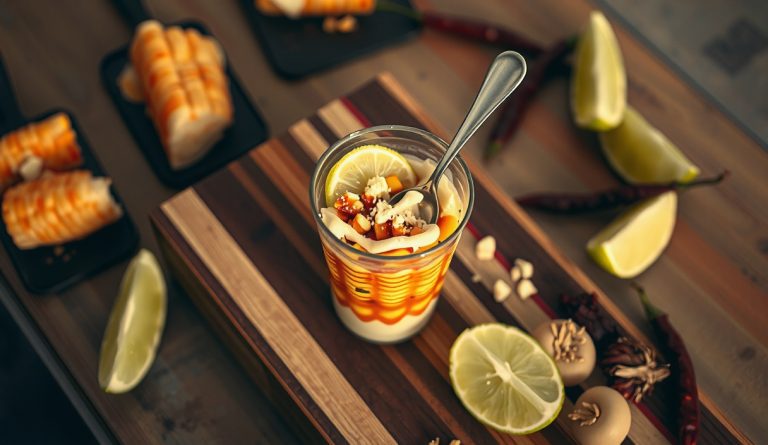
Elote en vaso (cup style): Cut the charred kernels off the cob using a sharp chef’s knife, collect them in a disposable cup or bowl, and toss with the full elote topping suite — mayo, crema, cotija, chili, lime. Add a tablespoon of hot sauce (Valentina or Tapatío) for additional acid-heat layering. This format travels better, requires no utensil gymnastics, and lets you control the sauce-to-kernel ratio more precisely. Kernels cut off the cob expose more surface area for sauce adhesion, which intensifies the coating effect.
Dairy-free adaptation: Replace the mayonnaise with a full-fat aquafaba-based vegan mayo (Duke’s Vegan or Sir Kensington’s Fabanaise) and the crema with full-fat coconut cream thinned with a teaspoon of rice vinegar and a pinch of salt to approximate the pH of cultured crema. Substitute cotija with a dry, aged vegan cheese or with a 50/50 blend of nutritional yeast and finely ground toasted pepitas — the yeast contributes glutamate umami while the pepita provides the salt-fat crystalline contrast that cotija normally supplies. The emulsion physics of vegan mayo are slightly less stable under heat, so apply the sauce more quickly after pulling the corn from the grill.
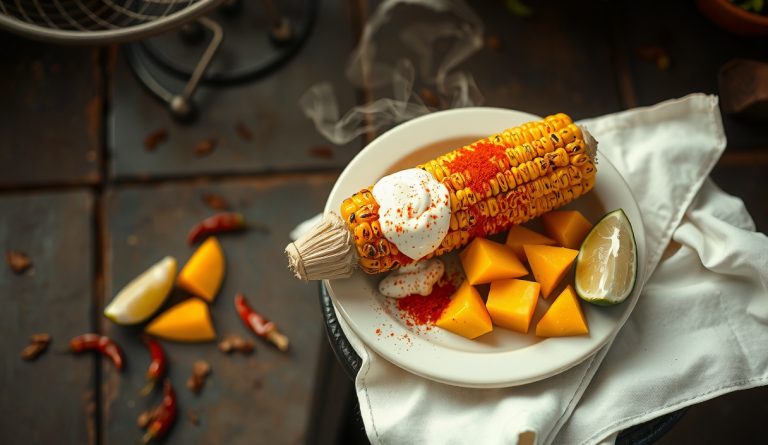
Tajín and mango variant: Swap the chili powder for Tajín Clásico (a commercial blend of chili, lime, and sea salt already balanced at an optimal TRPV1-to-acid ratio), and add thin mango slices fanned alongside each cob. The mango provides fructose and citric acid that further accelerates surface esterification on the warm corn, and its sweetness creates a hedonic contrast against the salt-chili crust that makes heat perception spike then fall away cleanly. This is a legitimate street variant common in coastal Mexican states.
Scaling for a crowd: This recipe scales linearly — double or triple the sauce quantities freely. The only grill constraint is grate real estate. Six ears of corn require approximately 18 inches of linear grate space. If cooking more than eight ears, stagger the starts by four minutes to avoid all cobs needing rotation simultaneously. The sauce can be prepared up to four hours ahead and refrigerated; the cotija can be pre-crumbled and held dry. Assembly takes ninety seconds per cob, which is the actual production-rate bottleneck at scale.
Frequently asked questions
Do I need to soak the corn in water before grilling? No. Soaking applies to husks-on corn to prevent the husk from catching fire. This recipe calls for husks-off, naked corn on direct flame. Soaking husks-off corn waterloads the outer kernel layers and severely delays surface desiccation, robbing the cook of the Maillard char the elote method requires. Do not soak.
Can I make elote in a cast iron grill pan indoors? Yes, with caveats. Preheat a 12-inch cast iron grill pan over high heat for 8–10 full minutes until it just begins to smoke. Work with one cob at a time, pressing the corn gently against the ridges and turning every 90 seconds. Char formation will be ridge-pattern only rather than full-kernel scatter, and smoke output will be significant — run the exhaust fan at full capacity. The pyrazine chemistry is identical to outdoor grilling; the aroma profile inside the apartment will be intense and will linger. This is acceptable.
Why does cotija slide off the cob? Cotija slides off when the mayo-crema coating has cooled and skinned over before the cheese is applied. The mayo-crema layer needs to be applied while the cob is still hot, then immediately packed with cotija before the fat layer loses viscosity. If the sauce was applied to a cooled cob, reheat the cob briefly over the grill for 30 seconds, re-apply a thin additional mayo layer, and immediately pack the cotija on again. The correct assembly sequence is one continuous motion: pull from grill, sauce, cotija, chili, zest, juice, serve.