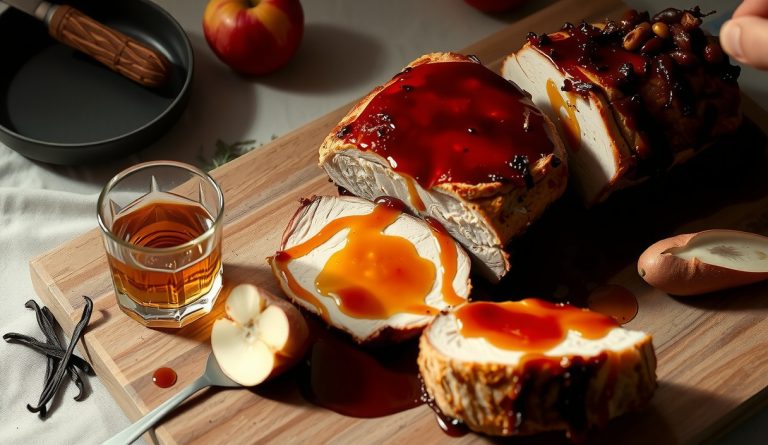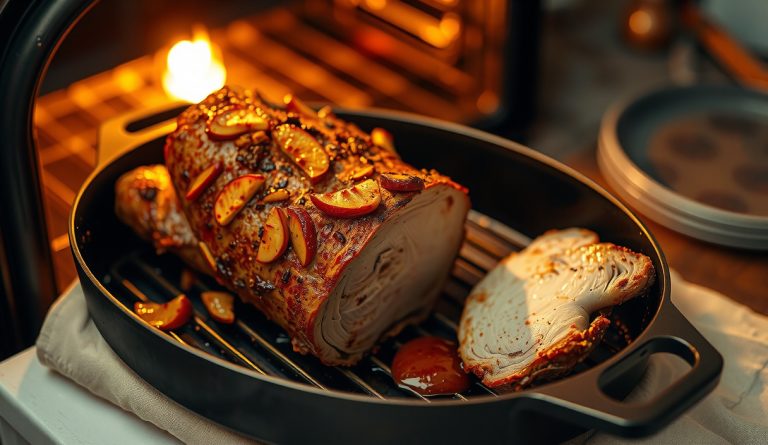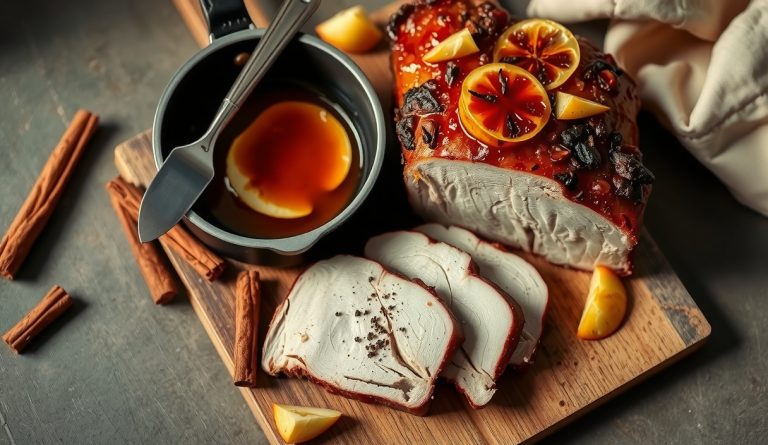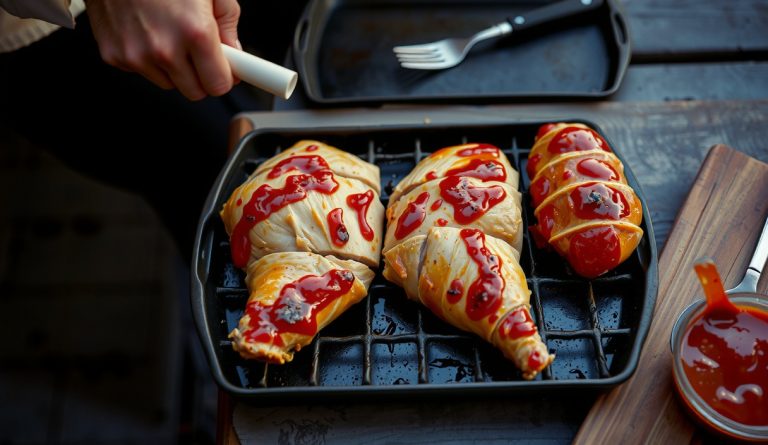
Smoked Pork Tenderloin with Apple-Cider Glaze

Equipment
- 1 Smoker (offset, pellet, kettle, or vertical) Calibrated to hold a stable 250°F (121°C) chamber temperature
- 1 Instant-read thermometer Insert into the geometric center of the thickest part of the tenderloin
- 1 Small saucepan For reducing the apple cider glaze on the stovetop
- 1 Wire rack For resting the finished tenderloin to preserve bark integrity
- 1 Silicone basting brush For applying the glaze in thin, even coats
- 2 Apple or cherry wood chunks or chips Chunks preferred for a pellet or offset smoker; chips in a foil pouch for a kettle grill
Ingredients
Pork
- 1 pork tenderloin (1 to 1.25 lb / 450–570 g), silver skin removed A single tenderloin as sold in most grocery stores; trim any visible fat and peel off the silver skin before proceeding
- 1 tsp kosher salt Diamond Crystal; use 3/4 tsp if Morton
- ½ tsp freshly ground black pepper
- ½ tsp smoked paprika Optional; adds a phenolic aromatic baseline if wood smoke alone is subtle
- ½ tsp garlic powder
- ½ tsp onion powder
- 1 tbsp neutral oil (avocado or canola) Acts as a binder for the dry rub and helps initiate surface browning
Apple-Cider Glaze
- 2 cups fresh unfiltered apple cider Not sparkling cider or cider vinegar; look for unfiltered, fresh-pressed juice at 10–11 °Brix for the best aromatic payload after reduction
- 1 tbsp apple cider vinegar Adds malic-acid brightness and keeps the glaze from tasting flat once concentrated
- 1 tbsp whole-grain Dijon mustard Provides emulsifying mucilage and a subtle piquancy that balances the sweetness
- ¼ tsp kosher salt
- ¼ tsp freshly ground black pepper
- 1 pinch cayenne pepper Optional; a small amount of capsaicin activates TRPV1 receptors and sharpens the perception of sweetness

Instructions
Prepare the Tenderloin
- Pat the pork tenderloin completely dry with paper towels. Locate the silver skin — the iridescent, pearlescent membrane running along one side — and slide a thin boning or paring knife under it. Hold it taut with a paper towel for grip and peel it off in one continuous strip. Discard.
- In a small bowl, combine the kosher salt, black pepper, smoked paprika, garlic powder, and onion powder. Coat the tenderloin evenly with the neutral oil, then apply the dry rub on all sides, pressing gently to adhere. Allow to rest uncovered at room temperature for 20 to 30 minutes while the smoker preheats. If time permits, dry-brine overnight in the refrigerator uncovered — the surface will desiccate slightly, which accelerates Maillard browning on the smoker.1 tsp kosher salt, 1/2 tsp freshly ground black pepper, 1/2 tsp smoked paprika, 1/2 tsp garlic powder, 1/2 tsp onion powder, 1 tbsp neutral oil (avocado or canola)
Reduce the Apple-Cider Glaze
- Combine the apple cider, apple cider vinegar, whole-grain Dijon mustard, salt, pepper, and cayenne (if using) in a small saucepan. Stir to combine. Set over medium-low heat and bring to a steady, gentle simmer — do not boil aggressively, as a rapid boil drives off desirable aromatic esters faster than it concentrates sugars.2 cups fresh unfiltered apple cider, 1 tbsp apple cider vinegar, 1 tbsp whole-grain Dijon mustard, 1/4 tsp kosher salt, 1/4 tsp freshly ground black pepper, 1 pinch cayenne pepper
- Simmer uncovered, stirring occasionally, until the liquid reduces to approximately 1/2 cup (one-quarter of the original volume) — roughly 20 to 25 minutes. The glaze is ready when it coats the back of a spoon and a line drawn through it holds its shape for two to three seconds. Remove from heat and set aside. The glaze will thicken slightly as it cools.2 cups fresh unfiltered apple cider, 1 tbsp apple cider vinegar
Smoke the Tenderloin
- Set up your smoker for indirect cooking and stabilize the chamber temperature at 250°F (121°C). Add apple or cherry wood chunks — two small chunks for a long cook smoker, or a foil packet of soaked chips positioned over a coal snake for a kettle. You want a thin, pale blue smoke; thick white billowing smoke indicates incomplete combustion and will produce acrid, bitter flavors on a lean cut.
- Place the seasoned tenderloin on the grate away from any direct heat source. Insert the probe of your instant-read thermometer into the thickest geometric center of the meat, avoiding the narrow tapered end. Close the lid and smoke undisturbed.
- Monitor the internal temperature every 10 minutes starting at the 40-minute mark. The tenderloin will typically reach 125–130°F (52–54°C) internal in 45 to 50 minutes at a stable 250°F chamber, then climb the final 10–15°F over the next 10 to 15 minutes as the thermal gradient equalizes. Total cook time is approximately 55 to 65 minutes depending on the exact weight and ambient conditions.
- When the internal temperature reaches 130°F (54°C), begin warming the cider glaze over low heat on the stovetop until it is fluid and brushable (approximately 130–140°F itself — warm enough to flow, concentrated enough to cling).2 cups fresh unfiltered apple cider, 1 tbsp apple cider vinegar, 1 tbsp whole-grain Dijon mustard
- When the internal temperature reaches 135°F (57°C), brush a thin, even coat of the cider glaze over all surfaces of the tenderloin using the silicone basting brush. Close the lid and allow it to set for 3 minutes. Apply a second thin coat and allow it to caramelize for an additional 3 to 4 minutes.2 cups fresh unfiltered apple cider, 1 tbsp apple cider vinegar, 1 tbsp whole-grain Dijon mustard, 1/4 tsp kosher salt, 1/4 tsp freshly ground black pepper, 1 pinch cayenne pepper
- Pull the tenderloin when the internal temperature reads 140°F (60°C). Carry-over heat during the rest period will bring the center to the USDA-recommended 145°F (63°C). Transfer immediately to a wire rack. Do not tent with foil — foil trapping steam will soften the lacquered glaze crust you just built.
Rest and Serve
- Rest the tenderloin on the wire rack for 5 minutes. This allows the thermal gradient to equalize across the cross-section and permits the intracellular pressure to redistribute, reducing juice loss on cutting. The internal temperature will rise to approximately 145°F (63°C) during this window.
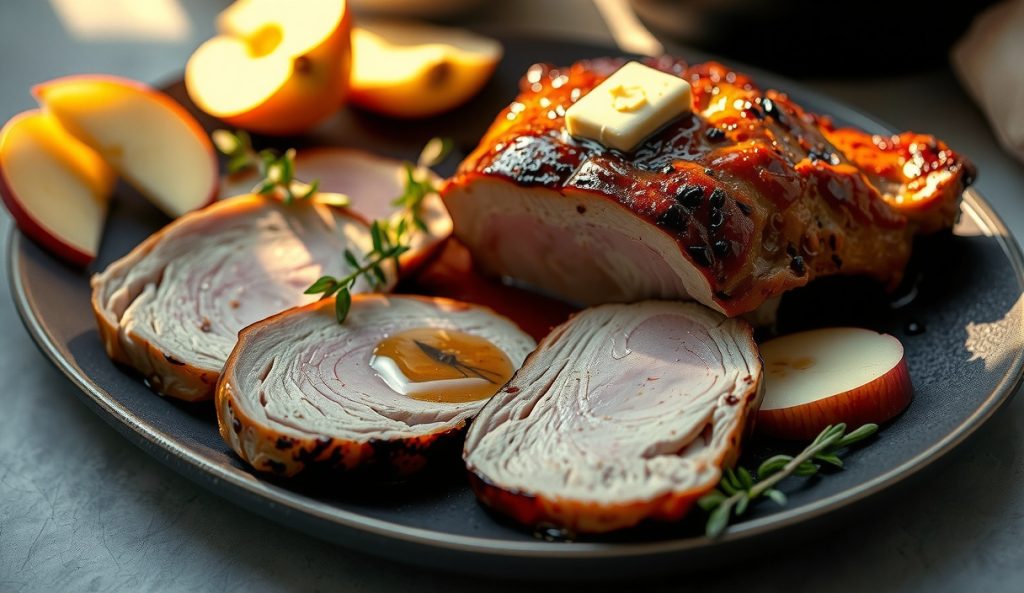
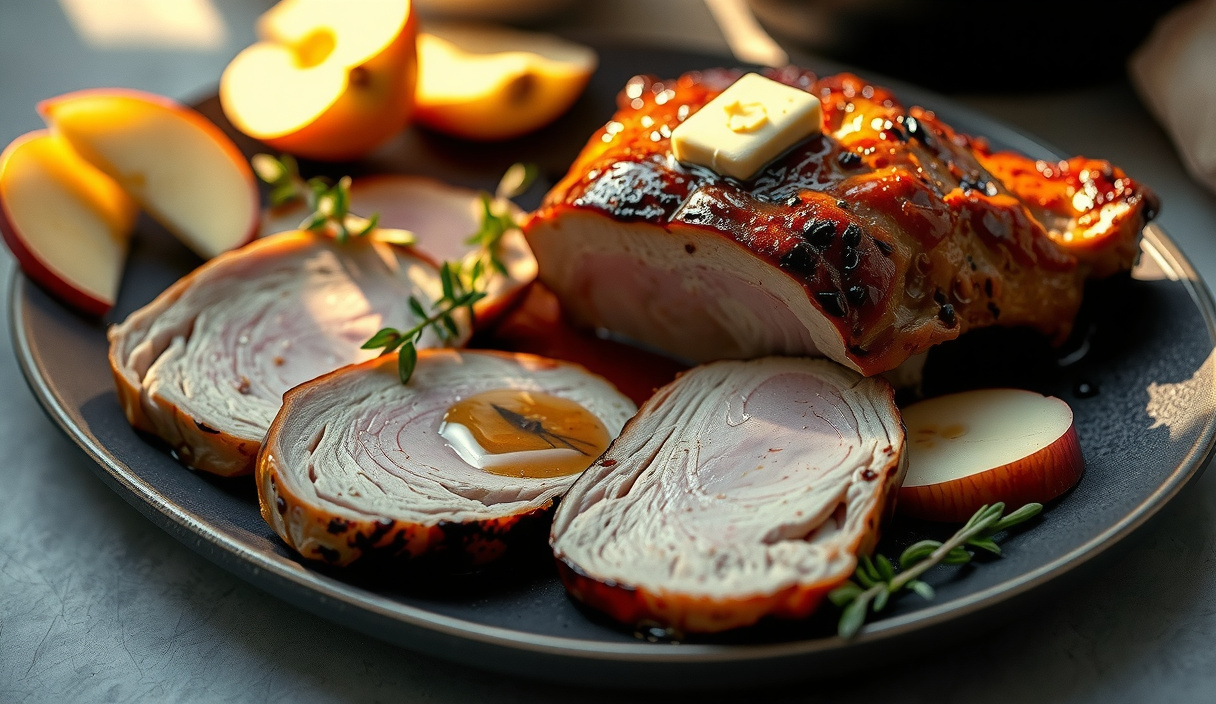
- Transfer to a cutting board and slice on a 45-degree bias against the grain into medallions approximately 3/4 inch thick. The grain runs longitudinally through the tenderloin; cutting at an angle shortens the visible muscle fiber length in each slice. Serve immediately with any remaining warmed cider glaze as a dipping sauce alongside.
Notes
Nutrition
Pork tenderloin is the sleeper cut of the smoker. It has none of the connective-tissue drama of a shoulder or a brisket — no twelve-hour stall, no fat cap to render — just a dense, lean cylinder of myofibrillar muscle that goes from raw to perfect in about sixty minutes at 250°F. The challenge is precisely that leanness: without intramuscular fat or collagen to buffer the heat, the difference between succulent and sawdust is a matter of a few degrees internal. Nail the window between 135°F and 145°F and you land in the zone where myosin has fully denatured but actin is still intact. Blow past 145°F and you are in dry, stringy territory with no coming back.
The apple-cider glaze is not decoration — it is structural. A 4:1 reduction of fresh cider concentrates the native sugars from roughly 10–11 °Brix in raw juice to above 40 °Brix in the finished syrup, raising the water activity floor enough to accelerate Maillard browning the instant it hits the hot, smoke-dried surface of the tenderloin. The result is a lacquered, deeply flavored crust that cannot be achieved by brushing raw cider on the meat. Reduce the cider fully, or skip the glaze entirely.
Why does smoked pork tenderloin work? The science
Smoked pork tenderloin works because the cut’s near-total absence of collagen makes temperature precision — not time — the sole variable controlling juiciness. Pork tenderloin is almost entirely psoas major muscle, a cut that does almost no postural work in the animal’s lifetime, which is why it is so tender to begin with. That anatomical fact also means it has minimal collagen content. In a tough braise cut like a shoulder, extended time above 160°F is mandatory to hydrolyze collagen into gelatin, which lubricates the drying fibers. In tenderloin, there is no collagen reservoir to fall back on once actin begins to denature above 165°F (74°C). The only moisture protection is the myosin-bound water that survives when the core is held below that threshold.
This is why the USDA’s 2011 revision to 145°F internal temperature (with a three-minute rest) matters directly to this recipe: that threshold is not a safety compromise. Trichinella and Salmonella achieve a 7-log reduction at 145°F. Hold the pork tenderloin at that temperature and the result is simultaneously safe and succulent.
The smoke ring and surface flavor develop through a separate pathway. At 250°F chamber temperature, wood combustion produces nitrogen dioxide (NO2) that dissolves in the surface moisture layer of the meat. This forms nitrous acid, which penetrates roughly 3–5 mm into the myoglobin-rich exterior, converting it to stable pink nitric oxide myoglobin — the compound that defines the smoke ring. Simultaneously, Maillard browning on the dry exterior surface requires water activity to drop below 0.7 before the reaction truly accelerates, which is exactly what the smoke-drying effect achieves over the first forty minutes of the cook.
The glaze, applied in the final ten minutes, introduces a concentrated reducing-sugar dose — primarily fructose and glucose from the cider — onto an already low-water-activity surface, triggering a rapid, intense Maillard burst that produces the hundreds of volatile aromatic compounds responsible for the lacquered crust’s complexity.
The cider reduction physics are worth understanding in detail. Fresh apple cider at 10–11 °Brix contains roughly 100 g of dissolved solids per liter. Reducing four parts cider to one part syrup concentrates those solids to approximately 400 g/L, pushing °Brix above 40 and dramatically lowering water activity in the glaze itself. At this concentration, viscosity climbs into the range where the liquid clings to a vertical meat surface rather than running off. Malic acid, naturally present in apple juice at pH 3.3–3.5, also acts as a mild denaturing agent that subtly opens protein structure at the surface during glaze application, improving adhesion of the aromatic melanoidin compounds formed during the Maillard cascade.
What equipment and ingredients do you need?
Smoker setup: Any offset, pellet, kettle, or vertical water smoker that holds a stable 250°F works for this cook. Pellet grills are the easiest to dial in because the short sixty-minute duration means fuel depletion is not a concern. If using a kettle with the snake method, use a two-zone setup and keep the tenderloin on the cool side throughout.
Wood choice: Apple or cherry wood. Both are dense, low-resin fruitwoods that produce a clean, mildly sweet smoke that will not overpower a lean cut in sixty minutes. Hickory is acceptable but aggressive — use one small chunk rather than two if you go that route. Avoid mesquite entirely for this cook; the short exposure window concentrates the phenolic bite unpleasantly.
Instant-read thermometer: Non-negotiable. A $20 thermometer is the single most important piece of equipment for this recipe. Insert into the thickest part of the tenderloin, avoiding the silver skin end, which is narrower and reads hotter. Pull the tenderloin at 140°F; carry-over heat will bring the core to 145°F during the five-minute rest.
Apple cider vs. apple juice: Use unfiltered, fresh-pressed apple cider if available. Fresh cider carries a broader aromatic payload — esters, aldehydes, and malic acid — that survive concentration better than the flatter flavor profile of filtered juice. Grocery-store pasteurized apple juice is an acceptable substitute but will yield a simpler, one-dimensional glaze.
Silver skin: Remove the silver skin before smoking. Silver skin is dense connective tissue that does not break down at 140–145°F internal; it will buckle, tighten the tenderloin into a curve, and create an unpleasant chew on the exterior. Slide a thin knife under it and peel it off in one pass, holding it taut with a paper towel for grip.
Smoked Pork Tenderloin with Apple-Cider Glaze
Equipment
- 1 Smoker (offset, pellet, kettle, or vertical) Calibrated to hold a stable 250°F (121°C) chamber temperature
- 1 Instant-read thermometer Insert into the geometric center of the thickest part of the tenderloin
- 1 Small saucepan For reducing the apple cider glaze on the stovetop
- 1 Wire rack For resting the finished tenderloin to preserve bark integrity
- 1 Silicone basting brush For applying the glaze in thin, even coats
- 2 Apple or cherry wood chunks or chips Chunks preferred for a pellet or offset smoker; chips in a foil pouch for a kettle grill
Ingredients
Pork
- 1 pork tenderloin (1 to 1.25 lb / 450–570 g), silver skin removed A single tenderloin as sold in most grocery stores; trim any visible fat and peel off the silver skin before proceeding
- 1 tsp kosher salt Diamond Crystal; use 3/4 tsp if Morton
- ½ tsp freshly ground black pepper
- ½ tsp smoked paprika Optional; adds a phenolic aromatic baseline if wood smoke alone is subtle
- ½ tsp garlic powder
- ½ tsp onion powder
- 1 tbsp neutral oil (avocado or canola) Acts as a binder for the dry rub and helps initiate surface browning
Apple-Cider Glaze
- 2 cups fresh unfiltered apple cider Not sparkling cider or cider vinegar; look for unfiltered, fresh-pressed juice at 10–11 °Brix for the best aromatic payload after reduction
- 1 tbsp apple cider vinegar Adds malic-acid brightness and keeps the glaze from tasting flat once concentrated
- 1 tbsp whole-grain Dijon mustard Provides emulsifying mucilage and a subtle piquancy that balances the sweetness
- ¼ tsp kosher salt
- ¼ tsp freshly ground black pepper
- 1 pinch cayenne pepper Optional; a small amount of capsaicin activates TRPV1 receptors and sharpens the perception of sweetness
Instructions
Prepare the Tenderloin
- Pat the pork tenderloin completely dry with paper towels. Locate the silver skin — the iridescent, pearlescent membrane running along one side — and slide a thin boning or paring knife under it. Hold it taut with a paper towel for grip and peel it off in one continuous strip. Discard.
- In a small bowl, combine the kosher salt, black pepper, smoked paprika, garlic powder, and onion powder. Coat the tenderloin evenly with the neutral oil, then apply the dry rub on all sides, pressing gently to adhere. Allow to rest uncovered at room temperature for 20 to 30 minutes while the smoker preheats. If time permits, dry-brine overnight in the refrigerator uncovered — the surface will desiccate slightly, which accelerates Maillard browning on the smoker.1 tsp kosher salt, 1/2 tsp freshly ground black pepper, 1/2 tsp smoked paprika, 1/2 tsp garlic powder, 1/2 tsp onion powder, 1 tbsp neutral oil (avocado or canola)
Reduce the Apple-Cider Glaze
- Combine the apple cider, apple cider vinegar, whole-grain Dijon mustard, salt, pepper, and cayenne (if using) in a small saucepan. Stir to combine. Set over medium-low heat and bring to a steady, gentle simmer — do not boil aggressively, as a rapid boil drives off desirable aromatic esters faster than it concentrates sugars.2 cups fresh unfiltered apple cider, 1 tbsp apple cider vinegar, 1 tbsp whole-grain Dijon mustard, 1/4 tsp kosher salt, 1/4 tsp freshly ground black pepper, 1 pinch cayenne pepper
- Simmer uncovered, stirring occasionally, until the liquid reduces to approximately 1/2 cup (one-quarter of the original volume) — roughly 20 to 25 minutes. The glaze is ready when it coats the back of a spoon and a line drawn through it holds its shape for two to three seconds. Remove from heat and set aside. The glaze will thicken slightly as it cools.2 cups fresh unfiltered apple cider, 1 tbsp apple cider vinegar
Smoke the Tenderloin
- Set up your smoker for indirect cooking and stabilize the chamber temperature at 250°F (121°C). Add apple or cherry wood chunks — two small chunks for a long cook smoker, or a foil packet of soaked chips positioned over a coal snake for a kettle. You want a thin, pale blue smoke; thick white billowing smoke indicates incomplete combustion and will produce acrid, bitter flavors on a lean cut.
- Place the seasoned tenderloin on the grate away from any direct heat source. Insert the probe of your instant-read thermometer into the thickest geometric center of the meat, avoiding the narrow tapered end. Close the lid and smoke undisturbed.
- Monitor the internal temperature every 10 minutes starting at the 40-minute mark. The tenderloin will typically reach 125–130°F (52–54°C) internal in 45 to 50 minutes at a stable 250°F chamber, then climb the final 10–15°F over the next 10 to 15 minutes as the thermal gradient equalizes. Total cook time is approximately 55 to 65 minutes depending on the exact weight and ambient conditions.
- When the internal temperature reaches 130°F (54°C), begin warming the cider glaze over low heat on the stovetop until it is fluid and brushable (approximately 130–140°F itself — warm enough to flow, concentrated enough to cling).2 cups fresh unfiltered apple cider, 1 tbsp apple cider vinegar, 1 tbsp whole-grain Dijon mustard
- When the internal temperature reaches 135°F (57°C), brush a thin, even coat of the cider glaze over all surfaces of the tenderloin using the silicone basting brush. Close the lid and allow it to set for 3 minutes. Apply a second thin coat and allow it to caramelize for an additional 3 to 4 minutes.2 cups fresh unfiltered apple cider, 1 tbsp apple cider vinegar, 1 tbsp whole-grain Dijon mustard, 1/4 tsp kosher salt, 1/4 tsp freshly ground black pepper, 1 pinch cayenne pepper
- Pull the tenderloin when the internal temperature reads 140°F (60°C). Carry-over heat during the rest period will bring the center to the USDA-recommended 145°F (63°C). Transfer immediately to a wire rack. Do not tent with foil — foil trapping steam will soften the lacquered glaze crust you just built.
Rest and Serve
- Rest the tenderloin on the wire rack for 5 minutes. This allows the thermal gradient to equalize across the cross-section and permits the intracellular pressure to redistribute, reducing juice loss on cutting. The internal temperature will rise to approximately 145°F (63°C) during this window.
- Transfer to a cutting board and slice on a 45-degree bias against the grain into medallions approximately 3/4 inch thick. The grain runs longitudinally through the tenderloin; cutting at an angle shortens the visible muscle fiber length in each slice. Serve immediately with any remaining warmed cider glaze as a dipping sauce alongside.
Notes
Nutrition
How do I nail it every time? Tips for a perfect cook
- Do not skip the dry brine. Even thirty minutes of kosher salt contact begins the osmotic process of drawing surface moisture out, dissolving it in the brine, and reabsorbing it into the meat as a seasoned, slightly more concentrated interior. An overnight dry brine at 0.5% salt by weight (about 1 tsp kosher salt per pound) is ideal if you plan ahead.
- Watch the narrow end. Pork tenderloins taper significantly. The thin tail end can read 10–15°F hotter than the center. Fold it under and tie it off with butcher’s twine to equalize the diameter, or pull from the geometric center and accept that the tip will be slightly more done.
- Reduce the cider low and slow. The reduction needs to happen over medium-low heat, not a rapid boil. Aggressive boiling drives off aromatic esters faster than it concentrates the sugars, leaving a flat, overly sweet syrup. Target a gentle, steady simmer until the volume drops to one-quarter — about 20 to 25 minutes for two cups of cider reducing to half a cup.
- Apply the glaze in two thin layers. Brush one coat on, close the smoker lid for three minutes to let it set and partially caramelize, then apply a second coat and finish the final three to four minutes. Two thin coats build better lacquer adhesion than one thick application that can run off or scorch.
- Rest on a wire rack, not a cutting board. Resting on a flat surface traps steam under the meat and softens the crust you just spent twenty minutes building. A wire rack lets ambient air circulate and keeps the bark intact.
- Slice against the grain at an angle. The grain in tenderloin runs longitudinally. Cutting on a 45-degree bias shortens the muscle fiber length in each slice and noticeably improves perceived tenderness, even in a cut that is already inherently tender.
What variations can you make on this recipe?
Bourbon-apple glaze: Deglaze the reduction pan with 2 tablespoons of bourbon in the final minute before pulling the cider syrup off the heat. The alcohol volatilizes quickly at this stage, leaving behind oak-barrel vanilla and caramel notes that pair exceptionally well with the apple and the smoke. The residual sugars from the whiskey also contribute additional Maillard browning substrate.
Spiced cider glaze: Add one cinnamon stick, three whole cloves, and a half teaspoon of black peppercorns to the cider before reducing. Strain before applying. This pulls the flavor profile toward autumn-harvest territory without interfering with the reduction physics — the spices contribute volatile aromatic compounds without changing the sugar concentration curve meaningfully.
Two-tenderloin cook: The recipe scales directly — two tenderloins placed side by side on the grate cook in the same sixty-minute time window as one, assuming airflow is not restricted. Space them at least two inches apart so smoke circulates evenly. Double the glaze volume accordingly; the reduction time remains the same since you are starting with more liquid in a wider pan.
Oven-roast adaptation: If a smoker is not available, this technique translates to a 250°F oven with two teaspoons of smoked paprika rubbed onto the tenderloin surface before roasting. The oven method will not produce a true smoke ring or the depth of wood combustion byproducts, but smoked paprika supplies some of the same phenolic aromatic compounds and delivers an acceptable approximation of smoke-roasted character. Finish under a broiler for two minutes after glaze application to drive rapid Maillard browning.
Frequently asked questions
Is pink pork tenderloin safe to eat? Yes, provided the internal temperature has reached 145°F and the tenderloin has rested for at least three minutes. The USDA updated its safe temperature guidance in 2011 to reflect this. Pink color in cooked pork is also common even without smoking — it can result from the pH of the meat, the presence of nitrites in the environment, or simple myoglobin chemistry. Color is not a reliable indicator of doneness; use a thermometer.
Can I use store-bought apple butter or applesauce instead of reducing cider? Not as a direct swap for the finishing glaze. Applesauce and apple butter are high-moisture, low-Brix products that will steam the surface of the tenderloin rather than lacquering it. Either product can work as a marinade base during the dry-brine phase, but for the finishing glaze the concentrated sugar content and low water activity of fully reduced cider are required to drive the Maillard browning that creates the crust.
Why smoke at 250°F and not a higher temperature? Pork tenderloin cooked at higher ambient temperatures — say 325°F or 350°F — exits the moisture-safe window too quickly. The exterior temperature climbs fast relative to the interior, meaning the outer 5–8 mm of meat begins approaching actin-denaturation territory (above 165°F) while the center is still catching up. At 250°F, the shallower thermal gradient produces a much more uniform internal temperature from edge to center — less gray band, more pink rosy interior — and the extended time in smoke produces a more developed bark.