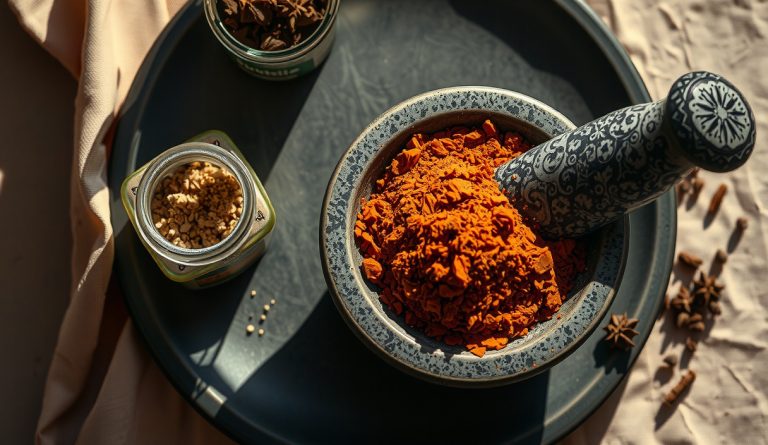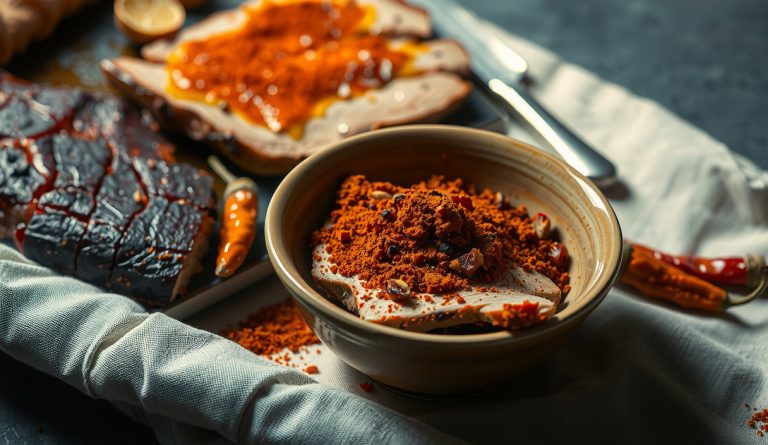
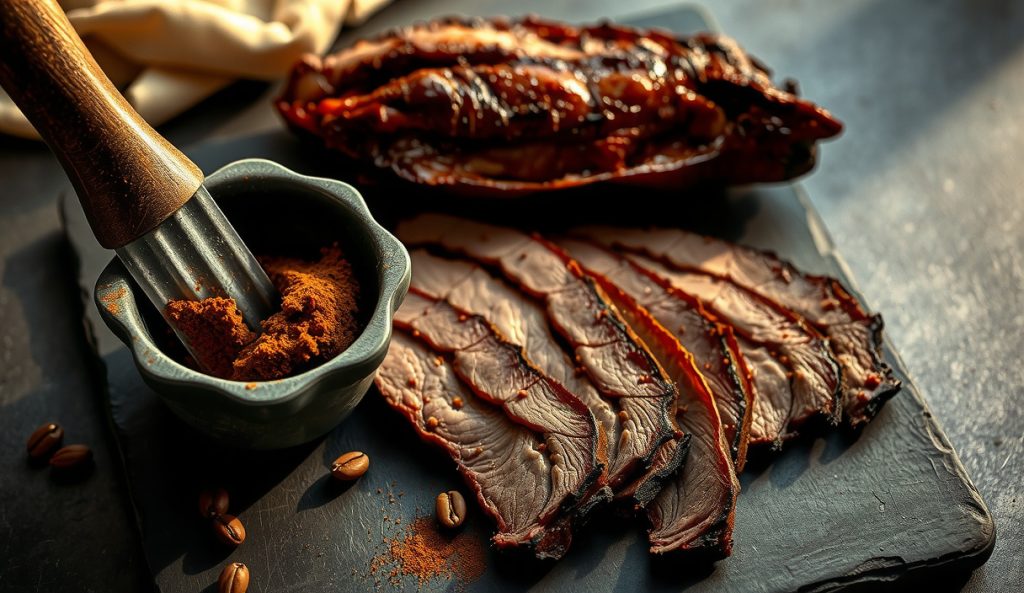
This coffee-forward variant replaces 1 tablespoon of smoked paprika with an equal volume of finely ground medium-roast coffee at espresso grind. The result is a rub that leans harder into the earthy-roasted register — a useful move when the protein already carries deep intramuscular fat and collagen, as brisket flat and pork shoulder do. The visual crust shifts from brick-red toward dark mahogany, which many competition judges associate with longer, hotter bark development.
What exactly changes in the coffee-forward variant?
Replace 1 tablespoon of smoked paprika with an equal volume of finely ground medium-roast coffee — espresso grind, not coarse drip. Grind consistency is not optional: coarser particles remain granular through the entire cook and produce bitter pockets in the finished bark; espresso-fine grounds disperse evenly into the bark matrix and integrate as intended. All other measurements remain at the canonical ratios established in the base recipe.
The mechanism behind the flavor shift is additive pyrazine stacking. Cumin already contributes alkylpyrazines from its own Maillard-adjacent roasting process; coffee brings a broader pyrazine suite plus caffeoylquinic acids — phenolic compounds that bind fat-soluble aroma precursors and release them gradually during the low-and-slow cook window. The net effect is a bark that reads roastier and more complex without requiring any increase in pit temperature. The mushroom powder dose and its glutamate-loading strategy are unchanged; the umami scaffolding holds the same structural role it does in the canonical rub.
What stays the same as the original low-sodium rub?
The low-sodium architecture, the remaining smoked paprika (the swap is 1 tablespoon out of the full paprika measure, not a total replacement), the mushroom powder glutamate strategy, and all cook temperatures and target internal temperatures are identical to the canonical rub. Only one aromatic input changes — every other ratio, technique, and structural ingredient remains exactly as written in the base formula.
When is the coffee-forward build the better choice?
Reach for this build when cooking beef brisket flat or bone-in pork shoulder where crust depth is a primary goal, or when competing in categories where judges score bark color and density as part of the appearance criteria. The coffee-forward rub is less useful on leaner, faster-cooking proteins: the coffee’s phenolic compounds require a long cook window and significant Maillard surface time — both present in a low-and-slow brisket or shoulder cook — to integrate into the bark rather than sitting on top of it as a harsh, bitter note.
Use the full method, equipment, and rub measurements from the original Low-Sodium BBQ Rub — Smoked Paprika-Forward.