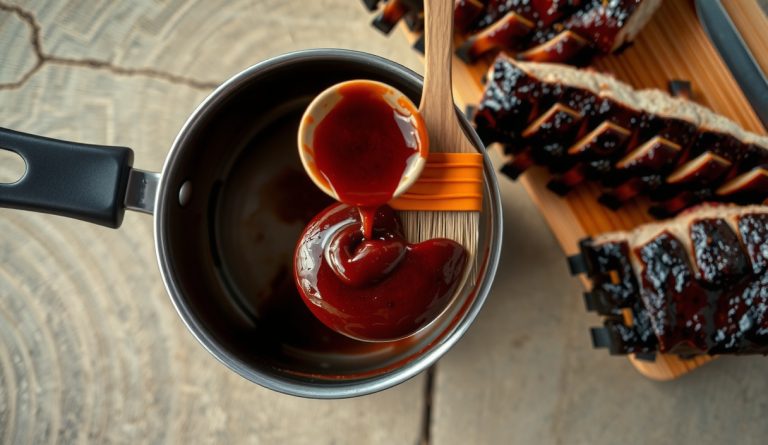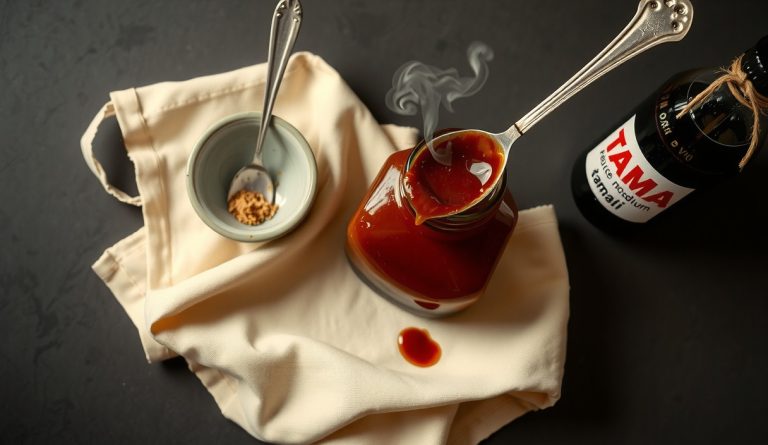
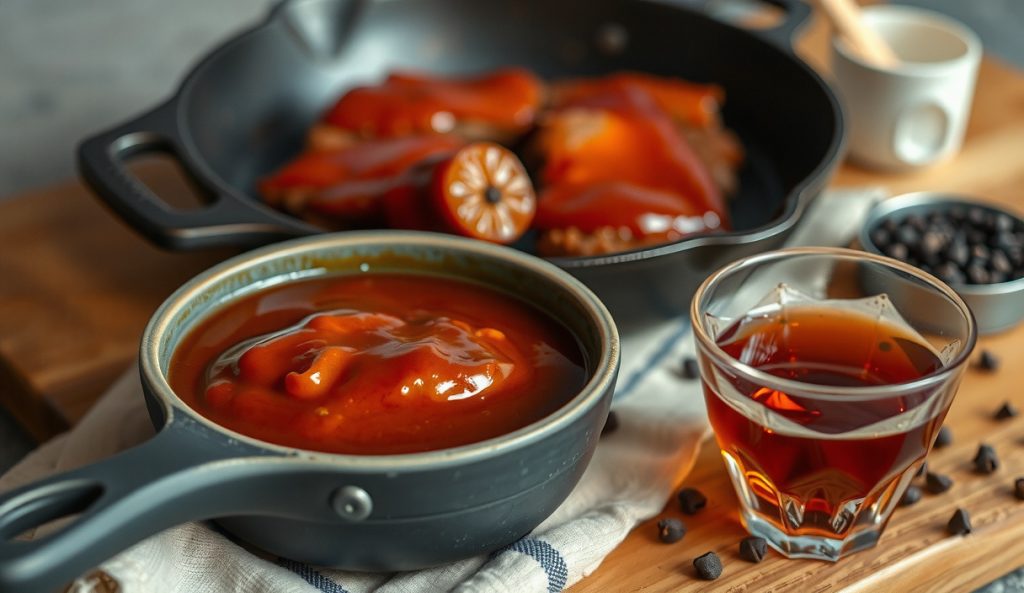
The canonical Kansas City BBQ sauce already carries deep, roasted-sugar complexity from blackstrap molasses. Introducing bourbon at the deglaze stage adds a second layer of aged, barrel-derived aromatics — vanilla, toasted oak, and a faint stone-fruit register — that amplifies rather than competes with the molasses base. This bourbon-smoked variant is not a novelty move; it is a deliberate aromatic construction that has become a fixture in competition BBQ circuits, particularly for pork rib applications.
What changes in the bourbon-smoked variant?
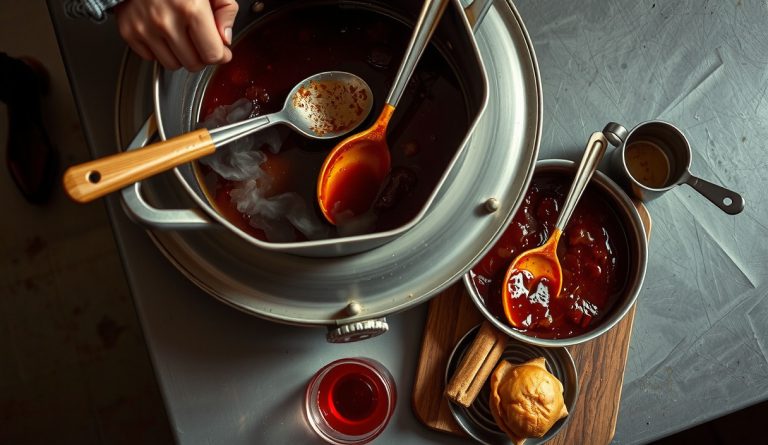
After softening the onion and garlic, and before adding the tomato paste, pour in 3 tablespoons of good-quality bourbon — Maker’s Mark, Woodford Reserve, or a comparable wheated mash are all appropriate choices. Let the bourbon deglaze the pan over medium heat for 60–90 seconds, scraping up any fond. The ethanol at approximately 40% ABV acts as a polar-nonpolar bridging solvent, carrying volatile esters and lactones from barrel aging into the aqueous sauce base.
Most of the ethanol cooks off during the subsequent 25-minute reduction, but the heavier aromatic compounds — vanillin, eugenol, and furfural derivatives — have significantly higher boiling points and remain in solution at meaningful concentrations, registering clearly in the finished sauce’s aroma. This is the mechanism by which 3 tablespoons of bourbon changes the aromatic profile without altering the sauce’s fundamental flavor structure.
The residual unfermented sugars present in aged whiskey also contribute a small but real increase to the sauce’s total dissolved solids. To prevent the finished sauce from over-thickening or clinging too aggressively, extend reduction time by 2–3 minutes beyond the canonical target, monitoring viscosity by the spoon-coat test rather than by the clock alone.
What stays the same as the base Kansas City recipe?
All remaining ingredients, proportions, and the full reduction method are identical to the canonical recipe. The bourbon step is an insertion at one specific point in the build sequence — it does not alter the tomato-to-molasses ratio, the vinegar balance, or the spice load. Final sauce body, gloss, and sweetness profile remain squarely within Kansas City style.
When is the bourbon-smoked variant the better choice?
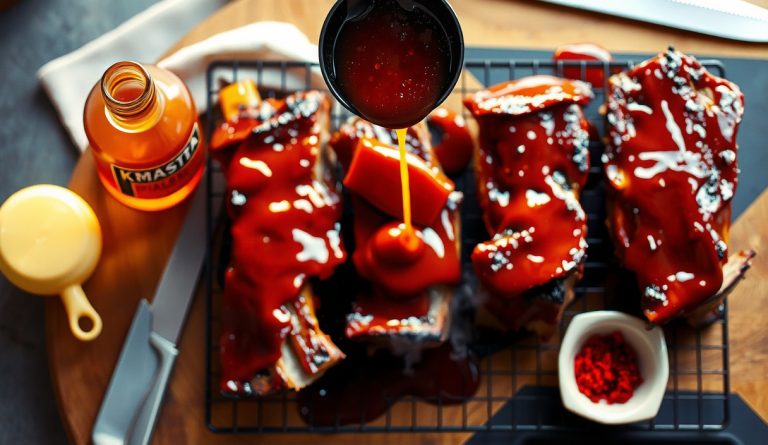
The bourbon-smoked variant is the stronger choice when the sauce is destined to be a finishing glaze or table sauce for pork — St. Louis ribs, spare ribs, pulled shoulder — where the vanilla-oak register of the bourbon creates a sensory bridge to wood smoke already present in the meat. The barrel esters are more perceptible at room temperature than at serving heat, making this the appropriate version for a competition batch where aroma complexity is scored alongside flavor.
Use the full method, equipment, and base measurements from the original Kansas City BBQ Sauce — Molasses-Tomato.