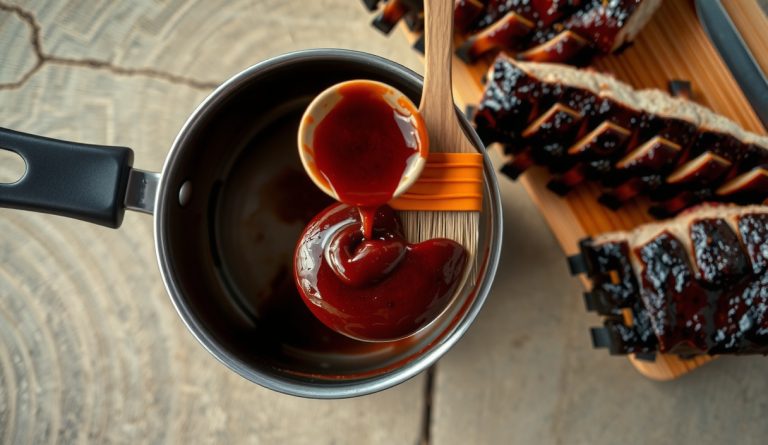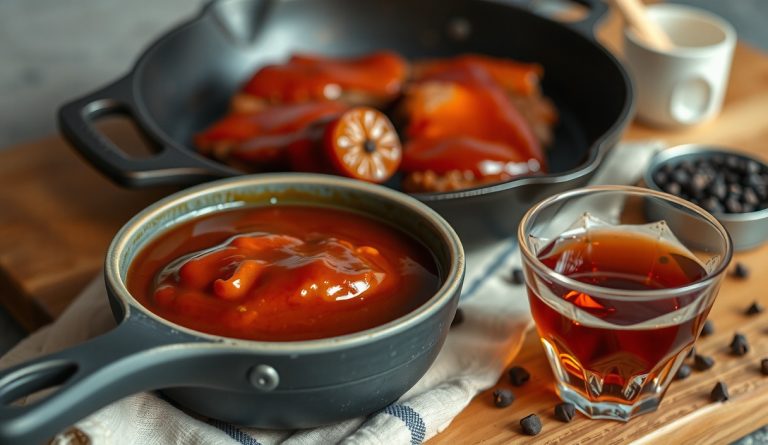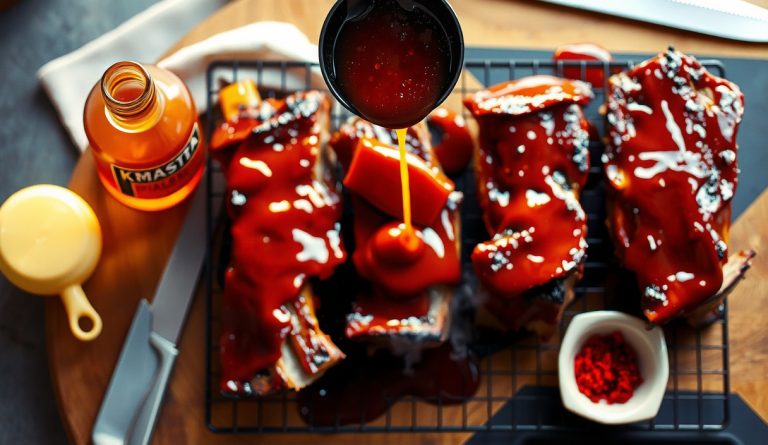
The canonical Kansas City BBQ Sauce recipe produces a single home batch suited to one or two cook sessions. At competition or catering scale — where consistency across multiple racks or hundreds of servings is non-negotiable — you need a production approach that accounts for how pan geometry and batch size interact with reduction kinetics. The formula itself requires zero reformulation up to 10x scale. The one variable to manage is the reduction.
What changes when you scale Kansas City BBQ Sauce to competition batch size?
Scale all ingredients linearly — every quantity multiplied by your target factor (2x, 5x, or 10x). The chemistry is proportional, and the sauce’s final flavor profile does not drift with scale. What does change is the time-to-target-viscosity during reduction, and that variable is determined almost entirely by the surface-area-to-volume ratio of your vessel.
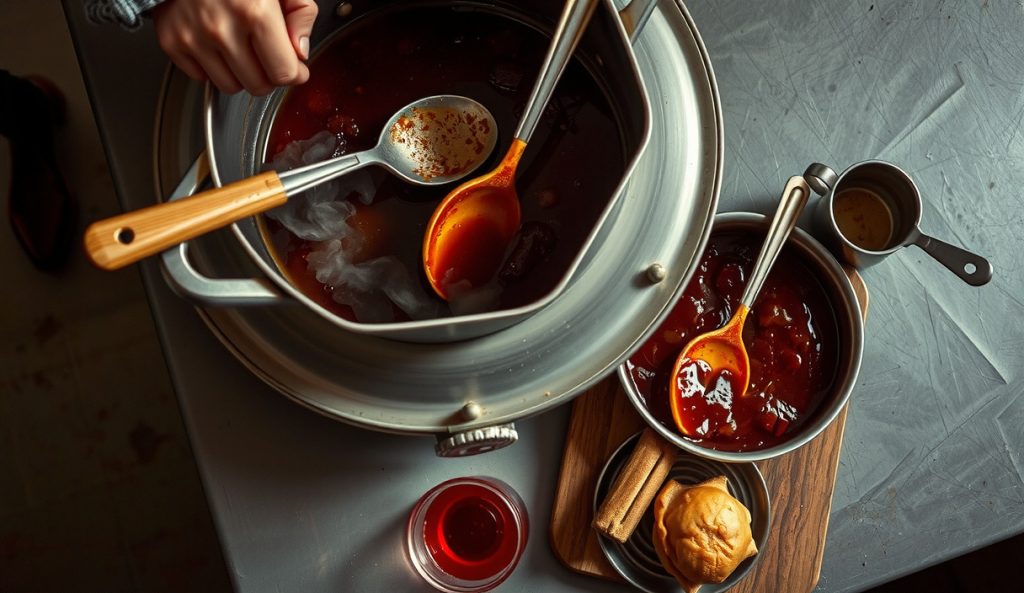
A wide, shallow brazier or rondeau exposes far more liquid surface per unit of volume than a deep stockpot drawing the same Btu output. At 5x scale in a wide brazier, the reduction window may be as short as 22–25 minutes from the point of adding all liquids. In a deep, narrow stockpot at the same scale, that window can stretch past 45 minutes. Neither outcome is wrong — both vessels produce the correct sauce — but misjudging reduction time due to vessel shape is the most common source of over-reduced (too thick, too bitter) or under-reduced (too loose, too raw-tasting) sauce at scale.
Do not rely on a fixed clock time at large batch sizes. Instead, monitor Brix with a handheld refractometer every 5 minutes beginning at the 25-minute mark, regardless of pan geometry. Target the same Brix window as the canonical single batch. The spoon-coat test is a reliable secondary check: the Kansas City BBQ Sauce should coat the back of a spoon and hold a clean line when you draw a finger through it.
What stays the same at competition batch scale?
Ingredient ratios, build sequence, seasoning balance, and the aromatic foundation are identical to the canonical recipe at every scale up to 10x. The Kansas City BBQ Sauce at 10x scale should taste indistinguishable from a single batch produced on the same day with the same ingredients. If the flavor profile diverges, the reduction was not calibrated correctly for the vessel used — not a formulation problem.
When is the competition batch approach the better choice?
Use this production approach for any run of 3 liters or more: competition day prep, catering service, bulk jarring for retail or gifting, or any situation where batch-to-batch consistency is non-negotiable. A handheld refractometer is a modest investment that pays for itself the first time it saves a 5x batch from over-reducing on a high-output burner.
Use the full method, equipment, and base measurements from the original Kansas City BBQ Sauce — Molasses-Tomato.