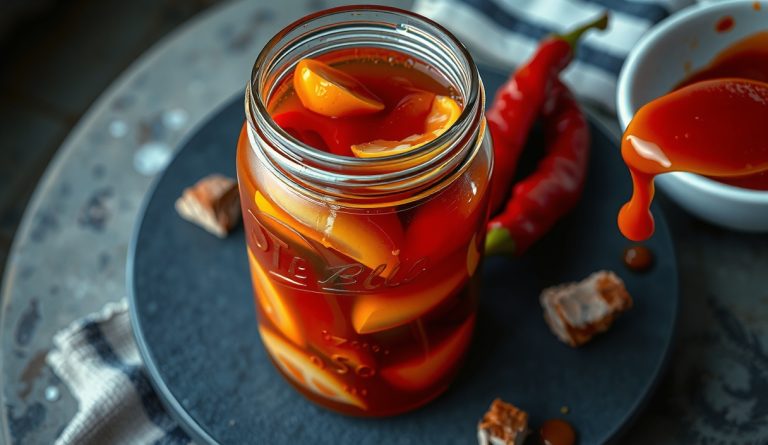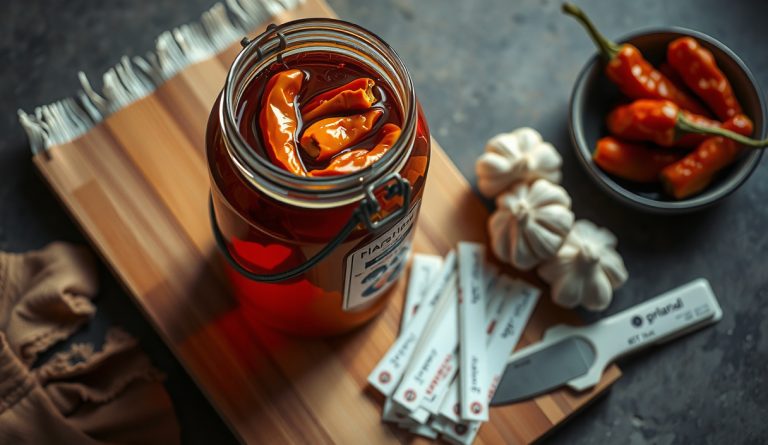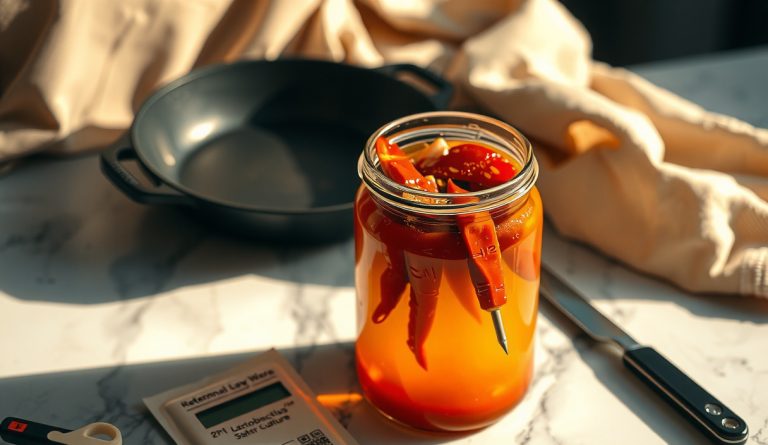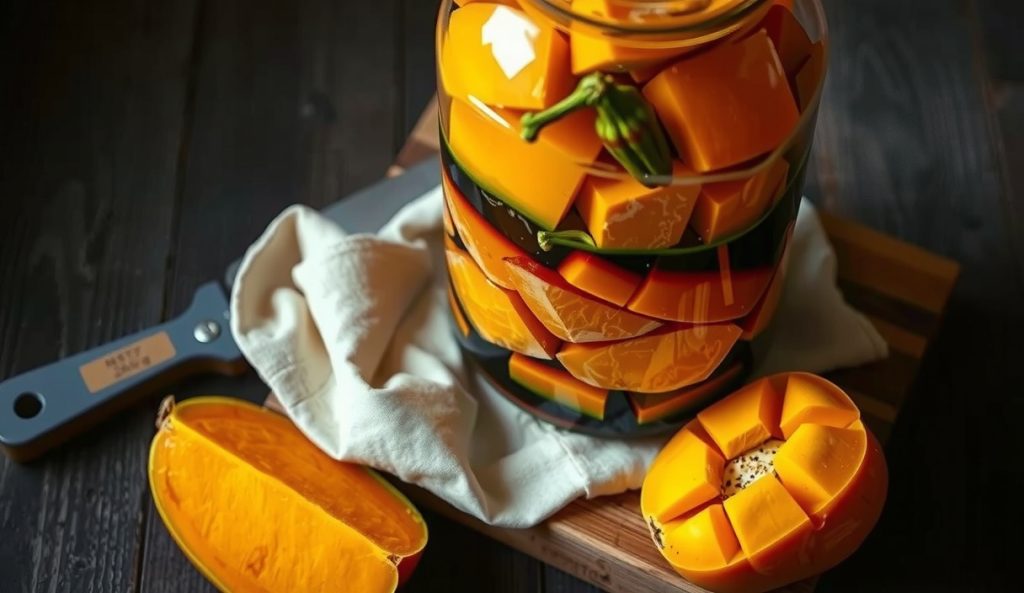
The habanero-mango build turns the canonical lacto-fermented smoked pepper hot sauce into a tropical variant with a faster fermentation arc and a genuinely different flavor architecture. Replacing four Fresno chiles with two habaneros adds upward of 30,000 SHU to the final heat profile while layering in the floral, apricot-adjacent top notes habaneros are known for. A single ripe mango — peeled and cubed — goes directly into the fermentation vessel alongside the smoked peppers.
What changes in the habanero-mango version?
Mango dramatically accelerates lactic acid production because it contributes a high proportion of fructose and freely available simple sugars. Lactobacillus strains preferentially metabolize monosaccharides, and the additional substrate density drives the culture into exponential-phase activity faster than a chile-only fermentation environment. In practice, the habanero-mango jar reaches pH 3.4 in roughly five days rather than seven — begin pH checks at day three rather than day four to avoid overshooting target acidity.
Garlic is optional in this variant. The allium’s sulfur compounds compete with the fruit-forward flavor profile; reducing or eliminating garlic lets the habanero florals and mango esters stay at the front of the palate. Smoke from the canonical smoked pepper base remains unchanged and provides the savory anchor that keeps the sauce from reading as a fruit purée. Because two habaneros replace four Fresnos, total chile volume decreases slightly — compensate with an additional half cup of mango to keep the vessel well-packed above the brine line.
What stays the same as the original recipe?
The brine concentration, submersion requirement, fermentation temperature range, and post-fermentation processing are all identical to the canonical method. Specifically: 3.5 g non-iodized salt per 100 mL filtered water, peppers held fully submerged below the brine line, ambient temperature maintained at 65–75°F, and the same blending and straining process after fermentation completes. Smoke is applied to the peppers before fermentation, exactly as described in the original recipe.
When is the habanero-mango version the better choice?
Choose the habanero-mango variant when serving audiences who want meaningful heat without the blunt, linear burn of superhot chiles, or when pairing with dishes that already carry tropical character. Strong pairing targets include fish tacos, grilled pineapple, jerk chicken, and ceviche — all contexts where the mango esters and habanero florals reinforce rather than clash with the plate. The shortened five-day fermentation window also makes this the practical choice when working against a timeline and needing a finished sauce in under a week.
Use the full method, equipment, and brine measurements from the original Lacto-Fermented Smoked Pepper Hot Sauce.