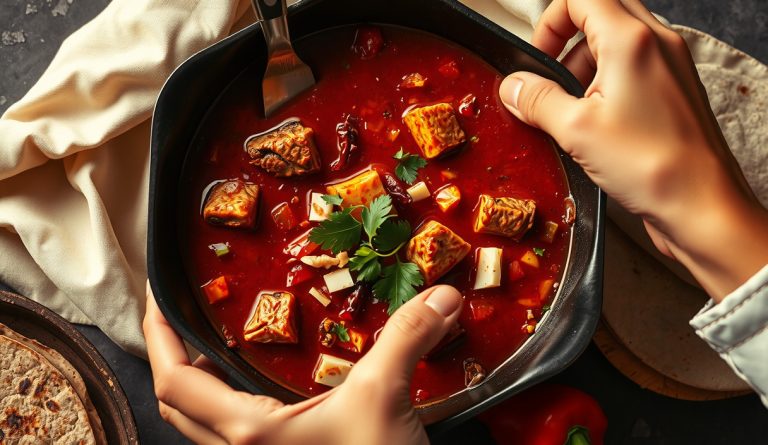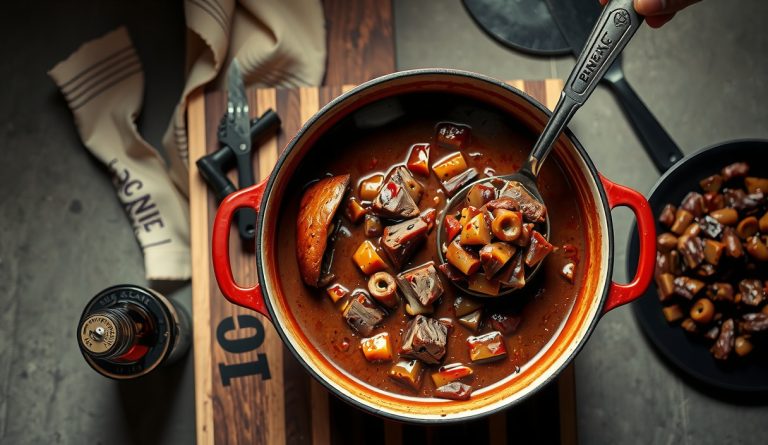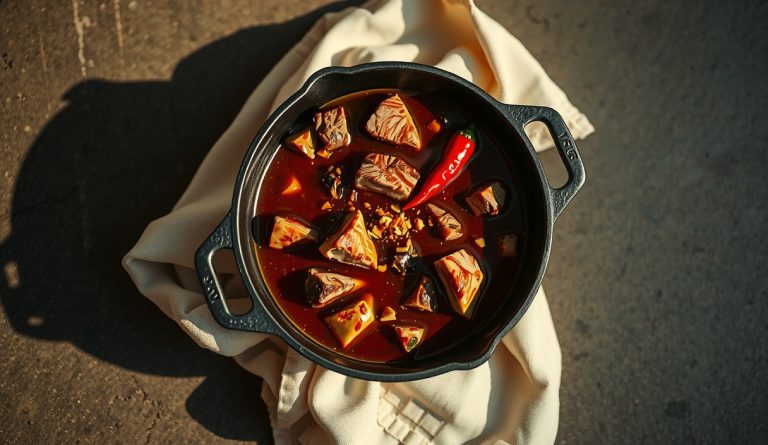
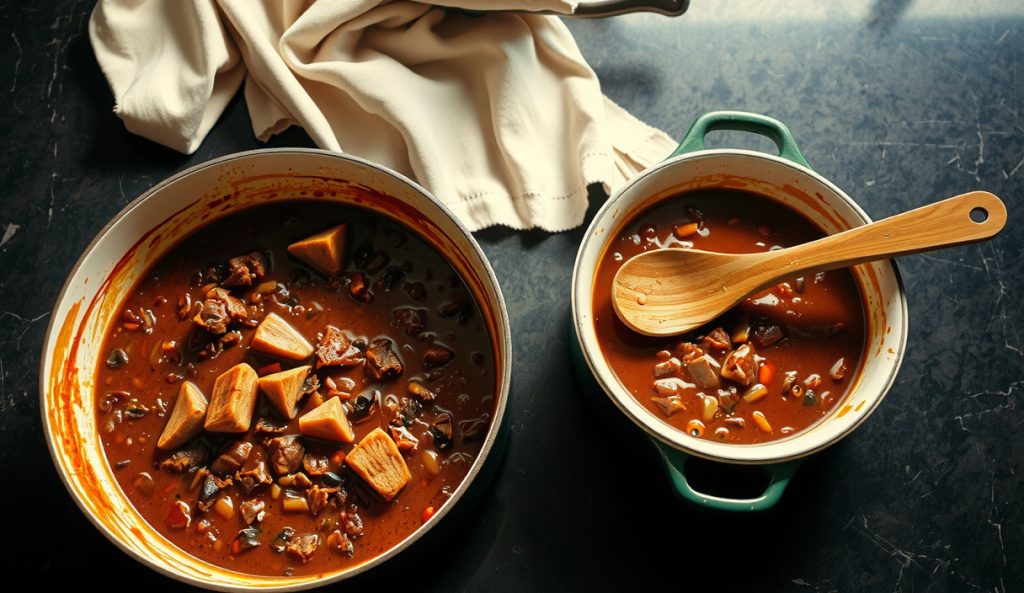
This scaled version of Smoked Brisket Chili doubles cleanly — the dried-chile paste, fat ratios, and seasoning all multiply without the compounding flavor distortion that plagues spice-heavy dishes at volume. The variable that demands active management when scaling up is not the ingredient list but the physics of liquid reduction: a larger volume of chili in a wider vessel behaves very differently than a standard 6-quart pot, and achieving the right viscosity without over-thickening requires close attention to both the masa harina ratio and the geometry of the vessel you are cooking in.
What changes when you scale Smoked Brisket Chili up?
When doubling the recipe, maintain a masa harina ratio of approximately 1.5 tablespoons per pound of meat rather than simply doubling the tablespoon count from the original recipe. Masa harina functions as a starch thickener: its gelatinized starch granules swell in hot liquid and increase viscosity. At scale, even a small excess of masa produces a paste-like body that is difficult to correct without adding significant liquid and rebalancing the entire seasoning profile. Treat the masa slurry as a finishing tool — add it in increments, stir, and assess consistency before committing the full quantity.
Vessel geometry is the less obvious scaling factor. When cooking in a 20-quart vessel for competition or catering, a wide, shallow rondeau or brazier exposes substantially more surface area than a tall stockpot holding the same volume. Evaporation rate scales with surface area, not volume — meaning a wider pot reduces faster per unit of liquid than a tall, narrow one. For wide vessels at competition scale, reduce the uncovered simmer time by 10–15 minutes relative to the canonical recipe and evaluate consistency before adding any masa slurry. A tall stockpot at the same volume can follow the canonical timing more closely, but requires periodic stirring from the bottom to prevent the masa-thickened liquid from scorching on the base.
What stays the same at any batch size?
The dried-chile soaking and blending process, the fat-blooming step for the paste, and the core seasoning ratios all scale directly without modification. The brisket-to-liquid ratio, the order of operations, and the final seasoning approach remain unchanged — only the timing of reduction and the masa harina quantity require active judgment at volume.
When is the scaled batch the better choice?
The scaled batch is the right approach for tailgates, competition submissions, catering service, or any occasion where a single canonical batch is insufficient. It is also the practical choice when cooking brisket at volume and working through a large point-and-flat yield — scaling the chili up to match the available smoked meat rather than portioning the brisket down to fit a single batch.
Use the full method, equipment, and rub measurements from the original Smoked Brisket Chili.