Memphis Dry-Rub Spare Ribs (3-2-1 Method)
Equipment
- 1 Offset smoker or charcoal kettle with two-zone setup Must hold 225–250°F (107–121°C) at grate level for 6 hours
- 1 Leave-in digital probe thermometer Calibrated; read at grate level, not dome
- 1 roll Heavy-duty aluminum foil Used to wrap ribs tightly during phase two; double-layer for zero steam escape
- 1 Spray bottle For apple cider vinegar spritz during phase one
- 1 Boning knife For trimming membrane and any excess flap if full spares are used
- 6 oz Hickory wood chunks Chunks, not chips; 70% of total wood by weight
- 3 oz Apple wood chunks 30% of total wood by weight; moderates phenolic sharpness of hickory
Ingredients
Ribs
- 1 rack St. Louis-cut spare ribs About 3 to 3.5 lbs; membrane removed, excess hard fat trimmed
Dry Rub
- 3 tablespoons smoked paprika (pimentón de la vera) Sweet or bittersweet; do not substitute sweet paprika
- 2 tablespoons light brown sugar, packed Packed; contributes Maillard browning and bark depth
- 1 tablespoon kosher salt Diamond Crystal; if using Morton, reduce to 2 teaspoons
- 1 tablespoon ground cumin Freshly ground from whole seeds if possible for maximum volatility
- 2 teaspoons freshly ground black pepper Coarse grind
- 1 teaspoon garlic powder Not garlic salt
- 1 teaspoon onion powder
- 1 teaspoon dry mustard powder Colman’s or equivalent; adds emulsified sulfur VOCs to the bark
- ½ teaspoon cayenne pepper Adjust to taste; this level registers as background warmth only
- ½ teaspoon dried thyme Optional but traditional in Memphis profiles
Spritz and Wrap
- ½ cup apple cider vinegar Mixed 1:1 with apple juice for the spritz bottle
- ½ cup unfiltered apple juice Mixed with vinegar for spritz
- 3 tablespoons apple juice Added inside the foil packet during the wrap phase to generate steam

Instructions
Prepare the Ribs and Rub
- Place the rack bone-side up on a cutting board. Slide a butter knife under the membrane (periosteum) at one end near a center bone. Grip the loosened edge with a paper towel and pull firmly in one motion to remove the entire membrane. Pat the rack dry on both sides with paper towels.
- Combine all dry rub ingredients in a small bowl: smoked paprika, brown sugar, kosher salt, cumin, black pepper, garlic powder, onion powder, dry mustard powder, cayenne, and thyme. Mix thoroughly. You need roughly 6 to 7 tablespoons total for one rack.2 tablespoons light brown sugar, packed, 1 tablespoon kosher salt, 1 tablespoon ground cumin, 2 teaspoons freshly ground black pepper, 1 teaspoon garlic powder, 1 teaspoon onion powder, 1 teaspoon dry mustard powder, 1/2 teaspoon cayenne pepper, 1/2 teaspoon dried thyme
- Apply the dry rub generously to the meat side, then the bone side, then the edges. Press it firmly into the surface with clean hands — you want adhesion, not a loose coating. Place the rack uncovered in the refrigerator for at least 1 hour, or up to 12 hours overnight. A surface pellicle will form, which aids bark adhesion and smoke absorption.2 tablespoons light brown sugar, packed, 1 tablespoon kosher salt, 1 tablespoon ground cumin, 2 teaspoons freshly ground black pepper, 1 teaspoon garlic powder, 1 teaspoon onion powder, 1 teaspoon dry mustard powder, 1/2 teaspoon cayenne pepper, 1/2 teaspoon dried thyme
Set Up the Smoker
- Light your charcoal or fire your offset 45 to 60 minutes before the ribs go on. Target a stable 225–250°F (107–121°C) at grate level. Verify with a calibrated probe at grate height — dome thermometers routinely read 15–30°F hotter than actual cooking temperature. Do not place the ribs until the temperature is stable and you have clean, thin, blue-gray smoke (not white billowing smoke, which indicates incomplete combustion and bitter creosote).
- Add the first wood addition: approximately 4 oz hickory chunks and 2 oz apple chunks placed directly on the coals or in the firebox. The smoke will be heaviest in the first 30 minutes — this is when the ribs absorb the most smoke, as cold protein surfaces are highly receptive. Prepare the spritz bottle by mixing apple cider vinegar and apple juice 1:1.1/2 cup apple cider vinegar, 1/2 cup unfiltered apple juice
Phase 1 — Unwrapped Smoke (3 Hours)
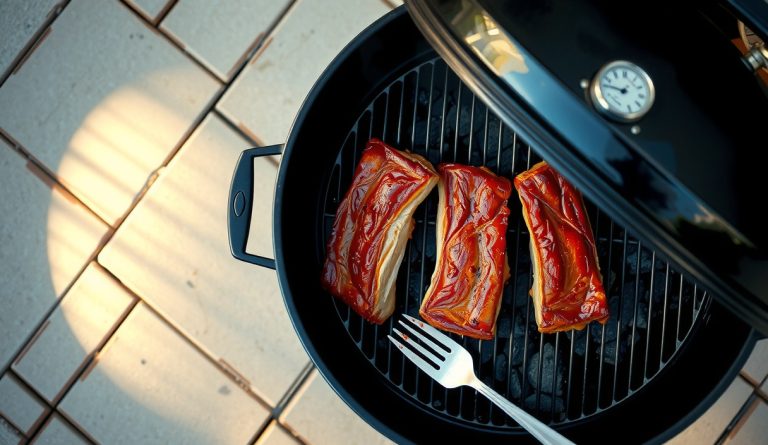
- Place the rack bone-side down on the grate over indirect heat. Insert a probe thermometer into the thickest part of the meat between two center bones, not touching bone. Close the lid. Do not open for the first 90 minutes. This phase is building the Maillard bark and establishing the smoke ring.
- At the 90-minute mark, open the smoker and quickly spritz both sides of the rack with the apple cider vinegar and apple juice mixture. Close immediately. Repeat the spritz every 45 to 60 minutes for the remainder of phase one. If the surface looks dry and the color is not deepening past pale orange, spritz more aggressively. Add a second wood addition (2 oz hickory, 1 oz apple) at the 2-hour mark if smoke production has dropped.1/2 cup apple cider vinegar, 1/2 cup unfiltered apple juice
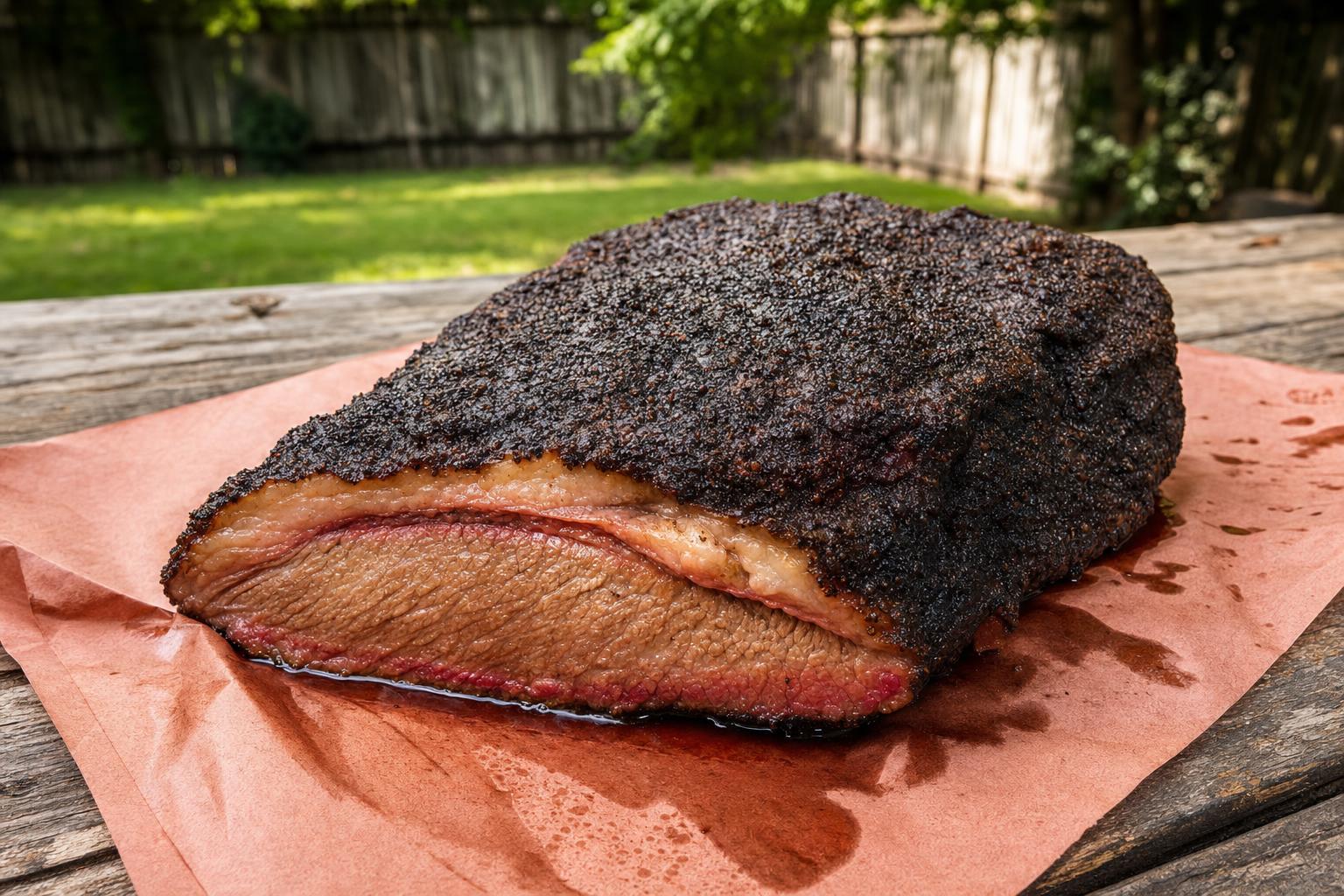
- After a full 3 hours, pull the rack. The surface should be deep mahogany to reddish-brown with a defined dry bark. The internal temperature will likely be in the 155–170°F (68–77°C) range, possibly stalled. This is normal and expected. Do not wait for the stall to break — proceed to the foil wrap on schedule.
Phase 2 — Foil Wrap (2 Hours)
- Tear two large sheets of heavy-duty aluminum foil, each about twice the length of the rack. Lay one sheet flat and place the rack bone-side up on it. Pour 3 tablespoons of apple juice directly onto the bone side of the rack. Fold the foil up tightly around the rack, then wrap the second sheet around the entire package to create a double-layered, steam-tight seal. There should be no gaps — even a small opening will let steam escape and slow collagen hydrolysis significantly.3 tablespoons apple juice
- Return the foil-wrapped rack to the smoker at 225–250°F, bone-side down. Cook for exactly 2 hours. During this phase the internal temperature will climb steadily through the 180s and into the low 190s°F (82–91°C) as the trapped steam accelerates collagen-to-gelatin conversion. No spritzing or opening is needed.
Phase 3 — Bark Set (1 Hour)
- After 2 hours, carefully unwrap the foil. The rack will be visibly more pliable and the surface will appear steamed and softened. Discard the foil and collected juices (or save the juices — they are intensely flavored rendered collagen and can be added to a finishing sauce). Return the rack unwrapped, bone-side down to the smoker.
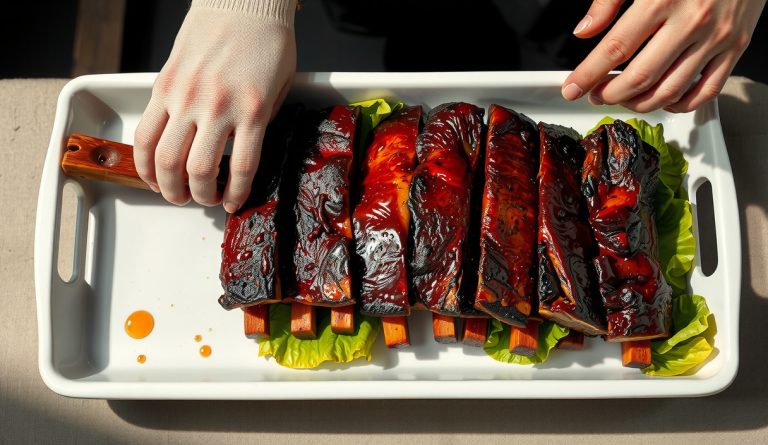
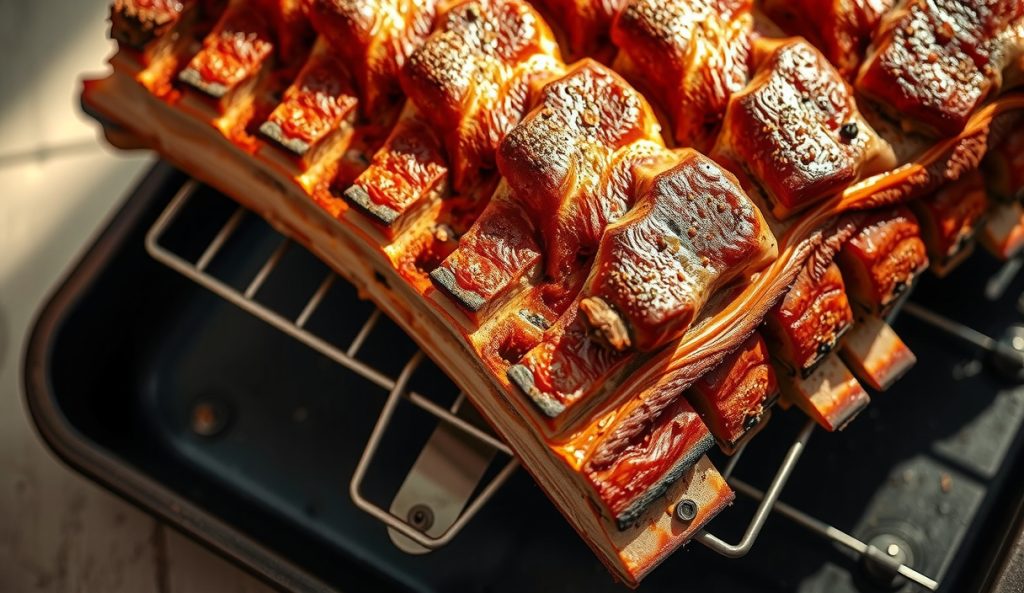
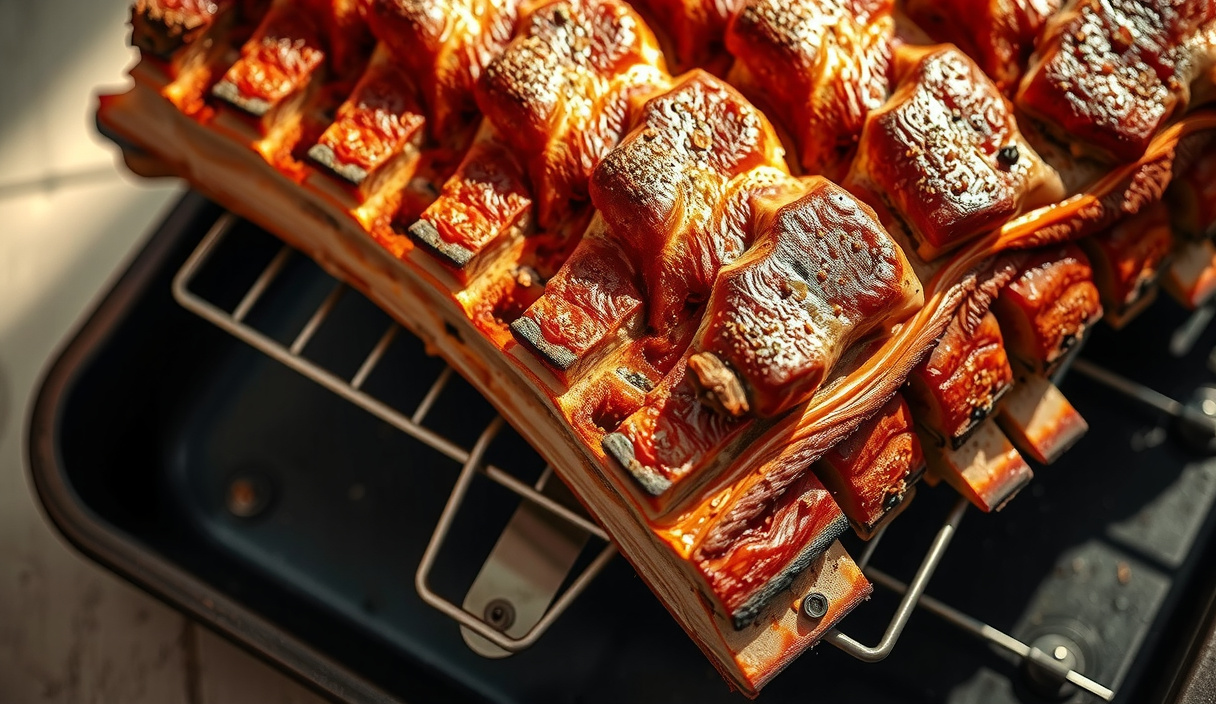
- Cook uncovered for 45 minutes to 1 hour. This phase re-dries the surface, concentrating the gelatin layer into a tacky, glossy bark. Check the bend test at the 45-minute mark: grip the rack with tongs at one end and lift — if it bends about 90 degrees with a visible crack forming in the bark before breaking, the ribs are done. If the rack droops more than 90 degrees with no resistance, it is past ideal but still excellent. If it is stiff and barely flexes, return to the smoker in 15-minute increments and re-test.
- Cross-check with the toothpick test: push a wooden toothpick between two center bones. It should slide in with zero resistance — like pushing into soft butter. Confirm the probe is reading 195–203°F (91–95°C) internal, understanding that the bend and toothpick tests override the thermometer as final arbiter.
Rest and Serve
- Remove the rack from the smoker and rest uncovered (or loosely tented in foil) on a cutting board for 15 to 30 minutes. This rest allows expelled moisture to redistribute through the muscle fibers. Do not skip it — cutting immediately will cause significant juice loss onto the board.
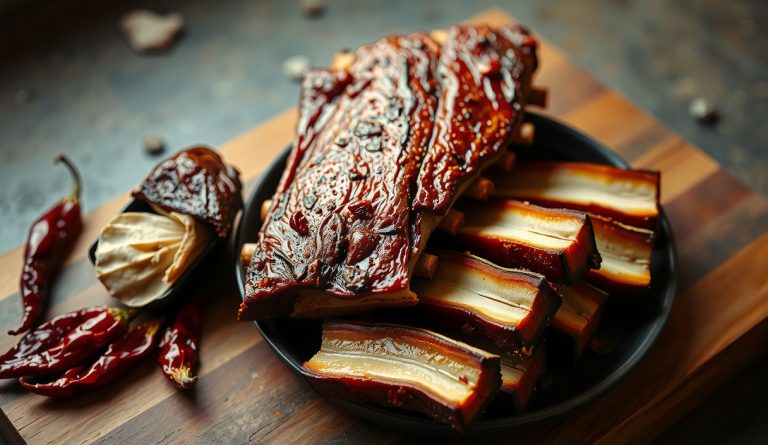
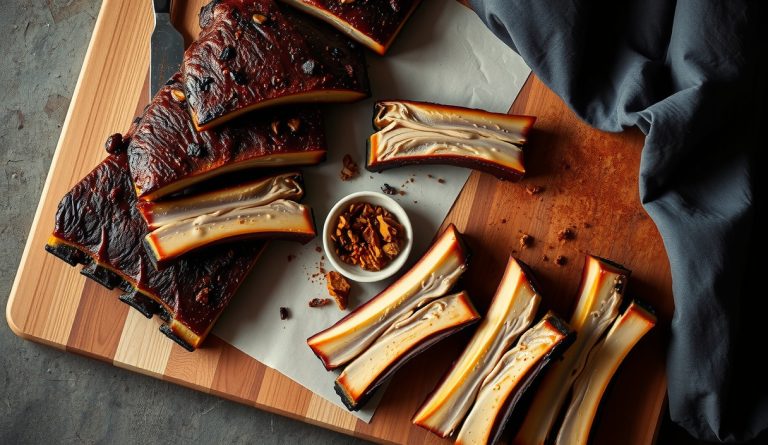
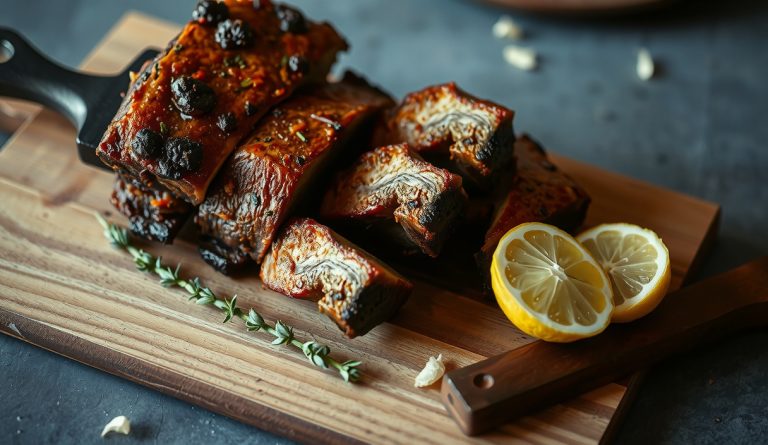
- Slice between each rib bone with a sharp slicing knife using a single smooth stroke. Each bone should separate cleanly, with the meat pulling away from the bone with a gentle tug — not zero tug (overcooked), and not a fight (undercooked). Serve immediately, bone-side down, with no sauce required. Memphis dry-rub ribs stand alone.
Notes
Nutrition
Memphis pit culture has exactly one commandment about spare ribs: they bend, they do not break. A rack draped over your index finger should arc gracefully at about 90 degrees before a single crack appears in the bark. If the meat is already sliding off the bone before you even pick it up, you have crossed from tender into braised mush — and no amount of sauce will resurrect it. That bend test is not affectation. It is thermodynamics speaking plain English.
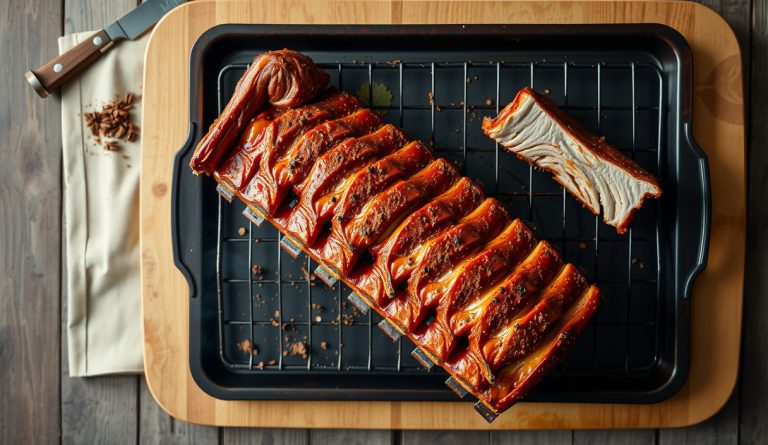
This recipe builds the canonical Memphis competition dry-rub profile on a St. Louis-cut spare rib — the tidied rectangle of pork ribs with the brisket flap and sternum cartilage removed — and runs the 3-2-1 technique on a two-zone charcoal or offset smoker. The rub leans hard on smoked paprika, cumin, and a measured hit of brown sugar. The smoke is a hickory-apple blend: hickory to drive a deep, almost bacon-like phenolic backbone; apple to keep that smoke from turning bitter on the longer, foil-wrapped phase.
Why does the 3-2-1 method work? The science behind Memphis dry-rub spare ribs
Memphis dry-rub spare ribs work because the 3-2-1 timetable sequences three distinct molecular pathways — Maillard browning, collagen hydrolysis, and smoke chemistry — so each runs at its optimal conditions rather than competing against the others. Understanding those three pathways is what separates a repeatable result from a lucky one.
The first pathway is the Maillard cascade. Smoked paprika is already pre-browned, loaded with Amadori rearrangement products that seed the reaction, but real surface Maillard onset begins the moment the rub-coated rib hits radiant heat above roughly 280°F (138°C). Brown sugar accelerates this: as a reducing disaccharide blend, brown sugar donates fructose and glucose to amino-carbonyl condensation far more readily than pork proteins alone. The result is the dark, lacquered bark that distinguishes a Memphis rib from a braised one. Water activity at the surface matters here — the first hour of uncovered smoke desiccates the exterior, dropping surface water activity from near 1.0 toward the 0.5–0.7 Maillard sweet spot, which is exactly why the rack never goes into foil during the first phase.
The second pathway is collagen hydrolysis. St. Louis spare ribs carry a meaningful burden of type I collagen in the intercostal connective tissue. Collagen begins thermal shrinkage at approximately 140–149°F (60–65°C), expelling moisture and toughening the bite. Sustained heat above 160°F (71°C), combined with enough time, drives first-order hydrolysis of those cross-linked tropocollagen helices into soluble gelatin. The 3-2-1 structure exploits this directly: the foil phase (hours 3–5) traps expelled moisture and steam around the ribs, holding the internal environment between 175–195°F (79–91°C) and accelerating collagen conversion without the surface continuing to lose water. The foil phase functions as a controlled, localized braising environment sealed inside the smoker. The final unwrapped hour then allows newly produced gelatin to re-concentrate at the surface, giving the bark its characteristic tacky, glossy finish.
The third pathway is smoke chemistry. Hickory combustion produces high concentrations of guaiacol and syringol — the phenolic VOCs that deliver the sharp, assertive smoke note characteristic of Memphis-style pork. Apple wood moderates this by contributing a lighter aldehyde and ester fraction. The smoke ring visible beneath the bark is not smoke physically penetrating the meat; it is myoglobin reacting with carbon monoxide and nitrogen dioxide from combustion gases to form carboxymyoglobin and nitrosomyoglobin, which are chemically stable at temperatures that convert normal oxymyoglobin to the gray-tan hemichrome. Ring depth is a function of surface moisture (wet surface equals better NO2 absorption) and fire management, not cook time alone. This is why moisture-spritz protocols during the unwrapped phase deepen the ring.
What equipment and ingredients do I need for Memphis spare ribs?
- St. Louis cut vs. full spare: St. Louis cut removes the sternum cartilage and the rib tips, creating a uniform rectangular slab that cooks evenly. Full spares cook unevenly and make timing the bend test harder. If the butcher gives you full spares, trim the flap yourself with a boning knife.
- Membrane removal: The periosteum (translucent membrane on the bone-side of the rack) must come off. The periosteum sets into an impenetrable, rubbery layer during the cook and blocks rub penetration. Slide a butter knife under it at one end, grip with a paper towel, and peel in one motion.
- Smoked vs. sweet paprika: Use smoked paprika (pimentón de la vera, preferably). Sweet paprika lacks the pre-formed Maillard compounds that give the rub its color depth. Hot paprika can substitute a portion — say, one-third of the total paprika — if you want heat without adding cayenne separately.
- Brown sugar hygroscopicity: Brown sugar pulls ambient moisture. Mix your rub batch fresh and store it airtight. In a humid environment, clumped rub will steam the surface rather than form a dry bark.
- Wood ratio: Use 70% hickory to 30% apple by weight. A full 3-2-1 cook on spare ribs needs roughly 6–8 oz of wood chunks per smoke addition. Over-smoking — common with chips that flare and smolder inconsistently — produces creosote bitterness. Chunks smolder; chips spike. Use chunks.
- Thermometer requirement: A calibrated leave-in probe (not an instant-read alone) is mandatory. The stall — the plateau where internal temperature holds at 160–170°F for 45–90 minutes — is driven by evaporative cooling absorbing heat as fast as the smoker delivers it. This is why the foil wrap must happen on a schedule (time), not when the stall breaks.
- Foil vs. butcher paper: Foil traps all moisture and accelerates the braise effect, giving a softer texture. Butcher paper breathes slightly, preserving more bark. For the authentic Memphis style emphasized here — maximum bark integrity — foil is correct.
Memphis Dry-Rub Spare Ribs (3-2-1 Method)
Equipment
- 1 Offset smoker or charcoal kettle with two-zone setup Must hold 225–250°F (107–121°C) at grate level for 6 hours
- 1 Leave-in digital probe thermometer Calibrated; read at grate level, not dome
- 1 roll Heavy-duty aluminum foil Used to wrap ribs tightly during phase two; double-layer for zero steam escape
- 1 Spray bottle For apple cider vinegar spritz during phase one
- 1 Boning knife For trimming membrane and any excess flap if full spares are used
- 6 oz Hickory wood chunks Chunks, not chips; 70% of total wood by weight
- 3 oz Apple wood chunks 30% of total wood by weight; moderates phenolic sharpness of hickory
Ingredients
Ribs
- 1 rack St. Louis-cut spare ribs About 3 to 3.5 lbs; membrane removed, excess hard fat trimmed
Dry Rub
- 3 tablespoons smoked paprika (pimentón de la vera) Sweet or bittersweet; do not substitute sweet paprika
- 2 tablespoons light brown sugar, packed Packed; contributes Maillard browning and bark depth
- 1 tablespoon kosher salt Diamond Crystal; if using Morton, reduce to 2 teaspoons
- 1 tablespoon ground cumin Freshly ground from whole seeds if possible for maximum volatility
- 2 teaspoons freshly ground black pepper Coarse grind
- 1 teaspoon garlic powder Not garlic salt
- 1 teaspoon onion powder
- 1 teaspoon dry mustard powder Colman’s or equivalent; adds emulsified sulfur VOCs to the bark
- ½ teaspoon cayenne pepper Adjust to taste; this level registers as background warmth only
- ½ teaspoon dried thyme Optional but traditional in Memphis profiles
Spritz and Wrap
- ½ cup apple cider vinegar Mixed 1:1 with apple juice for the spritz bottle
- ½ cup unfiltered apple juice Mixed with vinegar for spritz
- 3 tablespoons apple juice Added inside the foil packet during the wrap phase to generate steam
Instructions
Prepare the Ribs and Rub
- Place the rack bone-side up on a cutting board. Slide a butter knife under the membrane (periosteum) at one end near a center bone. Grip the loosened edge with a paper towel and pull firmly in one motion to remove the entire membrane. Pat the rack dry on both sides with paper towels.
- Combine all dry rub ingredients in a small bowl: smoked paprika, brown sugar, kosher salt, cumin, black pepper, garlic powder, onion powder, dry mustard powder, cayenne, and thyme. Mix thoroughly. You need roughly 6 to 7 tablespoons total for one rack.2 tablespoons light brown sugar, packed, 1 tablespoon kosher salt, 1 tablespoon ground cumin, 2 teaspoons freshly ground black pepper, 1 teaspoon garlic powder, 1 teaspoon onion powder, 1 teaspoon dry mustard powder, 1/2 teaspoon cayenne pepper, 1/2 teaspoon dried thyme
- Apply the dry rub generously to the meat side, then the bone side, then the edges. Press it firmly into the surface with clean hands — you want adhesion, not a loose coating. Place the rack uncovered in the refrigerator for at least 1 hour, or up to 12 hours overnight. A surface pellicle will form, which aids bark adhesion and smoke absorption.2 tablespoons light brown sugar, packed, 1 tablespoon kosher salt, 1 tablespoon ground cumin, 2 teaspoons freshly ground black pepper, 1 teaspoon garlic powder, 1 teaspoon onion powder, 1 teaspoon dry mustard powder, 1/2 teaspoon cayenne pepper, 1/2 teaspoon dried thyme
Set Up the Smoker
- Light your charcoal or fire your offset 45 to 60 minutes before the ribs go on. Target a stable 225–250°F (107–121°C) at grate level. Verify with a calibrated probe at grate height — dome thermometers routinely read 15–30°F hotter than actual cooking temperature. Do not place the ribs until the temperature is stable and you have clean, thin, blue-gray smoke (not white billowing smoke, which indicates incomplete combustion and bitter creosote).
- Add the first wood addition: approximately 4 oz hickory chunks and 2 oz apple chunks placed directly on the coals or in the firebox. The smoke will be heaviest in the first 30 minutes — this is when the ribs absorb the most smoke, as cold protein surfaces are highly receptive. Prepare the spritz bottle by mixing apple cider vinegar and apple juice 1:1.1/2 cup apple cider vinegar, 1/2 cup unfiltered apple juice
Phase 1 — Unwrapped Smoke (3 Hours)
- Place the rack bone-side down on the grate over indirect heat. Insert a probe thermometer into the thickest part of the meat between two center bones, not touching bone. Close the lid. Do not open for the first 90 minutes. This phase is building the Maillard bark and establishing the smoke ring.
- At the 90-minute mark, open the smoker and quickly spritz both sides of the rack with the apple cider vinegar and apple juice mixture. Close immediately. Repeat the spritz every 45 to 60 minutes for the remainder of phase one. If the surface looks dry and the color is not deepening past pale orange, spritz more aggressively. Add a second wood addition (2 oz hickory, 1 oz apple) at the 2-hour mark if smoke production has dropped.1/2 cup apple cider vinegar, 1/2 cup unfiltered apple juice
- After a full 3 hours, pull the rack. The surface should be deep mahogany to reddish-brown with a defined dry bark. The internal temperature will likely be in the 155–170°F (68–77°C) range, possibly stalled. This is normal and expected. Do not wait for the stall to break — proceed to the foil wrap on schedule.
Phase 2 — Foil Wrap (2 Hours)
- Tear two large sheets of heavy-duty aluminum foil, each about twice the length of the rack. Lay one sheet flat and place the rack bone-side up on it. Pour 3 tablespoons of apple juice directly onto the bone side of the rack. Fold the foil up tightly around the rack, then wrap the second sheet around the entire package to create a double-layered, steam-tight seal. There should be no gaps — even a small opening will let steam escape and slow collagen hydrolysis significantly.3 tablespoons apple juice
- Return the foil-wrapped rack to the smoker at 225–250°F, bone-side down. Cook for exactly 2 hours. During this phase the internal temperature will climb steadily through the 180s and into the low 190s°F (82–91°C) as the trapped steam accelerates collagen-to-gelatin conversion. No spritzing or opening is needed.
Phase 3 — Bark Set (1 Hour)
- After 2 hours, carefully unwrap the foil. The rack will be visibly more pliable and the surface will appear steamed and softened. Discard the foil and collected juices (or save the juices — they are intensely flavored rendered collagen and can be added to a finishing sauce). Return the rack unwrapped, bone-side down to the smoker.
- Cook uncovered for 45 minutes to 1 hour. This phase re-dries the surface, concentrating the gelatin layer into a tacky, glossy bark. Check the bend test at the 45-minute mark: grip the rack with tongs at one end and lift — if it bends about 90 degrees with a visible crack forming in the bark before breaking, the ribs are done. If the rack droops more than 90 degrees with no resistance, it is past ideal but still excellent. If it is stiff and barely flexes, return to the smoker in 15-minute increments and re-test.
- Cross-check with the toothpick test: push a wooden toothpick between two center bones. It should slide in with zero resistance — like pushing into soft butter. Confirm the probe is reading 195–203°F (91–95°C) internal, understanding that the bend and toothpick tests override the thermometer as final arbiter.
Rest and Serve
- Remove the rack from the smoker and rest uncovered (or loosely tented in foil) on a cutting board for 15 to 30 minutes. This rest allows expelled moisture to redistribute through the muscle fibers. Do not skip it — cutting immediately will cause significant juice loss onto the board.
- Slice between each rib bone with a sharp slicing knife using a single smooth stroke. Each bone should separate cleanly, with the meat pulling away from the bone with a gentle tug — not zero tug (overcooked), and not a fight (undercooked). Serve immediately, bone-side down, with no sauce required. Memphis dry-rub ribs stand alone.
Notes
Nutrition
How do I nail Memphis spare ribs every time? Tips and technique
- Run your smoker to temperature before the ribs go in. Placing cold meat into a smoker still climbing to 225°F (107°C) extends the cook unpredictably and risks a prolonged zone below 140°F (60°C) internal, which is both a food-safety concern and a texture problem. Target 225–250°F (107–121°C) grate temperature, measured at grate level — not the dome thermometer, which reads 15–30°F hotter.
- Spritz, do not soak. A light apple cider vinegar or apple juice spritz during the first unwrapped phase keeps the surface moist enough to absorb smoke compounds and deepens the ring. Spray every 45–60 minutes starting at the 90-minute mark. Over-spritzing drops the surface temperature and extends total cook time unpredictably.
- The bend test is your doneness signal, not internal temperature. Spare ribs pass the bend test typically between 195–203°F (91–95°C) internal, but that range varies by the fat content and connective tissue load of the specific rack. Use the probe to track progress; use the bend test to decide when to pull.
- Toothpick test as a cross-check: Push a wooden toothpick between two center bones. The toothpick should slide in with essentially zero resistance — like pushing into room-temperature butter — at the same moment the rack bends correctly. If the toothpick catches or drags, return the rack to the smoker unwrapped for 15-minute increments.
- Rest before cutting. A minimum 15-minute uncovered rest (or up to 30 minutes tented loosely in foil) allows moisture expelled during cooking to redistribute. Cutting immediately causes a visible flood of juice onto the board — moisture that should be in the meat.
- Failure mode — falling-off-the-bone: If the meat pulls cleanly away from the bone with zero tug, collagen hydrolysis went to completion and the muscle fibers themselves overcooked past 200°F (93°C) for too long. The foil phase likely ran too long or at too high a temperature. Dial the foil phase down to 90 minutes on the next cook.
What variations can I make on Memphis spare ribs?
Competition wet finish: Memphis competition rigs often apply a thin glaze of apple juice, honey, and a touch of the dry rub during the final 20 minutes of the unwrapped phase. This technique adds a candy-lacquer sheen without crossing into the sauced category. Brush lightly twice at 10-minute intervals to build layers rather than applying a single thick coat that runs and burns.
Hot Memphis variant: Swap one tablespoon of the smoked paprika for one teaspoon of cayenne plus one teaspoon of hot pimentón. Add a pinch of ancho chile powder for fruit-forward heat that complements the apple wood smoke without flattening the cumin note. This version benefits from reducing the brown sugar by half to prevent the rub surface from over-caramelizing at higher heat.
Baby back scaling: Baby backs carry far less connective tissue and fat than St. Louis spares. The 3-2-1 method overkills baby backs. Scale to a 2-2-1 (or even 2-1.5-0.5) structure and pull at the same bend test standard. All rub quantities in this recipe apply equally to baby backs; baby backs simply absorb the flavors faster due to their thinner meat layer over the bone.
Offset vs. kettle smoker: An offset smoker with a separate firebox is the traditional tool, but a 22-inch kettle with a slow-n-sear or snake-method charcoal arrangement runs this cook without modification. The key variable is holding grate temperature in the 225–250°F band without manual intervention every 20 minutes. On a kettle, aim for the bottom vent at roughly one-quarter open and the top vent at three-quarters open once the target temperature is stable.
Frequently asked questions about Memphis dry-rub spare ribs
Can I do 3-2-1 on a gas grill? Yes, with caveats. Gas grills produce no combustion-derived smoke compounds on their own, so a smoker box or foil pouch packed with soaked wood chips placed directly over a lit burner on one side is required. Run only that burner at its lowest setting, place ribs on the unlit side, and keep the lid closed. Smoke penetration will be lighter than with a charcoal or offset setup, and the smoke ring will be shallow or absent, but the collagen hydrolysis and bark physics are identical.
Do I need to brine or marinate spare ribs before dry-rubbing? No — and doing so actively works against bark formation. A wet surface suppresses the Maillard reaction by keeping water activity too high at the boundary layer. The dry rub pulls a small amount of surface moisture in the first 30–60 minutes via osmosis, which then re-absorbs into the meat as a natural cure. Apply the rub at minimum one hour before smoking, ideally overnight in the refrigerator uncovered so the surface can pellicle slightly.
My bark is dark but the meat is still tough after 6 hours — what happened? Two likely culprits. First, the smoker may be running cool: dome thermometers routinely read 20–30°F above actual grate temperature, meaning a dome reading of 225°F may be only 195–200°F at the grate, extending the cook significantly — verify with a calibrated grate-level probe. Second, the foil wrap may not have been tight enough to trap steam, leaving collagen hydrolysis in the slow, unaided phase for the entire cook. Re-wrap more tightly and add two tablespoons of apple juice inside the foil packet to generate sufficient steam pressure.