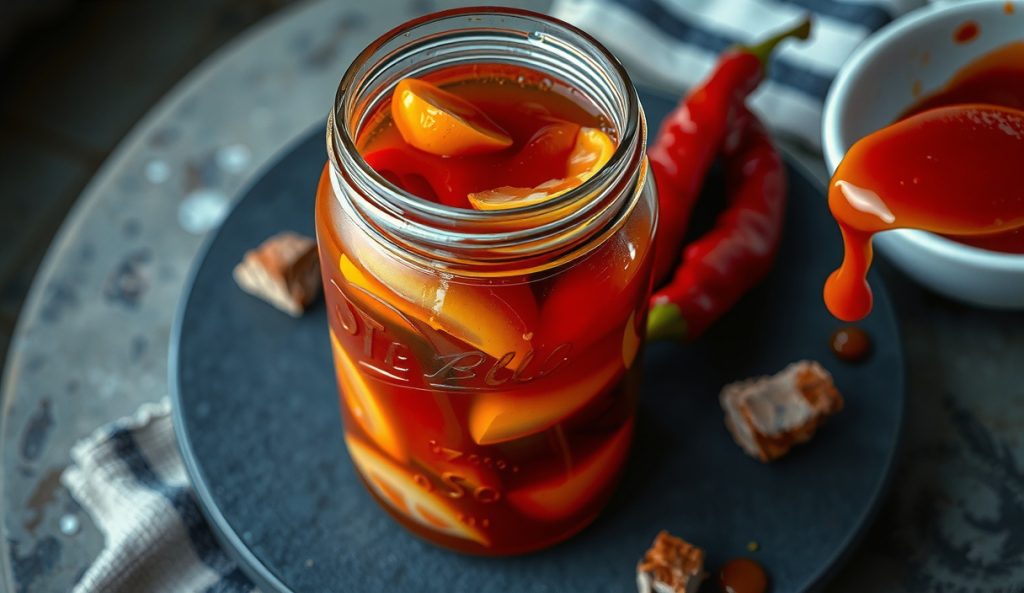
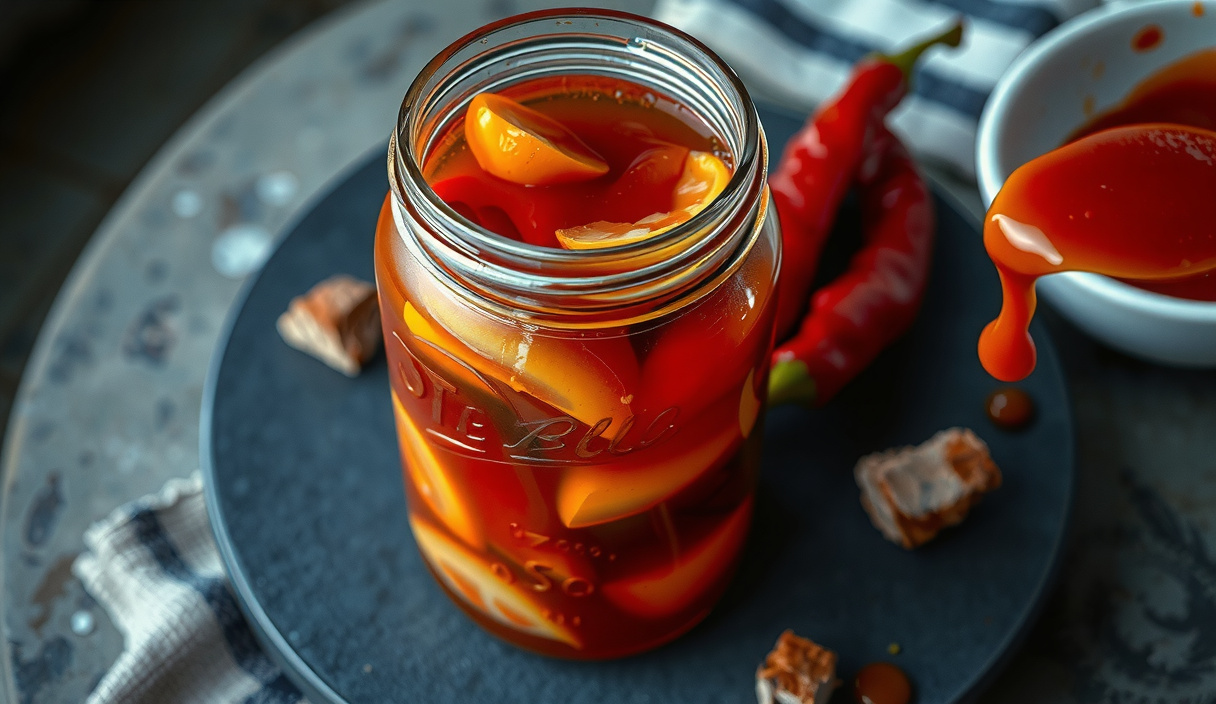
Lacto-Fermented Smoked Pepper Hot Sauce

Equipment
- 1 Smoker or kettle grill with wood chips Cherry or apple wood preferred. Chamber temp 180–200°F.
- 1 1-quart wide-mouth mason jar Clean thoroughly with hot soapy water; no need to sterilize as the salt brine is the primary selective agent.
- 1 pH meter or precision pH strips (range 3.0–5.0) Non-negotiable safety tool. Target final pH is 3.4–3.6.
- 1 Kitchen scale For precise salt measurement in grams. Volumetric salt measurement is unreliable.
- 1 Blender High-speed preferred. Wear splash protection when blending hot or acidic liquids.
- 1 Fine-mesh strainer or nut-milk bag For straining seed fragments and coarse pulp post-blend.
- 2 Glass hot sauce bottles or mason jars for storage Swing-top or standard cap bottles, 8–12 oz each. Sanitize before filling.
Ingredients
Peppers and Aromatics
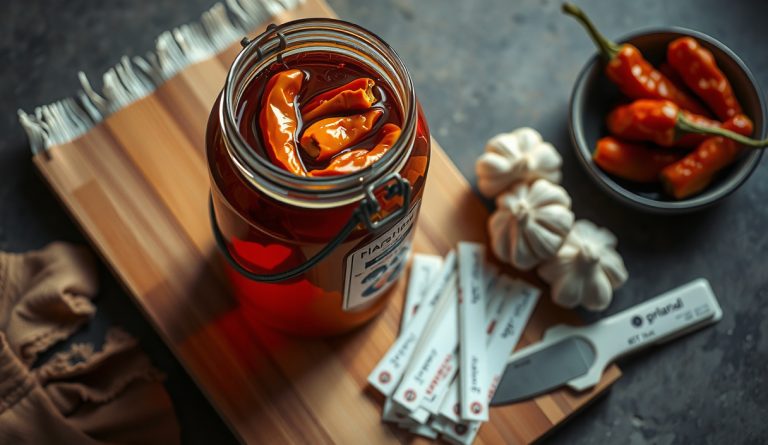
- 300 g red Fresno chiles Fully ripe, stems removed. Slice lengthwise to expose flesh for smoke penetration.
- 150 g jalapeños Green preferred. Stems removed, sliced lengthwise.
- 6 cloves garlic Peeled, left whole. Will ferment and mellow considerably.
Brine
- 600 mL filtered or non-chlorinated water Chlorine in tap water inhibits Lactobacillus. Use filtered, bottled, or water left uncovered overnight.
- 21 g non-iodized kosher salt or pickling salt This is exactly 3.5% w/v of 600 mL water. Do not use iodized salt — iodine is antimicrobial.

Instructions
Smoke the Peppers
- Prepare your smoker or kettle grill with cherry or apple wood chips. Bring the chamber to 180–200°F. Arrange the sliced Fresno chiles and jalapeños cut-side down on the grates. Smoke for 40–50 minutes — you want visible smoke color penetration and a slight tackiness on the flesh, not a fully cooked or dried pepper.150 g jalapeños
- Remove the peppers and allow them to cool completely to room temperature, about 20–30 minutes. The goal is maximum retention of fat-soluble smoke phenolics in the cell matrix before the aqueous brine environment is introduced. Do not rinse the peppers after smoking.150 g jalapeños
Prepare the Brine
- Weigh 21 g of non-iodized salt on a kitchen scale. Combine with 600 mL of filtered water and stir until the salt is fully dissolved. This produces a precise 3.5% w/v brine. Test with a finger — it should taste aggressively salty, well beyond seasoning-level salt.21 g non-iodized kosher salt or pickling salt, 600 mL filtered or non-chlorinated water
Pack the Fermentation Jar
- Pack the smoked Fresno chiles, jalapeños, and garlic cloves tightly into a clean 1-quart wide-mouth mason jar. The tight pack helps keep pieces submerged once the brine is added.150 g jalapeños, 6 cloves garlic
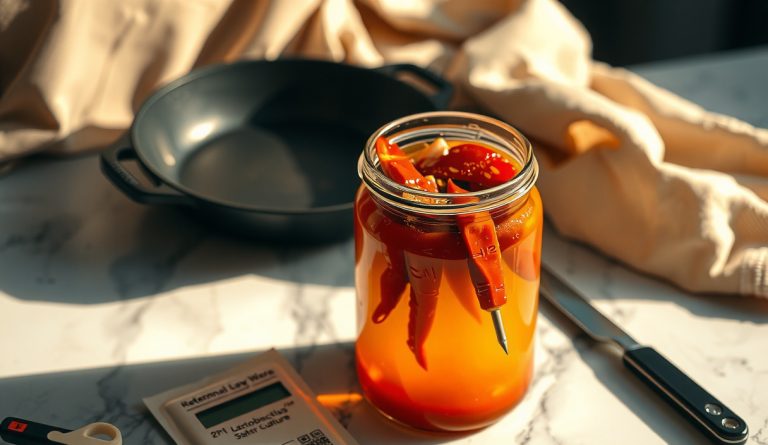
- Pour the prepared 3.5% brine over the peppers until they are fully covered, leaving approximately 1 inch of headspace. Fill a small zip-seal bag with additional brine (or water as a backup), seal it, and press it down over the peppers to act as a weight, keeping all vegetable matter below the brine surface. Alternatively, use a dedicated fermentation weight.600 mL filtered or non-chlorinated water, 21 g non-iodized kosher salt or pickling salt
- Cover the jar loosely with the lid (do not seal airtight — the fermentation produces CO2 that needs to escape) or fit with an airlock. Label the jar with the start date and target end date. Place in a location that holds 65–72°F consistently. A kitchen counter away from direct sunlight is ideal; avoid areas near the oven or refrigerator exhaust.
Ferment 5–7 Days
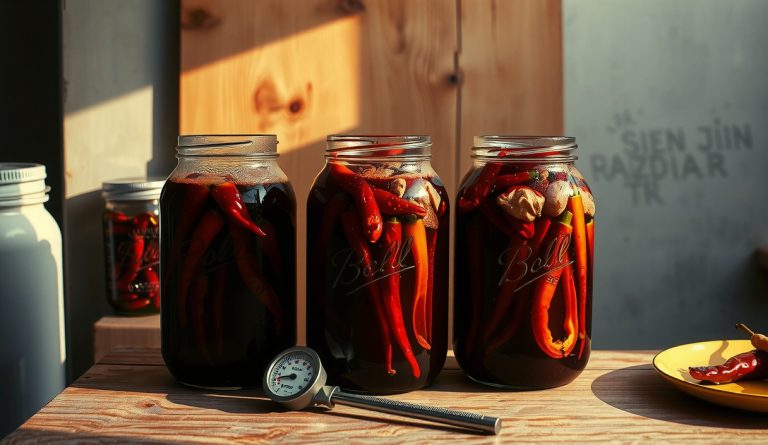
- Check the jar once daily for the first 3 days. You should see brine cloudiness beginning by day 2 and visible CO2 bubbling by day 2–3. If a white film forms on the surface (kahm yeast), skim it off with a clean spoon and ensure all pepper pieces remain submerged. Kahm yeast is harmless but should be controlled.
- On day 5, begin pH monitoring. Remove a small sample of brine from the jar and test with a pH meter or precise strips. A reading below pH 4.0 indicates active fermentation is well underway. Continue fermenting until the brine reaches pH 3.4–3.6. Depending on your ambient temperature, this occurs between day 5 and day 7. Do not rely solely on the calendar — the pH reading is the definitive safety and flavor endpoint.
Blend and Strain
- Once the target pH is reached, transfer the peppers, garlic, and all of the brine to a blender. Blend on high speed for 60–90 seconds until completely smooth. The brine carries active cultures, lactic acid, and dissolved smoke compounds — do not discard it.150 g jalapeños, 6 cloves garlic, 600 mL filtered or non-chlorinated water, 21 g non-iodized kosher salt or pickling salt
- Pour the blended sauce through a fine-mesh strainer or nut-milk bag into a clean bowl. Press the solids firmly with a spatula or squeeze the bag to extract maximum liquid. Discard the dry pulp. Taste the strained sauce and confirm the brightness, smoke depth, and heat are in balance. If the sauce tastes too sharp, allow it to rest refrigerated for 48 hours — the lactic acid integration smooths considerably.
- Transfer the finished sauce into clean glass bottles or mason jars. For a live-culture (probiotic) product: store sealed in the refrigerator at 38–40°F and use within 6–12 months. The sauce continues to evolve slowly in flavor. For shelf-stable pasteurized product: place sealed bottles in a 185°F water bath for 15 minutes, then cool completely before storing at room temperature for up to 18 months. Label each bottle with the pH reading and bottling date.
Notes
Nutrition
The bottle sitting on my shelf right now smells like smoke, brine, and something alive — because it is. Lacto-fermented hot sauce is not a condiment you buy at the grocery store and forget about. It is a controlled microbial event you set in motion, and if you understand the chemistry happening in that jar, you will never make a flat, one-dimensional hot sauce again.
The key decision in this recipe is smoking the peppers before they hit the brine. Most fermentation guides tell you to keep everything raw. But volatile phenolic compounds responsible for smoke character — primarily guaiacol, syringol, and 4-methylguaiacol — are fat-soluble and deeply embedded in the pepper’s cellular matrix after smoking. They survive the acidification process largely intact, whereas water-soluble aromatic compounds would be partially scrubbed by the CO2 purge of active fermentation. Smoke before you ferment, and those char notes become a permanent structural layer in the final sauce.
Why does lacto-fermented smoked hot sauce work? The science
Lacto-fermentation works because a precisely controlled salt concentration selects for lactic-acid-producing bacteria while suppressing every organism that would spoil the batch. Lactobacillus and Leuconostoc species, naturally present on pepper skins, thrive in a 3.5% w/v sodium chloride brine while competing microorganisms — Enterobacteriaceae, molds — are suppressed by the osmotic pressure. Those bacteria metabolize the glucose and fructose naturally present in Capsicum tissue through homofermentative and heterofermentative pathways, producing lactic acid as the dominant organic acid end-product.
The salt concentration is the critical control variable. Below 2% w/v, the brine fails to create sufficient osmotic selection pressure, giving spoilage organisms a competitive window in the first 24–48 hours. Above 4% w/v, the salt burden begins to inhibit even the target Lactobacillus strains, slowing the pH drop and extending the danger window. The 3.0–3.5% w/v band is the engineered sweet spot for vegetable fermentation.
The pH trajectory is the governing safety parameter, not calendar days. As lactic acid accumulates, pH drops continuously toward the 3.4 target for this recipe. At that pH, two critical thresholds are crossed: growth of Listeria monocytogenes is fully inhibited below pH 3.5, and Clostridium botulinum toxin production is prevented below pH 4.6 by a wide margin. That pH, combined with residual lactic acid concentration and low water activity in the strained, blended sauce, delivers genuine ambient shelf stability in a sealed bottle.
Maillard-derived phenolics from the smoking step — particularly guaiacol and syringol — remain stable below pH 4.0, meaning the char compounds driven into the pepper flesh during a 45-minute cold smoke survive the full 7-day fermentation intact. The Maillard reaction during smoking also generates carbonyl compounds including furfurals and hydroxymethylfurfural that react with residual free amino acids during fermentation in a low-temperature Amadori-adjacent rearrangement, deepening flavor without the high-heat pyrolysis products that make heavily charred sauces bitter. The capsaicin in the Fresnos and jalapeños is lipid-soluble and binds to TRPV1 receptors independently of pH, so heat perception in the final sauce is largely undiminished by acidification — though lactic acid adds a bright, clean finish that separates this from any vinegar-based hot sauce.
What equipment and ingredients do I need?
- Smoker or kettle grill with wood chips: Cherry or apple wood is ideal — moderate smoke density without the aggressive creosote load of hickory, which can turn bitter after 7 days of fermentation. Aim for a chamber temperature of 180–200°F and a 40–50 minute cold-smoke window. The goal is color penetration and phenolic uptake, not cook-through.
- 1-quart wide-mouth mason jar: Fermentation requires an anaerobic or semi-anaerobic environment. A loose lid or an airlock setup both work. A simple zip-seal bag filled with brine laid on top of the peppers to keep them submerged eliminates oxygen exposure without needing specialty equipment.
- pH meter or precise pH strips (range 3.0–5.0): Do not skip this step. Color-based strips in the 2.5–4.5 range are accurate enough. Reaching pH 3.4–3.6 is the confirmed safety target, not the 7-day marker alone. Temperature variability in your fermentation space shifts the kinetics.
- Fresno chiles: Fresno peppers run 2,500–10,000 SHU (Scoville Heat Units) — moderate heat with a distinctly fruity, slightly smoky native flavor profile that pairs beautifully with lactic acid. Red Fresnos (fully ripe) are preferred for maximum sugar content, which accelerates the fermentation and deepens the final color.
- Jalapeños: Green jalapeños contribute vegetal depth and higher chlorophyll content that maintains the sauce’s complexity. Jalapeños ferment readily at 65–72°F.
- Non-iodized salt: Iodine is antimicrobial. Using iodized salt suppresses the target Lactobacillus strains. Use kosher salt or pure pickling salt, weighed by grams for precision.
Lacto-Fermented Smoked Pepper Hot Sauce
Equipment
- 1 Smoker or kettle grill with wood chips Cherry or apple wood preferred. Chamber temp 180–200°F.
- 1 1-quart wide-mouth mason jar Clean thoroughly with hot soapy water; no need to sterilize as the salt brine is the primary selective agent.
- 1 pH meter or precision pH strips (range 3.0–5.0) Non-negotiable safety tool. Target final pH is 3.4–3.6.
- 1 Kitchen scale For precise salt measurement in grams. Volumetric salt measurement is unreliable.
- 1 Blender High-speed preferred. Wear splash protection when blending hot or acidic liquids.
- 1 Fine-mesh strainer or nut-milk bag For straining seed fragments and coarse pulp post-blend.
- 2 Glass hot sauce bottles or mason jars for storage Swing-top or standard cap bottles, 8–12 oz each. Sanitize before filling.
Ingredients
Peppers and Aromatics
- 300 g red Fresno chiles Fully ripe, stems removed. Slice lengthwise to expose flesh for smoke penetration.
- 150 g jalapeños Green preferred. Stems removed, sliced lengthwise.
- 6 cloves garlic Peeled, left whole. Will ferment and mellow considerably.
Brine
- 600 mL filtered or non-chlorinated water Chlorine in tap water inhibits Lactobacillus. Use filtered, bottled, or water left uncovered overnight.
- 21 g non-iodized kosher salt or pickling salt This is exactly 3.5% w/v of 600 mL water. Do not use iodized salt — iodine is antimicrobial.
Instructions
Smoke the Peppers
- Prepare your smoker or kettle grill with cherry or apple wood chips. Bring the chamber to 180–200°F. Arrange the sliced Fresno chiles and jalapeños cut-side down on the grates. Smoke for 40–50 minutes — you want visible smoke color penetration and a slight tackiness on the flesh, not a fully cooked or dried pepper.150 g jalapeños
- Remove the peppers and allow them to cool completely to room temperature, about 20–30 minutes. The goal is maximum retention of fat-soluble smoke phenolics in the cell matrix before the aqueous brine environment is introduced. Do not rinse the peppers after smoking.150 g jalapeños
Prepare the Brine
- Weigh 21 g of non-iodized salt on a kitchen scale. Combine with 600 mL of filtered water and stir until the salt is fully dissolved. This produces a precise 3.5% w/v brine. Test with a finger — it should taste aggressively salty, well beyond seasoning-level salt.21 g non-iodized kosher salt or pickling salt, 600 mL filtered or non-chlorinated water
Pack the Fermentation Jar
- Pack the smoked Fresno chiles, jalapeños, and garlic cloves tightly into a clean 1-quart wide-mouth mason jar. The tight pack helps keep pieces submerged once the brine is added.150 g jalapeños, 6 cloves garlic
- Pour the prepared 3.5% brine over the peppers until they are fully covered, leaving approximately 1 inch of headspace. Fill a small zip-seal bag with additional brine (or water as a backup), seal it, and press it down over the peppers to act as a weight, keeping all vegetable matter below the brine surface. Alternatively, use a dedicated fermentation weight.600 mL filtered or non-chlorinated water, 21 g non-iodized kosher salt or pickling salt
- Cover the jar loosely with the lid (do not seal airtight — the fermentation produces CO2 that needs to escape) or fit with an airlock. Label the jar with the start date and target end date. Place in a location that holds 65–72°F consistently. A kitchen counter away from direct sunlight is ideal; avoid areas near the oven or refrigerator exhaust.
Ferment 5–7 Days
- Check the jar once daily for the first 3 days. You should see brine cloudiness beginning by day 2 and visible CO2 bubbling by day 2–3. If a white film forms on the surface (kahm yeast), skim it off with a clean spoon and ensure all pepper pieces remain submerged. Kahm yeast is harmless but should be controlled.
- On day 5, begin pH monitoring. Remove a small sample of brine from the jar and test with a pH meter or precise strips. A reading below pH 4.0 indicates active fermentation is well underway. Continue fermenting until the brine reaches pH 3.4–3.6. Depending on your ambient temperature, this occurs between day 5 and day 7. Do not rely solely on the calendar — the pH reading is the definitive safety and flavor endpoint.
Blend and Strain
- Once the target pH is reached, transfer the peppers, garlic, and all of the brine to a blender. Blend on high speed for 60–90 seconds until completely smooth. The brine carries active cultures, lactic acid, and dissolved smoke compounds — do not discard it.150 g jalapeños, 6 cloves garlic, 600 mL filtered or non-chlorinated water, 21 g non-iodized kosher salt or pickling salt
- Pour the blended sauce through a fine-mesh strainer or nut-milk bag into a clean bowl. Press the solids firmly with a spatula or squeeze the bag to extract maximum liquid. Discard the dry pulp. Taste the strained sauce and confirm the brightness, smoke depth, and heat are in balance. If the sauce tastes too sharp, allow it to rest refrigerated for 48 hours — the lactic acid integration smooths considerably.
- Transfer the finished sauce into clean glass bottles or mason jars. For a live-culture (probiotic) product: store sealed in the refrigerator at 38–40°F and use within 6–12 months. The sauce continues to evolve slowly in flavor. For shelf-stable pasteurized product: place sealed bottles in a 185°F water bath for 15 minutes, then cool completely before storing at room temperature for up to 18 months. Label each bottle with the pH reading and bottling date.
Notes
Nutrition
How do I nail this recipe every time?
- Weigh your salt in grams, not tablespoons. 3.5% w/v means 35 grams of salt per liter of water. Volumetric measurement of kosher salt is unreliable due to crystal size variation — a tablespoon of Diamond Crystal kosher salt delivers roughly half the sodium of a tablespoon of Morton kosher. A kitchen scale removes this ambiguity entirely.
- Keep peppers fully submerged. Any pepper surface exposed to oxygen above the brine line is a mold nucleation site. The brine-filled zip-seal bag weight trick is more reliable than commercial fermentation weights for irregular pepper pieces. Check daily for the first 3 days.
- Ferment at 65–72°F, not warmer. At 75°F and above, heterofermentative strains become more active, producing acetic acid and CO2 at higher rates, pushing the flavor profile away from clean lactic brightness toward a less controlled acid blend. Warmer temperatures also accelerate fermentation to the point where the pH drop can overshoot the target before you check it.
- Check pH on day 5, not day 7. In summer ambient conditions or slightly warm kitchens, the fermentation may reach pH 3.4 in 5–6 days. A pH reading on day 5 lets you pull it early if acid development is ahead of schedule, protecting the fresh pepper flavor.
- Strain through a fine-mesh sieve, not cheesecloth. Cheesecloth leaves particulate that settles and creates a false impression of separation. A fine-mesh sieve or nut-milk bag retains enough body from the blended pepper pulp while removing coarser seed fragments that contribute bitterness after fermentation.
- Do not boil after blending if you want live cultures. Bringing the sauce above 140°F kills Lactobacillus. For a shelf-stable live-culture sauce, keep the final bottle below 45°F in the refrigerator. For room-temperature shelf stability, a brief 185°F pasteurization for 15 minutes achieves it — but the sauce becomes a non-probiotic product, still delicious, just different.
What variations can I make to this recipe?
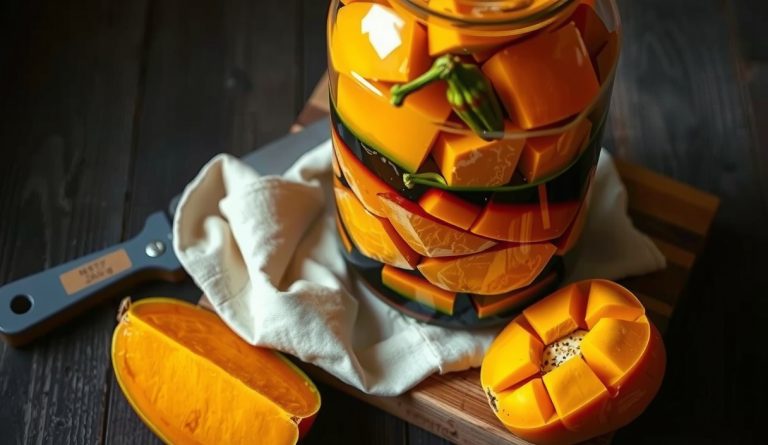
Habanero-mango version: Swap 4 of the Fresno chiles for 2 habaneros (adding 30,000+ SHU to the final profile) and add one ripe mango, peeled and cubed, to the fermentation vessel. The mango’s high fructose content accelerates fermentation — expect to hit pH 3.4 in 5 days rather than 7. The fruity top notes of habanero amplify the tropical character of the mango while the smoke anchors the sauce with savory depth. Reduce or eliminate the garlic if you want the fruit profile to dominate.
Carolina Reaper for serious heat: Replace all Fresnos with Carolina Reapers (1.4–2.2 million SHU). Use gloves throughout the entire process — capsaicin aerosolizes during blending at concentrations that cause serious mucosal irritation. The fermentation behavior is identical to the base recipe; the heat index is not. This version benefits from a higher proportion of garlic and a small addition of roasted sweet red bell pepper in the brine to moderate the fire with inherent sweetness, since the ferment contains no added sugar.
Scaling for larger batches: This recipe scales linearly — 3.5 grams of non-iodized salt per 100 mL of filtered water regardless of batch size. A half-gallon wide-mouth jar accommodates a double batch comfortably. Fermentation time does not change with batch size, because the fermentation is governed by microbial kinetics and temperature, not volume. The one variable that shifts is pH monitoring frequency; larger vessels have more thermal mass and can run cooler internally, occasionally adding 12–24 hours to the total timeline.
Low-sodium adaptation: Reducing the brine below 2.5% w/v is not recommended for safety in an ambient ferment. If sodium restriction is medically indicated, a 2% w/v brine with a commercial Lactobacillus starter culture added directly to the brine can compensate for the reduced competitive selection pressure from salt. Monitor pH twice daily starting on day 3 and target pH 3.3 for an additional safety margin given the reduced salt buffer.
Frequently asked questions
My brine turned cloudy and there are bubbles. Is something wrong? No — cloudiness and bubbles are exactly the signs of a healthy ferment. Cloudiness in a vegetable brine ferment is caused by microbial cell mass, CO2 nucleation, and lactic acid precipitating tannin-protein complexes from the pepper skins. The CO2 bubbles are a direct byproduct of heterofermentative Lactobacillus activity. A clean, transparent brine at day 3 would be the warning sign, indicating fermentation has not started. A white kahm yeast film on the surface is harmless — skim it, ensure the peppers are fully submerged, and continue.
Can I use a different wood for smoking? Yes, with caveats. Cherry and apple wood produce phenolic compounds (guaiacol, syringol) that survive fermentation without becoming bitter. Hickory and mesquite produce higher concentrations of heavier polycyclic aromatic compounds that can turn acrid after 7 days of acid exposure. Oak is a solid middle ground — moderate smoke intensity, neutral enough to let the pepper character lead. Avoid resinous softwoods such as pine and cedar entirely; their terpene compounds produce off-notes even before fermentation begins.
How long will the finished sauce keep? An unpasteurized, refrigerated sauce held below 40°F will remain safe and flavorful for 6–12 months. The pH 3.4 environment is self-preserving. Flavor peaks around weeks 2–6 post-bottling as the lactic acid mellows and the smoke integrates further. A pasteurized version (185°F for 15 minutes in a sealed bottle) is shelf-stable at room temperature for 12–18 months but will lose the live-culture character and some volatile aromatic brightness from the smoke compounds.