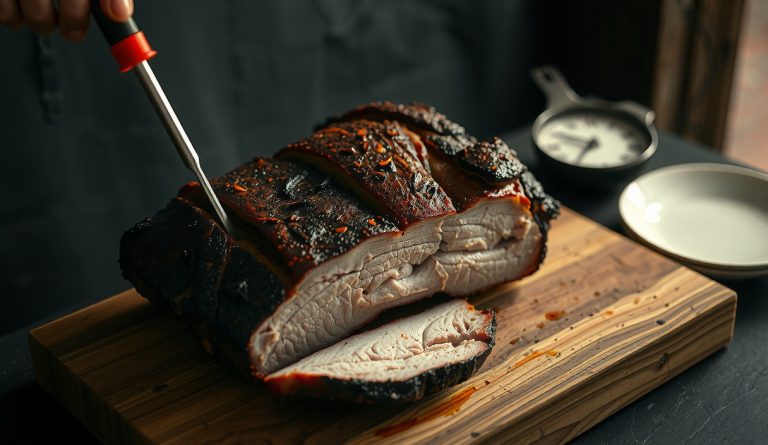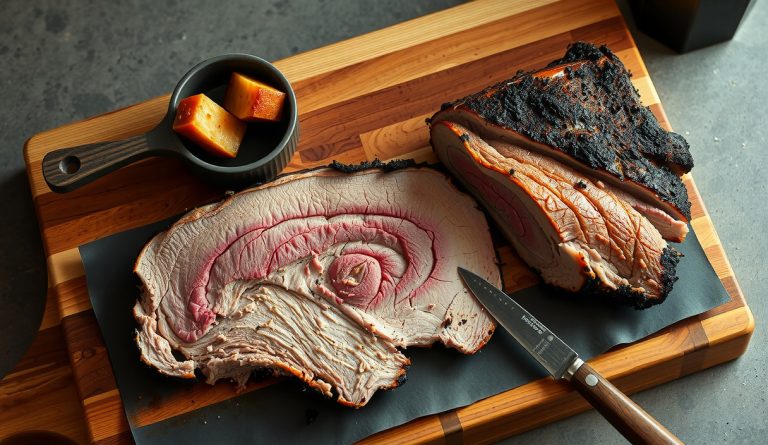
Scaling a brisket cook from one or two packers to six or more introduces a set of problems that have nothing to do with the brisket itself and everything to do with the smoker as a system. Each additional brisket adds thermal mass to the cook chamber — cold protein absorbing energy that would otherwise maintain ambient temperature — and displaces the airflow patterns the smoker was tuned for with a single load. Managing these variables systematically is what separates a successful large-service cook from a staggered disaster where half the briskets finish three hours before the others.
What changes when you scale up to six or more briskets?
Smoke moves through the cook chamber as a convective medium, and spacing is the first variable that breaks down at scale. Space briskets with a minimum of four inches of clearance on all sides — including between individual briskets and the chamber walls. Without that clearance, briskets packed into the center of a crowded rack cook slower and take on less smoke than those on the perimeter, producing uneven bark and inconsistent internal temperatures at the same nominal cook time. If the smoker’s geometry does not allow four inches of clearance for the full load, split the cook across two separate fires rather than crowding one.
Wrap timing must be driven by individual internal temperature, not by the clock. When several briskets approach the stall simultaneously, opening and closing the smoker lid repeatedly to wrap them one at a time bleeds significant thermal energy and destabilizes the fire. Instead, monitor every brisket with a multi-probe thermometer, identify which briskets will hit 165°F–170°F within the same thirty-minute window, and batch-wrap them in a single lid-open event. Briskets that are not yet near the stall stay on the grate undisturbed until their next batch window.
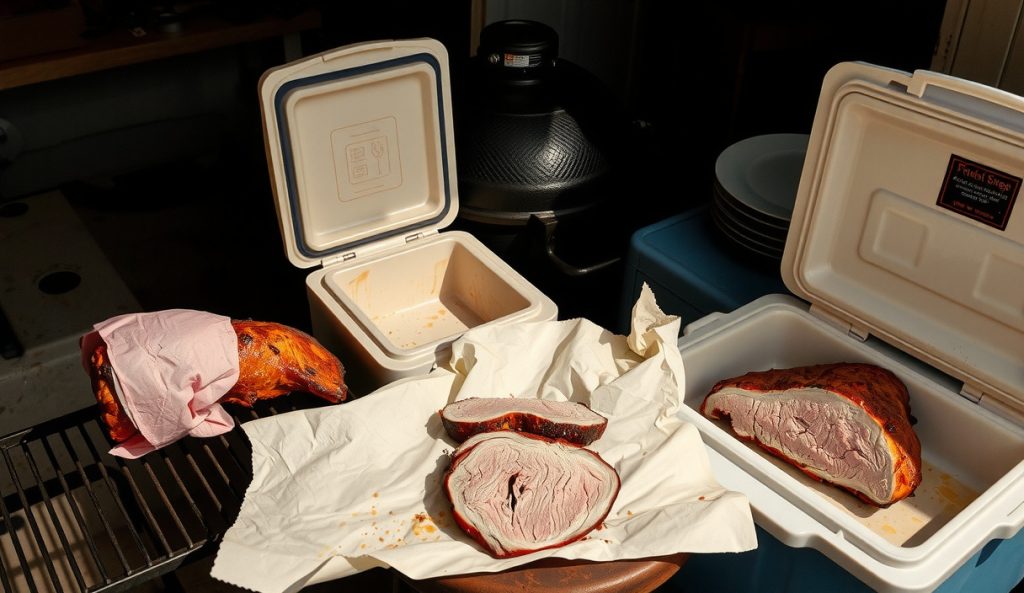
Faux Cambro capacity must be calculated before the fire is lit. Determine the total volume of wrapped briskets expected to be holding simultaneously, then confirm enough insulated coolers are pre-loaded with boiling water to hold every brisket flat — without stacking — for a minimum of two hours. Stacking briskets during the hold traps steam between the butcher paper and the meat, which softens bark and creates uneven carryover. Each brisket rests in a single layer whenever possible.
What stays the same no matter how many briskets are on the smoker?
Per-brisket prep is identical to the canonical single-brisket method at any volume. Trim, rub, fat-cap orientation, target cook and pull temperatures, butcher-paper wrap, and the probe-tender test do not change. The physics of collagen hydrolysis and bark development are properties of the individual brisket, not of the total load — only the management of the cook environment scales with volume.
When is the competition and large-service scaling method the better choice?
This approach is necessary for any cook serving more than twenty people, any competition cook where multiple briskets are submitted across categories, or any catering context where service time is fixed. The additional pre-cook logistics — individually probing every brisket, pre-calculating hold volume, and planning batch-wrap windows — add roughly one hour of preparation but prevent the kind of compounding errors that become impossible to correct once the cook is underway.
Use the full method, equipment, and rub measurements from the original Central Texas Brisket — Salt-and-Pepper Bark.