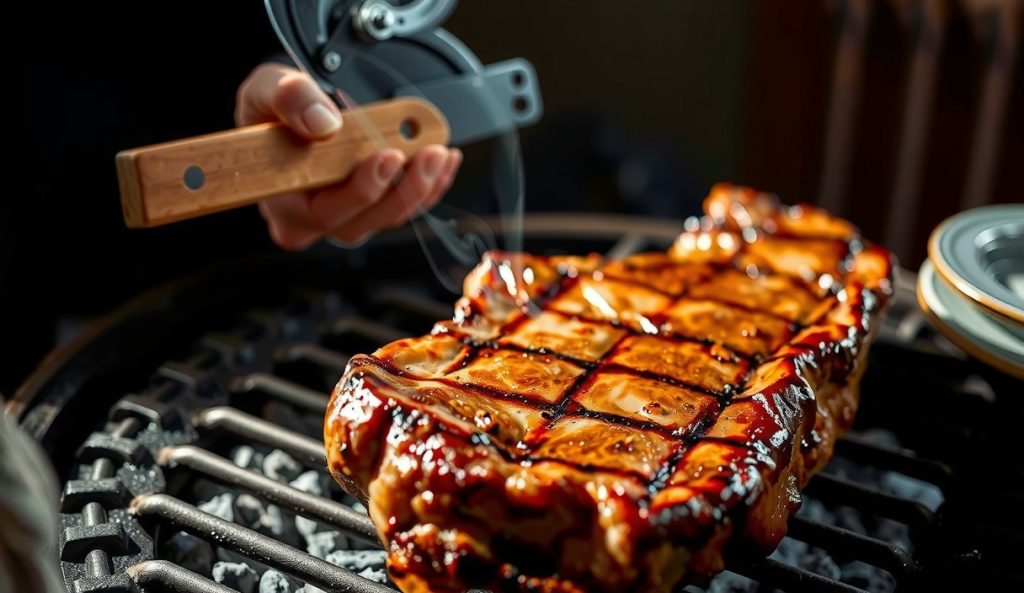
Smoke absorption in beef is not a continuous process — it is front-loaded. The surface of a cold ribeye entering the indirect zone still carries condensation moisture and has not yet formed the dry pellicle that blocks further uptake. That narrow early window, roughly the first 20 to 30 minutes of indirect cooking, is when phenolic and guaiacol compounds from burning wood dissolve into the surface moisture layer and bind to the meat. After that window closes, additional smoke contributes diminishing returns and risks depositing acrid creosote on a surface that can no longer absorb cleanly.
What changes when you add smoke to the reverse-sear?
Place a single fist-sized chunk of post oak, apple, or cherry wood directly on the lit coals at the exact moment you position the ribeye in the indirect zone. One chunk is deliberate — it generates clean, thin blue smoke for approximately 20 to 30 minutes, aligning precisely with the absorption window.
Post oak delivers a savory, mineral-edged smoke that reads as traditionally Texan and complements beef fat without competing with it. Apple and cherry run sweeter and lighter, which works well if you want smoke presence without dominance. Do not add a second chunk.
The mechanism here is specific: water-soluble phenolic compounds — syringol, guaiacol, and their derivatives — can only absorb into the ribeye while the surface retains free moisture. Once that moisture evaporates and the pellicle forms (the slight tacky-dry skin that develops around the midpoint of the indirect phase), smoke deposition effectively stops. Pellicle formation also builds the substrate for crust adhesion during the subsequent sear, so ongoing smoke after that point would undermine final texture rather than improve it. One chunk, timed at the start, captures the full absorption window without interfering with pellicle development.
What stays the same in the rest of the cook?
Indirect zone temperature, target pull temperature of 115°F, sear duration, coal configuration for the sear, and rest timing are all unchanged from the canonical method. The smoke chunk is the only addition to the process — it requires no adjustment to any other step in the sequence.
When is this smoke variation the better choice?
This variation is best suited to cooks who want a ribeye that reads as something between a grilled steak and a smoked steak — more complexity than the canonical version without the full commitment of an offset cook. The technique is particularly effective with thick 2.5-inch or 3-inch ribeyes, where the longer indirect phase gives the smoke absorption window more time to work before pellicle formation closes it off.
If your goal is clean beef flavor with a pure Maillard crust and no smoke signature, skip the wood chunk entirely. The addition is optional and additive — it changes the flavor profile, not the structure of the cook.
Use the full method, equipment, and rub measurements from the original Reverse-Sear Ribeye on the Grill.