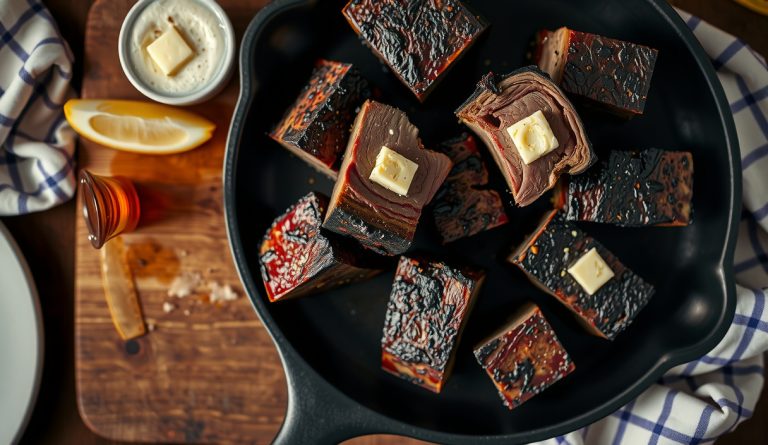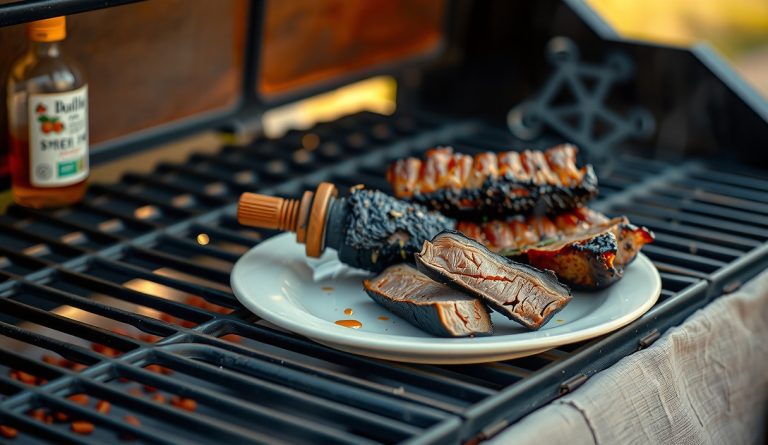
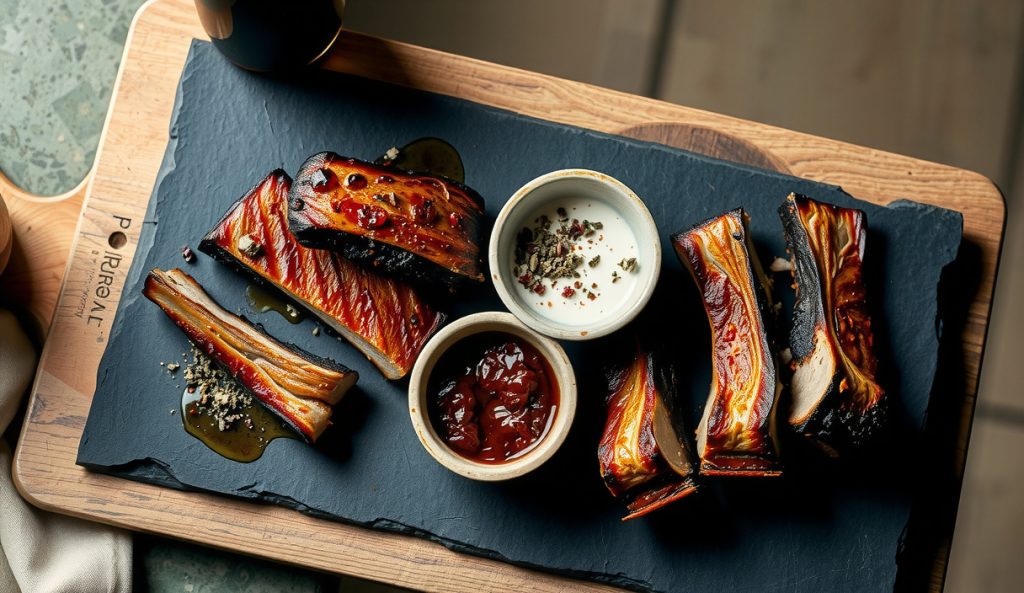
The canonical Burnt Ends with Cherry-Bourbon Foam recipe concentrates its sodium in exactly two places: the kosher salt in the dry rub and the Worcestershire sauce in the glaze. The cherry-bourbon foam base contributes negligible sodium. A targeted two-point reduction — rub salt and Worcestershire only — captures the majority of the dietary sodium load without requiring a full reformulation of every component.
What changes in the low-sodium adaptation?
Reduce the kosher salt in the dry rub by 50% and substitute a low-sodium Worcestershire sauce in equal volume. Salt performs a dual function on the brisket surface: it seasons the meat and depresses surface water activity, which accelerates the drying required for crust formation. At a 50% salt reduction, that water-activity-depressing effect is partially diminished, so expect a bark that forms slightly later in the cook and presents a lighter mahogany color rather than deep black.
The crust will still be present and textured — collagen hydrolysis and the Maillard reactions that drive bark color depend on temperature and time more than salt concentration — but the brisket surface may remain tacky slightly longer into the first phase of the cook. This is a cosmetic and timing difference, not a structural failure.
Low-sodium Worcestershire sauces typically carry around 65 mg sodium per teaspoon versus the 165 mg in standard formulations — a reduction of roughly 60% per teaspoon. The flavor profile is slightly less fermented-umami in character. If the sauce tastes flat during the reduction step, compensate with a half-teaspoon of fish sauce or additional cracked black pepper. The foam base — espresso or cherry, xanthan, N2O — contains no meaningful sodium and requires no adjustment.
What stays the same in the low-sodium version?
Cook temperatures, internal target temperatures, the two-phase smoke-and-braise structure, braising liquid ratios, and the entire foam preparation are all unchanged. The collagen hydrolysis window — roughly 160–205°F internal — is determined by heat, not salt concentration, so timing and tenderness remain on the canonical schedule.
When is the low-sodium adaptation the better choice?
This adaptation is the right call when serving guests managing hypertension, heart disease, or clinician-prescribed sodium-restricted diets, or when scaling the recipe for a catering context that requires formally accommodated dietary modifications. The low-sodium version delivers the full structural and flavor experience of the canonical dish — smoke ring, bark, braised interior, cherry-bourbon foam — with a meaningfully lower sodium contribution per serving.
Use the full method, equipment, and rub measurements from the original Burnt Ends with Cherry-Bourbon Foam, applying only the two substitutions described above.