
Smoky Margarita
Equipment
- 1 Cocktail Smoker
- Wood Chips
- 1 Kitchen Torch
- 1 Highball Glass
- 1 Cocktail Shaker
Ingredients
- 2 oz Tequila Mezcal
- 1 oz Lime Juice
- 0.5 oz Agave Syrup
- 1 rim Smoked Salt
- 1 wheel Lime
- ¾ oz Cointreau
- ½ oz Simple Syrup

Instructions
- Prepare Your Glass: If desired, rim your glass with smoked sea salt for an extra layer of flavor.1 rim Smoked Salt
- Mix: In your shaker, combine the lime juice, simple syrup, Cointreau, smoked agave nectar, and tequila/mezcal with ice. Shake well.2 oz Tequila Mezcal, 1 oz Lime Juice, 0.5 oz Agave Syrup, ½ oz Simple Syrup, ¾ oz Cointreau
- Smoke: Use your cocktail smoker loaded with your choice of wood chips to infuse the cocktail with a deep smoky aroma.
- Serve: Strain into your prepared glass over fresh ice. Optionally, garnish with a lime wheel or a lightly torched sprig of rosemary for visual appeal and a hint of herby smokiness.1 wheel Lime
Notes
Nutrition
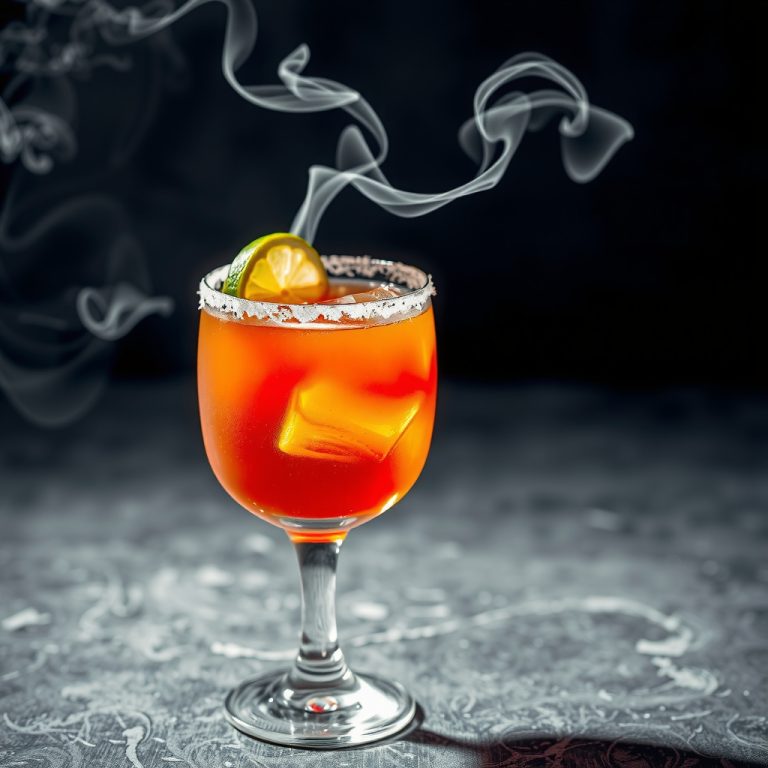
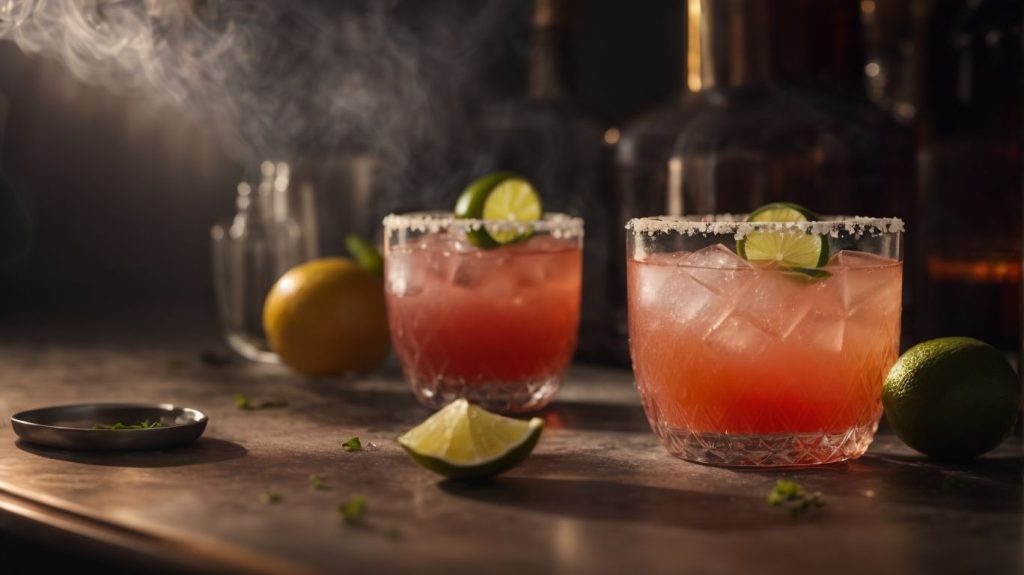
A margarita is already a study in precision — the acid-sweet-spirit triangle that, when calibrated correctly, lands on the palate like a clean knife cut. Now light wood chips under a cloche and let volatile phenols settle into that triangle, and you have something that belongs as much at a live-fire cookout as it does at a high-concept bar program. This is the Smoky Margarita: a cocktail that earns its smoke rather than faking it with a rinse of mezcal and calling it a day.
The approach here layers smoke at multiple points — the rim, the spirit selection, and a cold-infusion smoke step using a cocktail smoker — so the phenolic character builds in depth rather than landing as a single blunt note. If you have ever wondered why some smoked cocktails taste hollow and others taste genuinely three-dimensional, the answer is almost entirely about where and when smoke volatiles are introduced. The science below explains exactly why each layer matters.
Why does a Smoky Margarita actually taste smoky? The science
Smoke is not a single flavor — it is a suspension of volatile organic compounds (VOCs) produced by the incomplete combustion of wood, and the phenolic fraction is what the palate registers as “smoky.” Guaiacol, syringol, and 4-methylguaiacol are the dominant players, with boiling points ranging from roughly 205 °C to 261 °C. When a cocktail smoker is run over ice-cold liquid, those compounds partition across the gas-liquid interface according to Henry’s Law: the cold temperature (around 0–2 °C in a shaken, iced cocktail) dramatically lowers the vapor pressure of these phenols, which means they leave the gas phase and dissolve into the liquid far more readily than they would at room temperature. Cold-smoking a cocktail is, in thermodynamic terms, an efficient extraction — favorable partition coefficients are engineered without any applied heat that would drive off citrus esters.
Lime juice introduces roughly 6–7% citric acid by weight, dropping the Smoky Margarita’s pH into the 2.8–3.2 range depending on dilution. At that pH, the ester bonds in Cointreau’s orange-peel distillate — primarily linalool and limonene — remain structurally stable and volatile, which is why citrus-forward cocktails smell as vivid as they taste. The agave syrup (approximately 65–70 Brix, roughly 1.4 g sugar per mL) and the simple syrup together push total residual sugar high enough to coat the palate and carry fat-soluble aroma compounds — including the phenols — through the finish. Sugar does not just sweeten; it acts as an aromatic vehicle. That is why sweetness and smoke taste louder together than either does alone.
Mezcal provides a baseline of smoke before the cocktail smoker ever enters the picture. Traditional mezcal production involves roasting agave piñas in underground earthen pits, where temperatures can reach 65–75 °C over 3–5 days. That slow roast produces Maillard reaction byproducts and pyrolytic phenols that are carried through fermentation and distillation into the final spirit at concentrations typically ranging from 2–10 ppm guaiacol depending on producer and still type. The cold-smoke step then stacks an additional 1–4 ppm of freshly volatilized phenols onto an already phenol-forward base — the result is layered smoke with both a roasted low-end from the mezcal and a brighter, more aromatic high-end from the live wood-chip infusion.
What equipment and ingredients do you need to make this right?
The cocktail smoker is the variable that separates this Smoky Margarita from a standard mezcal margarita. Look for a unit with a tight-sealing cloche — poor seals mean smoke escapes before it can dissolve into the liquid, wasting wood chips and producing a thin smoky character. Apple and cherry wood chips read sweeter and align well with Cointreau’s citrus-orange character; hickory and mesquite skew more aggressive and compete with the lime acid. Start with apple wood when dialing in this recipe for the first time.
Smoked sea salt on the rim is doing structural work, not just visual work. Salt suppresses bitterness receptors and amplifies sweet and sour perception — a well-salted rim effectively lets you use slightly less simple syrup without the drink tasting thin. Use a coarse-grain smoked salt rather than fine smoked salt; the coarser crystal dissolves slowly on the lip and delivers sodium in pulses rather than a single front-loaded hit.
On the spirit: the ingredient list specifies tequila or mezcal. A blanco tequila means the smoke must come entirely from the cocktail-smoker step and the salted rim, which produces a cleaner, more citrus-forward result. Mezcal — particularly an espadín-based expression — contributes baseline phenols before the smoker fires. For the most expressive version of this recipe, a split base of 1 oz blanco tequila and 1 oz mezcal gives proof-positive smokiness without letting the agave spirit dominate the citrus-acid balance.
Smoky Margarita
Equipment
- 1 Cocktail Smoker
- Wood Chips
- 1 Kitchen Torch
- 1 Highball Glass
- 1 Cocktail Shaker
Ingredients
- 2 oz Tequila Mezcal
- 1 oz Lime Juice
- 0.5 oz Agave Syrup
- 1 rim Smoked Salt
- 1 wheel Lime
- ¾ oz Cointreau
- ½ oz Simple Syrup
Instructions
- Prepare Your Glass: If desired, rim your glass with smoked sea salt for an extra layer of flavor.1 rim Smoked Salt
- Mix: In your shaker, combine the lime juice, simple syrup, Cointreau, smoked agave nectar, and tequila/mezcal with ice. Shake well.2 oz Tequila Mezcal, 1 oz Lime Juice, 0.5 oz Agave Syrup, ½ oz Simple Syrup, ¾ oz Cointreau
- Smoke: Use your cocktail smoker loaded with your choice of wood chips to infuse the cocktail with a deep smoky aroma.
- Serve: Strain into your prepared glass over fresh ice. Optionally, garnish with a lime wheel or a lightly torched sprig of rosemary for visual appeal and a hint of herby smokiness.1 wheel Lime
Notes
Nutrition
How do you nail the Smoky Margarita every time? Tips and technique
- Shake hard, then smoke cold. The cocktail should be fully chilled and diluted before the smoke step. Smoking a warm or under-diluted cocktail means the liquid surface is less receptive to phenol absorption — you will get smoke on the nose but very little on the palate.
- Do not over-smoke. Ten to fifteen seconds under the cloche with apple or cherry chips is the target window. Beyond twenty seconds you push into astringent, ashy territory that the citrus acid cannot rescue. Time it.
- Fresh lime only. Bottled lime juice contains sodium metabisulfite as a preservative, which reacts with the phenols in smoked spirits and produces a sulfurous off-note. Squeeze to order — roughly half a large lime yields 1 oz of juice at adequate Brix.
- Rim half the glass. A full smoked-salt rim forces every sip through sodium. Rimming half the glass lets the drinker self-dose and preserves the acid-sweet balance on the clean side of the glass.
- Use large-format ice in the serving glass. A single 2-inch cube or a large sphere minimizes surface area, slows dilution, and keeps the smoke-infused cocktail from becoming waterlogged. The phenols dissolved into the liquid are water-soluble and dilute out quickly.
- If using a torch on the rosemary garnish, do it tableside. The aromatic release from torched rosemary — primarily camphor and borneol — lasts roughly 90 seconds before the volatile compounds disperse. Torching in the kitchen means the guest gets the visual but loses most of the aromatic payoff.
What are the best variations on a Smoky Margarita?
Spicy Smoky Margarita. Muddle two thin slices of fresh jalapeño in the shaker before adding ice and spirits. Capsaicin is fat- and alcohol-soluble, so it extracts readily into the tequila fraction during shaking — expect a sharp, clean heat that builds on the finish rather than hitting up front. Double-strain through a fine mesh to remove pulp and seeds. Smoke phenols and capsaicin are synergistic heat compounds and will read hotter together than either does alone; reduce jalapeño to one slice if your audience is heat-sensitive.
Grilled Citrus Smoky Margarita. Halve limes and grill cut-side down on a cast-iron grate at 450–500 °F for 3–4 minutes until caramelization and light char appear. Maillard browning converts the lime’s surface sugars into furans and pyrazines that read as nutty and roasted — this bridges the smoky mezcal character and the bright acid into a more unified, lower-frequency citrus note. Juice the limes immediately while warm. Brix will read slightly higher due to water evaporation during grilling; adjust simple syrup down by a quarter ounce.
Smoked Hibiscus Margarita. Replace the simple syrup with a hibiscus-infused syrup: steep 10 g dried hibiscus flowers in 250 mL hot simple syrup for 20 minutes, then strain. Hibiscus is high in anthocyanins — pH-sensitive pigments that shift from deep red toward purple below pH 3.5, which is exactly where this cocktail lives. The visual shift as lime juice hits the hibiscus syrup in the shaker is genuinely dramatic. The floral-tart character of hibiscus also has a natural affinity for smoke phenols — both register in the same mid-palate aromatic space.
Batch Format for Gatherings. Scale ingredients by the number of servings, combine all liquids without ice, and refrigerate in a sealed vessel for up to 8 hours. Cold-smoke the entire batch in a large-mouth pitcher just before service — the increased liquid volume requires a longer smoke exposure of approximately 25–30 seconds. Serve over fresh ice into pre-salted glasses. Smoke-volatile concentration will be slightly lower per serving in a batched format because the surface-area-to-volume ratio is lower than a single cocktail under a cloche; compensate by using a slightly more assertive wood such as cherry rather than apple, or by running the smoke step twice with a 10-second rest between passes.
Frequently asked questions about the Smoky Margarita
Can I make a Smoky Margarita without a cocktail smoker? Yes, with caveats. The most accessible workaround is to briefly hold the mouth of the serving glass over a slow-burning wood chip on a fireproof surface for 8–10 seconds, then quickly invert the glass to trap smoke, and strain the cocktail directly in. This method is less controlled than a cloche smoker — smoke concentration varies with chip type, ambient airflow, and glass size — but it produces a real phenolic infusion. Alternatively, increasing the mezcal ratio to 2 oz and omitting blanco tequila entirely gives a smoky spirit base without any active smoking equipment, though the result is a different drink in character.
What wood chips work best for this cocktail? Apple and cherry are the standard starting points for cocktail smoking because their phenol profiles skew toward lighter, fruitier compounds that do not overwhelm citrus-acid drinks. Hickory produces a heavier, more savory smoke that can work when serving the Smoky Margarita alongside grilled meat where the palate is already primed for aggressive smoke. Avoid mesquite for cocktails — its combustion produces higher concentrations of harsh VOCs that read as chemical rather than roasted at the concentrations achievable in a cloche smoker.
How much does the smoke step actually change the flavor of the margarita? Measurably. A properly executed 12-second cold-smoke infusion with apple chips introduces an estimated 1–3 ppm of guaiacol and syringol into the cocktail — concentrations well above the sensory threshold for both compounds in a water-ethanol matrix (guaiacol detection threshold in aqueous ethanol is approximately 0.02 ppm). The smoke step is not cosmetic. It is a real extraction that materially shifts the aromatic and flavor profile of the drink. The question is not whether to perform it but how long, with what wood, and at what stage — all of which is controlled by the technique described in this recipe.