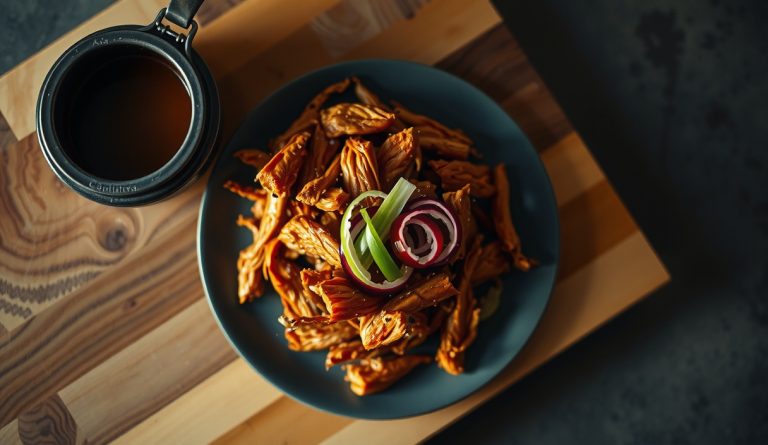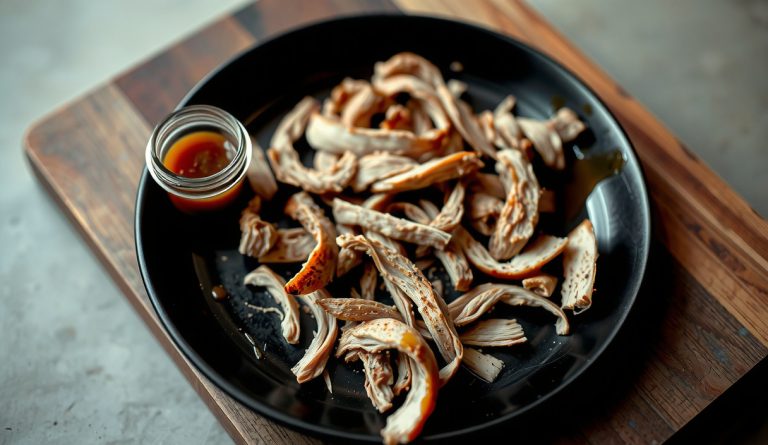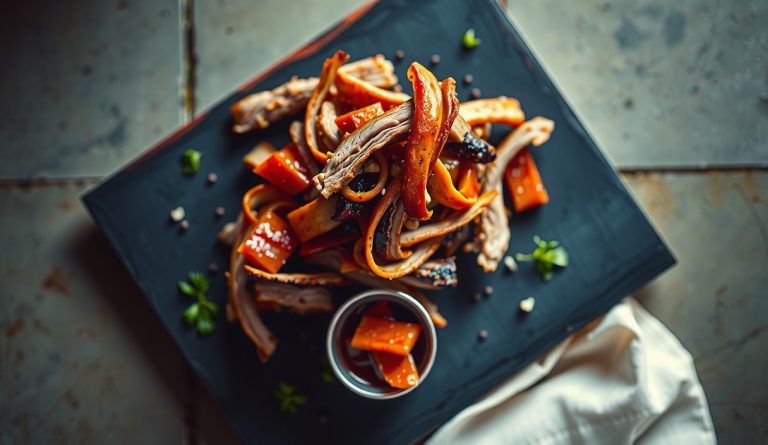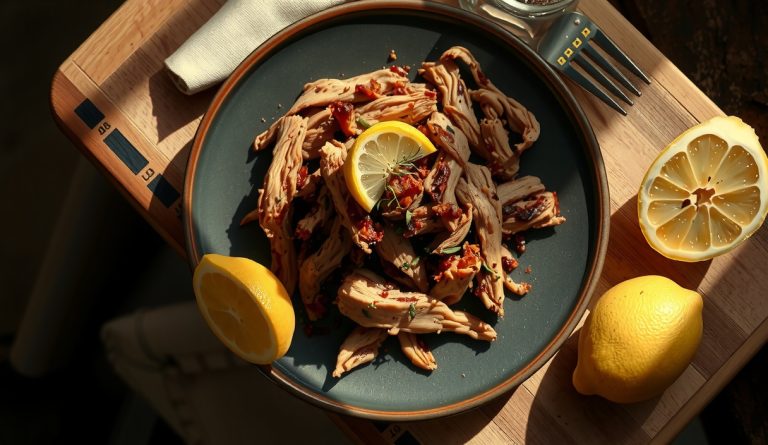
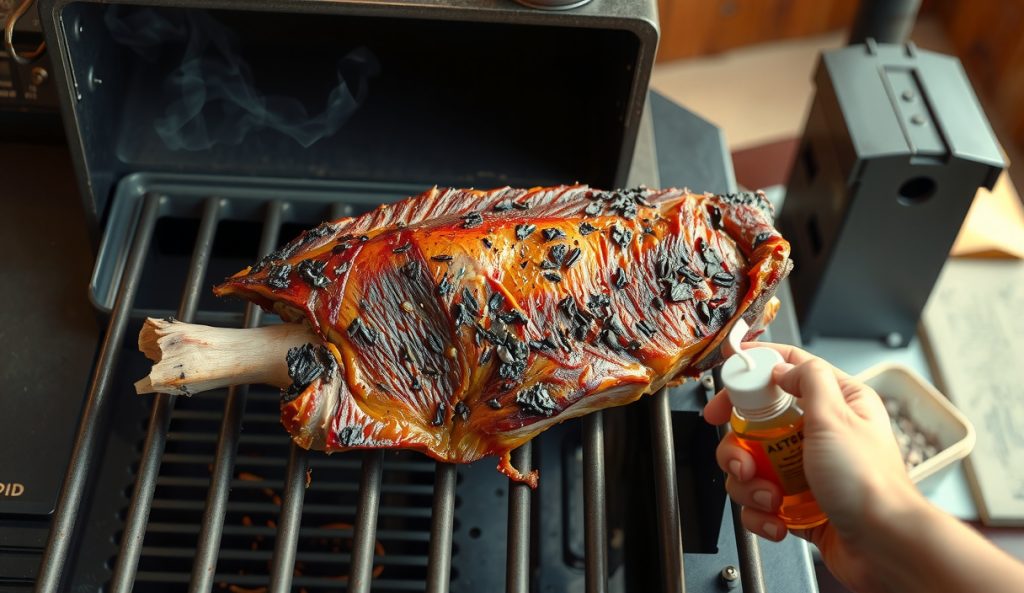
A pellet grill is a legitimate platform for Carolina pulled pork. The convenience of set-and-hold temperature control removes one major variable from an 11-to-13-hour smoke, and modern pellet cookers maintain remarkably stable chamber temperatures across that entire session. The trade-off is smoke character: pellet combustion at low settings is an efficient, near-complete burn that generates less particulate matter and fewer volatile organic compounds than an offset burning split wood. That efficiency is good for fuel consumption and consistency but results in a lighter smoke ring and a less pronounced smoke flavor on the finished shoulder. The fix is supplemental smoke delivered during the window when the meat is most receptive to it.
What changes when you move Carolina pulled pork to a pellet grill?
Set your pellet grill to 225°F, but verify actual grate temperature with an independent probe thermometer before loading the shoulder. Most pellet controllers read 10 to 15°F lower than actual grate surface temperature — a controller set to 225°F may be delivering 235 to 240°F at the cooking surface. Even a modest 10°F elevation accelerates surface moisture loss and can cause bark to set earlier than intended, potentially locking out further smoke absorption before the meat reaches its optimal smoke-uptake window.
Smoke ring formation and surface smoke deposition occur primarily while the meat surface is moist. Once the bark seals, smoke uptake drops sharply. Calibrate your controller offset once, record the difference, and apply that correction to every future long cook on the same unit.
To compensate for the lower particulate output of pellet combustion, place a smoke tube filled with soaked hickory chips directly on the grate at the very start of the cook. Run the smoke tube for the first 4 hours — the window during which the shoulder surface is still moist and maximally receptive to smoke deposition. After hour 4, the tube can be removed or allowed to burn out; additional smoke input past that point contributes minimally to flavor depth and risks bitterness if the exterior has begun to dry.
What stays exactly the same on a pellet grill?
The mop recipe, mop schedule, dry rub, pull temperature of 203°F, probe-feel doneness test, bone-slide check, and the minimum one-hour rest are entirely unchanged from the original method. The vinegar mop protocol is platform-agnostic — it performs identically on a pellet grill, an offset, a kettle, or a ceramic cooker. None of those elements require modification simply because the heat source has changed.
When is the pellet grill adaptation the better choice?
This adaptation is best suited for cooks who want the Eastern NC pulled pork result without managing fire and airflow on an offset through the night, for backyard cooks whose primary equipment is a pellet grill, or for any situation where temperature stability over a long unattended cook is the priority. The finished shoulder will have a slightly lighter smoke ring than an offset-cooked shoulder, but comparable bark texture and equivalent flavor depth when the 4-hour smoke tube protocol is followed.
Use the full method, equipment, and rub measurements from the original Carolina Pulled Pork with Eastern NC Vinegar Mop.