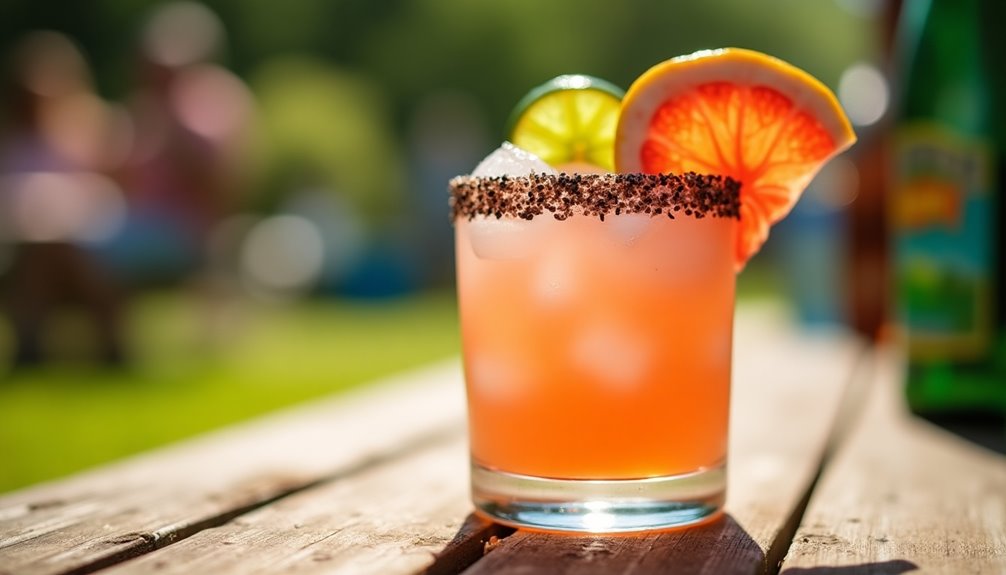

Smoked Salt Paloma

Equipment
- Cocktail Shaker
- Jigger or measuring cup
- Citrus juicer
- Glass for serving
- Small plate for the smoked salt
- Spoon for stirring
Ingredients
- 2 ounces tequila
- 1 ounce fresh lime juice
- 3 ounces grapefruit juice
- ½ ounce simple syrup
- Smoked salt for rimming the glass
- Fresh grapefruit slices for garnish
- Lime wedges for garnish

Instructions
- To prepare the Smoked Salt Paloma, begin by rimming your glass with lime juice and then dipping it into smoked salt to coat the rim.
- In a cocktail shaker, combine the tequila, fresh lime juice, grapefruit juice, and simple syrup with ice.
- Shake the mixture well until it’s chilled, then strain it into the prepared glass filled with ice.
- For the finishing touch, garnish with a slice of grapefruit and a lime wedge.
Notes
The Paloma is Mexico’s most-ordered tequila drink — outselling the margarita on its home turf by a wide margin — and yet it remains criminally underrated north of the border. The formula is clean: blanco tequila, grapefruit, lime, a kiss of sweetness, and salt. But “clean” does not mean “simple.” Every element is doing precise chemical work, and when you swap standard kosher salt for smoked salt on that rim, you introduce a third aromatic dimension that fundamentally rewires how your palate reads the drink. This is the Smoked Salt Paloma — the BBQ world’s answer to a cocktail that was already almost perfect.
This recipe was built for the crowd that thinks hard about smoke — the people who can tell applewood from pecan by nose alone. That instinct translates directly to the cocktail glass. Smoked salt carries the same volatile phenolic compounds (guaiacol, syringol, 4-methylguaiacol) that define wood-smoke flavor in a well-managed offset cooker. Every sip pulls those aromatics off the rim and straight into your retronasal passage before the liquid even hits your tongue. The result is a cocktail that tastes like it belongs next to a brisket, but drinks like a Sunday afternoon in the sun. Where Flavor Meets the Flame.
Why does the Smoked Salt Paloma work? The science
The Smoked Salt Paloma works because each ingredient targets a distinct receptor pathway, and the smoked salt rim activates your olfactory system before the first drop of liquid reaches your tongue. Grapefruit juice is one of the most chemically complex citrus products behind the bar. Its signature bitterness comes from naringin, a flavanone glycoside present at roughly 400–800 mg/L in fresh-squeezed juice, while its aroma is dominated by nootkatone (the compound responsible for that waxy, woody top note) and a family of sulfur-containing thiols — most notably 1-p-menthene-8-thiol — detectable by the human nose at concentrations below 0.1 parts per trillion.
Ethanol at the 15–20% ABV range of a typical shaken cocktail acts as a solvent-carrier for those hydrophobic aroma compounds, effectively concentrating them in the vapor phase above the glass. This is why a Paloma smells more intensely “grapefruit” than a glass of straight juice: the alcohol is performing active extraction work in real time, pulling volatile aromatics into the headspace with every swirl.
Lime juice introduces citric acid (pH approximately 2.0–2.4 in fresh-squeezed form), which has two jobs in this drink. First, it sharpens the perception of sweetness from the simple syrup by providing contrast — a well-understood psychophysical effect where sour and sweet stimuli compete for receptor binding, making both taste more vivid. Second, and less obviously, the acidic environment suppresses bitterness perception: proton availability at low pH partially blocks the T2R bitter-taste receptor family, which means a small amount of lime actually makes the naringin in grapefruit taste less aggressively bitter.
The simple syrup (typically 1:1 sucrose-to-water, approximately 65 Brix) balances residual acidity and provides body — viscosity that slows flavor release and extends mid-palate contact time. The smoked salt rim is the masterstroke: phenolic compounds absorbed onto salt crystals during the cold- or hot-smoking process have high vapor pressure at room temperature, meaning they volatilize readily and reach your olfactory epithelium before each sip. Sodium chloride simultaneously enhances overall flavor intensity by suppressing bitter compounds (sodium ions inhibit bitter transduction pathways) and increasing the perceived sweetness and fruitiness of the drink.
The shaking process itself is critical. Vigorous agitation over ice achieves roughly 20–25% dilution by weight, dropping the cocktail’s effective ABV to approximately 12–15% — the sweet spot where aromatic compounds remain soluble but ethanol does not dominate the sensory experience. Over-shaking pushes dilution past 30%, flattening everything: the grapefruit aromatics lose their intensity first.
What equipment and ingredients do you need?
Tequila selection matters more in a Paloma than in a spirit-forward drink. A 100% blue agave blanco in the 40% ABV range (80 proof) is the standard call — its grassy, vegetal methoxypyrazine character ties directly into the smoky phenols on the rim. Reposado works but adds oak-derived vanilla and caramel notes (vanillin, furfural) that can crowd the grapefruit. Avoid mixto tequilas: the added cane-sugar fermentation byproducts muddy the citrus-acid interaction.
Smoked salt is non-negotiable as written, but its source changes the drink. Alderwood-smoked salt delivers a lighter, sweeter phenolic profile. Hickory-smoked salt is more aggressive — more 4-methylguaiacol, more “BBQ pit” character. Applewood lands in between. Use a coarse-grain smoked salt for the rim: larger crystals provide slower sodium dissolution on the lip, extending the flavor-enhancement window across multiple sips rather than dumping all the salt intensity at once.
Fresh juice is not optional. Commercially processed grapefruit juice has been pasteurized at temperatures above 85°C, which degrades the sulfur-containing thiols responsible for fresh-grapefruit character by roughly 40–60% versus unpasteurized fresh-squeezed. Ruby Red grapefruit runs slightly sweeter (higher Brix, lower naringin) than white grapefruit — either works, but Ruby Red may let you pull back the simple syrup by a quarter ounce without losing balance. A standard cocktail shaker (Boston or cobbler) is fine; the key is sufficient ice mass to achieve rapid chilling. A jigger ensures the acid-to-spirit-to-sweetener ratio hits its mark — eyeballing a Paloma is how you end up with a sour mess or a candy drink.
Smoked Salt Paloma
Equipment
- Cocktail Shaker
- Jigger or measuring cup
- Citrus juicer
- Glass for serving
- Small plate for the smoked salt
- Spoon for stirring
Ingredients
- 2 ounces tequila
- 1 ounce fresh lime juice
- 3 ounces grapefruit juice
- ½ ounce simple syrup
- Smoked salt for rimming the glass
- Fresh grapefruit slices for garnish
- Lime wedges for garnish
Instructions
- To prepare the Smoked Salt Paloma, begin by rimming your glass with lime juice and then dipping it into smoked salt to coat the rim.
- In a cocktail shaker, combine the tequila, fresh lime juice, grapefruit juice, and simple syrup with ice.
- Shake the mixture well until it’s chilled, then strain it into the prepared glass filled with ice.
- For the finishing touch, garnish with a slice of grapefruit and a lime wedge.
Notes
How do I nail the Smoked Salt Paloma every time?
- Juice to order. Grapefruit and lime juice begin oxidative degradation within 20–30 minutes of cutting. Pre-juicing an hour ahead produces a noticeably flatter, more bitter cocktail. Cut and juice right before you shake.
- Do not over-shake. Ten to twelve hard shakes is sufficient to chill and dilute properly. Beyond fifteen seconds of aggressive shaking you are pushing past 28–30% dilution and the drink goes thin and watery — the grapefruit aromatics lose their intensity first.
- Rim only half the glass. Full-rim salting forces salt into every sip whether you want it or not. A half-rim gives the drinker control, which is good hospitality and better flavor management on a hot day when salt craving varies.
- Use large-format ice in the serving glass. A single large cube or two big rocks melts slower than cracked ice, holding the cocktail in its optimal dilution window for the full drinking experience rather than watering it down in the glass.
- Taste your grapefruit before you build. Brix and acidity vary significantly by season and variety. A very sour fruit may need the simple syrup bumped to 3/4 ounce. A very sweet fruit can drop to 1/4 ounce. Calibrate before you commit.
- Strain with pressure. Double-straining through a fine-mesh strainer removes ice chips and pulp solids that accelerate dilution and can make the drink look cloudy. A clean, clear cocktail with a defined salt rim reads as intentional craft, not an afterthought.
What variations can I make on the Smoked Salt Paloma?
Mezcal Swap. Replace the blanco tequila with a joven or espadin mezcal at equal volume. Mezcal’s smoke-derived phenolic content (guaiacol concentrations typically 2–5x higher than tequila) amplifies the smoked salt rim dramatically. The drink tilts earthier and more complex — essentially a full BBQ-pit Paloma. Pull the simple syrup back to 1/4 ounce to keep the added phenolic weight from making the drink feel heavy.
Spicy Paloma. Muddle two thin slices of fresh jalapeño in the shaker before adding the remaining ingredients. Capsaicin is lipophilic and ethanol-soluble: it extracts efficiently during the shake and delivers a measured, warming heat that builds on the back palate. The citric acid environment slightly slows capsaicin receptor binding, giving you heat that arrives about two seconds after the citrus — a sequential flavor effect worth engineering deliberately.
Grilled Grapefruit Paloma. Cut a grapefruit in half and place it cut-side down on a grill grate at 450–500°F for 4–5 minutes until caramelized. The Maillard reaction and caramelization at the cut surface produce furfurals and lactones that add a toasty, almost coconut-adjacent note to the juice. Squeeze the grilled halves while still warm and use immediately. This version pairs the smoked salt rim with an internally smoked-fruit base — layered, cohesive, and genuinely impressive.
Batch Version for a Crowd. Scale the recipe by the number of servings, combine tequila, citrus juices, and simple syrup in a pitcher, and refrigerate until ready to serve. Do not pre-dilute — add 15% of the total liquid volume as cold water to approximate shaker dilution, then stir well and pour over ice. Prepare rimmed glasses in advance: apply lime juice to the rim, dip in smoked salt, and let dry for five minutes so the salt adheres firmly and does not shed into the drink.
Frequently asked questions
Can I use bottled grapefruit juice? Technically yes, but the quality drop is significant. Pasteurization destroys the sulfur-containing thiols that make fresh grapefruit juice smell the way it does. You will get sweetness and some bitterness, but the aromatic complexity that makes a Paloma worth drinking will be largely absent. If fresh grapefruit is unavailable, look for cold-pressed, never-heated grapefruit juice at a specialty grocery — it is a meaningfully better substitute than shelf-stable pasteurized product.
What is the best smoked salt for this cocktail? Alderwood-smoked salt is the most versatile starting point — its lighter phenolic profile complements citrus without overwhelming it. Hickory or mesquite smoked salts are bolder and work especially well in the mezcal variation. Avoid smoked salts with added flavoring agents or liquid smoke: those products use synthetic pyrolysis compounds that read as artificial against fresh citrus. Look for salts that list only two ingredients: sea salt and smoke.
Does the tequila proof affect the recipe? Yes, measurably. A 40% ABV (80 proof) blanco is the baseline assumption for the Smoked Salt Paloma. Moving to a higher-proof tequila — say, 46% ABV — increases aromatic extraction efficiency and also means your post-shake dilution yields a slightly higher final ABV in the glass. If you use a higher-proof spirit, consider adding a small amount of additional ice to the shaker or shaking two to three seconds longer to compensate. Going below 38% ABV risks insufficient ethanol to carry the citrus aromatics effectively — the drink will taste flat despite having all the right ingredients.